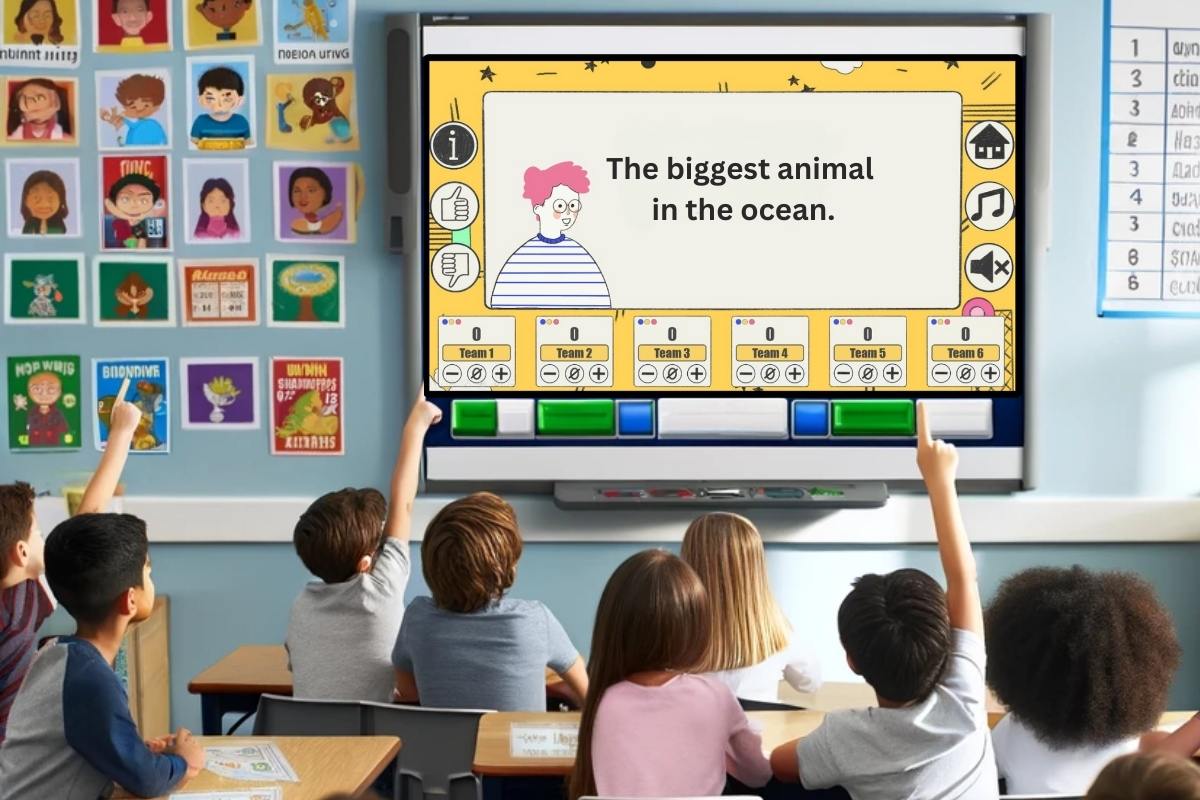



In this article, you will find fun Jeopardy categories and questions with answers designed for elementary school students. These categories cover a range of topics including animals, famous storybooks, math concepts, scientific wonders, global geography, and musical elements. Each category comes with questions an answers.
Categories
- Animal Kingdom
- Famous Storybooks
- Math Magic
- Science Wonders
- Around the World
- Musical Notes
Animal Kingdom
- $100: This furry friend barks and is often called man’s best friend. Answer: What is a dog?
- $200: This cuddly bear is black and white and loves to eat bamboo. Answer: What is a panda?
- $300: The biggest animal in the ocean. Answer: What is a blue whale?
- $400: An animal with a really long neck that can eat leaves from tall trees. Answer: What is a giraffe?
- $500: This animal from Australia carries its baby in a special pocket. Answer: What is a kangaroo?
Famous Storybooks
- $100: He’s a wooden boy whose nose grows when he lies. Answer: Who is Pinocchio?
- $200: This girl falls down a rabbit hole into a magical world. Answer: Who is Alice from “Alice in Wonderland”?
- $300: A bear who loves honey and lives in the Hundred Acre Wood. Answer: Who is Winnie the Pooh?
- $400: This girl wears a red hood and visits her grandmother’s house. Answer: Who is Little Red Riding Hood?
- $500: A wizard boy with a lightning-shaped scar. Answer: Who is Harry Potter?
Math Magic
- $100: 5 plus 5 equals this. Answer: What is 10?
- $200: The shape with four equal sides. Answer: What is a square?
- $300: If you have two dimes and a nickel, you have this many cents. Answer: What is 25 cents?
- $400: The number of sides on a hexagon. Answer: What is six?
- $500: Half of 100. Answer: What is 50?
Science Wonders
- $100: This is what rain is made of. Answer: What is water?
- $200: The color of the leaves on most trees and plants. Answer: What is green?
- $300: This is what you see in the sky at night, shining and twinkling. Answer: What are stars?
- $400: This is the season when flowers start to bloom and it gets warmer. Answer: What is spring?
- $500: These creatures lived a long time ago and are now found as fossils. Answer: What are dinosaurs?
Around the World
- $100: This country is famous for its pyramids and the Nile River. Answer: What is Egypt?
- $200: The country known for kangaroos and the Great Barrier Reef. Answer: What is Australia?
- $300: The country where you can see the Eiffel Tower. Answer: What is France?
- $400: The country known for its Great Wall. Answer: What is China?
- $500: This North American country is known for its maple syrup and hockey. Answer: What is Canada?
Musical Notes
- $100: This instrument has black and white keys and is played with fingers. Answer: What is a piano?
- $200: The musical symbol that indicates the pitch of written notes. Answer: What is a clef?
- $300: This string instrument is held under the chin and played with a bow. Answer: What is a violin?
- $400: A large brass instrument played in marching bands, known for its deep sound. Answer: What is a tuba?
- $500: The number of lines in a standard musical staff. Answer: What is five?
The Jeopardy game helps students think fast, remember more, and enjoy learning together as a team and it is so easy to set up with a Jeopardy PowerPoint template. Turn your classroom into a fun game show and see your students enjoy and learn in this exciting new way!
More Jeopardy Category Ideas for Kids
Creating engaging jeopardy category ideas for kids means striking the right balance between educational value and pure fun. The best jeopardy topics tap into what children already know while gently stretching their learning in new directions.
Classic subject-based categories work well for classroom settings. Try “Animal Kingdom” for younger students, where questions range from identifying common pets to learning about wildlife habitats. “Famous Landmarks” introduces geography through recognizable structures like the Statue of Liberty or the Great Wall of China. “Story Time” can pull from popular children’s books, asking questions about characters, settings, and plot points from tales students have read together.
Funny jeopardy categories add an element of surprise that keeps kids engaged. “Foods That Are Orange” challenges students to think beyond the obvious (carrots, oranges, pumpkins). “Things With Wheels” spans bicycles, shopping carts, and roller skates. “Backwards Words” has kids spell common terms in reverse, turning a vocabulary exercise into a brain teaser.
Pop culture categories resonate with today’s students. “Cartoon Characters” taps into shows they watch, while “Video Game Basics” (focused on age-appropriate games) speaks their language. “Silly Sounds” asks students to identify animal noises or everyday sounds, working well for auditory learners.
Seasonal jeopardy category ideas keep content fresh throughout the school year. “Winter Holidays Around the World” in December, “Spring Flowers” in March, or “Summer Sports” before school lets out. These themed categories connect classroom learning to real-world events happening outside the school walls.
The key is mixing familiar territory with gentle challenges. Kids need some questions they can answer confidently right away, but they also need a few that make them think hard and work together to puzzle out the answer.
Tips for Hosting a Kids Jeopardy Game
Setting up a successful Jeopardy for kids requires some planning, but the payoff in engagement and learning is worth it. Start by dividing your classroom or group into three to four teams of equal size. Smaller teams mean more participation per child, which keeps energy high and attention focused.
Create a game board using a whiteboard, poster board, or digital presentation software. Organize your questions into five or six categories with four to five questions each, increasing in difficulty from $100 to $500. Make sure the categories align with what your students have been learning recently so they feel confident tackling at least some questions.
Choose one person to be the host (this can rotate between rounds). The host reads questions, keeps score, and decides if answers are correct. Having clear rules before you start prevents arguments later. Decide whether you’ll require answers in question form like the TV show, or if you’ll accept direct responses for younger players.
Use a bell, buzzer, or even just raised hands for answering. If you have multiple teams, the first person to signal gets to answer. Wrong answers mean the next team gets a chance, which keeps everyone involved even after a miss.
Keep the pace moving. If a team struggles for more than five seconds, open the question to others. Consider offering bonus points for particularly tough questions or adding a “Daily Double” that lets teams wager points they’ve already earned.
The final round should be a “Final Jeopardy” question where teams write down answers privately and wager any amount of their current points. This creates suspense and gives trailing teams a chance to catch up, making the game exciting until the very end.