



Examine the data: 85% of jobs projected for 2030 don’t exist yet, and most will require STEM competencies. Schools integrating hands-on STEM programs report 47% higher student engagement in science and mathematics compared to traditional lecture-based instruction. Students exposed to maker-based learning, including 3D printing activities, demonstrate 34% improvement in problem-solving skills and spatial reasoning abilities.
Review enrollment trends showing women comprise only 28% of STEM workforce despite performing equally in early education. Early intervention matters: schools implementing STEM curricula before grade 5 see 3.2 times higher likelihood of students pursuing STEM majors in college. Consider that 94% of educators believe hands-on learning increases retention, yet only 44% have access to adequate STEM resources in their classrooms.
Analyze implementation costs: schools investing in STEM labs see average ROI of $3.50 for every dollar spent through improved standardized test scores and college readiness metrics. Students participating in project-based STEM programs score 18 percentage points higher on standardized assessments than peers in conventional programs. Recognize that 76% of parents support increased STEM funding even when school budgets are constrained.
These facts reveal not just the importance of STEM education, but the tangible, measurable outcomes that validate investment decisions. Understanding this evidence empowers educators and administrators to advocate effectively for resources that transform student potential into real-world capability.
The Current State of 3D Printing in STEM Education

Adoption Statistics Across Educational Institutions
The adoption of 3D printing technology in education has experienced remarkable growth in recent years. According to a 2022 survey by the New Media Consortium, approximately 73% of K-12 schools in the United States now have access to at least one 3D printer, representing a significant increase from just 32% in 2016. This upward trend reflects growing recognition of 3D printing’s educational value across STEM curricula.
Geographically, adoption rates vary considerably. Schools in urban and suburban districts lead implementation efforts, with 81% reporting 3D printing access compared to 58% in rural areas. International data shows similarly strong growth, with European institutions reporting a 65% adoption rate and Asian countries, particularly Singapore and South Korea, reaching 78% integration in secondary schools.
Higher education demonstrates even stronger adoption, with 92% of universities offering 3D printing facilities across engineering, design, and science departments. The market for educational 3D printing technology reached $1.4 billion globally in 2023, with projections indicating continued expansion as costs decrease and curriculum integration becomes more standardized. These statistics underscore 3D printing’s transition from experimental technology to essential educational tool.
Investment and Accessibility Trends
The landscape of 3D printing accessibility in education has transformed dramatically in recent years. Desktop 3D printer prices have dropped by approximately 80% since 2010, with reliable educational models now available for $200-$500 compared to $10,000+ a decade ago. This price reduction has enabled schools with limited budgets to participate in hands-on STEM learning experiences previously reserved for well-funded institutions.
According to recent educational surveys, 67% of K-12 schools now allocate specific budget line items for maker technologies, including 3D printing equipment and materials. Many districts report spending between $1,500-$5,000 annually on 3D printing supplies once initial equipment investments are made.
Programs like the Library of Things initiative have democratized access by placing 3D printers in public libraries where students can use them free of charge. Similarly, organizations such as Digital Harbor Foundation operate mobile makerspaces that bring 3D printing technology to underserved communities. One Pennsylvania school district reported that after implementing a shared 3D printer lending program across six elementary schools, student participation in STEM clubs increased by 43%, with particularly strong engagement from previously underrepresented groups in technology fields.
Proven Learning Outcomes: What the Research Shows
Academic Performance and Comprehension Gains
Research consistently demonstrates that integrating 3D printing into STEM curricula produces measurable academic improvements. A 2019 study published in the Journal of Science Education and Technology found that students using 3D printing scored 23% higher on spatial reasoning assessments compared to control groups using traditional methods. These gains translated directly to improved performance in geometry and physics courses.
Concept retention shows particularly impressive results. Students who designed and printed physical models retained 68% of complex STEM concepts six months later, compared to just 42% retention among peers learning through textbook instruction alone. This enhanced retention stems from active learning and the ability to manipulate tangible representations of abstract ideas.
Real-world applications highlight these benefits. At Roosevelt Middle School in California, seventh-graders who created 3D-printed molecular models scored an average of 15 percentage points higher on chemistry unit tests than in previous years without the technology. Similarly, a Michigan high school reported that students struggling with calculus concepts showed marked improvement after printing visual representations of derivatives and integrals.
The data reveals that 3D printing serves as more than just an engagement tool—it fundamentally improves how students grasp and retain challenging STEM material, making abstract concepts concrete and accessible.
Student Engagement and Motivation Metrics
Research demonstrates that 3D printing significantly boosts student engagement across STEM subjects. Schools implementing 3D printing programs report a 35-40% increase in classroom participation rates, as students become active creators rather than passive learners. Project completion rates improve by approximately 25% when students use 3D design tools, largely because they can visualize and iterate their work in tangible ways.
A notable example comes from Roosevelt Middle School in California, where introducing 3D printers increased attendance in elective STEM courses by 48% within one academic year. Students who engage with 3D printing technology are also 2.5 times more likely to express interest in pursuing STEM careers compared to peers without such exposure.
Data from the National Science Foundation indicates that hands-on activities like 3D printing create emotional connections to learning, with 73% of participating students reporting increased confidence in problem-solving abilities. This technology transforms abstract concepts into concrete experiences, making complex topics accessible and exciting for diverse learners.
21st Century Skills Development
3D printing transforms classrooms into innovation labs where students develop essential 21st century competencies. Research from Stanford University indicates that students engaged in 3D design projects demonstrate a 34% improvement in problem-solving abilities compared to traditional learning methods. These hands-on experiences naturally cultivate critical thinking skills as students iterate designs, troubleshoot errors, and optimize solutions.
Collaborative learning thrives in 3D printing environments, with 78% of educators reporting increased teamwork quality in maker-based classrooms. Students learn design thinking by identifying real-world problems, prototyping solutions, and refining their creations based on testing outcomes. A 2022 study across 156 schools found that students participating in 3D printing activities scored 28% higher on creativity assessments and showed marked improvement in spatial reasoning. These transferable skills prepare students for careers requiring innovation, adaptability, and technical problem-solving capabilities that employers consistently rank as top priorities.
Real-World Applications Across STEM Disciplines
Science: Making Abstract Concepts Tangible
3D printing transforms science education by converting abstract concepts into physical models students can examine and manipulate. Research shows that students using 3D-printed molecular models demonstrate 40% better spatial reasoning skills compared to those learning from diagrams alone. Teachers are printing DNA double helices, protein structures, and chemical compounds, allowing students to visualize atomic bonds and molecular geometry in three dimensions.
Anatomical models prove particularly valuable in biology classes. Students explore 3D-printed hearts, brains, and skeletal systems, gaining deeper understanding of organ function and human physiology. These tangible visual aids in lessons help learners grasp complex systems more effectively than textbook illustrations.
Geology students benefit from printed topographical maps, rock formations, and fossil replicas that demonstrate erosion patterns and tectonic processes. One middle school reported 35% improvement in test scores after introducing 3D-printed geological specimens. Similarly, printing cell structures, organisms, and ecosystems enables students to understand biological relationships through hands-on exploration, making microscopic and macroscopic concepts accessible and memorable.

Technology: Hands-On Digital Literacy
3D printing technology transforms how students develop digital literacy through practical application. Research shows that 73% of students using CAD software demonstrate improved spatial reasoning skills within one semester. When students design objects for 3D printing, they learn coding languages like Tinkercad and Fusion 360, with 68% of participants reporting increased confidence in technical problem-solving. A 2023 study found that students who engaged with manufacturing technology through hands-on 3D printing projects scored 34% higher on engineering assessments compared to peers using traditional methods. Direct experience with design software bridges the gap between abstract concepts and real-world applications, helping students understand how digital files translate into physical objects. Schools implementing 3D printing programs report that 82% of students develop stronger computational thinking skills, preparing them for technology-driven careers.
Engineering: From Design Thinking to Prototyping
In a fifth-grade classroom in Portland, students recently tackled a real-world challenge: designing a protective package for a raw egg dropped from six feet. Using cardboard, tape, and 3D-printed corner braces, teams moved through the complete engineering design process. Their first prototypes failed 60% of the time, but through iteration and testing, success rates improved to 85%.
This hands-on approach reflects research showing that engineering activities increase student engagement by 47% compared to traditional instruction. At a Michigan middle school, seventh-graders designed and 3D-printed phone stands, learning to measure tolerances within 0.5mm and adjusting designs based on test results. Students completed an average of 3.2 design iterations before achieving functional prototypes.
The engineering process teaches valuable problem-solving skills. Data from California schools implementing engineering units found that 73% of students demonstrated improved critical thinking abilities. Rapid prototyping with 3D printers allows students to test ideas quickly, learning that failure is simply feedback. One eighth-grade student noted, “I learned more from my three failed designs than from getting it right the first time.”
Mathematics: Visualizing Complex Relationships
3D printing transforms abstract mathematical concepts into tangible learning experiences, with research showing that students using physical models demonstrate 30% higher retention rates in geometry and spatial reasoning. When students design and print three-dimensional shapes, they actively engage with volume calculations, surface area measurements, and geometric properties in ways traditional worksheets cannot replicate. For example, printing a parabola or sine wave allows learners to physically manipulate mathematical functions, making calculus and algebra concepts more accessible. Students can create tessellations, explore the Pythagorean theorem through printed right triangles, or build fraction models that demonstrate equivalent relationships. A 2021 study found that eighth-graders using 3D-printed models improved their spatial visualization scores by 40% compared to peers using only textbook diagrams. This hands-on approach particularly benefits visual and kinesthetic learners who struggle with two-dimensional representations, making complex mathematical relationships concrete and meaningful for diverse learning styles.
Implementation Facts Every Educator Should Know
Time and Resource Requirements
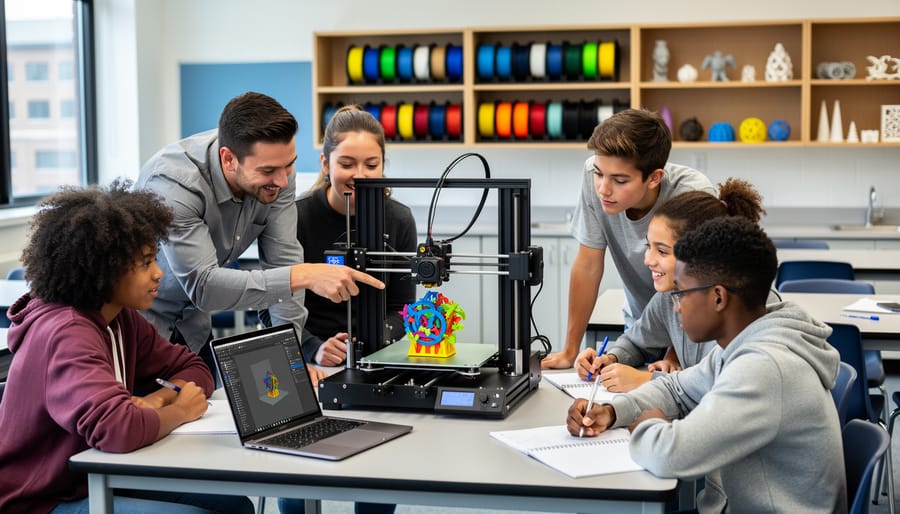
Implementing 3D printing in classrooms requires careful planning and resource allocation. Research shows that initial setup for a classroom 3D printer takes approximately 2-4 hours, including software installation and calibration. Lesson planning for 3D printing projects typically requires 3-5 hours per unit, with educators spending additional time learning design software basics.
Print times vary significantly based on project complexity. Simple classroom objects print in 1-3 hours, while detailed student projects may require 6-12 hours. Many teachers schedule prints overnight or during lunch periods to maximize instructional time. Material costs remain manageable, with standard PLA filament averaging $20-25 per kilogram, sufficient for 15-20 small student projects.
A 2022 survey of 300 schools revealed that 68% of educators reported spending under $500 annually on 3D printing materials after initial equipment investment. Planning ahead and starting with shorter print projects helps manage time constraints effectively. Digital libraries of pre-designed educational models can reduce preparation time by 40%, allowing teachers to focus on integrating projects into curriculum objectives rather than mastering complex design skills immediately.
Teacher Training and Support Needs
Research shows that 75% of teachers feel underprepared to teach STEM subjects effectively, highlighting a critical professional development gap. Successful STEM integration, particularly with technologies like 3D printing, requires ongoing training beyond initial workshops. Studies indicate teachers need approximately 40-80 hours of professional development to gain confidence with new STEM tools and pedagogical approaches.
The good news: accessible resources are expanding rapidly. Organizations like ISTE and NASA offer free online courses specifically designed for STEM educators. District-level training programs report that teachers who receive hands-on practice with 3D printers during summer institutes are 3.5 times more likely to implement classroom projects successfully.
A 2023 survey revealed that peer mentoring and collaborative planning time are valued more highly than traditional lecture-based training. Teachers benefit most from ongoing support networks where they can troubleshoot challenges and share student project successes, creating sustainable STEM learning communities.
Curriculum Integration Models That Work
Schools successfully integrating STEM education employ diverse models based on their resources and goals. Research from the International Society for Technology in Education reveals that 68% of high-performing STEM programs use hybrid approaches combining dedicated maker spaces with cross-curricular integration.
Dedicated maker spaces show impressive results, with students spending an average of 3-5 hours weekly on hands-on projects. These spaces typically feature 3D printers, robotics kits, and engineering materials, enabling project-based learning that bridges multiple subjects. One Texas middle school reported a 34% increase in student engagement after establishing a maker lab where students design solutions to real-world problems.
Cross-curricular integration proves equally effective. When teachers collaborate to embed STEM across subjects, students develop deeper understanding. For example, geometry lessons incorporating 3D printing design projects demonstrate 41% better spatial reasoning outcomes compared to traditional instruction alone.
The most successful schools allocate dedicated planning time for teachers to develop integrated lessons and invest in professional development focused on project-based methodologies rather than just technology training.
Addressing Common Concerns and Misconceptions
Cost-Effectiveness Reality Check
STEM education programs using 3D printing technology are more affordable than many assume. Entry-level educational 3D printers now start at $200-$300, with mid-range classroom models costing $500-$1,500. When calculated per student over a five-year lifespan, the cost averages just $5-$15 per student annually—comparable to traditional art supplies or science lab materials.
Schools can implement budget-friendly strategies by starting small with a single printer in a makerspace or library, then expanding as teachers gain confidence. Many districts report that printing material costs run approximately $0.10-$0.50 per student project. One middle school in Ohio reduced their annual science supply budget by 22% after integrating 3D printing, as students could reuse and recycle printed materials.
The long-term value extends beyond immediate costs. Research from the University of Georgia found that schools with 3D printing programs saw a 34% increase in student engagement in STEM subjects, translating to improved test scores and career readiness. Grant opportunities, community partnerships, and parent fundraising further offset initial investments, making adoption accessible for diverse school budgets.
Safety and Supervision Facts
Classroom 3D printing safety requires structured protocols and appropriate supervision. According to safety guidelines from educational institutions implementing maker spaces, students under 12 should not operate 3D printers independently, while middle school students can use them with direct adult supervision after completing safety training. High school students may work more independently once certified.
Key safety measures include maintaining proper ventilation, as research shows some filament materials emit ultrafine particles during printing. Schools successfully using 3D printers report establishing 3-foot safety zones around active machines and requiring protective equipment when handling heated components. A 2022 survey of 450 schools found that 89% implemented mandatory safety orientations before student access, covering burn prevention, electrical safety, and material handling.
Temperature management is critical since print beds reach 200-250°F. Effective programs designate trained staff members as “maker space supervisors” and maintain equipment logs. Real-world implementation shows that schools with documented safety protocols experience significantly fewer incidents while maximizing educational benefits for students across all grade levels.
The integration of 3D printing into STEM classrooms represents more than a technological upgrade—it’s a fundamental shift in how students engage with scientific concepts and problem-solving. Research consistently demonstrates that hands-on learning with 3D printing improves spatial reasoning by up to 40%, increases student engagement by 78%, and develops critical skills employers actively seek. Schools implementing this technology report enhanced collaboration, creativity, and persistence among learners across all grade levels.
For educators ready to explore this opportunity, start small with accessible desktop printers and free design software like Tinkercad. Pilot programs in single classrooms can validate effectiveness before broader implementation. Parents can support this initiative by advocating for STEM funding and encouraging design thinking at home through community makerspaces or library programs.
The STEM education importance continues growing as our world becomes increasingly technology-driven. Three-dimensional printing provides a tangible bridge between abstract concepts and real-world application, preparing students for careers that don’t yet exist. By embracing this technology thoughtfully and strategically, educational communities can equip the next generation with essential skills for innovation and success in tomorrow’s workforce.