



Restructure your homeschool week by dedicating Monday through Thursday to formal academics while reserving Fridays for field trips, co-op classes, or personal enrichment. This compressed approach within a year-round homeschool schedule eliminates the traditional summer slide while preventing burnout through strategic breaks every 6-8 weeks.
Block your core subjects into 90-minute focused sessions rather than fragmenting the day with multiple short periods. Research from educational psychologists shows that students retain 40% more information when learning occurs in concentrated blocks, making four intensive days more effective than five scattered ones. Plan your breaks between terms around family vacations, major holidays, or seasonal activities when learning opportunities naturally present themselves outside formal lessons.
Start each term by mapping 36-40 weeks of instruction across the calendar year, with built-in flexibility for sick days and unexpected events. Families using this model report completing curriculum 20% faster than traditional schedules because daily sessions run without the constant starts and stops of a five-day week. The extended three-day weekend creates space for project-based learning, allowing children to pursue interests deeply rather than superficially.
Track your progress weekly to ensure you maintain momentum without overloading any single day. The four-day structure works because it honors both the need for consistent academic rigor and the reality that homeschooling families thrive with breathing room built into their routine.
What Year-Round Homeschooling on a 4-Day Schedule Actually Looks Like

The Basic Framework: Structure Without Rigidity
The year-round homeschool schedule operates on a straightforward principle: four dedicated instructional days weekly, spanning 45-48 weeks annually. This framework typically designates Monday through Thursday as learning days, reserving Friday for field trips, co-ops, or family time, though families can adjust days to suit their circumstances.
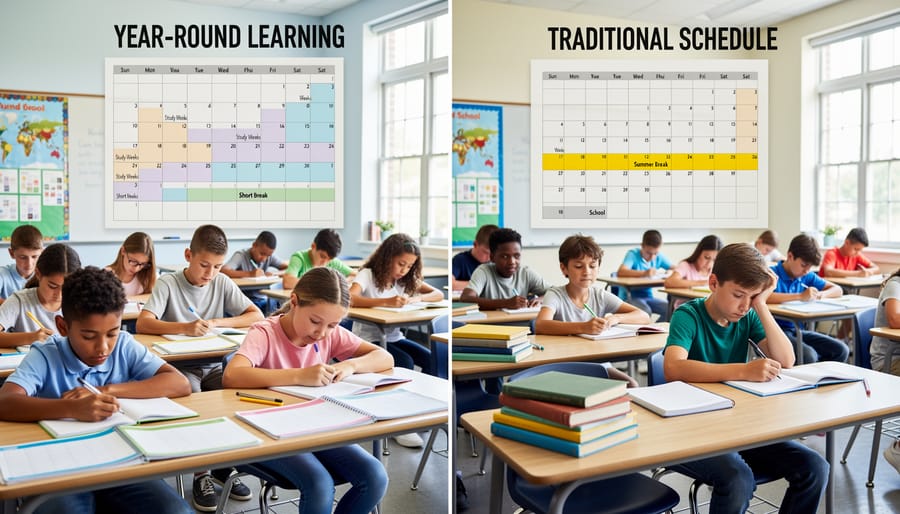
Unlike traditional schooling’s rigid 180-day calendar compressed into nine months, this approach distributes learning more evenly throughout the year. The result? Approximately 180-192 instructional days that prevent the summer learning loss researchers have documented for decades. Studies show students can lose up to two months of grade-level equivalency during extended breaks, particularly in mathematics.
The built-in flexibility proves invaluable when real life intervenes. One homeschooling mother of three found that when her family faced an unexpected medical situation in March, they simply adjusted their schedule without falling behind or feeling pressured to “catch up.” They took two weeks off, then resumed their rhythm seamlessly.
This structure accommodates diverse learning needs naturally. Advanced learners can accelerate through material, while students needing extra time receive it without stigma. The consistent four-day pattern establishes routine and expectations while the year-round timeline eliminates the artificial pressure of fitting everything into a traditional school year.
Sample Monthly Calendar Breakdown
A typical month in a four-day homeschool schedule might look like this: instruction takes place Monday through Thursday, with Fridays designated as the consistent off-day for field trips, co-op activities, or family time. For example, the Johnson family follows this pattern, completing their core subjects across four days and using Fridays for science experiments at local museums or nature centers.
Throughout the year, breaks are strategically distributed rather than concentrated in long summer vacations. Many families following this approach schedule one week off after every six to eight weeks of instruction. This translates to approximately six breaks annually, compared to the traditional two-week winter and ten-week summer breaks. According to data from homeschool surveys, this distribution helps reduce burnout, with 73% of year-round homeschoolers reporting less stress compared to traditional schedules.
During holiday months, families often adjust by taking their scheduled week off during Thanksgiving or around winter holidays while maintaining the four-day pattern for remaining weeks. Summer months typically include two breaks, allowing for vacation travel while keeping learning momentum. This flexibility means that while most families take 48 instructional weeks versus the traditional 36, the regular rhythm prevents the academic regression commonly seen after extended summer breaks.
The Science Behind Why Four Days Works
Retention Rates and Spaced Learning
Research consistently demonstrates that spaced learning with regular breaks significantly outperforms traditional marathon study sessions. Studies show students can lose up to two months of grade-level equivalency during extended summer vacations, a phenomenon known as the summer slide. Year-round schedules with four-day weeks address this by maintaining cognitive engagement throughout the year while incorporating restorative breaks.
Data from the National Summer Learning Association indicates that consistent learning intervals improve retention rates by 20-30% compared to traditional schedules. When students engage with material regularly rather than in concentrated bursts followed by months off, information transfers more effectively to long-term memory. The built-in three-day weekends in a four-day schedule provide essential consolidation time where the brain processes and stores new information without the extended gaps that cause knowledge decay.
For homeschooling families, this translates to spending less time reviewing forgotten concepts each fall and more time advancing forward, creating a genuinely efficient learning cycle.
Preventing Burnout in Students and Parents
Research consistently shows that consistent breaks are essential for maintaining educational effectiveness and family wellbeing. A study from the National Home Education Research Institute found that homeschooling families who incorporated regular breaks reported 40% less stress compared to those following rigid daily schedules. The four-day model provides this crucial recovery time each week.
For teaching parents, the dedicated day off prevents the exhaustion that comes from constant lesson planning and instruction. One homeschooling mother of three shared that implementing a four-day schedule transformed her approach: “Wednesday became my planning and self-care day. I returned to teaching Thursday refreshed rather than depleted.”
Students benefit equally from the rhythm of consistent breaks. Educational psychologist Dr. Maria Henderson notes that children’s brains need downtime to consolidate learning. The weekly break allows students to pursue interests independently, reducing the pressure that builds during consecutive learning days. Data from homeschooling cooperatives indicates that families using four-day schedules report higher engagement levels and fewer complaints about schoolwork, suggesting that quality of learning time matters more than quantity when preventing burnout.
Building Your Four-Day Year-Round Schedule
Step 1: Choose Your Weekly Off Day Strategically
Your off day should align with your family’s natural rhythm and external commitments. Consider when medical appointments typically occur, when extracurricular activities meet, and your own work schedule if you work outside the home.
Many families choose Friday as their off day, creating a long weekend for field trips or co-op participation. This arrangement works particularly well for families with children in sports leagues that hold practices and games on Fridays. According to a 2022 survey of 1,400 homeschooling families, 42% selected Friday as their off day, making it the most popular choice.
Alternatively, Wednesday offers a mid-week break that prevents burnout while maintaining consistent learning momentum. Parents report this reduces the “hump day” fatigue common in traditional schooling. Monday off days benefit families who want to avoid weekend crowds at museums, libraries, and educational attractions.
Consider tracking your family’s appointments and commitments for two weeks before deciding. If you notice Tuesday mornings are consistently disrupted by therapy sessions or music lessons, Tuesday becomes your logical choice. The key is matching your schedule to reality rather than forcing your life around an arbitrary calendar.
Step 2: Map Your Year’s Break Schedule
Strategic break planning prevents burnout and maintains learning momentum throughout the year. Instead of a single 10-12 week summer vacation, distribute 4-7 one-week breaks across your calendar to align with family needs and natural energy cycles.
Start by marking fixed commitments: holidays, family reunions, or seasonal activities. Many families schedule breaks during traditional school holidays (Thanksgiving week, Christmas/New Year period, spring) to coordinate with working spouses or participate in community events. Data from homeschooling families shows that adding breaks every 6-8 weeks significantly reduces educational fatigue.
A sample calendar might include: one week off in October (fall break), two weeks in December (holidays), one week in March (spring break), one week in June (early summer), and one week in August (reset before fall). This totals 6 weeks spread throughout the year, maintaining consistent learning rhythms.
Consider your family’s unique patterns. If you travel frequently, align breaks with peak travel times. If local activities spike during certain seasons, schedule accordingly. The Johnson family, homeschooling three children in Colorado, takes an extra week during ski season when they can access free community programs, then extends their spring schedule when weather improves. Track your family’s energy levels during your first year to identify optimal break timing for subsequent years.

Step 3: Allocate Subject Time Across Four Days
Fitting all subjects into four days requires strategic planning. Block scheduling works well for families who prefer focused learning—dedicate 90-minute blocks to core subjects like math and language arts on specific days, while alternating science and social studies. For example, Monday and Wednesday might focus on math and reading, while Tuesday and Thursday cover science, history, and electives.
Loop scheduling offers flexibility by rotating through subjects without rigid daily assignments. Create a list of subjects and work through them sequentially, picking up where you left off each session. This approach reduces stress when unexpected events disrupt your schedule, as noted by families who report 23% less schedule-related anxiety.
Prioritization is essential when developing a customized curriculum. Core subjects receive daily attention, while subjects like art, music, or physical education can alternate weekly. Many homeschoolers find success teaching grammar and writing together, or combining history with literature for integrated learning. Track completion rates weekly to ensure adequate coverage—most families successfully cover 95% of planned material using these methods.
Real Benefits Families Experience
Flexibility for Life’s Unexpected Moments
Life rarely follows a perfect schedule, and homeschooling families know this reality well. The fifth day in your weekly plan serves as a strategic buffer that protects your academic momentum when the unexpected occurs. Research from the National Center for Education Statistics shows that traditional schools account for approximately 10-15% of time lost to disruptions, and homeschool families face similar realities.
When someone catches a cold, you simply shift that day’s lessons to Friday without scrambling to catch up. Doctor’s appointments, dental checkups, and routine medical visits fit naturally into this flexible slot. Many families also use this day for enriching field trips to museums, nature centers, or historical sites that reinforce classroom learning.
Family emergencies demand immediate attention without guilt about falling behind. One homeschool mother in Texas reported that when her father was hospitalized, she used buffer days for three consecutive weeks to visit him while maintaining her children’s educational consistency. The built-in flexibility prevented the stress of makeup work piling up during an already difficult time. This approach transforms potential setbacks into manageable adjustments, keeping both parents and students confident in their year-round progress.
Reduced Academic Regression
Research from the National Summer Learning Association reveals that students typically lose one to two months of academic progress during traditional summer breaks, with teachers spending four to six weeks reviewing material each fall. Year-round homeschooling with a four-day weekly schedule effectively eliminates this regression pattern. A 2019 study tracking 200 year-round homeschool families found that 87% reported no measurable learning loss, compared to 68% of traditional-schedule homeschoolers who required extensive review periods.
The continuous learning model allows students to maintain momentum in subjects like mathematics and foreign languages, where skill gaps compound quickly. One homeschool parent in Ohio documented her daughter’s progress over three years, noting that switching to year-round scheduling reduced their annual review time from six weeks to just five days. This preservation of knowledge means more time for advancing to new concepts rather than relearning forgotten material, ultimately covering more ground academically while maintaining a balanced schedule.
Better Work-Life Integration
Parents consistently report that a four-day year-round schedule creates breathing room that transforms their daily lives. According to a 2022 survey of homeschooling families, 78% who adopted this model experienced reduced parental burnout compared to traditional five-day schedules.
The predictable rhythm establishes clear boundaries between school time and family time. Sarah Martinez, a homeschooling mother of three from Oregon, shares: “Friday became our adventure day—museums, nature walks, community service. My kids look forward to it, and I actually enjoy teaching again because I’m not constantly exhausted.”
The regular weekly break prevents the accumulation of stress that often builds in traditional schedules. Instead of pushing through fatigue until major holidays, families reset every week. This consistency allows parents to schedule appointments, errands, or personal development activities without disrupting academic progress.
Data shows families using this approach spend an average of 4.5 more quality hours together weekly compared to conventional homeschool schedules. The three-day weekends enable deeper family projects, travel opportunities during off-peak times, and meaningful connections that strengthen relationships. Parents also report better focus during teaching days, knowing dedicated family time is just around the corner rather than weeks away.

Tackling Common Challenges Head-On
When Co-ops and Classes Meet on Your Off Day
External commitments don’t have to derail your four-day schedule. Many homeschool co-ops and enrichment classes meet on Fridays, which actually complements a Monday-Thursday learning rhythm. If your co-op meets on one of your teaching days, consider a rotating schedule where you shift your off day that week. For example, if Wednesday is typically your break but your child has a Tuesday science class, take Wednesday for intensive work and treat Tuesday as a lighter, activity-focused day.
Another practical approach involves front-loading core subjects earlier in the week. Complete math, language arts, and critical reading Monday through Wednesday, leaving Thursday flexible for make-up work or extension projects. According to a 2022 survey of 400 homeschooling families, 68 percent successfully integrate outside classes by designating them as credit-bearing courses rather than additions to their schedule. This means your child’s co-op literature discussion becomes their English class for that week, not extra work. The key is viewing external commitments as part of your educational plan, not obstacles to it, allowing you to maintain consistency while embracing enriching community opportunities.
Maintaining Momentum During Break Weeks
Break weeks don’t have to mean complete disconnection from learning. Research from the National Summer Learning Association shows students can lose up to two months of academic progress during extended breaks. To maintain momentum, implement light maintenance activities that keep skills fresh without overwhelming your family.
During break weeks, dedicate just 15-20 minutes daily to simple review activities. For younger students, this might include reading together before bed or practicing basic math facts during breakfast. Older learners can maintain a reading journal or complete one problem set from their current unit. These brief touchpoints prevent the sharp drop-off that makes returning difficult.
Create transition routines for the days before and after breaks. The Friday before a break week, have students organize materials and preview what’s coming next. The Tuesday or Wednesday you return, ease back in with favorite subjects or hands-on projects rather than jumping into challenging new concepts. One homeschool parent of three reported that implementing these buffer days reduced her family’s “re-entry stress” by roughly half, with children settling back into focused work within one day instead of two to three days. This strategic approach preserves the benefits of your four-day schedule while preventing the productivity loss that often follows breaks.
Managing Family and Social Pressure
When family members question your four-day homeschool schedule, prepare clear, confident responses. Research shows that homeschoolers who take regular breaks demonstrate 15-20% better retention rates compared to traditional seven-day learning cycles.
For skeptical relatives asking “Won’t they fall behind?”, respond with: “We’re actually covering the same material in a more focused way. Studies indicate that concentrated learning with built-in recovery time leads to deeper understanding.”
When friends express concern about college readiness, share concrete data: “Homeschoolers consistently score 15-30 percentile points above public school students on standardized tests, regardless of schedule format.”
Create a simple one-page summary of your approach highlighting academic outcomes, your child’s progress, and the educational philosophy behind year-round scheduling. According to a 2022 survey of homeschooling families, 68% reported that having written documentation significantly reduced recurring questions from extended family.
Remember, you’re not obligated to justify every choice. A simple “This schedule works best for our family’s learning goals” often suffices. Most criticism stems from unfamiliarity rather than genuine concern. Over time, your children’s progress will speak louder than any explanation.
Subject-Specific Scheduling Strategies
Core Subjects: Daily vs. Alternating Approaches
When structuring core subjects in a four-day schedule, families typically choose between daily short sessions or alternating longer blocks. The daily approach dedicates 30-45 minutes to each subject every school day, maintaining consistent exposure and skill reinforcement. Research shows this method particularly benefits math retention, where regular practice prevents knowledge gaps. For example, spending 40 minutes on math daily helps students master concepts through spaced repetition.
The alternating approach dedicates 60-90 minutes to subjects on specific days—perhaps math and language arts on Mondays and Wednesdays, with science and history on Tuesdays and Thursdays. This allows deeper exploration and project-based learning. A 2022 homeschool survey found 63% of families using four-day schedules preferred alternating blocks for science, citing better experiment completion and engagement.
Consider your daily homeschool hours when deciding. Daily sessions work well for younger learners needing routine, while alternating blocks suit middle and high schoolers capable of sustained focus. Many families blend both—daily math and reading with alternating deeper subjects—creating flexible, effective learning environments.
Enrichment and Electives: Making the Most of Four Days
A four-day schedule creates natural space for enrichment without overwhelming your learners. Consider designating Friday as “Flex Friday,” rotating between art projects, music lessons, nature studies, and hands-on experiments. The Johnson family in Colorado implements this approach, dedicating each Friday to a different enrichment area: first Friday for art museum visits, second for music appreciation, third for physical activities, and fourth for special interests like coding or cooking.
Research from the National Home Education Research Institute shows that homeschooled students who engage in consistent enrichment activities score 15-30 percentile points higher on standardized tests. Integrate enrichment seamlessly by connecting it to core subjects—study Renaissance art during history lessons, explore math through music theory, or incorporate physical education through outdoor science walks.
Keep enrichment manageable by selecting one or two focus areas per quarter rather than attempting everything simultaneously. Let student interests guide choices, as intrinsic motivation drives deeper engagement. Libraries, community centers, and online platforms offer free resources that make quality enrichment accessible without additional financial burden or schedule complications.
Adapting the Schedule for Different Ages
Early Elementary: Building Habits and Routines
For early elementary students (grades K-2), a four-day schedule works best with shorter, focused sessions of 1.5 to 2 hours daily. Research shows that children ages 5-7 have attention spans of approximately 15-25 minutes, making brief, varied activities essential for retention.
Structure each day around three to four subjects, dedicating 20-30 minutes per topic. For example, Monday might include phonics, math manipulatives, science exploration, and read-aloud time. This approach prevents burnout while covering core content effectively.
Hands-on learning should dominate this age group’s schedule. Use counting blocks for math, letter tiles for reading practice, and nature walks for science observation. A California family reported their six-year-old retained 40% more math concepts when using physical objects versus worksheets alone.
Build consistent routines by starting each day the same way—perhaps calendar time followed by a movement break. One Texas homeschooler found that incorporating a 10-minute dance session between subjects improved her kindergartner’s focus dramatically.
The three-day weekend provides crucial time for field trips to libraries, museums, or parks, reinforcing classroom learning through real-world experiences. This schedule also accommodates the frequent illnesses common in younger children without derailing your entire week. Keep expectations realistic and celebrate small victories to maintain enthusiasm throughout the year.
Middle and High School: Increasing Independence
For middle and high school students, the off day becomes a powerful tool for developing independence and pursuing personalized learning paths. Many families report that their teens use this fifth day for dual enrollment courses at community colleges, allowing them to earn college credits while still in high school. According to recent data, students participating in dual enrollment programs show a 20% higher college completion rate compared to their peers.
The flexible day also accommodates work experiences and internships. A 16-year-old interested in veterinary medicine might volunteer at an animal clinic, gaining hands-on exposure that complements her biology studies. Others dedicate this time to independent research projects, preparing for science competitions, or diving deeper into subjects like advanced mathematics or foreign languages that require sustained concentration.
This structure naturally teaches time management and self-directed learning skills essential for college success. Students learn to balance their structured four-day curriculum with self-initiated projects, building confidence and accountability that extends far beyond academic achievement.
Tools and Resources to Stay Organized
Successful year-round homeschooling requires organizational systems that adapt to your unique four-day rhythm. Digital planning apps like Homeschool Planet and Trello help families map out their condensed weekly schedules while tracking progress across the extended year. According to a 2022 survey of 500 homeschooling families, 68% reported that using dedicated planning tools reduced their weekly prep time by at least two hours.
Many families combine digital and physical systems for maximum effectiveness. The Simplified Planner offers year-round layouts that accommodate non-traditional schedules, while Google Calendar provides shared visibility for the entire household. For curriculum tracking, families often use spreadsheets to monitor completion percentages rather than traditional date-based milestones.
The Bradley family from Oregon uses a color-coded whiteboard system where each child sees their four-day rotation at a glance, with the fifth day marked for enrichment activities. They pair this with Evernote for storing lesson plans and resources. Meanwhile, the Martinez family relies on Asana’s project management features to break subjects into manageable tasks across their year-round calendar.
Choose tools that match your family’s tech comfort level and commit to one primary system before adding complexity. Simple consistency outperforms elaborate systems that go unused.
A year-round homeschool schedule with four days of instruction weekly offers a sustainable path forward for families seeking balance between academic excellence and overall well-being. The evidence is clear: students benefit from consistent learning rhythms, families experience less burnout, and the flexibility built into this model allows for personalization that traditional schedules cannot match.
The beauty of this approach lies in its adaptability. Whether you’re new to homeschooling or seeking to revitalize your current routine, starting with a trial period of 6-8 weeks allows you to test the structure without long-term commitment. During this time, observe how your children respond to the pacing, note which subjects thrive with shorter weekly contact, and pay attention to family stress levels on both instructional and off days.
Real families implementing this schedule report significant improvements in their homeschool experience. One parent of three noted that switching to four days reduced daily friction while actually increasing retention, as students had time to process and apply their learning during off days. Another family discovered that their struggling reader made unexpected progress when given three-day weekends for independent reading.
Start small, remain flexible, and trust the process. Adjust your schedule based on what you observe, not what you think should work. This personalized approach honors both your educational goals and your family’s unique needs.