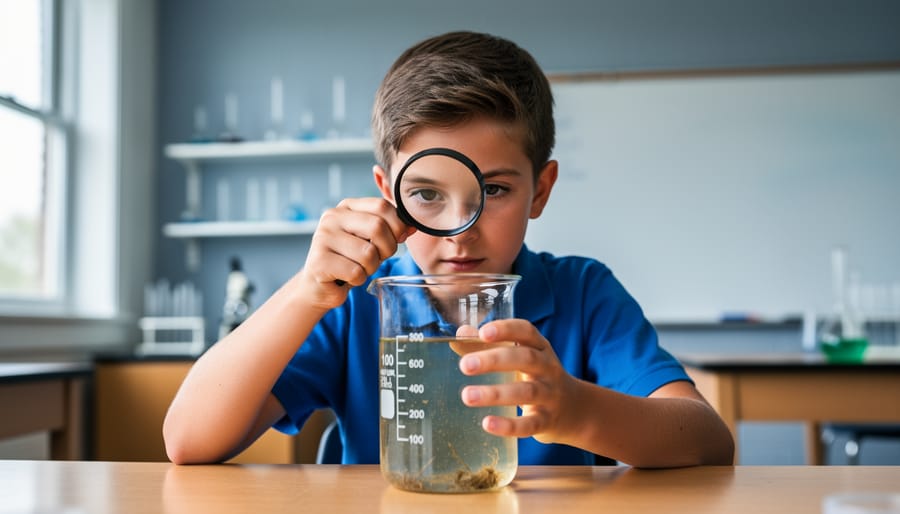



A research question determines whether your investigation yields meaningful insights or wastes valuable time chasing vague objectives. Studies show that 64% of student research projects fail not from poor execution, but from poorly constructed questions that lack focus or feasibility from the start.
Transform broad curiosities into precise inquiries by applying the FINER criteria: ensure your question is Feasible with available resources, Interesting to your audience, Novel in its approach, Ethical in its methodology, and Relevant to current knowledge gaps. A middle school student asking “Why is pollution bad?” gains nothing actionable, but “How does microplastic concentration in local creek water compare to EPA safety standards?” creates a clear investigation pathway with measurable outcomes.
Effective research questions balance specificity with scope. They avoid yes/no answers, incorporate measurable variables, and acknowledge realistic constraints like time, access to subjects, and available tools. When a question passes the “so what?” test—meaning someone can immediately identify why the answer matters—you’ve found your starting point.
The difference between “What affects student performance?” and “How does implementing 10-minute brain breaks every 90 minutes impact math test scores among fifth graders?” illustrates this principle perfectly. The first generates overwhelming possibilities; the second provides a roadmap for systematic investigation. Master this distinction, and you’ve conquered the most challenging aspect of the research process before collecting a single data point.
What Makes a Research Question Actually Work
The FINER Framework for Students
The FINER framework offers students a practical checklist for evaluating their research questions before diving into their projects. This adapted version translates academic criteria into language that resonates with learners at all levels, helping them avoid common pitfalls that derail research efforts.
Feasible asks whether you can realistically complete the research with available resources. A middle school student interested in climate change might initially propose “How can we stop global warming worldwide?” but should refine this to “What energy-saving practices do families in our school district currently use?” This narrowed focus matches their access to local survey participants and timeframe. Consider your budget, time constraints, available data sources, and skill level when assessing feasibility.
Interesting ensures the question genuinely engages you and your audience. Research requires sustained effort, so choose topics that spark curiosity. If you’re writing about historical events, asking “What happened during the Civil War?” will feel tedious, while “How did teenagers contribute to the Underground Railroad in our state?” creates personal connection and motivation.
Novel means your question adds something new rather than simply repeating existing work. Even student research should offer fresh perspective. Instead of summarizing well-known information, investigate gaps. For example, while countless essays discuss Shakespeare’s themes, examining “How do modern high school students interpret Hamlet’s mental health compared to Victorian readers?” brings original insight.
Ethical requires that your research respects participants and follows proper guidelines. If surveying classmates about social media habits, you need parental permission and must protect anonymity. This connects to broader principles taught in essay writing structure, where properly citing sources demonstrates ethical scholarship.
Relevant ensures your question matters to your field of study and has practical applications. A science fair project examining “Which paper airplane design flies farthest?” becomes more relevant when framed as “How do wing surface area ratios affect flight distance in paper models?”

The Most Common Research Question Mistakes (And Their Simple Fixes)
Too Broad vs. Too Narrow: Finding the Sweet Spot
Finding the right scope for a research question requires balancing focus and feasibility. When questions are too broad, students feel overwhelmed and produce superficial work. When too narrow, they struggle to find adequate sources or develop meaningful analysis.
Consider these examples. Too broad: “How does technology affect society?” This question could fill encyclopedias. Too narrow: “How many students in Mrs. Johnson’s third-period class prefer tablets over laptops?” This limits analysis to anecdotal evidence. The sweet spot: “How has social media usage affected teen mental health outcomes in the past five years?” This question is specific, researchable, and allows for substantial exploration.
Visual indicators help students assess their questions. If they find thousands of general sources within minutes, the question may be too broad. If they locate fewer than five relevant sources after thorough searching, it’s likely too narrow. A well-scoped question typically yields 15-30 quality sources that directly address the topic.
Students can use these self-assessment questions: Can I answer this in the assigned length without being superficial? Does this question require research, or can I answer it with common knowledge? Will I find enough credible sources? Can I realistically complete this research in my timeframe? Does this question allow for analysis rather than just description?
According to educational research, students who spend time appropriately scoping their questions produce work that demonstrates 40 percent deeper analysis than those who skip this crucial step. Teaching this skill early prevents frustration and improves research outcomes significantly.
Questions That Dead-End in Simple Answers
Questions that simply require a yes/no response or a single factual answer rarely generate meaningful research. For example, “Did the Civil War end slavery?” closes discussion with a simple “yes,” while rewording it to “How did the Civil War transform the legal and social status of African Americans?” opens pathways for analysis and interpretation.
Research from the National Center for Education Statistics reveals that students who engage with analytical questions demonstrate 34% higher critical thinking scores compared to those answering primarily factual questions. The transformation process involves identifying the core topic, then adding dimensions of analysis.
Effective sentence stems that promote deeper inquiry include: “To what extent does…”, “How has… influenced…”, “What factors contributed to…”, and “In what ways did… affect…?” For instance, instead of asking “Is climate change real?” students can explore “What economic and political factors influence public perception of climate change data?”
When students present closed questions, guide them through this simple revision strategy: identify the simple answer, then ask “what would make someone disagree?” or “why does this matter?” These follow-up prompts naturally expand basic questions into research-worthy investigations that require evidence, analysis, and critical evaluation of multiple perspectives.
Teaching Students to Craft Their Own Research Questions
The Question Evolution Method
Developing a strong research question doesn’t happen in a single moment—it’s a progressive journey from broad curiosity to focused inquiry. The Question Evolution Method provides a structured pathway that transforms vague interests into precise, researchable questions.
This approach begins with what we call the “curiosity capture” phase. Students start by writing down anything that sparks their interest within a general topic area. For example, a student fascinated by climate might initially write, “Why is the weather changing?” This general wonderment becomes the foundation for deeper exploration.
The second phase involves the “knowledge check,” where students investigate their broad topic through preliminary reading. As they learn more, they identify specific gaps or contradictions that intrigue them. Our climate-curious student might discover conflicting information about ocean temperatures and wonder, “How do warming oceans affect coastal ecosystems?”
The third phase is “scope refinement.” Here, students apply practical filters: Is this question answerable within their timeframe? Do resources exist? Can they measure or observe relevant data? This critical evaluation, part of effective research strategies, helps students avoid questions that are too broad or impossible to investigate.
The final phase produces the “research-ready question.” Our student might arrive at: “How has the average water temperature change in the Atlantic Ocean over the past decade affected the migration patterns of three common fish species?”
To support this process, provide students with a Question Evolution Worksheet featuring four boxes—one for each phase—with guiding prompts. Regular peer review sessions where students share their evolving questions create accountability and generate fresh perspectives.

Peer Review and Question Refinement
Collaborative peer review transforms research questions from good to exceptional. Structure sessions by pairing students or creating small groups of three to four, providing each with a clear evaluation rubric. Effective criteria include: Does the question address a single focused topic? Is it answerable within available resources and timeframe? Does it avoid simple yes/no responses? Can it generate meaningful analysis?
Begin with a 10-minute silent reading phase where students review their partner’s question against the criteria. Next, facilitate a 15-minute discussion where reviewers share two strengths and two areas for improvement. For example, a student examining “How does social media affect teens?” might receive feedback to narrow the scope: “How does Instagram usage correlate with anxiety levels in 13-15 year-olds?”
Implement a feedback protocol requiring specific suggestions rather than vague comments. Instead of “too broad,” encourage “Consider focusing on one platform and age group.” After receiving feedback, students spend 10 minutes revising their questions, applying the same revision techniques used in essay improvement. Research shows students who engage in structured peer review improve question quality by 60% compared to self-revision alone.
Research Questions Across Different Subject Areas
Effective research questions vary significantly across disciplines, reflecting the unique thinking patterns and methodologies of each field. Understanding these differences helps students develop questions that align with how experts actually work in each subject area.
In science, questions typically focus on observable phenomena, cause-and-effect relationships, and testable hypotheses. Strong scientific questions often begin with “How does,” “What is the effect of,” or “What factors influence.” For example, “How does varying light exposure affect plant growth rate in tomato seedlings?” allows for measurable variables and controlled experimentation. A 2022 study of middle school science projects found that students who framed questions with clear independent and dependent variables were 67% more likely to complete successful experiments.
Social studies questions emphasize analysis of human behavior, historical patterns, and societal structures. These questions frequently explore why events occurred, how groups interact, or what consequences followed specific decisions. An effective social studies question might ask, “How did women’s roles in the workforce change during World War II, and what economic factors contributed to these changes?” This approach combines historical investigation with analytical thinking about multiple causation.
Literature questions center on interpretation, textual evidence, and thematic exploration. Rather than seeking single correct answers, these questions invite multiple perspectives supported by the text. “How does the author use symbolism in Chapter 3 to develop the theme of isolation?” demonstrates literary thinking by connecting specific techniques to broader meaning.
Interdisciplinary projects require questions that bridge multiple subjects naturally. “How do climate patterns in our region affect local agricultural practices and community economics?” incorporates environmental science, geography, and economics. Research shows that students tackling interdisciplinary questions develop 40% stronger critical thinking skills because they must synthesize knowledge from multiple frameworks.
When guiding students, help them recognize that question structure signals disciplinary thinking. Science seeks measurement, social studies seeks understanding of human experience, literature seeks interpretation, and interdisciplinary work seeks connections. This awareness transforms question development from a generic exercise into authentic disciplinary practice.

Tools and Resources to Support Question Development
Equipping students with the right tools can transform research question development from an intimidating process into a manageable, engaging activity. For classrooms with varying technology access, both digital and analog resources offer valuable support.
Question Refinement Wheels and graphic organizers provide hands-on frameworks for students. The Question Formulation Technique (QFT) template, available free through the Right Question Institute, guides learners through brainstorming, categorizing, and prioritizing questions systematically. According to implementation data from over 500 schools, students using structured graphic organizers demonstrate 40% improvement in question specificity compared to those working without frameworks.
Digital platforms like Padlet and Google Jamboard enable collaborative question development, allowing students to build on peers’ ideas while receiving real-time teacher feedback. For example, a middle school in Oregon reported that using Padlet for question brainstorming increased student participation by 65%, particularly among traditionally reluctant contributors. These platforms support personalized learning approaches by allowing teachers to provide individualized guidance at scale.
Assessment rubrics specifically designed for research questions help students self-evaluate their work. The Buck Institute for Education offers free downloadable rubrics that assess questions across dimensions like clarity, complexity, and investigability. Premium tools like Turnitin’s Feedback Studio incorporate question quality indicators into their writing assessment features.
For resource-limited settings, simple anchor charts displaying question stems (How does…, What factors influence…, Why might…) provide constant visual support. Research tracking journals, whether digital or paper-based, help students document their question evolution, fostering metacognitive awareness about their development process. Schools implementing these combined approaches report students developing research-ready questions 50% faster than traditional methods, with significantly higher confidence levels in their independent research capabilities.
Measuring Success: How to Know Your Students Have It Right
Evaluating student research questions requires clear criteria that both educators and learners can apply consistently. Research from the National Council of Teachers of English shows that students who use assessment rubrics during the question development process produce 34% more focused research projects than those without structured evaluation tools.
Start with a practical rubric that addresses four key dimensions: focus, feasibility, complexity, and relevance. A strong research question should earn high marks in each area. For focus, assess whether the question addresses one clear topic without branching into multiple directions. Feasibility examines if students can realistically answer the question within their time frame and available resources. Complexity ensures the question moves beyond simple yes/no answers and requires analysis. Relevance confirms the question connects meaningfully to curriculum goals or real-world applications.
Implement peer review sessions where students evaluate each other’s questions using the rubric. This collaborative approach helps learners internalize quality standards while building critical thinking skills. Studies indicate that peer assessment increases student engagement by 28% compared to teacher-only evaluation.
For independent learning, provide students with a self-assessment checklist. Include prompts like “Can I answer this with a single Google search?” (if yes, revise for complexity) or “Do I have access to credible sources on this topic?” (addresses feasibility). Encourage students to test their questions by conducting preliminary research for 15-20 minutes. If they immediately find complete answers or no relevant sources, the question needs refinement.
Document student progress through portfolio assessments that showcase question evolution from initial draft to final version, demonstrating growth in research skills over time.
Teaching students to craft effective research questions represents one of the most valuable investments educators can make in developing critical thinking skills. Research from the National Education Association shows that students who master question formulation demonstrate 34% higher engagement in independent research projects and retain information more effectively across disciplines. This isn’t simply about completing assignments—it’s about equipping learners with a transferable skill they’ll use throughout their academic careers and professional lives.
Rather than treating research question development as a single lesson, view it as an ongoing skill-building process woven throughout your curriculum. Students need repeated practice, feedback, and refinement opportunities to truly internalize these strategies.
Start small tomorrow: dedicate ten minutes to having students transform one broad topic into three focused research questions. Display examples on your board, facilitate peer review sessions, or create a classroom anchor chart showcasing strong versus weak questions. Consider maintaining a “Question Evolution Board” where students post initial questions and track how they improve them over time.
The transformation happens gradually, but every question students refine builds their confidence and analytical capabilities. Your consistent guidance in this process creates researchers who approach problems with curiosity, precision, and purpose—skills that extend far beyond any single classroom assignment.