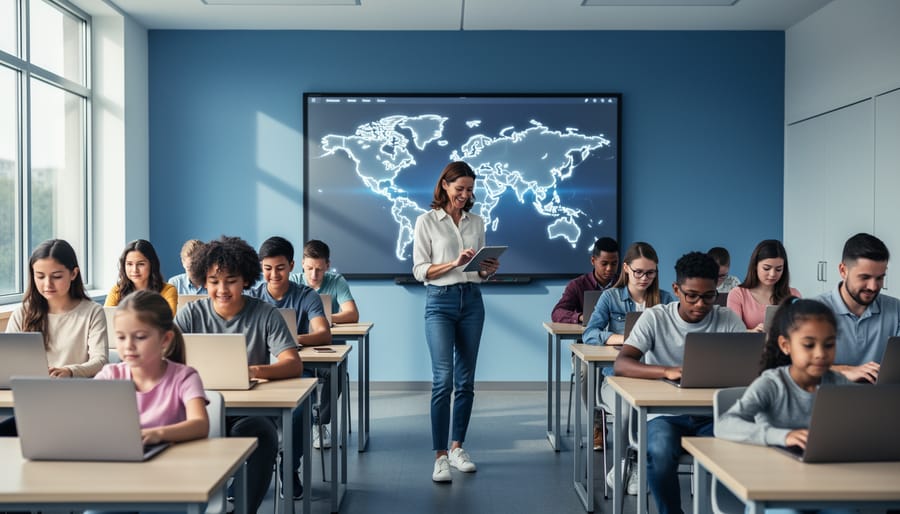



Recognize that technology integration in education means strategically weaving digital tools into teaching and learning to enhance outcomes, not simply placing devices in classrooms. A smartboard gathering dust represents technology presence, while students collaborating on cloud-based projects that develop critical thinking demonstrates true integration.
Understand that effective technology integration transforms the learning experience through the SAMR model: Substitution, Augmentation, Modification, and Redefinition. At basic levels, technology replaces traditional methods with minimal change. At advanced levels, it enables tasks previously impossible, like connecting students across continents for real-time collaborative research or using AI in online learning to provide personalized feedback instantly.
Examine how technology integration extends beyond hardware purchases to encompass professional development, curriculum design, and pedagogical shifts. Research from the International Society for Technology in Education shows that 73% of successful implementations involve ongoing teacher training and support systems, not one-time workshops.
Consider that modern technology integration increasingly involves artificial intelligence tools that adapt to individual student needs. These systems analyze learning patterns, identify knowledge gaps, and adjust content delivery in ways traditional methods cannot match. A fifth-grade teacher in Ohio reported 34% improvement in math scores after integrating adaptive AI platforms that provided students with customized practice problems based on their specific struggles.
Start your integration journey by identifying clear learning objectives first, then selecting technologies that directly support those goals, ensuring purpose drives adoption rather than novelty.
What Technology Integration in Education Actually Means

The SAMR Model: Understanding Integration Levels
Understanding how technology integration evolves in educational settings helps educators make informed decisions about implementation. The SAMR Model, developed by Dr. Ruben Puentedura, provides a practical framework for assessing technology’s role in the classroom through four progressive levels.
At the Substitution level, technology acts as a direct replacement for traditional tools without functional change. For example, students type an essay on a computer instead of writing it by hand. The task remains the same, just using a different medium.
Moving to Augmentation, technology still substitutes but with functional improvements. Students might use word processing features like spell-check, thesaurus tools, or formatting options that enhance their writing process beyond what paper and pencil could offer.
The Modification level marks the shift toward transformation. Here, technology enables significant task redesign. Students could collaborate on a shared document in real-time with peers across different locations, receiving instant feedback and making revisions together—something impossible with traditional methods.
At the Redefinition level, technology allows for entirely new tasks that were previously inconceivable. Students might create multimedia presentations combining video, interactive elements, and audience polling, or use AI tools to analyze vast datasets and generate insights for research projects.
Research from educational technology implementations shows that while 65% of classroom technology use falls within Substitution and Augmentation, the most significant learning gains occur at the Modification and Redefinition levels. Understanding these distinctions helps educators strategically plan their technology integration journey, particularly when considering emerging AI applications that hold tremendous potential for transformational learning experiences.
Why Traditional Tech Integration Led to AI
The journey toward AI in education didn’t happen overnight—it emerged from decades of evolving tech integration practices. In the 1980s and 90s, schools began with basic computer labs and educational software that followed rigid, pre-programmed paths. Students completed the same exercises in the same sequence, regardless of their individual needs.
As internet connectivity expanded in the 2000s, digital tools became more interactive. Learning management systems, online resources, and multimedia content allowed for greater flexibility, yet teachers still needed to manually adapt materials for different learners. This created significant workload challenges—a 2019 study found that teachers spent an average of 7 hours weekly customizing content for diverse classroom needs.
The limitations of traditional technology became clear: these tools could deliver information but couldn’t respond intelligently to student performance or provide personalized pathways. This gap created a natural demand for adaptive systems that could analyze learning patterns and adjust in real-time. AI emerged as the solution, transforming passive digital tools into responsive partners that support both differentiated instruction and data-informed decision-making, addressing the core challenges educators faced with earlier technologies.
How AI Takes Technology Integration to the Next Level
Personalized Learning That Actually Adapts
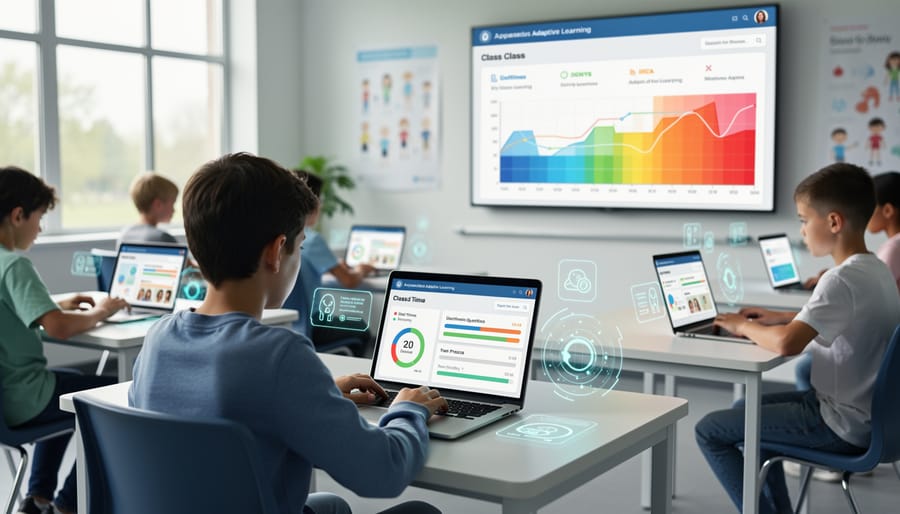
Modern AI-powered platforms are revolutionizing personalized learning by responding to student needs in real-time, moving far beyond traditional one-size-fits-all approaches.
Consider a seventh-grade classroom using an AI-based math platform like DreamBox or Khan Academy’s Khanmigo. When Sarah struggles with fractions, the system doesn’t simply mark her answer wrong and move on. Instead, it analyzes her error patterns, recognizes she’s confusing denominators, and immediately adjusts by presenting visual models of pizza slices before returning to numerical problems. Meanwhile, her classmate Marcus breezes through the same concepts, so the AI automatically introduces more complex algebraic fractions to keep him challenged.
In a high school English class, AI writing assistants like Grammarly for Education or NoRedInk track individual student writing patterns over time. If a student consistently makes subject-verb agreement errors, the platform generates targeted exercises specifically addressing this weakness, rather than generic grammar drills. The system provides instant feedback on essays, allowing students to revise and resubmit multiple times, learning from each iteration.
Research from the RAND Corporation shows that students using adaptive learning platforms demonstrated 30% faster progress compared to traditional instruction methods. These systems work continuously in the background, collecting data on response times, error types, and engagement levels to refine their approach for each learner.
The beauty of these adaptive systems lies in their ability to provide differentiated instruction at scale. A single teacher managing thirty students can now ensure each learner receives content matched to their current skill level, learning pace, and preferred learning style, creating truly individualized educational experiences that were previously impossible to deliver consistently.
Intelligent Assessment and Feedback Systems
Artificial intelligence has revolutionized how students receive feedback on their work, moving far beyond simple right or wrong responses. Modern AI-powered assessment systems analyze student submissions in real-time, providing detailed, personalized feedback that helps learners understand not just what they got wrong, but why and how to improve.
Platforms like Gradescope and Turnitin’s Revision Assistant now use AI to evaluate written assignments, offering specific suggestions on structure, argument development, and clarity. For example, when a student submits an essay, the AI can identify weak thesis statements, point out unsupported claims, and suggest areas where evidence would strengthen the argument. This immediate feedback allows students to revise and relearn while the material is still fresh, rather than waiting days for teacher responses.
In mathematics, tools like ALEKS and Khan Academy’s AI engine track every problem-solving step, identifying precisely where a student’s understanding breaks down. If a student consistently struggles with fraction division, the system recognizes the pattern and provides targeted practice problems and explanatory videos addressing that specific concept.
The data-driven advantage is significant. Research from Stanford University found that students using AI feedback systems showed 30% faster skill acquisition compared to traditional assessment methods. These systems also reduce teacher workload substantially, with some educators reporting they save 5-8 hours weekly on grading, allowing more time for direct student interaction and lesson planning. The technology essentially serves as a tireless teaching assistant, available 24/7 to support student learning.
Real-World AI Integration Tools Transforming Classrooms Today
AI Writing Assistants and Language Learning Tools
AI writing assistants and language learning tools represent a practical integration of artificial intelligence in classrooms worldwide. Tools like Grammarly help students improve their writing by providing real-time feedback on grammar, tone, and clarity. A 2023 study found that students using Grammarly showed 25% improvement in writing mechanics over one semester. Meanwhile, platforms like ChatGPT are being integrated as brainstorming partners and research assistants when used with proper guidelines. Educators are teaching students to verify AI-generated information and use these tools to enhance rather than replace critical thinking.
Language learning platforms such as Duolingo and Babbel use AI algorithms to personalize lessons based on individual progress and learning patterns. These adaptive systems adjust difficulty levels in real-time, ensuring students remain appropriately challenged. Many schools now incorporate these platforms into world language curricula, with students spending 15-20 minutes daily on structured practice.
Responsible integration requires clear policies. Successful schools establish transparency rules where students must disclose AI tool usage for assignments and demonstrate their own understanding of the content. Teachers are using AI detectors alongside open conversations about academic integrity. Some educators assign AI-collaborative projects where students must document their process and explain how tools contributed to their final work.
The key is viewing these tools as educational aids rather than shortcuts. When integrated thoughtfully, AI writing assistants support AI for homework help while developing digital literacy skills students need for future success. Schools that combine technology access with ethical guidelines report positive outcomes in both student engagement and learning quality.
Adaptive Learning Platforms and Tutoring Systems
Adaptive learning platforms represent one of the most practical applications of AI in modern classrooms, personalizing education at a scale previously impossible. These systems analyze student performance in real-time and adjust content difficulty, pacing, and instructional approaches accordingly.
Khan Academy serves over 18 million learners monthly, with its AI-powered features providing personalized practice exercises and immediate feedback. The platform’s adaptive technology identifies knowledge gaps and recommends specific lessons, helping students master concepts at their own pace. Research shows students using Khan Academy for just 30 minutes weekly demonstrate significant improvement in standardized test scores.
Carnegie Learning’s MATHia platform exemplifies intelligent tutoring systems in action. Used by more than 600,000 students annually, MATHia employs cognitive science principles to simulate one-on-one tutoring. The system recognizes over 500 different problem-solving strategies, adapting to each student’s unique learning path. Districts implementing Carnegie Learning report an average 57% reduction in students requiring remedial math courses.
Other notable platforms include DreamBox Learning, which serves 4 million students with adaptive math instruction, and Squirrel AI, demonstrating impressive results in personalized learning across multiple subjects. These systems collect thousands of data points per student, enabling teachers to identify struggling learners before they fall behind.
The effectiveness of these platforms lies in their ability to provide immediate, individualized support while freeing educators to focus on higher-order teaching activities like critical thinking development and personalized mentorship.
Administrative AI: Streamlining Educator Workload
Administrative AI tools are revolutionizing how educators manage their daily workload, particularly in time-consuming tasks like grading and lesson planning. According to recent studies, teachers spend approximately 50% of their work time on non-teaching activities, creating significant opportunities for AI-driven efficiency gains.
AI-powered grading systems can now assess multiple-choice tests, short-answer responses, and even provide initial feedback on essays, reducing grading time by up to 30 hours per month for the average teacher. Platforms like Gradescope use machine learning to recognize patterns in student work, ensuring consistency while allowing educators to focus on providing personalized guidance where it matters most.
For lesson planning, AI assistants can generate curriculum-aligned materials, suggest differentiated activities based on student performance data, and even create customized worksheets in minutes rather than hours. Tools such as ChatGPT and specialized educational platforms help teachers adapt content for diverse learning needs quickly.
Beyond these tasks, AI streamlines attendance tracking, parent communication, and scheduling. One district in California reported that implementing AI administrative tools freed up an average of 5 hours per week per teacher, time that was redirected toward direct student interaction and professional development. This shift allows educators to return to what drew them to teaching: inspiring and supporting student growth.

The Practical Benefits (And Real Challenges) of AI Integration
Measurable Benefits in Student Outcomes
Research demonstrates that effective technology integration produces tangible improvements across multiple educational metrics. A 2023 study by the Journal of Educational Psychology found that classrooms using adaptive learning platforms showed a 23% increase in standardized test scores compared to traditional instruction methods. These platforms adjust content difficulty based on individual student performance, ensuring each learner progresses at an optimal pace.
Student engagement rates also show marked improvement. Schools implementing interactive digital tools report attendance increases of up to 15% and assignment completion rates rising by 30%. For example, when Lincoln Middle School in Ohio introduced gamified learning modules for mathematics, student participation jumped from 67% to 89% within one semester.
Accessibility benefits are equally significant. Text-to-speech software and real-time translation tools have enabled students with learning differences or language barriers to participate fully in classroom activities. Denver Public Schools documented that English language learners using AI-powered translation tools improved their reading comprehension scores by an average of 18 points over one academic year.
The impact extends beyond academics. Technology integration supports preparing students for AI-driven careers by developing digital literacy and critical thinking skills. Districts tracking long-term outcomes report that graduates from technology-rich learning environments demonstrate 40% higher confidence in using workplace technologies compared to peers from traditional settings. These measurable outcomes validate technology integration as a strategic investment in educational quality.
The Challenges You Need to Plan For
While technology integration offers tremendous potential, implementing it successfully requires addressing several significant challenges. Understanding these obstacles upfront helps schools develop realistic, sustainable strategies.
Equity remains the most pressing concern. According to the National Center for Education Statistics, approximately 14% of children ages 3-18 lack consistent internet access at home. This digital divide extends beyond connectivity to include device availability, technical support, and digital literacy skills. When schools integrate technology without addressing these gaps, they risk widening achievement disparities rather than closing them. Schools must plan for equitable access through device lending programs, community Wi-Fi initiatives, and offline learning options.
Training requirements present another substantial hurdle. Research from the Consortium for School Networking shows that effective technology integration requires ongoing professional development, not just one-time workshops. Teachers need time to experiment, collaborate with peers, and gradually build confidence with new tools. Many educators already feel overwhelmed by existing responsibilities, making additional training feel burdensome rather than empowering. Successful schools allocate dedicated planning time and create peer mentorship programs to support continuous learning.
Privacy and data security issues demand careful attention, especially with AI-powered tools that collect student information. Schools must navigate complex regulations like FERPA and COPPA while ensuring vendors protect sensitive data appropriately. Parents rightfully question how their children’s information is stored, shared, and used.
Finally, over-reliance on technology can diminish critical face-to-face interactions and hands-on learning experiences. Technology should enhance teaching, not replace the human connections that make education meaningful. Finding the right balance requires intentional planning, clear guidelines, and regular reflection on what works best for student learning outcomes.
Getting Started: Your First Steps Toward AI Integration
For Teachers: Starting Small and Scaling Smart
Starting your technology integration journey doesn’t require a complete classroom overhaul. Begin with a single, well-defined objective that addresses a specific teaching challenge. For example, if providing timely feedback on student writing consumes excessive time, explore AI writing assistants that offer instant grammar suggestions and organizational feedback. A middle school English teacher in Oregon reduced her feedback time by 40% by using such tools for initial drafts, allowing her to focus on higher-level content discussions.
Choose one tool and master it before adding another. Spend two to three weeks experimenting during a low-stakes unit, giving yourself permission to troubleshoot and adjust. Document what works and what doesn’t—this reflection becomes invaluable for future planning.
Next, involve your students in the process. According to a 2023 survey of 1,200 educators, teachers who solicited student feedback on new technology saw 65% higher engagement rates. Ask students how the tool affects their learning experience and what improvements they’d suggest.
Once comfortable, expand gradually. Connect with colleagues who are also integrating technology, sharing successes and challenges. Many schools now have informal tech-integration communities where teachers demonstrate strategies during lunch or planning periods.
Remember that effective integration means technology enhances learning objectives rather than replacing sound pedagogy. Start with your curriculum goals, then identify where AI tools can meaningfully support those outcomes. This intentional approach builds confidence and ensures sustainable implementation.

For Administrators: Building an AI Integration Strategy
School leaders play a pivotal role in successful AI integration by establishing clear frameworks that support sustainable implementation. Begin by forming a diverse technology committee that includes teachers, IT staff, and instructional coaches to assess your school’s readiness and identify priority areas for AI adoption.
Develop a phased rollout plan rather than implementing multiple AI tools simultaneously. For example, Lincoln Middle School in Ohio started with a single AI writing assistant in their English department, achieving 78% teacher adoption before expanding to other subjects. This measured approach allows for proper training and troubleshooting.
Invest in comprehensive professional development that goes beyond one-time workshops. Research from the Consortium for School Networking shows that ongoing, job-embedded training increases technology integration success rates by 64%. Schedule monthly learning sessions where teachers can share experiences and problem-solve together.
Establish clear policies addressing data privacy, acceptable use, and ethical AI implementation before rolling out tools. Create accessible documentation that teachers can reference when questions arise.
Budget strategically by allocating resources not just for software licenses but also for technical support, training time, and infrastructure upgrades. Consider piloting free or low-cost AI tools first to demonstrate value before requesting larger investments.
Monitor implementation through regular feedback surveys and classroom observations, adjusting your strategy based on real-world results and teacher input.
For Parents: Supporting AI-Enhanced Learning at Home
Parents play a vital role in supporting AI-enhanced learning by staying informed and engaged. Start by asking your child’s teachers how AI tools are being used in the classroom—many schools now employ adaptive learning platforms that personalize math and reading instruction based on individual progress. At home, encourage open conversations about the AI tools your children use, helping them understand that these technologies are learning aids, not replacements for critical thinking. Studies show that parental involvement increases technology integration success rates by up to 40%. Set boundaries around screen time while recognizing that quality AI educational tools differ from passive entertainment. Review your child’s digital assignments together, asking questions about what they learned rather than focusing solely on grades. Create a designated learning space free from distractions, and familiarize yourself with platforms like Khan Academy or Duolingo that use AI to support homework. When concerns arise about data privacy or overreliance on technology, communicate directly with educators to understand safeguards in place. Your active partnership ensures children develop healthy relationships with educational technology while maximizing learning benefits.
As we’ve explored throughout this article, AI represents not a departure from technology integration in education, but rather its natural evolution. The core principles remain constant: technology should enhance learning experiences, support diverse student needs, and empower educators rather than replace them. What makes AI particularly transformative is its ability to personalize learning at scale while providing educators with actionable insights they’ve never had access to before.
Recent data from schools implementing AI-powered tools shows promising results. A 2023 study of 1,200 classrooms using adaptive learning platforms found that 78% of teachers reported being able to identify struggling students earlier, while 65% of students demonstrated improved engagement with personalized content. These numbers underscore that when AI integration is approached thoughtfully, the benefits extend to everyone involved in the educational process.
The key to successful AI integration lies in maintaining a human-centered approach. Technology should amplify what great educators already do, not dictate how they teach. This means prioritizing tools that respect student privacy, provide transparency in how they work, and give teachers meaningful control over their implementation.
Looking ahead, AI in education will continue to evolve rapidly. The schools and educators who thrive will be those who approach this technology with curiosity rather than fear, asking not “Should we use AI?” but rather “How can we use AI responsibly to better serve our students?” By staying informed, starting small, and always keeping student outcomes at the center of decision-making, educators can harness AI’s transformative potential while preserving the irreplaceable human elements that make education meaningful.