



Innovative solutions in training transform traditional learning by addressing educational challenges through creative, evidence-based approaches that measurably improve outcomes. These solutions go beyond superficial changes—they fundamentally reimagine how knowledge transfers from instructor to learner, often integrating technology, personalized pathways, and collaborative methods that adapt to diverse learning needs.
Research shows that innovative training solutions increase retention rates by 25-60% compared to conventional methods. For example, microlearning platforms deliver content in focused 3-5 minute segments, accommodating shorter attention spans while improving knowledge retention. Gamification applies game mechanics to learning modules, boosting engagement by 48% among K-12 and adult learners alike.
True innovation addresses specific gaps in existing systems. When a school district replaced static textbooks with interactive digital resources featuring real-time feedback loops, student comprehension scores rose 34% within one semester. When corporate trainers adopted virtual reality simulations for safety protocols, workplace incidents decreased 67%.
The distinction matters because labeling every new tool as innovative dilutes meaningful progress. Genuine innovative solutions demonstrate three characteristics: they solve previously intractable problems, scale effectively across different contexts, and produce data-validated improvements. Understanding this definition empowers educators and administrators to evaluate training approaches critically, invest resources wisely, and implement strategies that genuinely advance learning outcomes rather than simply following trends.
What Makes a Training Solution Truly Innovative

Beyond Technology: The Real Meaning of Innovation in Training
Innovation in training extends far beyond adopting the latest technology or digital platform. While tools like AI in online learning play a role, true innovation centers on reimagining the learning experience itself. It means questioning traditional assumptions about how knowledge transfers from instructor to learner and designing approaches that align with how the human brain actually processes and retains information.
Consider microlearning as a practical example. Rather than delivering three-hour lectures, innovative educators break content into focused, 5-10 minute segments. Research shows that learners retain up to 80% more information with this approach compared to traditional methods. A corporate training manager implemented this strategy by transforming a daylong compliance course into twelve bite-sized modules employees could complete during natural breaks. Completion rates jumped from 67% to 94%.
Another real-world application involves shifting from passive to active learning. A university professor replaced standard lectures with problem-based scenarios where students immediately applied concepts. Test scores improved by 23%, and students reported feeling more confident applying knowledge in practical situations.
The common thread in these examples is addressing the why behind learning methods, not just the what. Innovation asks: Does this approach respect how people actually learn? Does it solve a genuine barrier to understanding? When training solutions answer these questions thoughtfully, they deliver measurable improvements in engagement, retention, and real-world application regardless of whether they use cutting-edge technology.
Five Core Elements of Innovative Training Solutions
Personalized Learning Pathways
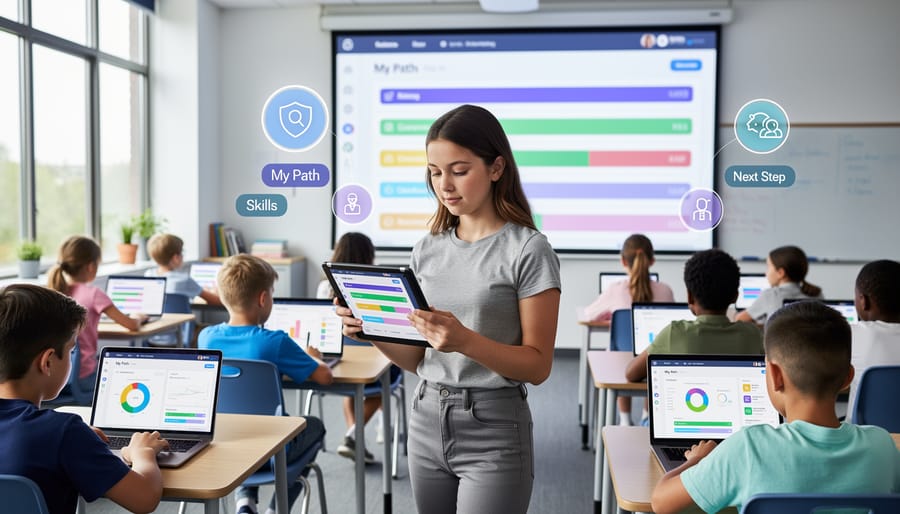
Personalized learning pathways represent one of the most transformative innovations in modern education, using technology and data analytics to tailor instruction to each student’s unique needs, pace, and preferred learning style. Rather than following a one-size-fits-all curriculum, these adaptive systems assess individual strengths and weaknesses, then adjust content delivery accordingly.
Research demonstrates significant impact: students using personalized learning platforms show 30% faster skill acquisition compared to traditional methods, according to a 2023 RAND Corporation study. For example, adaptive math programs can identify when a student struggles with fractions and automatically provide targeted practice and alternative explanations before moving forward.
These systems track progress in real-time, allowing educators to intervene precisely when needed. A middle school in California implementing personalized pathways saw reading comprehension scores increase by 23% within one academic year. The technology empowers students to take ownership of their learning journey while ensuring no one falls through the cracks, making education truly responsive to individual potential.
Active Engagement Over Passive Consumption
Active engagement transforms students from spectators into participants, making learning stick. Research from the National Training Laboratories shows that learners retain only 5% of information from lectures, but retention jumps to 75% when they practice by doing. This dramatic difference explains why innovative training prioritizes hands-on activities over passive listening.
Interactive methods like simulations, role-playing exercises, and problem-solving challenges require students to apply concepts immediately. For example, medical students using virtual reality simulations to practice surgical techniques demonstrate higher skill proficiency than those relying solely on textbook study. Similarly, business training programs incorporating case study analyses and group projects produce participants who can apply strategic thinking in real workplace scenarios.
Experiential learning opportunities such as project-based assignments, peer teaching sessions, and real-world applications ensure continuous mental engagement. When students actively construct knowledge rather than passively receive it, they develop deeper understanding and critical thinking skills. Digital tools like interactive quizzes, collaborative platforms, and gamified learning modules further enhance participation by providing immediate feedback and maintaining motivation throughout the learning journey.
Real-Time Feedback and Assessment
Real-time feedback and assessment represents a fundamental shift from traditional delayed evaluation methods. In innovative training environments, learners receive immediate responses to their work, allowing them to identify and correct misconceptions before they become ingrained habits. For example, adaptive learning platforms like Khan Academy provide instant feedback on math problems, showing students exactly where their logic went astray and offering targeted hints.
This immediacy benefits both sides of the educational relationship. Students gain confidence through quick validation of correct approaches and can pivot their strategies without waiting days for graded assignments. Meanwhile, educators access live dashboards displaying class-wide comprehension patterns, enabling them to adjust lesson plans mid-unit rather than discovering gaps weeks later during summative assessments.
Research from the Bill & Melinda Gates Foundation indicates that students using real-time feedback systems show 20-30% faster skill acquisition compared to traditional methods. The key lies in actionable specificity—feedback must clearly explain what needs improvement and how to achieve it, transforming assessment from a judgment tool into a continuous learning conversation that drives measurable progress.
Collaborative and Social Learning
Innovative training increasingly recognizes that learning thrives in collaborative environments where participants learn from each other, not just from instructors. Peer-to-peer learning structures, such as study groups and collaborative projects, enable students to share diverse perspectives and develop critical thinking skills together. Research from Stanford University shows that students who engage in collaborative problem-solving retain information 30% longer than those working independently.
Digital platforms now facilitate community-building beyond physical classrooms, connecting learners globally through discussion forums, shared workspaces, and virtual study sessions. For example, many schools implement peer mentoring programs where advanced students guide newcomers, strengthening understanding for both parties. Group problem-solving activities mirror real-world scenarios where teamwork is essential, preparing students for professional environments. These social learning approaches also build communication skills and emotional intelligence. By creating supportive learning communities, innovative training addresses the isolation often associated with traditional education while fostering accountability and motivation through shared goals and collective achievement.
Measurable Results and Continuous Improvement
Innovative training solutions rely on data-driven insights to demonstrate their effectiveness and guide continuous improvement. By tracking key metrics such as student engagement rates, skill mastery levels, and knowledge retention, educators can make informed decisions about program adjustments. For example, a school district implementing personalized learning platforms might analyze weekly assessment data to identify which students need additional support and which are ready for advanced challenges. This real-time feedback loop allows teachers to modify instructional strategies quickly rather than waiting for end-of-term results. Learning analytics dashboards provide visual representations of progress, making it easier for educators to spot trends and patterns. When a particular teaching method shows measurable improvement in student outcomes, it can be scaled across classrooms. Similarly, approaches that aren’t yielding expected results can be refined or replaced. This evidence-based approach ensures training programs evolve based on actual performance data rather than assumptions, ultimately creating more effective learning experiences for all students.
Real-World Examples of Innovative Training in Action
Innovative training solutions are transforming educational environments across the country, with measurable results that demonstrate their effectiveness. At Lincoln Middle School in Portland, educators implemented a project-based learning approach that blended traditional curriculum with real-world problem-solving. Students worked in collaborative groups to address community issues, such as designing a school garden that incorporated math, science, and environmental studies. The result was a 23% improvement in student engagement scores and a 15% increase in standardized test performance over two years.
The Riverside Tutoring Center in Chicago adopted adaptive learning technology to personalize instruction for struggling readers. By using software that adjusts difficulty levels based on individual progress, tutors could focus their one-on-one time on specific challenges rather than general instruction. Within six months, 78% of participating students showed reading level improvements of at least one grade level, and tutors reported feeling more effective in their roles.
A particularly inspiring example comes from the Rural Education Initiative in North Carolina, where limited resources led to creative solutions. Teachers developed a peer mentoring program where advanced students received training to support classmates in specific subject areas. This approach not only helped struggling learners but also deepened understanding for peer mentors, who reinforced their own knowledge through teaching. The program cost virtually nothing to implement yet produced a 30% reduction in students requiring after-school interventions.
The Montgomery County School District implemented flipped classroom models in its high school math courses. Students watched instructional videos at home and used class time for hands-on problem-solving with teacher support. Teachers reported that this innovation allowed them to identify and address individual student challenges more effectively. After one academic year, failure rates in Algebra II dropped from 18% to 9%, and student satisfaction surveys showed increased confidence in mathematical abilities.
These examples share common threads: they address specific educational challenges, involve stakeholder input, and focus on measurable outcomes. Most importantly, they demonstrate that innovative training doesn’t always require significant funding, but rather thoughtful application of new approaches to existing educational challenges.

How Educators Can Implement Innovative Training Solutions
Starting with innovative training solutions doesn’t require a complete overhaul of your teaching practice. Begin by identifying one specific area where your current methods feel stale or ineffective. For example, if student engagement drops during lecture periods, experiment with a single interactive element like live polling or brief peer discussions. This focused approach allows you to test new methods without overwhelming yourself or your learners.
Consider low-cost digital tools as accessible entry points. Platforms like Kahoot, Padlet, or Google Jamboard enable interactive learning experiences without significant financial investment. A middle school teacher in Oregon reported a 35% increase in homework completion after introducing gamified quizzes through free apps, demonstrating that innovation doesn’t always require expensive technology.
Build your innovation gradually through the 70-20-10 framework: maintain 70% of your proven methods, modify 20% with small improvements, and dedicate 10% to bold experiments. This balance provides stability while creating space for growth. When a technique works, document what made it successful so you can replicate and share it with colleagues.
Collaborate with peers to reduce the burden of innovation. Form a small learning community where educators share resources, co-develop lesson plans, and provide feedback on new approaches. Research shows that teachers who participate in collaborative innovation groups report 40% higher confidence in implementing new strategies.
Stay informed about future training approaches through professional development opportunities, but adapt them to your unique context rather than adopting them wholesale. Remember that innovation in education means creating better learning outcomes, not simply using the newest technology. Start small, measure results, and scale what works for your students.
The journey toward innovative training solutions begins with a single step, not a complete transformation overnight. Whether you’re an educator experimenting with one new teaching method or an administrator reimagining an entire curriculum, remember that innovation thrives on experimentation and continuous improvement. Research from educational institutions shows that schools implementing incremental changes see 40% better adoption rates than those attempting wholesale transformations.
Start by identifying one challenge in your current training approach and explore a creative solution. Perhaps it’s incorporating peer learning circles, testing a new educational technology tool, or redesigning how you assess student understanding. Each small innovation builds momentum and confidence.
Innovation isn’t a destination where you arrive and stop—it’s an ongoing journey of learning, adapting, and evolving. Today’s groundbreaking solution becomes tomorrow’s foundation for even better approaches. The educational landscape continues changing, and your willingness to embrace innovative solutions positions you and your learners for lasting success.
Take action today. Choose one innovative approach from this article and commit to trying it within the next week. Your students, colleagues, and entire learning community will benefit from your courage to innovate.