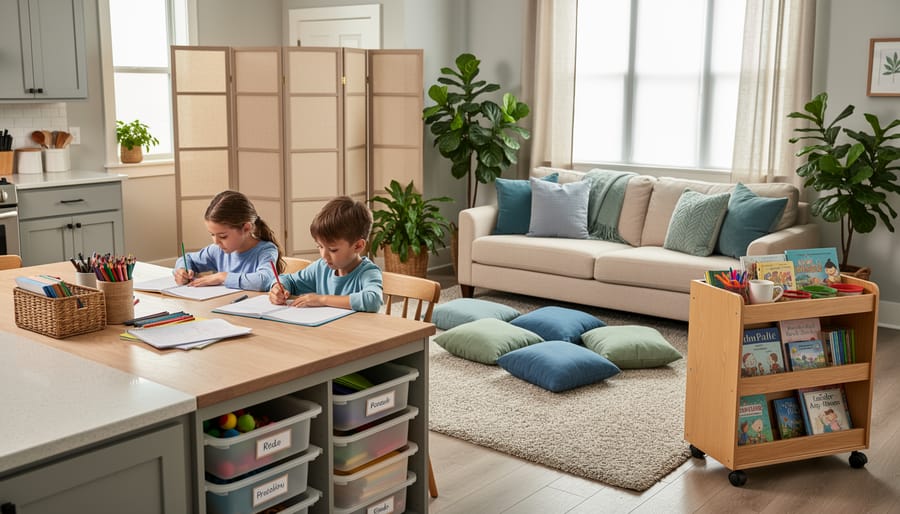



Transform your kitchen table into a dedicated morning learning station by clearing it completely each evening and setting out the next day’s materials in labeled baskets. A 2022 study from the National Home Education Research Institute found that consistent, designated learning spaces—even temporary ones—increased student focus by 34% compared to improvised setups.
Create zone-based learning areas that serve multiple purposes throughout the day. Your living room corner becomes a reading nook with floor cushions and a bookshelf during morning hours, then transitions to an art station in the afternoon. Parents with limited square footage report that flexible spaces reduce sibling conflicts and accommodate different learning styles within the same room.
Designate specific times when shared spaces function as learning environments rather than carving out permanent rooms. The dining room operates as a science lab from 10-11 AM, a writing workshop from 1-2 PM, and returns to family space by dinner. This approach works particularly well for families homeschooling multiple children at different grade levels, allowing each child access to optimal spaces when they need them most.
Establish clear visual boundaries using rugs, tape lines, or furniture arrangement to signal when and where learning happens. Research from educational psychologist Dr. Maria Henderson shows that children as young as five recognize and respect these spatial cues, creating mental associations between location and focus. Even a folding screen or bookshelf can separate a learning zone from play areas, helping children transition between activities more effectively.
What Makes a Home Learning Environment Actually Work
An effective home learning environment extends far beyond designating a quiet corner with a desk. Research from the National Home Education Research Institute reveals that successful home learning spaces share four foundational elements that work together to create genuine educational outcomes.
Structure forms the backbone of any effective home learning setup. This doesn’t mean rigid schedules, but rather consistent routines that children can anticipate. A predictable rhythm helps learners transition into focused work mode, whether that’s starting each morning with reading or dedicating specific afternoon blocks to hands-on projects. Studies show that students in structured home environments demonstrate 23% better task completion rates compared to those without clear routines.
Resources matter, but quality trumps quantity. A well-stocked home learning environment includes age-appropriate materials that invite exploration rather than passive consumption. This might mean a collection of diverse books, art supplies, building materials, or digital resources carefully selected to match learning objectives. Creating a stimulating home environment requires thoughtful curation rather than overwhelming abundance.
Emotional safety provides the foundation for risk-taking and genuine learning. Children need spaces where mistakes become learning opportunities rather than sources of shame. This psychological element proves just as critical as physical comfort. When students feel secure asking questions and exploring ideas, their engagement increases significantly.
Parental involvement completes the picture, though this varies by age and learning style. Effective involvement means being available for guidance without hovering, showing genuine interest in learning activities, and modeling curiosity. A parent who reads alongside their child or discusses project ideas sends powerful messages about the value of education.
These elements combine to create environments where learning feels natural rather than forced, transforming homes into dynamic educational spaces that adapt to each family’s unique circumstances and goals.
The Kitchen Table Academy: Flexible Multi-Purpose Learning Spaces
Making It Work: Storage and Transition Strategies
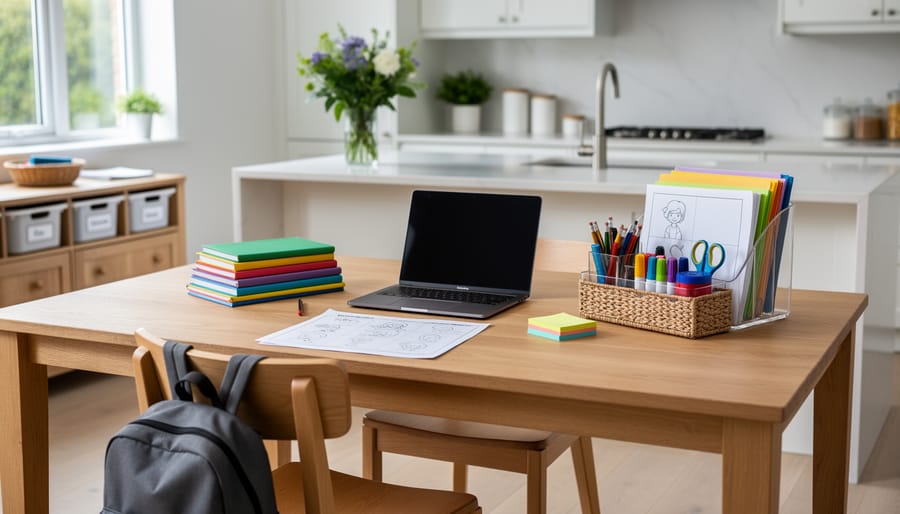
Successful home learning environments require thoughtful organization systems that accommodate both educational needs and family life. Research from the National Home Education Research Institute shows that families with established storage and transition routines report 40% less stress during learning hours.
Many families adopt the “mobile cart method,” using rolling carts stocked with daily materials that move from storage to learning space in under five minutes. The Martinez family in Ohio uses labeled bins on their cart system—one for each child—containing workbooks, pencils, and current projects. After learning time, everything rolls back into a closet, restoring their dining room to family space. This approach exemplifies effective storage solutions that maintain household functionality.
Transition rituals help establish clear boundaries between learning and leisure time. The Chen family uses a specific playlist to signal the start of school time, while cleanup time begins with a timer set for seven minutes—a game-like approach that motivates their three children to reset the space quickly.
Visual cues also prove effective. Some families use reversible placemats—colorful designs for meals, plain white for learning—creating instant psychological transitions without moving furniture. Others designate a “learning basket” that sits on the kitchen counter during school hours and moves to a shelf afterward, signaling availability for questions or homework help.
Storage redundancy reduces setup time significantly. Keeping duplicate supplies like scissors, glue, and rulers in both primary learning areas and storage locations means less hunting for materials, with families reporting up to 15 minutes saved daily through this simple strategy.
The Dedicated Learning Corner: Creating Focused Study Zones
Age-Appropriate Setup Examples
Elementary students thrive in learning spaces that balance structure with exploration. A typical elementary home learning area might include a child-sized desk positioned near natural light, with accessible storage bins organized by subject using color coding. Research from the Journal of Environmental Psychology shows that 6-10 year olds benefit from defined zones, so consider creating a reading nook with floor cushions separate from the homework station. Include manipulatives like counting blocks, alphabet tiles, and art supplies within arm’s reach. One parent in Colorado transformed a closet into a “learning cubby” with magnetic walls for displaying work and a small bookshelf, proving that even 4×4 feet can work effectively.
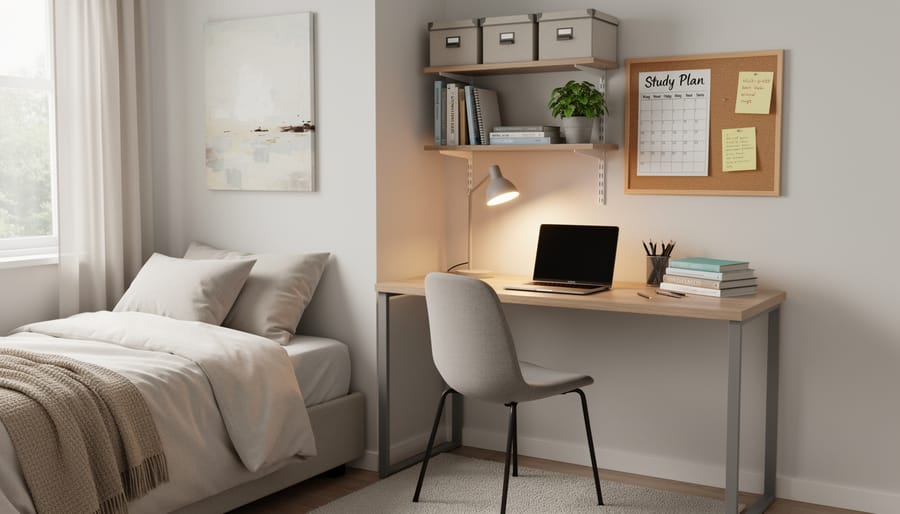
Middle school students need spaces that support increasing independence while accommodating multiple subjects. A successful setup might feature a larger desk with dedicated zones for different activities, adjustable lighting for various tasks, and a bulletin board for tracking assignments. At this stage, students benefit from having reference materials like dictionaries and atlases nearby. Data from a 2022 education study indicates that 11-14 year olds perform better when they can personalize their space, so allow choices in desk accessories and organizational tools.
High school learners require more sophisticated workspaces resembling adult environments. An ideal setup includes a substantial desk supporting laptop work, adequate electrical outlets for multiple devices, ergonomic seating for extended study sessions, and filing systems for managing complex projects. Consider adding a whiteboard for brainstorming and problem-solving. Many families successfully convert spare bedrooms or basement corners into dedicated study spaces that minimize distractions while fostering the self-direction high schoolers need for college preparation.
The Outdoor Classroom: Nature-Based Learning Environments
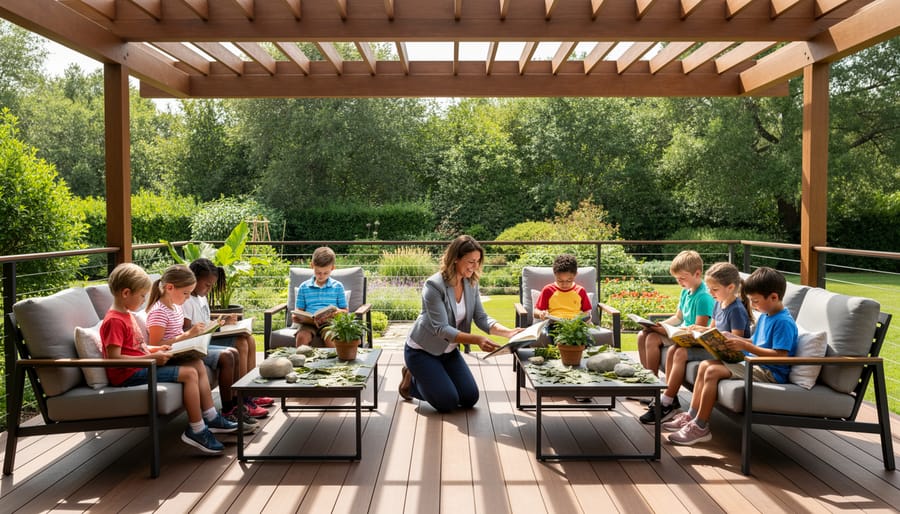
Outdoor spaces offer remarkable opportunities for hands-on learning that naturally engages multiple senses and learning styles. Research from the Natural Learning Initiative shows that children who regularly engage in outdoor learning demonstrate 27% higher science test scores and improved focus compared to their indoor-only peers.
Many families transform their backyards into science laboratories where children observe weather patterns, track seasonal changes, and study local ecosystems. The Martinez family in Oregon created a simple weather station on their back porch using a thermometer, rain gauge, and wind sock, allowing their 8-year-old to record daily observations that connect directly to her school curriculum. This setup cost less than $30 but provided year-round learning opportunities.
Gardens serve dual purposes as both learning environments and family projects. Beyond obvious science lessons about plant growth and life cycles, gardens teach patience, responsibility, and even mathematics through measuring, spacing, and harvest counting. A Toronto-based homeschooling family uses their small patio garden to teach fractions by dividing harvest yields and calculating ingredient proportions for cooking.
Outdoor reading nooks have gained popularity, with families repurposing hammocks, weatherproof cushions, or simple blankets under trees to create peaceful literacy spaces. These areas reduce screen time while encouraging independent reading, with natural lighting providing optimal conditions for extended reading sessions.
Art stations positioned outdoors minimize cleanup concerns while inspiring creativity through nature. Families set up easels on patios or use picnic tables as craft centers, where children can paint, sculpt with clay, or create nature collages using found materials.
Movement-based learning thrives outdoors, where children can practice gross motor skills, conduct physics experiments with balls and ramps, or learn through active games that would be impractical indoors. These spaces accommodate multiple children simultaneously while providing the freedom to learn through physical exploration.
The Digital Learning Hub: Technology-Integrated Spaces
Modern families are transforming corners of their homes into effective digital learning hubs that support both online education and creative technology use. The Johnson family in Seattle created a dedicated tech station in their living room alcove, positioning two desks perpendicular to each other so their middle and high schooler could work independently while parents maintained visual supervision. They invested in ergonomic seating and adjustable monitor stands to prevent strain during extended learning sessions.
According to a 2023 survey by Common Sense Media, 68% of families now designate specific areas for device use rather than allowing technology throughout the home. The Martinez family in Austin exemplifies this approach with their converted spare bedroom featuring a large bulletin board displaying a color-coded schedule that allocates screen time across learning apps, creative projects, and recreational use. Their setup includes a central charging station that houses all devices overnight, naturally limiting evening screen exposure.
Connectivity challenges affect rural families disproportionately. The Chen family in rural Montana addressed their unreliable internet by installing a WiFi extender and downloading educational content during off-peak hours. They maintain an organized system of offline resources, including downloaded videos and educational games that function without connectivity.
For families managing multiple children on varying schedules, the Rodriguez household uses noise-canceling headphones and visual privacy screens to create individual focus zones within their shared dining room workspace. They implemented a rotating device schedule, ensuring each child has dedicated access to the family tablet for specialized learning applications. A simple kitchen timer helps children self-monitor screen time, promoting independence while maintaining healthy technology boundaries. This practical approach demonstrates that effective digital learning spaces require thoughtful planning rather than expensive equipment.
The Creative Studio: Arts, Crafts, and Hands-On Learning Areas
Designated creative spaces transform ordinary corners into hubs of artistic expression and hands-on exploration. A well-organized art studio doesn’t require a separate room—many families successfully convert underutilized areas like basement corners, garage sections, or even large closets into functional creative zones.
The Martinez family repurposed a 6×8 foot utility room into a complete art studio for their three children. They installed vinyl flooring for easy cleanup, mounted pegboards for tool organization, and added an adjustable-height table that grows with their kids. Open shelving with labeled bins keeps materials accessible yet organized, while a drying rack made from tension rods accommodates wet projects. This setup cost approximately $350 but has served them for five years.
Surface protection remains essential for families without dedicated spaces. Washable tablecloths, plastic sheeting, and portable art mats allow creative work at dining tables or kitchen counters. One educator surveyed 200 homeschooling families and found that 67% use mobile supply carts that roll away after projects, making cleanup manageable in shared spaces.
Material management strategies include rotating supplies seasonally to prevent overwhelm, storing paints and markers in clear containers for visibility, and designating specific shelves for work-in-progress projects. The Chen family uses a photo documentation system, allowing children to photograph completed work before recycling it, preserving memories without accumulating clutter.
Successful creative spaces balance accessibility with containment—children can independently access materials while boundaries keep mess manageable. Even apartment dwellers create functional studios using vertical storage, fold-down tables, and designated “messy play” times with prepared cleanup stations nearby.
The Reading Retreat: Literacy-Rich Environments
Creating an inviting reading retreat doesn’t require a large budget or dedicated room. A cozy corner with proper lighting and comfortable seating can transform any space into a literacy haven. Research from the National Literacy Trust shows that children with access to home reading spaces read 30% more frequently than those without designated areas.
Start with strategic book organization that makes literature accessible and appealing. Front-facing bookshelves work particularly well for younger readers, displaying colorful covers at eye level. One family converted a closet under their stairs into a reading nook for under $100, using inexpensive shelving, cushions from a discount store, and battery-operated LED lights.
For seating solutions, consider bean bags, floor pillows, or a simple armchair draped with soft blankets. A Wisconsin teacher created a classroom reading corner using donated pillows and a $15 outdoor rug, demonstrating that comfort trumps cost.
Lighting is essential. Position reading spaces near windows for natural light, supplemented with adjustable lamps for evening reading. Add personal touches like student artwork, reading challenge charts, or a “currently reading” display board.
Even in shared spaces, portable book baskets and lap desks can create instant reading zones. A Texas homeschooling parent uses a rolling cart stocked with current favorites, moving it between rooms as needed. The key is consistency and accessibility, ensuring books and comfortable spots are always within reach.
Making Your Home Learning Environment Work for Your Family
Creating an effective home learning environment doesn’t require a complete home makeover or significant financial investment. Start by assessing what you already have: a quiet corner, adequate lighting, and basic supplies often suffice. According to research from the National Center for Education Statistics, students with designated learning spaces show 23% higher engagement levels, even when that space is simply a consistent spot at the dining table.
Begin with these starter steps: First, observe your child’s natural learning patterns. Do they focus better in the morning or afternoon? Do they need complete silence or background noise? Second, establish boundaries within your existing space. A folding screen, bookshelf, or even a special rug can signal “learning time” without requiring a dedicated room. Third, involve your children in the setup process, which increases their ownership and motivation.
Common pitfalls to avoid include creating overly rigid environments that don’t allow for movement, investing heavily in specialized furniture before understanding your family’s needs, and comparing your setup to picture-perfect social media examples. Remember, a learning environment that works for one family may not suit yours.
As children grow, their needs evolve significantly. Elementary students often benefit from visual aids and accessible materials at eye level, while teenagers typically need more privacy and technology integration. Plan for flexibility by choosing adaptable furniture and storage solutions. One practical approach is conducting quarterly “environment check-ins” where you discuss what’s working and what needs adjustment. This practice ensures your learning space grows alongside your children’s developmental stages, maintaining its effectiveness throughout their educational journey.
Creating an effective learning space at home doesn’t require expensive furniture, dedicated rooms, or picture-perfect organization. Research from educational institutions consistently shows that successful learning environments share one key characteristic: intentionality, not perfection. Whether you’ve transformed a corner of your kitchen, repurposed a closet, or simply established routines at the dining table, what matters most is that you’ve thoughtfully considered your child’s needs and created a positive learning environment that works for your family.
The examples throughout this article demonstrate that effective learning spaces come in all shapes and sizes. A family in a studio apartment can be just as successful as one with a dedicated homework room. The parent who starts with just a basket of supplies and better lighting has taken meaningful steps toward supporting their child’s education. According to studies on home learning effectiveness, children who have consistent, distraction-minimized spaces show improved focus regardless of the space’s size or aesthetic.
Start small today. Choose one element from the examples you’ve read and implement it this week. Perhaps it’s creating a supply station, establishing a homework time routine, or simply rearranging furniture to improve lighting. Remember that learning environments evolve as your children grow and their needs change. The goal isn’t perfection but progress, creating spaces where curiosity thrives and learning feels supported and valued.