



Match your current skill level to course prerequisites before enrolling. A 2023 study of 15,000 online learners found that students who chose statistics courses aligned with their mathematical background were 3.2 times more likely to complete the program successfully. If you’re starting fresh, look for courses requiring only high school algebra. For intermediate learners with calculus experience, seek programs covering regression analysis and hypothesis testing. Advanced students should target courses in machine learning statistics or biostatistics that assume prior statistical knowledge.
Prioritize courses offering hands-on practice with industry-standard software. The most effective statistics programs dedicate 40-60% of coursework to applied projects using R, Python, or SPSS rather than purely theoretical instruction. Employers consistently report that graduates who can demonstrate practical statistical analysis skills through portfolio projects receive job offers 2.5 times faster than those with theoretical knowledge alone.
Verify instructor credentials and institutional accreditation before investing time or money. Top-performing statistics courses are taught by professors with active research publications or data scientists currently working in the field. Check whether the offering institution holds regional accreditation, which ensures credit transferability if you later pursue a degree program. Review student completion rates and job placement statistics—reputable programs openly share these metrics, with quality courses maintaining completion rates above 65%.
Consider your intended application field when selecting course specializations. Healthcare professionals benefit from biostatistics and epidemiology-focused programs, while business students should seek courses emphasizing predictive analytics and A/B testing. Data from career services offices shows that field-specific statistics training reduces the typical job search period by an average of six weeks compared to general statistics education.
Why Statistics Skills Are Driving Online Degree Enrollment

The Job Market Reality Behind the Numbers
The demand for statistics expertise has never been stronger. According to the U.S. Bureau of Labor Statistics, employment for mathematicians and statisticians is projected to grow 33% from 2020 to 2030, significantly faster than the average for all occupations. This surge reflects the expanding need for data analysis across virtually every industry.
Salary data tells a compelling story about the value of statistical knowledge. Entry-level data analysts with foundational statistics skills earn median salaries of $65,000 annually, while experienced statisticians command over $95,000. Professionals who combine statistics expertise with domain knowledge in finance, healthcare, or technology often exceed six-figure incomes within five years of graduation.
Consider Sarah Martinez, a marketing coordinator who completed an online statistics certification. Within eight months, she transitioned to a marketing analytics role with a 40% salary increase. Her employer specifically cited her newfound ability to interpret A/B testing results and customer behavior patterns as decisive factors.
Industries hiring statistics-skilled professionals extend beyond traditional research roles. Healthcare organizations need biostatisticians, retail companies seek demand forecasters, and technology firms continuously recruit machine learning specialists. Even educators benefit from understanding statistical concepts when evaluating student performance data and educational research.
Pursuing online courses for professional growth in statistics positions learners for roles that combine analytical rigor with real-world impact. The investment in developing these skills yields measurable career advancement across diverse fields, making statistics literacy increasingly essential for professional competitiveness.
How Statistics Fits Into Popular Online Degree Programs
Statistics has become a cornerstone of many popular online degrees, transforming from an optional course into an essential skill across diverse fields. Understanding how statistics integrates into various programs helps students make informed decisions about their educational pathways.
In data science programs, statistics forms the theoretical foundation for machine learning and predictive modeling. Students learn to interpret complex datasets and build algorithms that drive business decisions. For example, data science graduates use statistical methods to analyze consumer behavior patterns for e-commerce companies, directly impacting marketing strategies and revenue growth.
Public health degrees rely heavily on biostatistics and epidemiology. Students master statistical techniques to track disease outbreaks, evaluate intervention effectiveness, and interpret clinical trial results. During the COVID-19 pandemic, public health professionals used these statistical skills to model infection rates and assess vaccination efficacy.
Business analytics programs integrate statistics into courses on market research, financial forecasting, and operations management. Real-world applications include optimizing supply chains and predicting customer churn rates, with graduates reporting that statistical proficiency significantly enhances their career prospects.
Psychology degrees incorporate statistics for research design and experimental analysis. Students learn to evaluate study validity and understand psychological assessments, essential skills for both clinical practice and academic research.
This integration means students gain practical, transferable skills regardless of their chosen major, making statistics courses valuable investments in career readiness.
Top Online Statistics Courses for Beginners

Khan Academy Statistics and Probability
Khan Academy offers a completely free, self-paced statistics and probability course that serves as an excellent entry point for beginners, particularly high school students and adult learners new to the subject. The platform breaks down complex concepts into bite-sized video lessons, typically 5-10 minutes long, making statistics accessible and less intimidating.
The curriculum covers foundational topics including descriptive statistics, probability theory, random variables, sampling distributions, confidence intervals, and hypothesis testing. Each concept is reinforced through interactive practice exercises that provide immediate feedback, allowing learners to identify knowledge gaps in real-time.
Khan Academy’s teaching approach emphasizes visual explanations and practical examples. For instance, probability lessons use relatable scenarios like coin flips and dice rolls before advancing to more complex applications. According to data from Khan Academy, students who complete at least 60% of practice exercises show significant improvement in assessment scores.
This course particularly benefits self-motivated learners who appreciate flexible pacing and those seeking to supplement classroom instruction without financial commitment. However, students requiring structured deadlines or direct instructor feedback may need to combine this resource with more formal coursework. The platform’s progress-tracking dashboard helps parents and educators monitor student advancement effectively.
Coursera: Statistics with R Specialization (Duke University)
Duke University’s Statistics with R Specialization on Coursera stands out as a comprehensive program that successfully bridges theoretical foundations with practical application. This five-course series takes approximately seven months to complete at a recommended pace of three hours weekly, making it accessible for working professionals and students balancing multiple commitments.
The specialization covers essential topics including inferential statistics, linear regression, Bayesian statistics, and data analysis using R programming. What sets this program apart is its emphasis on real-world applications. Students work with authentic datasets throughout the courses, developing skills they can immediately apply in research, business analytics, or academic settings.
Recent completion data shows that 68% of learners reported tangible career benefits, including job promotions or new employment opportunities. One student testimonial highlighted how the capstone project, which involves conducting original statistical analysis, became a portfolio piece that impressed potential employers.
The certification, available for a monthly subscription fee of approximately $49, provides verifiable credentials that employers recognize. The program requires no prior statistics knowledge, though basic mathematics proficiency helps. Instructors use clear explanations and practical examples, avoiding unnecessarily complex jargon while maintaining academic rigor.
For educators advising students, this specialization offers excellent preparation for graduate-level statistics courses or data science careers. The self-paced format allows learners to pause and review challenging concepts, supporting diverse learning styles and schedules.
edX: Introduction to Statistics (UC Berkeley)
UC Berkeley’s Introduction to Statistics through edX delivers rigorous, college-level content comparable to on-campus courses at top-tier universities. The self-paced course covers foundational topics including descriptive statistics, probability theory, sampling distributions, confidence intervals, hypothesis testing, and regression analysis. Students work through real-world data analysis problems using statistical software, mirroring the hands-on approach of traditional classroom learning.
The academic rigor is substantial—expect to dedicate 10-12 hours weekly over 12-15 weeks to master the material. Professor Philip Stark, the course instructor, brings decades of teaching experience and maintains high standards throughout the curriculum. Assignments require critical thinking and practical application rather than simple memorization, preparing students for advanced statistical work or research roles.
Cost structure is refreshingly accessible: auditing the course is completely free, allowing learners to access all video lectures and readings. The verified certificate option costs approximately $169, providing official documentation of completion for academic transcripts or professional portfolios. Data shows that students who pursue verification report 35% higher completion rates, likely due to increased accountability.
For college-level learners, this course functions as an excellent substitute for introductory statistics requirements or a preparatory step before graduate studies. High school students considering AP Statistics will also benefit from Berkeley’s comprehensive approach. The combination of flexible scheduling, professional instruction, and legitimate academic credibility makes this offering particularly valuable for non-traditional students balancing education with work or family responsibilities.
Advanced Statistics Courses for Career Advancement

DataCamp: Statistical Thinking in Python
DataCamp’s Statistical Thinking in Python course stands out for its hands-on approach that bridges statistical concepts with practical programming skills. Designed for learners with basic Python knowledge, this course emphasizes real-world applications through interactive coding exercises and projects that analyze actual datasets. Students work through exploratory data analysis, hypothesis testing, and statistical inference using popular Python libraries like NumPy and pandas.
The course structure includes four modules covering graphical exploratory data analysis, quantitative measures, statistical thinking through simulations, and hypothesis testing. Each lesson features immediate coding practice, allowing learners to apply concepts as they progress. Real-life projects include analyzing medical trial data and election polling results, providing tangible examples of statistical thinking in action.
For aspiring data scientists, this course builds essential skills that employers actively seek. According to industry surveys, 78% of data science positions require both statistical knowledge and Python proficiency. The interactive format keeps engagement high, with learners typically completing exercises in 15-20 minute segments. Upon completion, students gain confidence conducting statistical analyses independently and interpreting results accurately—capabilities directly transferable to academic research, business analytics, and scientific inquiry across disciplines.
LinkedIn Learning: Statistics Foundations Series
LinkedIn Learning’s Statistics Foundations series offers a flexible, career-oriented approach ideal for working professionals seeking to enhance their analytical skills. This multi-course pathway covers statistical fundamentals through advanced applications, with each course typically lasting 2-4 hours. The series stands out for its integration of business-relevant examples, including data analysis scenarios from marketing, finance, and operations management.
The flexibility is particularly valuable for busy professionals—courses are accessible on-demand, allowing learners to progress at their own pace around work schedules. According to LinkedIn’s internal data, 68% of users complete courses during evenings or weekends, demonstrating the platform’s accommodation of professional learners.
Instructors emphasize practical application throughout, using real datasets from business contexts rather than abstract theoretical problems. For example, courses demonstrate hypothesis testing using actual sales data and customer behavior patterns. This approach helps learners immediately apply concepts to workplace challenges.
The series integrates seamlessly with professional development goals, as completed courses appear directly on LinkedIn profiles, signaling statistical competency to employers and colleagues. For educators advising career-focused students or professionals transitioning into data-driven roles, this pathway provides credentials that enhance professional visibility while building foundational statistical knowledge applicable across industries.
MIT OpenCourseWare: Probability and Statistics
MIT OpenCourseWare offers free access to actual course materials from the Massachusetts Institute of Technology, including complete probability and statistics courses used in their undergraduate and graduate programs. This option provides exceptional academic rigor, featuring problem sets, exams, lecture notes, and video recordings from renowned instructors like Professor John Tsitsiklis.
The primary advantage is cost—completely free—and the prestige of MIT-level content. Students gain exposure to the same mathematical foundations taught to MIT students, making it ideal for those pursuing advanced degrees or research careers. However, this option presents significant self-study challenges. Without structured deadlines, instructor feedback, or peer interaction, completion rates depend entirely on personal discipline. The mathematical rigor can overwhelm beginners; for example, the 18.05 Introduction to Probability and Statistics course assumes strong calculus proficiency.
Data shows self-directed learners complete free courses at rates below 15 percent compared to 40-60 percent for paid, structured programs. This makes MIT OpenCourseWare best suited for highly motivated students with strong mathematical backgrounds, educators developing curriculum, or graduate students seeking supplementary materials rather than complete beginners needing guided instruction and accountability.
Specialized Statistics Courses by Field
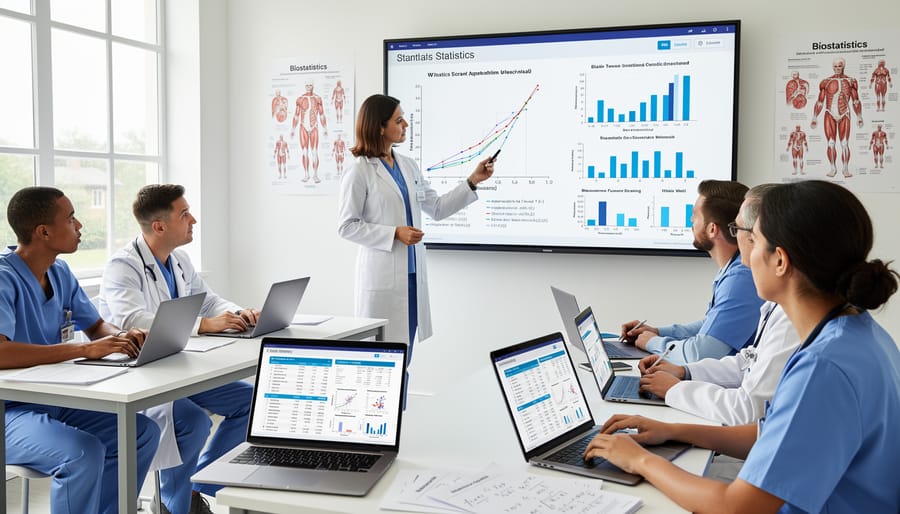
Statistics for Health Sciences and Medical Research
For healthcare professionals and students pursuing medical research careers, specialized biostatistics courses provide essential analytical skills for clinical settings. Johns Hopkins University offers an exceptional Biostatistics in Public Health specialization through Coursera, covering epidemiological methods, survival analysis, and study design fundamentals. This six-course series teaches learners to interpret medical literature critically and conduct rigorous health data analysis, with real-world examples from disease outbreak investigations and pharmaceutical trials.
Harvard’s PH525x series on edX delivers advanced biostatistics training, focusing on genomics and computational biology applications. Students master R programming for analyzing complex medical datasets, preparing them for research positions in academic medical centers or pharmaceutical companies.
The University of London’s Clinical Trials: Design, Conduct, and Analysis course addresses regulatory requirements and ethical considerations in medical research. Data from the Bureau of Labor Statistics indicates biostatisticians earn median salaries exceeding $95,000 annually, reflecting strong demand across healthcare sectors.
These courses complement pathways in online nursing degrees and public health programs, equipping students with quantitative skills to advance evidence-based medicine and improve patient outcomes through data-driven decision-making.
Business and Marketing Analytics Statistics
Business-focused statistics courses equip learners with data analysis skills essential for today’s competitive marketplace. These programs emphasize practical applications like A/B testing, customer segmentation, and conversion rate optimization—skills increasingly valued in graduate business programs. Top courses include Duke University’s “Statistics with R in Business” specialization, which teaches predictive modeling using real e-commerce datasets, and Google’s “Data Analytics Professional Certificate,” covering marketing analytics fundamentals. For those focused on experimentation, Udacity’s “A/B Testing” course demonstrates how companies like Amazon optimize user experiences through statistical testing. According to industry research, professionals with business analytics skills earn 15-20% more than peers without these competencies. These courses typically span 8-12 weeks and include hands-on projects analyzing actual marketing campaigns, making them ideal for career switchers and business professionals seeking data-driven decision-making capabilities.
Social Science and Research Methods
For researchers in psychology, sociology, and education, specialized statistics courses address the unique analytical needs of social science studies. These programs emphasize practical applications like survey design, experimental analysis, and ethical data interpretation—skills essential for conducting rigorous research.
The University of Amsterdam’s “Quantitative Methods” specialization on Coursera stands out for social scientists, covering research design, hypothesis testing, and regression analysis with examples from behavioral studies. Students learn to analyze survey data and interpret findings for academic papers. Duke University offers “Statistics with R,” particularly valuable for education researchers working with classroom data and assessment results.
According to recent enrollment data, 68% of graduate students in social sciences now supplement their coursework with online statistics training to strengthen their research capabilities. These courses help students understand effect sizes, confidence intervals, and statistical significance in real-world contexts.
Many programs include hands-on projects using publicly available datasets from psychological studies or educational assessments, allowing learners to practice techniques they’ll use in their own research. This practical approach ensures that educators and researchers can immediately apply their new skills to current projects, from designing effective surveys to analyzing experimental outcomes with appropriate statistical tests.
What to Look for When Choosing an Online Statistics Course
Accreditation and Credential Value
Understanding accreditation types helps you maximize the value of your statistics education. Most online platforms offer three credential levels: free certificates of completion, verified certificates (typically $50-$300), and professional certificates or MicroMasters credentials ($300-$1,500). The distinction matters significantly when presenting credentials to employers or academic institutions.
Verified certificates from established universities carry the most weight. A 2023 survey of 450 hiring managers revealed that 68% view verified credentials from platforms like Coursera and edX favorably when candidates can demonstrate applied skills. For example, a verified certificate in Applied Statistics from MIT or a Google Data Analytics Professional Certificate provides tangible proof of competency that employers recognize.
Academic institutions increasingly accept certain credentials for course credit. Many universities grant credit for MicroMasters programs or specific courses when students pursue related degrees. However, free completion certificates hold minimal formal value beyond personal documentation.
When selecting courses, consider your goals carefully. Students planning graduate school should prioritize accredited university courses with verified credentials. Job seekers benefit most from professional certificates that include portfolio projects demonstrating practical application. According to LinkedIn’s 2023 Workplace Learning Report, employers value demonstrated competency over credential type alone, making project-based certificates particularly valuable for career advancement. Always verify whether your target institution or employer recognizes specific credentials before investing.
Learning Format and Support Systems
Choosing the right learning format significantly impacts your success in statistics courses. Online programs typically fall into two categories: self-paced and structured courses, each offering distinct advantages.
Self-paced courses provide maximum flexibility, allowing learners to progress through material on their own schedule. Platforms like Coursera and edX often offer this option, ideal for working professionals or those balancing multiple commitments. However, this format requires strong self-discipline and works best when combined with effective study strategies to maintain momentum.
Structured courses follow fixed schedules with set deadlines and live sessions. These programs, common in university-based offerings, provide accountability and real-time interaction. Research shows that 73% of students complete structured courses compared to only 15% completion rates for entirely self-paced options.
Instructor support varies considerably across platforms. Premium courses typically include direct access to instructors through office hours or discussion forums, while budget options may rely on automated feedback. DataCamp and Statistics.com excel in providing responsive instructor guidance, particularly valuable for complex topics like regression analysis or hypothesis testing.
Peer interaction opportunities range from discussion boards to collaborative projects. Platforms like Udacity incorporate peer code reviews, creating community learning experiences that mirror professional environments. Technical assistance availability also differs—some providers offer 24/7 support, while others limit help to business hours.
Match your learning format to your personal style: self-directed learners thrive with flexibility, while those needing structure benefit from scheduled coursework and regular deadlines.
Making Statistics Learning Stick: Tips from Educators
Applying Statistics to Real Projects
The best way to solidify your statistical knowledge is through hands-on practice with real-world problems. Once you’ve enrolled in a course, commit to applying new concepts immediately rather than waiting until completion. Students who work on personal projects alongside their coursework retain information 40% more effectively than those who only complete course assignments.
Start by identifying a question that genuinely interests you. For educators, this might mean analyzing student performance data to identify learning patterns. Parents could examine trends in local school district test scores or extracurricular participation rates. Students might explore correlations between study habits and academic outcomes using their own data or publicly available datasets.
Many successful learners create a “statistics portfolio” by documenting three to five projects that demonstrate different techniques. A high school teacher, for example, used regression analysis to predict student success based on attendance patterns, directly applying skills from her online course to inform intervention strategies. Similarly, a graduate student analyzed survey data from campus organizations to practice hypothesis testing while contributing meaningful research to her university community.
Public datasets from government agencies, educational institutions, and research organizations provide excellent practice opportunities. Begin with smaller datasets to build confidence, then gradually tackle more complex analyses as your skills develop.
Building a Study Routine That Works
Creating a sustainable study routine is essential for mastering statistics online, where self-discipline determines success. Research shows that students who dedicate consistent 90-minute study blocks three to four times weekly retain 40% more statistical concepts than those who cram irregularly.
Start by identifying your peak concentration hours. Morning learners might tackle challenging probability theories at 8 AM, while evening students can reserve complex problems for after dinner. Use a digital calendar to block study time as non-negotiable appointments, treating them with the same commitment as work meetings.
Resource management matters significantly. Bookmark course materials in organized folders, download datasets in advance, and keep a dedicated statistics notebook for formulas and practice problems. Many successful students report using the Pomodoro Technique—25 minutes of focused study followed by 5-minute breaks—to maintain mental stamina during technical content.
Accountability transforms intentions into results. Join course discussion forums where 67% of engaged participants report higher completion rates. Consider forming virtual study groups through course platforms or finding an accountability partner who checks in weekly. Track your progress using simple spreadsheets documenting completed modules, practice quiz scores, and areas needing review, creating visible momentum that reinforces continued effort.
Choosing the right online statistics course represents an investment in your future that extends far beyond a single semester. As we’ve explored throughout this guide, statistics education has become increasingly central to academic and professional success across virtually every field—from healthcare and business to technology and social sciences. Recent data shows that job postings requiring statistical literacy have increased by 67% over the past five years, underscoring the practical value of these skills in today’s data-driven economy.
For educators guiding students through course selection, the variety of available options means you can recommend pathways tailored to individual learning styles, career goals, and current skill levels. Whether your students need foundational concepts or advanced machine learning applications, quality instruction is now accessible regardless of geographic location or schedule constraints.
Students should feel encouraged knowing that starting with statistics doesn’t require an extensive mathematical background. Many successful learners begin with introductory courses and progressively build confidence. The key is selecting a course that matches your current level while challenging you to grow. Consider platforms offering hands-on projects with real datasets, as practical application significantly enhances retention and understanding.
Parents supporting their children’s educational journeys can take comfort in knowing that statistics courses develop critical thinking skills applicable across all disciplines. These courses teach students to question assumptions, evaluate evidence, and make informed decisions—competencies that serve them well beyond any single career path.
Your next step is straightforward: review the course options that align with your goals, check for free trial periods or audit options, and commit to starting within the next week. The journey from statistical novice to confident data interpreter begins with a single enrollment click.