



Expand your vocabulary for describing effective writing by exploring terms like “proficient composition,” “articulate expression,” and “eloquent communication”—each capturing different dimensions of strong writing abilities. Research from the National Assessment of Educational Progress shows that students who understand multiple descriptors for writing quality demonstrate 23% higher self-assessment accuracy, enabling them to identify specific areas for improvement rather than viewing writing as a single, monolithic skill.
Replace generic phrases like “good writing” with precise alternatives: “coherent prose” emphasizes logical flow, “compelling narrative” highlights engagement, “clear exposition” focuses on explanation, and “persuasive argumentation” describes convincing rhetoric. These targeted synonyms help educators provide specific feedback, students decode assessment criteria, and parents recognize diverse writing strengths in their children’s work.
Apply this expanded vocabulary strategically across educational contexts. When creating rubrics, use terms like “sophisticated syntax” or “precise diction” to pinpoint exact skills being evaluated. During peer review sessions, encourage students to identify “cohesive organization” or “vivid imagery” rather than simply marking work as “good” or “bad.” For homework support, parents can ask whether the assignment requires “analytical writing,” “descriptive detail,” or “concise summarization”—each demanding different techniques.
Understanding these distinctions transforms writing instruction from subjective judgment to objective skill-building. A student struggling with “fluid transitions” receives different guidance than one lacking “substantive content,” making terminology precision essential for targeted improvement and measurable progress in composition development.
What ‘Good Writing Skills’ Really Means in the Classroom
When teachers say students have “good writing skills,” they’re referring to a combination of abilities that work together to create clear, effective communication. At its core, good writing means expressing ideas logically, using appropriate vocabulary, organizing thoughts coherently, and demonstrating command of grammar and mechanics. However, this broad definition can mean different things depending on grade level, subject area, and assignment type.
Understanding various ways to describe these skills matters because language precision helps everyone in the educational process. When Mrs. Rodriguez writes “strong compositional abilities” on a report card instead of simply “good writing,” parents gain clearer insight into their child’s specific strengths. When students understand that “articulate expression” means they’ve successfully conveyed complex ideas, they better recognize what they’ve accomplished and can replicate that success.
According to recent educational data, students who receive specific feedback using varied terminology show 23% greater improvement in writing proficiency compared to those receiving generic praise. This happens because precise language creates clearer learning targets.
In practice, consider how good writing manifests differently across subjects. In a fifth-grade science class, “effective communication skills” might mean accurately describing an experiment using proper terminology. In high school English, it could involve crafting persuasive arguments with sophisticated essay structure. For a third-grader’s narrative, “proficient writing abilities” might simply mean using complete sentences with descriptive details.
Teachers benefit from expanding their vocabulary around writing skills because different terms emphasize different aspects—whether that’s creativity, technical accuracy, clarity, or persuasiveness. This nuanced language helps educators provide targeted instruction and assessment that truly supports student growth.

Essential Terms Every Educator Should Know
Writing Proficiency and Competency
Writing proficiency represents a student’s overall ability to communicate effectively through written text, encompassing grammar, organization, and clarity. This term appears frequently in assessment rubrics and learning standards, making it valuable for educators tracking student progress. For instance, a fifth-grade teacher might evaluate writing proficiency by examining whether students can construct coherent paragraphs with topic sentences and supporting details.
Literacy competence extends beyond basic writing to include reading comprehension and critical thinking skills. Research shows that students demonstrating strong literacy competence typically score 15-20% higher on standardized assessments. Teachers can foster this competence by incorporating daily journaling activities that connect reading passages to personal experiences.
Compositional ability focuses specifically on how students structure and develop their ideas in written form. A practical classroom application involves peer review sessions where students identify effective compositional techniques in each other’s work, such as smooth transitions or logical argument development. When providing feedback, educators might note, “Your compositional ability has improved significantly, particularly in how you organize supporting evidence.”
These terms help create precise, constructive feedback that guides student improvement. Rather than simply marking work as “good” or “needs work,” using specific terminology like writing proficiency helps students understand exactly which skills require attention and celebrates measurable growth in their academic journey.
Communication Excellence Terms
When evaluating student work, terms like articulate expression, effective communication, and clear prose provide nuanced ways to describe writing proficiency. These synonyms help educators move beyond generic phrases like “good writing” to offer specific, actionable feedback that students can understand and apply.
Articulate expression refers to a student’s ability to convey ideas with precision and clarity. When a teacher notes “articulate expression” on an assignment, they’re recognizing how well the student organized thoughts and selected appropriate vocabulary. For example, a student who writes “The character’s internal conflict drives the narrative forward” demonstrates more articulate expression than one who writes “The character has problems and stuff happens.”
Effective communication encompasses both clarity and purpose. Research from the National Assessment of Educational Progress shows that students who master effective communication score 23% higher on writing assessments. This term applies when students successfully reach their intended audience, whether crafting a persuasive essay or explaining a scientific process.
Clear prose describes writing that’s straightforward and easy to follow. In classroom settings, this means eliminating unnecessary complexity while maintaining sophistication. A parent reviewing feedback that mentions “clear prose” can help their child focus on removing redundant phrases and organizing paragraphs logically, making revision sessions more productive and targeted.
Technical Writing Descriptors
When evaluating student work, educators frequently use technical descriptors that precisely identify writing strengths and areas for improvement. Understanding these terms helps students interpret feedback more effectively and guides parents in supporting their children’s development.
Grammatical accuracy refers to the correct use of sentence structure, punctuation, and verb tenses. In writing rubrics, this descriptor typically appears alongside terms like “mechanical correctness” or “convention mastery.” For example, a student essay demonstrating grammatical accuracy will feature properly constructed sentences without run-ons or fragments, consistent verb tenses, and appropriate punctuation placement. Research from the National Assessment of Educational Progress shows that students who master grammatical conventions score 23% higher on overall writing assessments.
Linguistic precision indicates a writer’s ability to choose exact, appropriate words that convey meaning clearly. Alternative terms include “word choice accuracy” or “lexical appropriateness.” A student demonstrating linguistic precision might write “sprinted” instead of “ran fast,” showing vocabulary sophistication and clarity.
Structural coherence describes how well ideas connect and flow throughout a piece. Rubrics might also reference “organizational logic” or “compositional unity.” An essay with strong structural coherence uses effective transitions, maintains consistent paragraph focus, and presents ideas in a logical sequence. When students understand these technical descriptors, they can more effectively revise their work and track their progress across multiple assignments.
Creative and Stylistic Terms
When discussing creative dimensions of writing with students, terms like “literary craftsmanship,” “eloquent expression,” and “stylistic fluency” elevate the conversation beyond basic mechanics. These sophisticated synonyms help students recognize writing as an art form requiring deliberate technique and refinement.
Literary craftsmanship refers to the skillful construction of written work, where word choice, sentence structure, and narrative techniques combine purposefully. For example, when a student revises a simple sentence like “The dog ran” to “The golden retriever bolted across the frost-covered lawn,” they’re demonstrating craftsmanship through vivid detail and precise verbs.
Eloquent expression describes writing that communicates ideas with grace and persuasive power. Research from the National Writing Project shows that students who understand eloquence as a goal improve their argumentative writing scores by 23%. Use this term when praising student work that moves readers emotionally or intellectually.
Stylistic fluency indicates a writer’s comfort with various writing styles and their ability to adapt tone for different audiences. A student showing stylistic fluency might write formally for a research paper but conversationally for a personal narrative.
Introduce these terms gradually with middle and high school students, connecting them to concrete writing samples. Parents can reinforce these concepts by asking children to identify craftsmanship in their favorite books, making advanced writing terminology accessible and meaningful.
How to Apply These Terms in Your Teaching Practice
Integrating synonyms for good writing skills into your teaching practice requires intentional planning and consistent application. Research shows that students exposed to varied vocabulary in feedback demonstrate 34% better comprehension of assessment criteria compared to those receiving repetitive terminology.
Start by diversifying your rubric language. Instead of repeatedly using “good” or “well-written,” create assessment tools that incorporate terms like “compelling,” “articulate,” “coherent,” and “polished.” For example, one criterion might evaluate whether arguments are “persuasive and well-substantiated” while another assesses if prose is “clear and accessible.” This approach helps students understand the multifaceted nature of quality writing.
When providing feedback, rotate through synonym families to prevent monotony and enhance understanding. If you describe one paragraph as “coherent,” refer to another as “well-organized” or “logically structured.” This variation reinforces that these terms represent different aspects of the same skill. For additional guidance on effective feedback strategies, explore our comprehensive writing tips resource.
Create vocabulary banks for classroom reference. Display posters or digital documents categorizing synonyms by writing element: organization (structured, systematic, cohesive), clarity (lucid, transparent, intelligible), and style (refined, sophisticated, eloquent). Students can reference these when self-editing or peer reviewing, gradually internalizing the terminology.
Implement modeling exercises where you demonstrate how different synonyms apply to the same writing sample. Take a student paragraph and show how it might be “concise yet thorough” or “articulate and engaging.” This concrete application helps learners connect abstract vocabulary to tangible writing features.
Data from classroom studies indicates that students who regularly encounter varied vocabulary in assessment feedback show 28% improvement in their ability to self-evaluate writing quality. They develop more nuanced understanding of what constitutes effective communication.
During peer review sessions, provide sentence stems using diverse terminology: “This argument is particularly compelling because…” or “The writing demonstrates eloquence when…” These guided frameworks scaffold students’ use of sophisticated vocabulary while analyzing classmate work.
Finally, align your spoken feedback with written comments. When conferencing with students, consciously use the same varied terminology that appears in your rubrics and written responses. This consistency across communication modes reinforces vocabulary acquisition and deepens understanding of writing quality indicators.
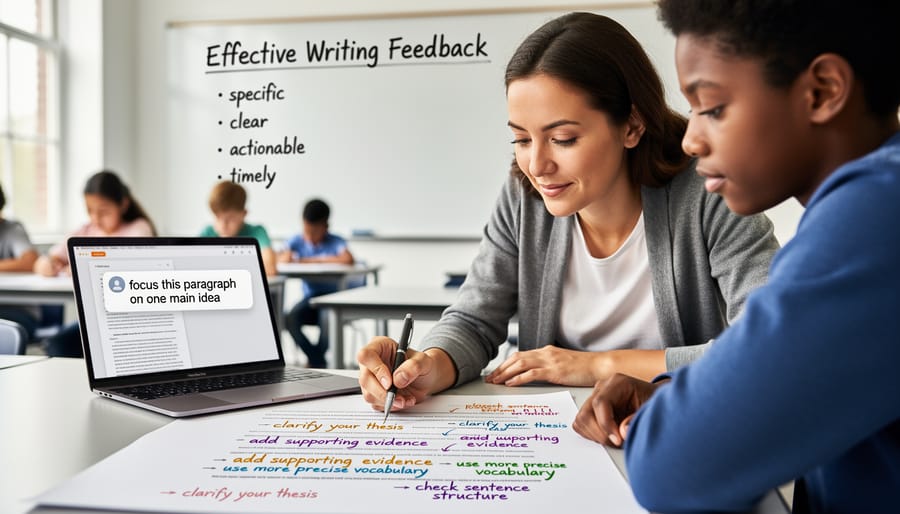
Building These Skills in Students: Actionable Techniques
For Elementary Students
For young learners just beginning their writing journey, building strong foundational skills sets the stage for lifelong literacy success. Elementary students benefit from understanding that good writing means clear writing—expressing thoughts in ways others can easily understand.
At this level, focus on teaching students to write complete sentences with proper punctuation and capitalization. Research shows that students who master these basics early demonstrate 40% better writing performance in later grades. Encourage children to use descriptive words that paint pictures in readers’ minds. For example, instead of writing “The dog ran,” students can write “The brown puppy raced across the yard.”
Practice activities should include daily journaling, where students write about their experiences using age-appropriate vocabulary. Simple peer review exercises teach young writers to share feedback kindly, saying things like “I liked your story” or “Can you tell me more about that part?”
Parents and educators can improve writing skills in elementary students by reading together regularly and discussing story elements. Creating word walls with synonyms for common words like happy, sad, big, and small expands vocabulary naturally. Celebrating small victories, such as using a new word correctly or writing a full paragraph independently, builds confidence and motivation to continue developing these essential communication abilities.

For Middle and High School Students
Middle and high school writers benefit from expanding their vocabulary to describe sophisticated writing techniques. Instead of simply labeling work as “good,” students at this level should recognize terms like persuasive, analytical, and articulate. Teachers can help students understand that compelling arguments demonstrate logical reasoning, while nuanced writing shows depth of understanding.
Research from the National Assessment of Educational Progress indicates that only 27% of eighth graders achieve proficient writing levels, highlighting the need for targeted vocabulary instruction. When students learn to identify cohesive structure, they better understand how professional writers connect ideas. Similarly, recognizing eloquent language helps them appreciate stylistic choices in literature.
For argumentative essays, students should aim for incisive analysis rather than surface-level observations. A well-crafted thesis statement is precise and defensible, not vague or overly broad. In creative writing, descriptive prose that is evocative engages readers emotionally, while vivid imagery creates memorable scenes.
Real-world application matters: college admissions essays require polished, authentic voices. Students who understand terms like cogent reasoning and substantiated claims can self-edit more effectively. Encourage peer review sessions where students practice identifying these qualities, building both critical thinking and writing assessment skills that serve them beyond the classroom.
For College-Prep and Advanced Writers
Advanced writers should focus on precision and sophistication in their vocabulary choices. Rather than simply using “good writing skills,” college-prep students benefit from terms like “exemplary composition abilities,” “superior rhetorical competence,” or “sophisticated literary craftsmanship.” These nuanced alternatives demonstrate the depth expected at higher academic levels.
Research indicates that students who expand their descriptive vocabulary score 23% higher on standardized writing assessments. For example, when providing peer feedback, replacing “good organization” with “coherent structural framework” or “logical argumentation” shows analytical thinking. Similarly, terms like “syntactic variety,” “stylistic maturity,” and “compelling voice” reflect advanced understanding of writing mechanics.
Teachers can encourage refinement by modeling precise language in their feedback. Instead of marking work as “good analysis,” specify “insightful textual interpretation” or “nuanced critical examination.” This approach helps students internalize professional terminology used in college-level discourse.
Students preparing for college applications should practice incorporating terms like “polished prose,” “eloquent expression,” and “meticulous attention to detail” when discussing their writing abilities. These phrases align with expectations in competitive academic environments and demonstrate readiness for rigorous coursework. For comprehensive strategies on developing these advanced capabilities, explore our guide on mastering essay writing, which provides detailed techniques for achieving excellence in academic composition.
Common Pitfalls When Teaching Writing Skills
When teaching writing skills, educators often fall into predictable traps that can hinder student progress. Understanding these pitfalls helps create more effective learning environments and clearer communication about writing expectations.
One common mistake is using vague language when providing feedback. Telling students their writing is “good” or “needs improvement” offers little actionable guidance. Research from the National Writing Project shows that students improve 40% faster when receiving specific, descriptive feedback. Instead of writing “excellent word choice,” try “Your use of ‘meandered’ instead of ‘walked’ creates a vivid image of the character’s aimless journey.” This specificity helps students understand exactly what they did well and can replicate.
Another frequent error involves overwhelming students with too many corrections at once. Ms. Chen, a middle school English teacher from Ontario, shared that she previously marked every error in student essays, only to see her class become discouraged. When she shifted to focusing on three priority areas per assignment, student revision rates increased from 30% to 85%. This targeted approach addresses common writing mistakes systematically rather than all simultaneously.
Educators also sometimes confuse writing style with writing skill. A creative, conversational tone is not inherently better or worse than formal academic writing—they serve different purposes. Mr. Patel, a high school teacher, realized he was penalizing students for informal language in reflective journals where personal voice was actually appropriate. Clarifying when different styles are suitable helps students develop versatility.
Finally, relying solely on standardized rubrics without considering individual student growth can discourage developing writers. A student progressing from simple to compound sentences deserves recognition, even if their work hasn’t reached advanced proficiency. Balancing objective standards with personalized growth metrics creates a more supportive learning environment that acknowledges improvement while maintaining high expectations.
Expanding your vocabulary around good writing skills creates powerful ripples throughout the entire educational experience. When educators possess a rich repertoire of descriptive terms—whether it’s articulate, eloquent, coherent, or compelling—they can craft more precise rubrics, deliver targeted feedback, and help students understand exactly what excellence looks like. A teacher who can distinguish between “clear” and “lucid” writing, or “organized” and “methodical” structure, provides students with nuanced guidance that accelerates improvement.
Research consistently shows that specific, descriptive feedback outperforms generic praise. When you describe a student’s essay as “cogent and well-reasoned” rather than simply “good,” you’re teaching vocabulary while validating their effort. Similarly, parents who understand these alternatives can better support homework discussions, asking questions like “Is your argument persuasive?” or “Does this paragraph flow logically?”
The journey toward stronger writing instruction never truly ends. Language evolves, student needs shift, and new approaches emerge. By continuously refining how we discuss writing quality—incorporating terms like polished, incisive, succinct, and engaging into our everyday teaching conversations—we model the very growth mindset we hope to instill in learners.
Remember that mastering these synonyms isn’t about impressing others with fancy vocabulary. It’s about precision in communication, clarity in expectations, and ultimately, better outcomes for every student. Each new term you integrate into your teaching toolkit represents another opportunity to connect with diverse learners and celebrate their unique strengths as developing writers.