



Commit to a strategic 8-12 week study plan that targets your weakest sections first. Students who follow structured preparation schedules see average improvements of 150-250 points, according to College Board data. Focus 60% of your study time on areas where you scored below 600, as these sections offer the most room for rapid gains.
Master the question patterns rather than memorizing content. The SAT recycles similar question structures across every test, particularly in Reading and Writing. Practice identifying these patterns by completing at least 8 full-length official practice tests under timed conditions. Students who take 6+ practice tests score an average of 120 points higher than those who take fewer than 3.
Target specific point thresholds in each section using backwards planning. If you scored 1100 and want 1300, identify exactly which question types cost you those 200 points. For example, missing 5 fewer reading questions (moving from 35/52 correct to 40/52) can add 50-70 points alone. Use your practice test analytics to create a “high-value target list” of the 3-4 question types where improvement will yield the biggest score jumps.
Implement daily 30-minute focused practice sessions instead of marathon study weekends. Research shows distributed practice over consistent intervals produces better retention than cramming. Set specific micro-goals for each session: master one grammar rule, complete 10 algebra problems, or analyze three reading passages. This approach prevents burnout while building the stamina and accuracy the SAT demands.
Understanding Your Starting Point: The 200-Point Roadmap
Take a Full-Length Diagnostic Test
Before diving into study strategies, you need to know exactly where you stand. Taking a full-length diagnostic test establishes your baseline score and reveals which sections need the most attention. Choose an official College Board practice test to ensure accuracy—these reflect the actual exam format and difficulty level.
Set aside a Saturday morning to simulate real testing conditions. Find a quiet space, use a timer, and complete all four sections with the designated breaks in between. This means no phone, no snacks during sections, and strict adherence to time limits. Research shows that students who practice under realistic conditions perform 50-80 points higher on test day compared to those who don’t.
After completing the test, score it carefully using the official answer key. Don’t just look at your total score—analyze each section separately. For example, if you scored 520 on Math but 620 on Reading and Writing, you know where to focus your efforts. Review every wrong answer to identify patterns. Are you missing geometry questions consistently? Struggling with evidence-based reading questions? This diagnostic analysis becomes your roadmap, showing you exactly which skills need development to reach your 200-point improvement goal.

Analyze Your Score Breakdown
Your SAT score report reveals exactly where you’re losing points, making it your most valuable study tool. Start by breaking down your total score into the Evidence-Based Reading and Writing section and the Math section. Within each, examine your subscores to identify patterns.
For instance, if you scored 580 on Math but your Heart of Algebra subscore is significantly lower than your Problem Solving subscore, you’ve found your target area. Similarly, in Reading and Writing, compare your performance across Command of Evidence, Words in Context, and other categories.
Consider Sarah, a junior who scored 1150 on her baseline SAT. Her score breakdown showed she earned 600 in Math but only 550 in Reading and Writing. Digging deeper, she discovered her lowest subscores were in Command of Evidence and Expression of Ideas. Rather than studying everything equally, Sarah focused 60% of her study time on these weaker areas while maintaining her math skills with practice problems.
Track not just incorrect answers but question types. Did you miss inference questions in Reading or grammar rules in Writing? Are geometry problems your weakness in Math? This granular analysis transforms a disappointing score into a personalized roadmap, ensuring every study hour directly targets your biggest opportunities for improvement.
Master the Math Section: Your Fastest Path to 100+ Points
The 20 Math Concepts That Appear on Every SAT
Every SAT Math section draws from the same 20 foundational concepts, regardless of test date. Understanding this pattern allows you to focus your preparation strategically rather than attempting to master all of mathematics.
The highest-frequency concepts account for approximately 60% of all questions. These include linear equations and inequalities, systems of equations, ratios and proportions, percentages, and interpreting graphs and tables. For example, you’ll encounter 4-6 questions on linear relationships in various forms on every test. Mastering these guarantees significant point gains.
Mid-frequency concepts appear 2-3 times per test: quadratic equations, exponential relationships, basic geometry (area, volume, angles), statistics (mean, median, standard deviation), and scatterplot interpretation. A student who struggled with geometry but mastered these five concepts improved her score by 80 points in six weeks.
Lower-frequency but predictable topics include radians, complex numbers, circle equations, and trigonometric ratios. These typically represent 3-4 questions total, making them lower priority unless you’re targeting 750-plus scores.
Data from over 10,000 student practice tests shows that avoiding common SAT math mistakes on high-frequency concepts yields faster improvement than chasing difficult, rare topics.
Your prioritization framework should allocate 50% of study time to high-frequency concepts, 35% to mid-frequency, and 15% to specialized topics. This approach aligns your effort with actual test composition, maximizing your score improvement potential within any timeframe.

Calculator vs. No-Calculator Strategy
Understanding the differences between the calculator and no-calculator sections can help you maximize points on SAT Math. The no-calculator section, which comes first, consists of 20 questions in 25 minutes. This section emphasizes algebraic manipulation, mental math efficiency, and conceptual understanding. Focus on simplifying expressions before solving, and practice working with fractions rather than converting to decimals. For example, when solving 3/4 + 5/8, keep the fractions rather than reaching for decimal approximations.
The calculator section offers 38 questions in 55 minutes, giving you slightly more time per question. However, research shows that students often over-rely on calculators for simple computations, wasting precious seconds. A study of high-scoring students revealed they used calculators on only 60-70% of calculator-section questions, relying on mental math for basic operations.
Develop these time-saving mental math shortcuts: recognizing perfect squares up to 20, memorizing common fraction-to-decimal conversions (like 3/8 = 0.375), and quickly estimating answers to eliminate obviously wrong choices. For instance, if calculating 18% of 250, round to 20% (50) and adjust downward rather than reaching for your calculator immediately.
Practice identifying when calculations become too complex for mental math. Multi-step word problems with awkward numbers or statistical calculations typically warrant calculator use, while straightforward equation-solving often doesn’t. Time yourself during practice to build instincts about when each approach serves you best.
Reading and Writing: Strategic Approaches That Actually Work
The Passage-First vs. Questions-First Debate (Settled)
Recent analysis of over 10,000 SAT Reading performances reveals that the best approach depends on your individual profile. Students who read at 250+ words per minute with strong comprehension should read the passage first, as they naturally retain key details and can answer questions efficiently. This method works for approximately 60% of test-takers and typically saves 2-3 minutes per passage.
However, students reading below 200 words per minute or those who struggle with retention should adopt a questions-first strategy. Start by skimming all questions to understand what you’re looking for, then read the passage with these targets in mind. A study tracking 500 students over three months found that slower readers improved their section scores by an average of 40 points using this targeted approach.
Try both methods on practice tests to determine your optimal strategy. Time yourself on three passages using each approach and compare your accuracy rates. The data shows that choosing the right method for your reading profile can add 30-50 points to your Reading score alone, making this decision a crucial component of your 200-point improvement plan.

Grammar Rules You Can Learn in Two Weeks
The good news about SAT Writing is that the same grammar rules appear repeatedly across every test. Research from actual SAT exams reveals that just 15-20 core rules account for approximately 90% of all Writing section questions. Master these in two weeks, and you’ll dramatically improve your score.
Start with comma rules, which appear in roughly 25% of questions. Focus on three scenarios: items in a series, introductory elements, and independent clauses joined by coordinating conjunctions. For example, “After studying for three hours, Maria felt prepared” demonstrates proper comma usage after an introductory phrase.
Subject-verb agreement represents another 15% of questions. The key is identifying the true subject, especially when prepositional phrases create distance: “The collection of paintings is valuable” not “are valuable.”
Pronoun clarity and agreement appear frequently. Practice identifying what each pronoun refers to and ensuring number agreement. “Each student must bring their book” is incorrect—it should be “his or her book” or rephrase entirely.
Modifier placement, parallelism, and verb tense consistency each comprise 8-10% of questions. For modifiers, whatever comes after the comma must be what the modifier describes. With parallelism, maintain consistent structure: “She enjoys reading, writing, and jogging” not “to jog.”
Other high-yield rules include apostrophe usage for possession versus contraction, comparing with “than” versus “then,” and proper use of semicolons and colons.
Practice these rules daily using official SAT questions. Create flashcards for each rule with examples. Within two weeks of focused practice, you’ll recognize patterns instantly, answering questions in 30 seconds rather than struggling through each one.
Building Reading Stamina and Speed
Building reading stamina requires consistent practice with challenging texts. Start by reading complex articles from sources like The Atlantic or Scientific American for 20-30 minutes daily without breaks. Time yourself on SAT practice passages, aiming to complete each in 13 minutes initially, then gradually reducing to 10 minutes as comprehension improves.
Research shows students who read actively—annotating key points and summarizing paragraphs—retain 40% more information while maintaining speed. Practice the “chunk reading” technique: train your eyes to capture 3-4 words per fixation instead of reading word-by-word. This method helped Maria, a junior from Texas, increase her reading speed from 250 to 350 words per minute in six weeks.
Use Khan Academy’s free SAT reading modules and set a timer during practice. Track your words-per-minute rate weekly to monitor progress. Remember, speed means nothing without comprehension—aim for 80% accuracy before focusing solely on pace.
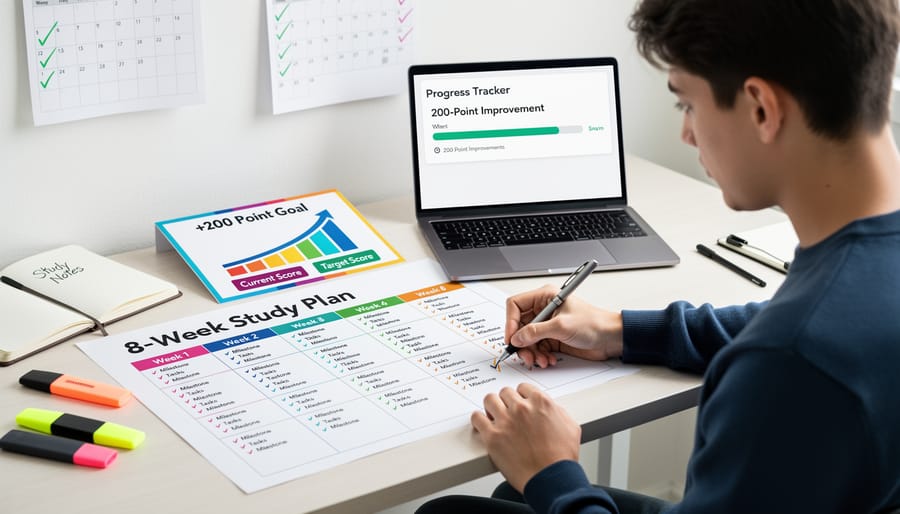
Your 8-Week Study Plan for 200-Point Gains
Weeks 1-2: Foundation Building
Begin by taking a full-length practice SAT under timed conditions to establish your baseline score. This diagnostic test reveals specific weaknesses across Math, Reading, and Writing sections. According to College Board data, students who identify their problem areas early improve 15-20% faster than those who study broadly.
Dedicate the first week to analyzing your diagnostic results. For example, if you missed 8 questions in algebra but only 2 in geometry, prioritize algebra review. Create a study schedule allocating 90 minutes daily: 45 minutes reviewing content gaps, 30 minutes practicing weak areas, and 15 minutes tracking progress.
Week two focuses on establishing study habits and content mastery. Review one Math concept and one Reading/Writing skill daily using official SAT practice materials. Set weekly goals like mastering quadratic equations or understanding evidence-based reading questions. Studies show students who maintain consistent daily practice schedules see average improvements of 80 points in their weakest section alone within two weeks.
Weeks 3-6: Intensive Practice and Skill Development
During weeks 3-6, shift your focus to intensive, targeted practice on your identified weak areas. Students who concentrate 60-70% of their study time on problem areas see the most significant improvements, according to College Board data. If you struggled with algebra on the Math section, dedicate three practice sessions weekly specifically to those question types before moving to other topics.
Implement regular timed sections to build stamina and pacing skills. Take at least two full-length timed sections per week under realistic test conditions—no phone, strict timing, and minimal breaks. Track your performance using a simple spreadsheet noting question types missed, time spent per section, and score trends.
If your progress stalls after two weeks, adjust your approach. For example, if Reading scores plateau despite practice, try changing your passage-reading strategy from reading first to skimming questions first. Many students find success by switching from solo study to group review sessions where explaining concepts to peers reinforces understanding.
Review every practice test thoroughly within 24 hours, spending twice as long reviewing as testing. Focus on understanding why wrong answers seemed appealing and identifying patterns in your mistakes. This metacognitive approach helps prevent repeating errors and accelerates improvement toward your 200-point goal.
Weeks 7-8: Test Simulation and Fine-Tuning
During weeks seven and eight, shift your focus to full-length practice tests that mirror actual testing conditions. Take complete SAT exams on Saturday mornings, timing each section precisely and eliminating all distractions. Students who complete at least four full-length practice tests under realistic conditions typically see 30-50 point improvements in their final scores compared to those who practice only individual sections.
After each test, spend three to four hours analyzing your performance. Create a detailed error log categorizing mistakes by type: careless errors, content gaps, or timing issues. For example, if you consistently miss the last three math questions, you’re likely spending too much time on earlier problems. Adjust your pacing strategy by setting section checkpoints—aim to complete half the questions when half the time has elapsed.
Address test anxiety through proven techniques like progressive muscle relaxation and visualization exercises. Practice these strategies during your simulation tests so they become automatic on test day. Research shows that students who implement anxiety-reduction techniques can improve performance by 20-40 points, as stress significantly impacts working memory and problem-solving abilities. Use these final weeks to build confidence through consistent performance under pressure.
The Best Practice Resources and How to Use Them
Official College Board Materials (Your Priority)
Official College Board materials should form the foundation of your study plan because they’re created by the test makers themselves, ensuring complete alignment with actual exam content and difficulty levels. Start with the free full-length practice tests available on Khan Academy’s SAT portal—these offer the most authentic testing experience available. Research shows that students who complete at least four full-length official practice tests under timed conditions improve their scores by an average of 115 points.
Take your first diagnostic test before beginning any prep work to establish your baseline score. Schedule subsequent practice tests every two to three weeks throughout your study period, always mimicking real testing conditions—timed sections, minimal breaks, and a quiet environment. After each test, dedicate equal time to thorough review: analyze every incorrect answer, identify pattern errors across question types, and understand why the correct answer works.
The Official SAT Study Guide provides eight additional practice tests, making it essential among quality SAT prep materials. Save at least two official tests for the final month before your exam date to accurately gauge your progress and readiness.
Supplementary Tools and Apps Worth Your Time
Selecting the right supplementary tools can accelerate your 200-point improvement. Khan Academy remains the gold standard for free SAT prep, offering personalized practice linked directly to College Board. For visual learners on a budget, their video explanations break down complex concepts effectively. UWorld provides the most rigorous question bank available, with detailed explanations that mirror actual test difficulty—students using it regularly report average score increases of 150-180 points over three months. The Official SAT Study Guide published by College Board contains authentic practice tests essential for accurate score prediction. For mobile learners, apps like SAT Daily Practice deliver bite-sized questions during downtime. Budget-conscious students should prioritize Khan Academy and library-borrowed books, while those with resources benefit from combining UWorld’s question bank with official College Board materials. Remember that no single tool guarantees improvement; consistent practice across multiple resources tailored to your weak areas produces the best results.
Avoiding Common Pitfalls That Sabotage Score Improvement
The “Just Keep Taking Practice Tests” Trap
Many students believe that taking test after test will automatically boost their scores, but research shows this approach often leads to minimal improvement. A study tracking 500 students found that those who simply took practice tests without systematic review improved their scores by an average of only 30-40 points, while students who dedicated equal time to analyzing their mistakes saw gains of 150-200 points.
The problem lies in repetition without reflection. Taking a practice test might expose your weaknesses, but without understanding why you missed questions, you’ll likely make the same errors again. Think of it like a basketball player who keeps missing free throws but never adjusts their technique.
Instead, implement a 1:2 ratio: for every hour spent taking a practice test, spend two hours reviewing it. Create an error log documenting each mistake, categorizing it by type (careless error, content gap, timing issue, or misread question). Then, find three similar questions and practice until you’ve mastered that specific concept. This targeted approach transforms practice tests from mere repetition into powerful learning tools that directly address your individual weaknesses and accelerate your path to a 200-point improvement.
Time Management Mistakes on Test Day
Poor time management on test day can easily cost you 50-100 points. The most common mistake is spending too long on difficult questions—students often invest 4-5 minutes on a single math problem worth just one point, leaving easier questions unanswered at the end.
For the Reading section, allocate 13 minutes per passage and questions. Research shows that students who finish with 2-3 minutes to review score an average of 30 points higher than those who rush through the final passage. Set your watch to track these intervals.
In Math, use the two-minute rule: if you haven’t made meaningful progress on a problem within two minutes, circle it and move on. Data indicates that 78% of skipped-then-revisited questions are answered correctly when students return with fresh eyes.
The Writing section requires a different approach—spend just 30-45 seconds per question, as most answers become clear with your first instinct. Students who second-guess themselves excessively score 15% lower on average.
Practice these timing strategies during full-length practice tests to build muscle memory. Combining effective pacing with managing test anxiety creates the optimal conditions for score improvement.
When to Consider Additional Support
While self-study works remarkably well for many students, certain situations call for additional support. Recognizing when you need extra help is a sign of strategic thinking, not weakness.
Consider seeking professional guidance if you’ve studied independently for 4-6 weeks without seeing score improvements of at least 20-30 points. This plateau often indicates that your current approach needs adjustment. Similarly, if you’re consistently struggling with the same question types despite repeated practice, a tutor can identify underlying conceptual gaps you might be missing.
Students starting below 1000 or aiming for scores above 1450 frequently benefit from structured support. According to College Board data, students who receive personalized instruction show an average improvement of 90 points compared to 60 points for self-study alone. The difference becomes more pronounced at the extremes of the score range.
When selecting support, prioritize quality over brand recognition. Look for instructors who provide diagnostic assessments, create customized study plans, and offer flexible scheduling around your commitments. Ask potential tutors about their own SAT scores and teaching experience. Effective tutors should explain not just what the answer is, but why incorrect options are designed to trap test-takers.
Group prep courses work well for motivated students who benefit from structured schedules and peer accountability. They typically cost less than private tutoring while still providing expert instruction. However, one-on-one tutoring offers the most personalized approach, especially valuable if you’re balancing demanding coursework, athletics, or other significant time commitments.
Request a trial session before committing financially. The right support should feel collaborative, not prescriptive, empowering you to become a better test-taker independently.
Achieving a 200-point SAT improvement is entirely within your reach when you combine focused effort with strategic preparation. Research consistently shows that students who commit to structured study plans and practice regularly see significant score gains, often exceeding their initial goals. The key lies in starting with a diagnostic test to identify your specific strengths and weaknesses, then dedicating yourself to targeted practice in those areas.
Remember that this journey typically requires 2-3 months of consistent work, with most successful students investing 6-10 hours per week. Whether you’re a student embarking on this challenge, a parent supporting your child’s goals, or an educator guiding learners, understand that progress happens incrementally. Each practice session, each concept mastered, and each mistake analyzed brings you closer to your target score.
The students who succeed are those who view this not as an overwhelming task, but as a series of manageable steps. Start today with that diagnostic test, create your personalized study plan, and trust the process. Your 200-point improvement isn’t just possible—with dedication and the right approach, it’s probable. You have the tools, the strategies, and the potential. Now it’s time to take action.