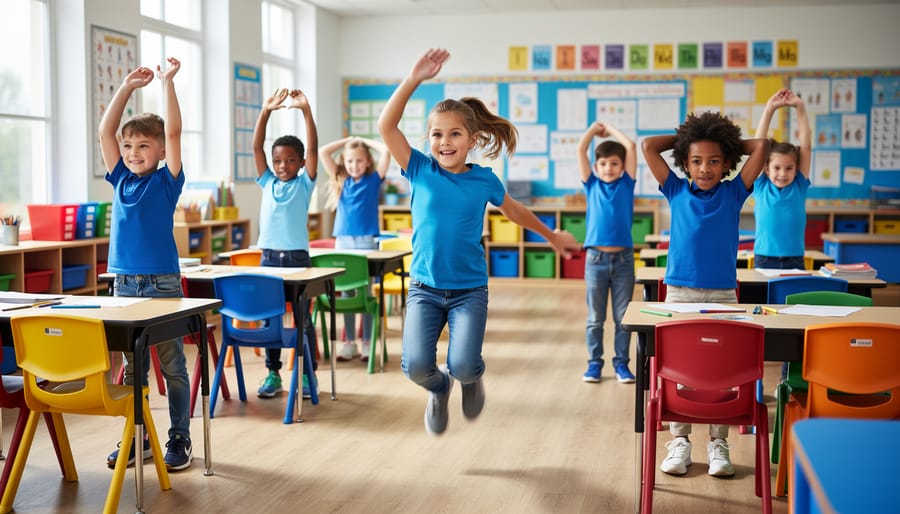



Elementary classrooms buzz with energy, but too often that energy sits trapped while students fidget in chairs for hours. Movement activities transform restless wiggles into focused learning, delivering a 20-30% improvement in attention span and measurable gains in academic performance. Schools that integrate short bursts of physical activity throughout the day report fewer behavioral disruptions, better information retention, and students who actually want to participate in lessons.
The science backs what teachers observe. Physical movement increases blood flow to the brain, releases focus-enhancing neurotransmitters, and helps children process and store new information more effectively. For elementary students still developing executive function and self-regulation skills, movement breaks aren’t just nice additions to the schedule. They’re essential tools for creating an environment where learning actually sticks.
You don’t need specialized equipment, extra space, or a complete schedule overhaul. The 15 activities ahead work in standard classrooms, take between two and ten minutes each, and address different learning objectives from math practice to vocabulary review. Some get hearts pumping with cardio bursts while others incorporate gentle stretching and mindful movement. Each activity includes clear implementation steps, grade-level guidance, and tips for adapting to your specific classroom needs and constraints.
Why Movement Matters in Elementary Classrooms
Elementary classrooms function best when students move regularly throughout the day, not despite learning but as a catalyst for it. When children shift from passive sitting to active participation, their brains work more efficiently, their bodies stay healthier, and their social skills develop naturally through interaction.
The cognitive case for movement is compelling. Physical activity increases blood flow and oxygen delivery to the brain, which directly supports memory formation and information processing. Recent research demonstrates significant executive function benefits when students engage in structured movement activities, particularly improvements in working memory and attention control. Students who move learn better because their brains are primed to absorb and retain information.
Beyond cognition, movement activities deliver multiple benefits that transform the classroom environment:
- Enhanced memory retention through physical encoding of concepts
- Improved classroom behavior and reduced disruptions
- Increased oxygen delivery to the brain for sharper focus
- Better peer interaction and communication skills
- Reduced sedentary time that contributes to childhood obesity
The physical health advantages matter just as much. Elementary students who incorporate regular movement breaks demonstrate better posture, coordination, and overall fitness levels. They’re building healthy habits that extend far beyond the classroom walls.
Social-emotional development accelerates when movement activities involve cooperation and shared goals. Students practice taking turns, following rules, managing emotions during games, and supporting classmates. These aren’t side benefits, they’re essential skills that movement naturally cultivates in ways that seated instruction cannot replicate.
How to Choose the Right Movement Activities
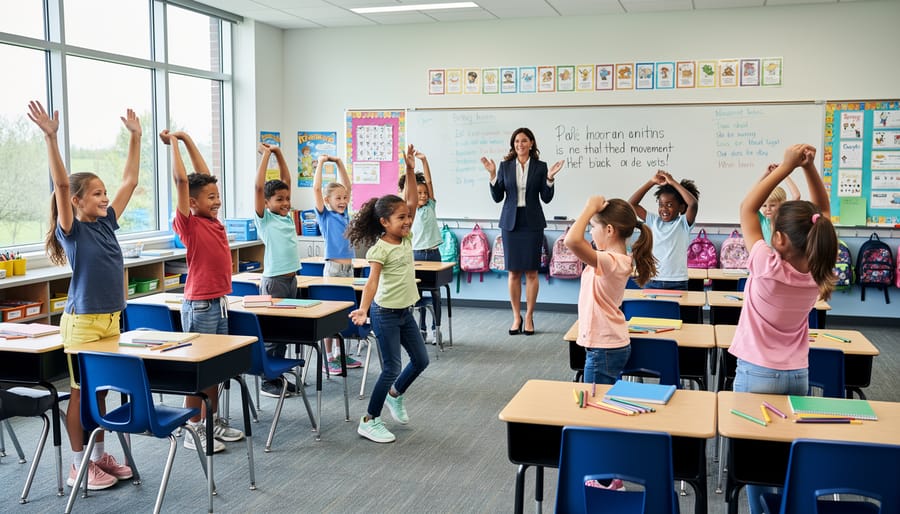
Selecting the right movement activities starts with matching them to your students’ developmental level. Kindergarteners thrive with simple, repetitive movements like animal walks or color-coded actions, while fifth graders can handle complex sequences that integrate multiple academic concepts simultaneously. The CDC’s age-appropriate activity guidance recommends varying intensity levels throughout the day, so mix high-energy bursts with controlled movements.
Space constraints shape your options more than most educators realize. A full classroom with 28 desks limits you to seated stretches, stationary exercises, or activities where students move in place. If you can push desks aside, you gain room for small-group rotations or line-based games. Access to hallways, gyms, or outdoor areas opens up relay races and scavenger hunts, but these require additional supervision and transition time.
Time is your next filter. One-minute brain breaks slip easily between math problems without disrupting flow. Five-minute activities work during natural transitions between subjects. Fifteen-to-twenty-minute movement sessions need dedicated scheduling, typically during morning meetings or after lunch when students need the most engagement support.
Match activities to your actual learning objectives rather than treating movement as just a break. If you’re teaching multiplication, choose Movement Stations where students jump the answer or create human arrays. Teaching vocabulary? Action words become physical demonstrations. This integration justifies the time to administrators and maximizes instructional minutes.
Finally, consider your materials realistically. No-equipment activities like Stretch and Spell cost nothing and launch immediately. Bean bags, cones, or printed cards require minimal investment but need storage space and setup time.
15 Effective Movement Activities for Elementary Students
Quick Energy Breaks (1-5 Minutes)
These three quick activities require no setup and can be deployed instantly when you notice energy dropping or attention wandering.
Activity 1: Jumping Jacks Math
Students perform jumping jacks while solving simple math problems called out by the teacher. For example, “What’s 7 plus 8?” Students jump and shout the answer on their landing. This works particularly well for K-2 students practicing addition and subtraction facts, or 3-5 students reviewing multiplication tables. The physical rhythm helps encode math facts into memory while burning off restless energy. One second-grade teacher reports that three rounds of 10 jumping jacks with math facts transforms her afternoon slump into renewed focus.
Activity 2: Stretch and Spell
Call out spelling words while students perform different stretches for each letter. Short words work best: reach high for tall letters (b, d, f, h, k, l, t), stretch wide for round letters (o, c, g), and bend down for letters with descenders (g, j, p, q, y). This combines vocabulary practice with flexibility work and body awareness. It’s particularly effective for kinesthetic learners who struggle with traditional spelling drills. Teachers can find additional brain break ideas that similarly blend movement with academic content.
Activity 3: Desk Push-ups
Students stand and place hands on their desk edge, then perform modified push-ups against the desk. Count to ten, rest, and repeat twice. This strengthens upper body muscles and releases physical tension from prolonged sitting. Fourth and fifth graders especially appreciate this strength-building break. It’s completely silent, making it ideal when noise levels must stay low or when the classroom next door is testing.
Learning-Integrated Movement Activities (5-15 Minutes)
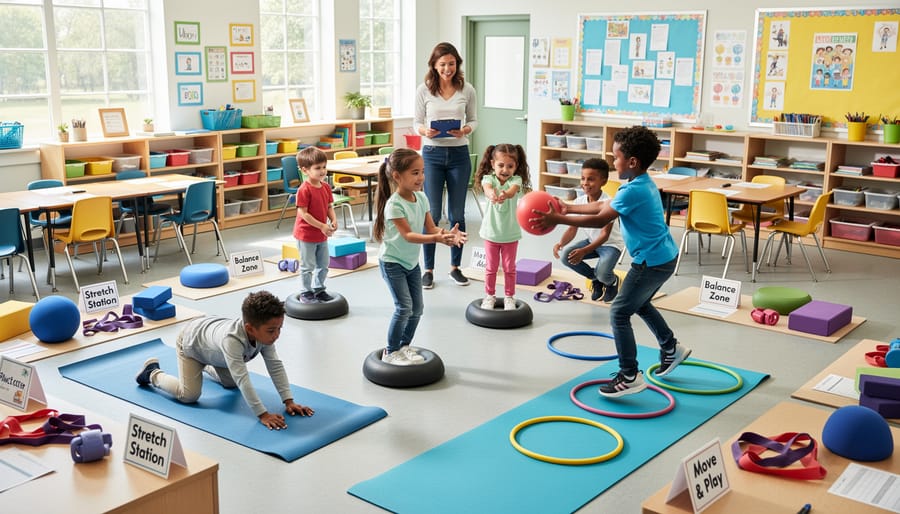
Activity 4: Movement Stations
Grade Level: K-5 (adapt content by grade)
Duration: 10-15 minutes
Setup: Create 4-6 stations around the classroom, each with a different academic task and movement component.
Set up stations where students rotate every 2-3 minutes. Station 1 might have multiplication flashcards with jumping jacks for each answer. Station 2 could feature spelling words where students do a squat for each letter. Station 3 might involve reading a paragraph while standing on one foot, testing balance and comprehension simultaneously.
The rotation keeps energy high while covering multiple subjects. A third-grade teacher in Oregon reported that her Friday station rotations improved weekly quiz scores by 12% over the semester because students encountered material in an active, memorable way.
Activity 5: Human Number Line
Grade Level: 1-4
Duration: 8-12 minutes
Setup: Use tape or chalk to create a number line across your classroom floor (0-20 for younger students, extending to 100 or beyond for older grades).
Students become the markers on a physical number line. Call out math problems and have students jump to the answer. For addition, they start at one number and hop forward. Subtraction means hopping backward. This works brilliantly for teaching number sense, inequalities, and even fractions with older students.
One second-grade class used their human number line daily for ten minutes before math lessons. Their teacher found that students who struggled with abstract number concepts grasped them faster when they could physically experience the distance between numbers.
Activity 6: Action Vocabulary
Grade Level: K-5
Duration: 5-10 minutes
Setup: No materials needed, just vocabulary words from current units.
Assign a specific movement to each vocabulary word or part of speech. Nouns get a clap, verbs require a jump, adjectives mean arms raised. As you read a passage aloud or students read independently, they perform the corresponding action when they hear or see the target words.
For content vocabulary, create movements that connect to meaning. “Evaporation” means reaching arms up like rising steam. “Multiplication” involves expanding arms wide. The physical association strengthens memory retention.
Activity 7: Science Scavenger Hunt
Grade Level: 2-5
Duration: 12-15 minutes
Setup: Create a list of observable science concepts students can find in or around the classroom.
Students move around searching for examples: something using friction, an example of a simple machine, evidence of a life cycle, or items made from different materials. They record findings on clipboards while walking, crouching, reaching, and observing.
A fourth-grade science teacher integrated these hunts before starting new units, using them as diagnostic assessments. Students arrived at formal lessons already thinking critically about concepts they’d physically discovered.
Activity 8: Geography Relay
Grade Level: 3-5
Duration: 10-15 minutes
Setup: Mark locations around the room representing continents, states, or map features.
Teams race to designated spots answering geography questions. “Run to the corner representing South America.” “Find the state capital.” Students sprint, process information, and make decisions simultaneously. Add complexity by requiring teams to discuss answers before running, building both movement and collaboration into content mastery.
Cooperative Movement Games (10-20 Minutes)
These longer-duration activities build social skills and teamwork while keeping students physically active. They work particularly well after lunch or during afternoon slumps when students need both physical release and social connection.
Activity 9: Partner Challenges
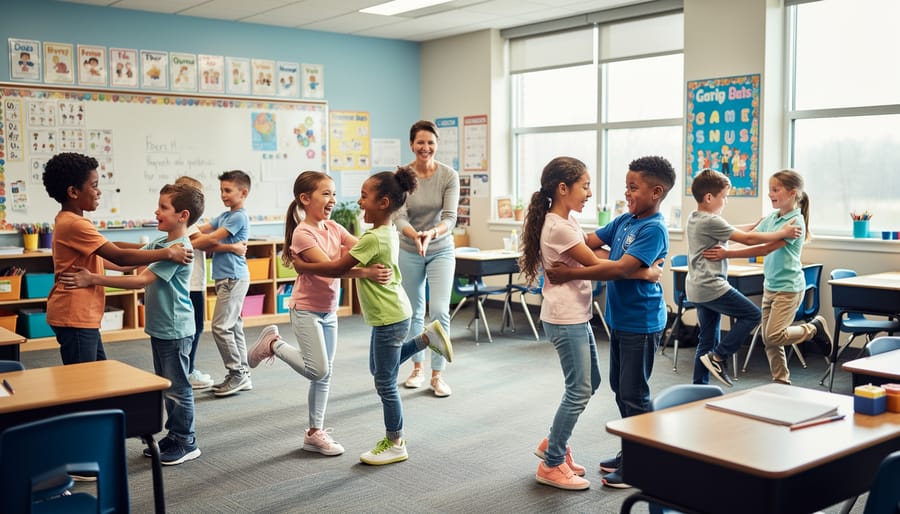
Pair students for movement-based problem-solving tasks. One effective challenge: partners stand back-to-back, link arms, and work together to sit down and stand up without unlocking arms. Another option has partners mirror each other’s movements while maintaining eye contact. For grades K-2, keep challenges simple like synchronized jumping or clapping patterns. Grades 3-5 can handle more complex sequences like creating letters with their bodies together or coordinating opposite movements (when one raises their right arm, partner raises left). This activity builds trust, communication, and spatial awareness while requiring constant negotiation and adjustment between partners.
Activity 10: Freeze Dance with Facts
Play upbeat music while students dance freely around the room. When music stops, call out a review question or problem. Students freeze in place and either answer individually or discuss with the nearest person before sharing. In math, pause for “freeze and show me an angle with your arms” or “make a shape with four sides.” For reading, students freeze and act out a vocabulary word you call. Science classes can freeze into states of matter (solid, liquid, gas poses). The movement releases energy while the content integration keeps brains engaged. Rotate through different music genres to maintain novelty and expose students to cultural diversity.
Activity 11: Circle Passing Games
Students stand in a circle and pass objects with specific rules. Pass a ball around while skip-counting by fives, or pass multiple items in different directions simultaneously to build concentration. The “hot potato” variation works for vocabulary review, whoever holds the item when music stops must define the current term or answer a question. For younger students, simple patterns work: pass right while saying consonants, pass left for vowels. Older students can handle layered complexity: passing two balls in opposite directions while alternating between math facts and spelling words.
Activity 12: Team Building Exercises
Group challenges require collective problem-solving and coordination. Have teams of four to six students create human sculptures representing concepts like the water cycle or fraction equivalents, using only their bodies. Another option: students hold a large parachute or bedsheet and work together to keep lightweight balls bouncing without letting them fall off. Line challenges work well too, arrange the group in order by birthday, height, or alphabetically without talking. These activities develop leadership skills, active listening, and compromise while meeting substantial movement needs.
Outdoor and Large-Space Activities (15-30 Minutes)
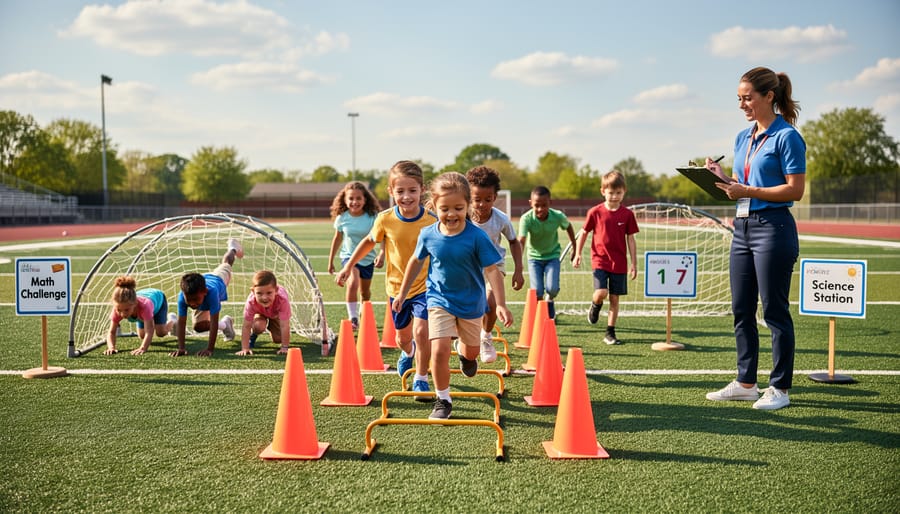
Transform standard playground equipment or gym space into a multi-subject learning circuit. Set up 5-8 stations where students must complete both a physical challenge and an academic task before moving forward. For example, climb the monkey bars while counting by 5s to 100, hop through hula hoops while naming U.S. states, or balance on a beam while solving single-digit multiplication problems. Third through fifth graders particularly benefit from this format because it combines the physical challenge they crave with meaningful content review.
Create themed courses tied to current curriculum units. A science-themed obstacle course might include stations where students identify animal habitats, demonstrate the water cycle through movements, or classify rocks while navigating balance beams. The competitive element motivates students who struggle with traditional desk work, while the movement helps cement concepts through kinesthetic learning. Rotate through different academic focuses weekly to maintain interest and address various subject areas.
Take mathematics outdoors with structured scavenger hunts that incorporate measurement, estimation, geometry, and data collection. Before the walk, provide students with clipboards, worksheets, and collection bags. Kindergarten through second grade might count natural objects, sort leaves by shape, or measure shadows with non-standard units. Upper elementary students can estimate distances between landmarks, calculate perimeter using found sticks, or collect data on tree types for graphing back in class.
This activity exemplifies how outdoor education reinforces classroom learning while building observation skills and environmental awareness. Partner students strategically, pairing strong math students with those who need support. The outdoor setting reduces math anxiety for many learners while the concrete, real-world applications make abstract concepts tangible. Plan 20-25 minutes for the walk itself, plus 5-10 minutes for follow-up discussion or data analysis.
Use playground equipment as props for collaborative challenges that require planning, communication, and creative thinking. Present scenarios like “Your team must cross the playground using only these three hula hoops without touching the ground” or “Design a relay that includes every piece of equipment and takes exactly 90 seconds.” Fourth and fifth graders excel at these complex challenges that demand both physical coordination and strategic thinking.
Assign roles within teams: planner, timekeeper, encourager, and materials manager. This structure ensures all students contribute regardless of athletic ability. After each challenge, gather teams for brief reflection: What strategies worked? How did you handle disagreements? What would you do differently? These debriefs transform physical play into lessons about teamwork, problem-solving processes, and resilience that transfer directly to classroom group work.
Implementation Tips for Success
Successfully integrating movement activities requires intentional planning and consistent implementation. Start by scheduling short movement breaks between subjects or during natural transition points, research from the 2025 Physical Activity and Academic Achievement Initiative shows that even three 5-minute movement breaks improve sustained attention by up to 23% compared to continuous seated instruction.
Establish clear routines early. Designate specific signals for beginning and ending movement activities, whether a chime, hand signal, or countdown. Students should understand expectations before the first movement: voice levels, space boundaries, and how to freeze on command. Practice these routines during the first week until they become automatic, which prevents management issues later.
For classrooms with limited space, strategic planning prevents chaos. Move desks to create pathways, use hallways during off-peak times, or take activities outdoors when weather permits. Many activities like desk push-ups, chair yoga, and seated stretching require minimal space while still delivering physical benefits.
To build an effective movement routine:
- Start with 2-3 activities and master them before expanding your repertoire
- Build student ownership by rotating student leaders to demonstrate activities
- Use visible timers so students know how long activities last
- Create visual cue cards with activity instructions for quick reference
- Rotate activities weekly to maintain engagement and novelty
Track the impact systematically. Keep a simple log noting when you use movement activities and observe student engagement levels in the lesson immediately following. Many teachers report that on-task behavior improves 30-40% after movement breaks, particularly in afternoon sessions when fatigue typically peaks. Share these observations with administrators to demonstrate how movement supports rather than interrupts learning objectives.
Common Questions About Movement Activities
How often should I incorporate movement activities?
Start with 2-3 brief movement breaks daily and gradually increase based on student response. Many successful classrooms integrate one 1-2 minute break between lessons plus one longer 10-15 minute activity mid-morning or afternoon.
What if students get too excited and struggle to refocus?
Establish clear start and stop signals, set behavioral expectations before beginning, and choose calm-down transitions like deep breathing or gentle stretching to bridge back to seated work. Consistent routines and effective classroom management reduce over-excitement over time.
How do I justify movement time when there’s so much curriculum to cover?
Frame movement as a teaching tool, not time away from learning. Research shows students retain more information and complete work faster after movement breaks, making the investment worthwhile for overall productivity.
What if I have very limited classroom space?
Focus on seated or standing-in-place activities like desk push-ups, seated twists, or arm movements. Even small movements in confined spaces provide cognitive benefits.
How can I tell if movement activities are actually helping?
Track simple metrics like time-on-task observations, completion rates before and after implementing breaks, or student focus ratings. Many teachers notice improved attention spans and reduced behavioral disruptions within the first two weeks.
These questions reflect the real concerns educators face when introducing movement into their classrooms. The key is starting small, building consistency, and adjusting based on what works for your specific students and space constraints. Once you experience the benefits firsthand, calmer transitions, better focus, more engaged learners, movement activities become a natural part of your teaching rhythm rather than an added burden.
Movement activities aren’t an add-on to your elementary curriculum, they’re a catalyst for better learning. The 15 activities outlined here represent practical, research-backed approaches that transform classrooms into dynamic learning environments where students stay focused, retain information more effectively, and develop healthier habits.
Start small. Choose two or three activities that fit your schedule and space constraints, then observe how your students respond. You’ll likely notice improved attention spans, fewer behavior disruptions, and more enthusiastic participation in lessons. As these movements become routine, gradually introduce new activities that align with your curriculum goals.
Remember that every minute spent on movement pays dividends in student engagement and academic performance. You’re not sacrificing instructional time when students jump through a math problem or spell words while stretching. You’re creating neural pathways that make learning stick. The most successful elementary classrooms recognize that kids who move are kids who learn.