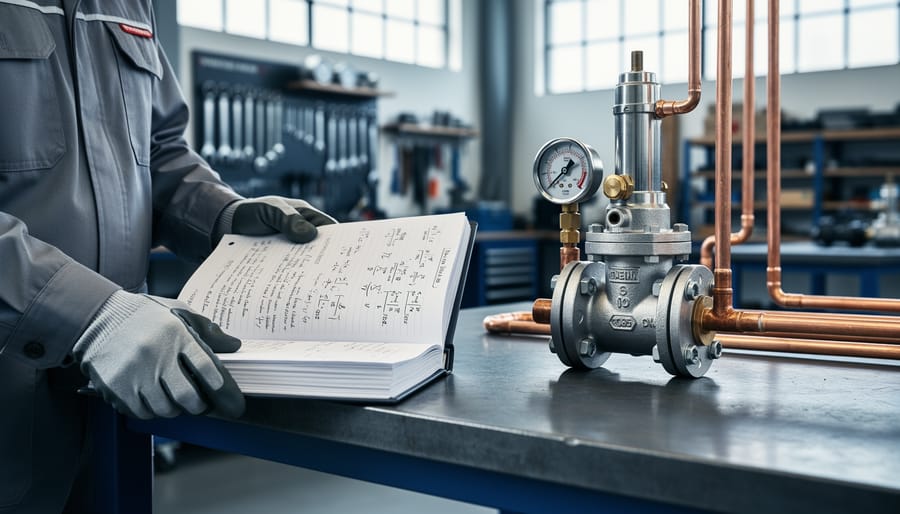



Preparing for the 4th class power engineer exam requires mastering approximately 1,200 pages of technical material across boiler systems, steam engineering, refrigeration, and workplace safety, a process most candidates complete in three to six months of focused study. Success hinges on three core strategies: organizing study materials around the exam blueprint, building knowledge through active recall rather than passive reading, and consistently testing yourself under realistic conditions.
The exam’s 40-50% failure rate stems largely from candidates underestimating its technical depth. Provincial regulations require power engineers to demonstrate competency in heat transfer calculations, combustion analysis, water treatment chemistry, and emergency response protocols. These aren’t subjects you can cram the week before test day.
Effective preparation follows a structured path. Begin by collecting current study guides, relevant codes (particularly ASME Section I and your province’s boiler regulations), and verified practice materials. Safety fundamentals represent roughly 30% of exam content, making them non-negotiable. From there, break technical topics into weekly targets, dedicating specific hours to calculations, system diagrams, and equipment troubleshooting scenarios.
The verification phase separates passing candidates from those who need to retake the exam. Taking a 4th class power engineer practice exam under timed conditions reveals knowledge gaps while you still have runway to address them. Studies show candidates who complete at least three full-length practice exams score 18-22% higher than those who skip this step.
This guide walks you through each preparation phase with concrete examples, recommended study schedules for different timelines, and troubleshooting strategies for common weak areas.
Understanding the 4th Class Power Engineer Exam Requirements
The 4th class power engineer certification exam tests your technical knowledge across multiple disciplines essential for safe plant operation. Most provincial regulatory bodies structure the exam as a closed-book, multiple-choice test lasting three to four hours, typically containing 100 to 150 questions. You’ll encounter questions covering thermodynamics, boiler operation and maintenance, refrigeration systems, electricity and instrumentation, water treatment, and safety regulations.
The exam divides roughly into five major subject areas. Thermodynamics and heat transfer questions assess your understanding of pressure-temperature relationships, heat transfer mechanisms, and energy calculations. Boiler operation questions test knowledge of firing systems, water level controls, blowdown procedures, and equipment startup and shutdown sequences. Refrigeration components cover compression cycles, refrigerants, and system troubleshooting. Electricity sections examine basic circuits, motors, and control systems. Regulatory content focuses on jurisdictional codes, safety standards, and inspection requirements.
Jurisdictional variations matter significantly because power engineering certification falls under provincial or territorial authority in Canada. British Columbia’s Technical Safety BC, Alberta’s ABSA, Saskatchewan’s TSASK, and Ontario’s TSSA each maintain slightly different exam formats and content emphasis. Some jurisdictions weight safety and regulatory knowledge more heavily, while others increase the proportion of technical calculations. Check your local regulatory body’s website for jurisdiction-specific certification details including current exam blueprints and candidate handbooks.
Exam format typically prohibits calculators with programming or text storage capabilities, limiting you to basic scientific calculators. You’ll receive a formula sheet, but it won’t contain every equation you need, memorizing core formulas remains essential. Questions progress from straightforward recall to multi-step problem solving, testing both theoretical understanding and practical application. Some jurisdictions offer computer-based testing with immediate preliminary results, while others still use paper exams with results mailed within two to four weeks.
Essential Study Materials and Resources

Official Study Guides and Textbooks
The foundation of your exam preparation starts with obtaining the correct official study guide for your jurisdiction. In Canada, each province’s power engineering board publishes specific exam preparation manuals. For example, candidates in Alberta use the ABSA Power Engineering Study Guide, while Ontario students rely on TSSA’s syllabus materials. These jurisdictional guides define exactly what appears on your exam and typically cost between $100 and $250.
Beyond official materials, several industry-standard textbooks prove essential. “Thermodynamics: An Engineering Approach” by Çengel and Boles covers the calculation-heavy thermodynamics section thoroughly. For boiler operations, “Steam Plant Operation” by Everett Woodruff remains the definitive reference used across North America. “Refrigeration and Air Conditioning Technology” by Whitman addresses the refrigeration component comprehensively.
Purchase current editions directly from your provincial regulatory body’s website or authorized distributors. Used textbooks work for core concepts, but regulations change frequently, so verify that any secondhand official guide matches the current exam syllabus. Many community colleges offering power engineering programs also stock these materials through their bookstores at competitive prices.
Digital Tools and Practice Platforms
Online practice exam platforms have become essential for power engineering certification prep. SOPEEC (Safety Organization for the Petroleum and Energy Educators of Canada) offers province-specific practice tests that mirror actual exam formats, complete with timed simulations and detailed answer explanations. Many jurisdictions also provide official sample questions through their regulatory websites, these are gold because they show exactly how questions are worded and what level of detail examiners expect.
Mobile apps like “Power Engineering Exam Prep” and “4th Class Study Helper” let you squeeze in study sessions during commutes or breaks. They’re particularly useful for drilling flashcards on steam tables, formula memorization, and quick concept reviews when you can’t carry textbooks.
YouTube channels run by licensed power engineers offer free walkthroughs of complex calculations and equipment operation sequences. Look for instructors who explain the reasoning behind solutions rather than just showing steps, understanding why matters more than memorizing procedures.
Interactive simulation software for boiler operations exists through some technical colleges’ online portals. These virtual boiler rooms let you practice startup sequences, troubleshoot malfunctions, and visualize how pressure and temperature changes affect system components. While not universally available, they’re worth investigating if your local institution offers access.
Safety Knowledge Fundamentals
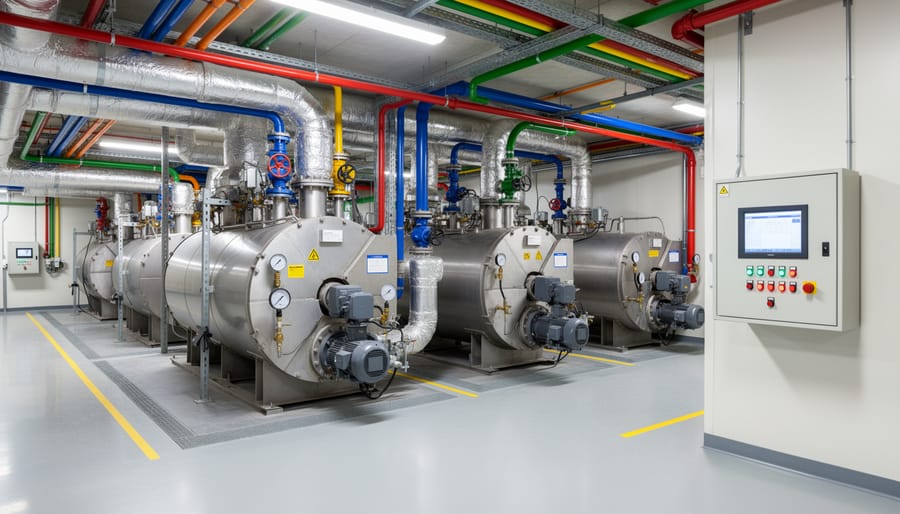
Safety isn’t just a token chapter in the 4th class power engineer exam, it’s a fundamental pillar that can make or break your certification attempt. Exam boards weight regulated safety knowledge areas heavily because power engineers work with equipment where mistakes can cause catastrophic failures, injuries, or fatalities. Understanding boiler safety protocols means knowing ignition sequences, low-water cutoff functions, and why bypassing interlocks represents a serious violation. You need to grasp how flame failure devices work, what conditions trigger safety shutdowns, and the proper response when alarms sound.
Pressure vessel regulations are grounded in ASME standards for pressure vessels which establish design codes, inspection intervals, and operating limits. Study pressure relief valve sizing calculations, hydrostatic testing requirements, and the reasons behind maximum allowable working pressure designations. Your exam will likely include scenarios requiring you to determine whether a vessel meets code, identify improper installations, or calculate required relief capacity.
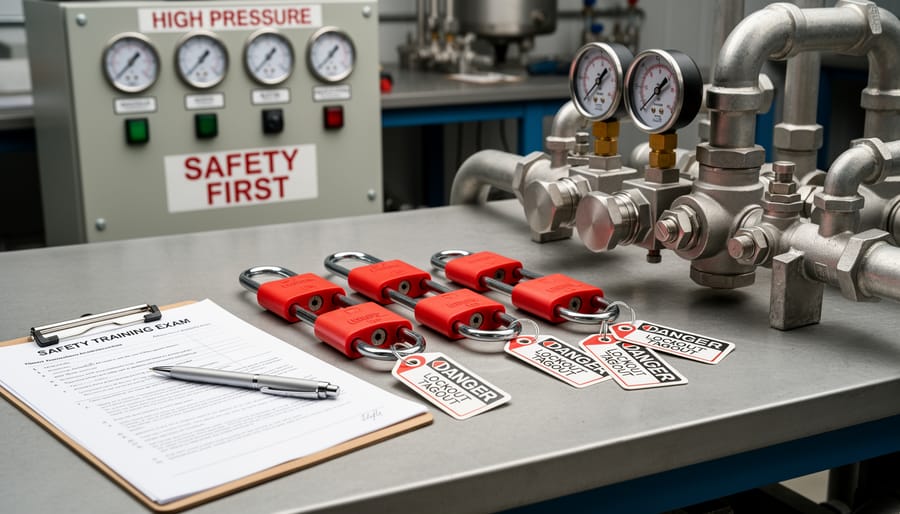
Lockout/tagout procedures prevent accidental equipment energization during maintenance. Know the six-step isolation process: preparation, shutdown, isolation, lockout application, stored energy release, and verification. You’ll encounter questions about who can remove locks, what energy sources require isolation beyond electrical power, and why verification testing is mandatory before work begins.
Emergency protocols cover response procedures for common hazards: low-water conditions, tube ruptures, loss of flame, overpressure situations, and hazardous material releases. The exam tests your ability to prioritize actions, whether to shut down immediately or follow a controlled sequence, when to evacuate versus mitigate, and how to communicate incidents properly. These safety training topics translate directly into real-world scenarios you’ll face on the job, which is precisely why certification boards emphasize them so strongly in the examination process.
Creating Your Personalized Study Plan
Time Allocation by Subject Area
Allocate approximately 30% of your study time to thermodynamics and heat transfer calculations, as these concepts form the foundation of power engineering and typically comprise the largest portion of exam questions. Boiler operation and equipment should receive about 25% of your effort, given the practical emphasis and detailed knowledge required about systems, components, and operational sequences.
Dedicate 20% to electrical principles and motor controls, which many candidates find challenging without prior electrical background. Refrigeration and air conditioning warrant 15% of your study hours, while less heavily weighted on most exams, these topics require understanding distinct thermodynamic cycles and regulatory requirements.
Reserve the remaining 10% for safety regulations, codes, and jurisdictional requirements. Though this represents less study time, don’t underestimate its importance; safety knowledge often appears throughout the exam in various contexts.
If you struggle with mathematics, increase thermodynamics time by 5-10% while reducing refrigeration allocation slightly. Conversely, candidates with weak electrical backgrounds should boost that category. Track your practice test performance weekly and adjust these percentages as you identify persistent knowledge gaps. The key is to build a routine that addresses your specific weaknesses while maintaining coverage across all exam domains.
Step-by-Step Exam Preparation Process
Phase 1: Master Core Calculations and Formulas
Start with the formulas that appear most frequently: specific enthalpy calculations, heat transfer rates, and ideal gas law applications. Write out each equation by hand daily for the first week, this motor memory helps during high-pressure exam moments when you need to recall them quickly.
Create a formula sheet with units clearly marked. Power engineering calculations fail most often because of unit conversion errors, not conceptual misunderstandings. Practice converting between kPa and psi, Celsius and Kelvin, kW and BTU/hr until it becomes automatic.
Work through at least five variations of each core problem type. For example, calculate boiler efficiency using different given variables: sometimes you’ll have fuel input and steam output, other times you’ll need to derive heat losses first. This builds the pattern recognition that lets you adapt when exam questions twist familiar concepts.
Connect every formula to equipment you’ve seen. When calculating pressure drop across a pipe, visualize the actual piping in a boiler room. If you’re working heat exchanger problems, picture the unit and which fluids flow where. This concrete anchoring makes abstract equations stick and helps you catch unrealistic answers that indicate calculation errors.
Phase 2: Study Boiler and Equipment Operations
Start by mastering the major boiler classifications, fire-tube, water-tube, and cast iron, because exam questions frequently test your ability to identify components and explain operational differences. Sketch each type from memory, labeling feedwater inlets, steam outlets, safety valves, and burner assemblies until you can reproduce them without reference materials.
Move through a complete startup sequence for one boiler type, documenting each step: pre-start inspections, purge cycles, ignition procedures, pressure buildup, and steady-state operation. Then work backwards through the shutdown process. This dual approach cements cause-and-effect relationships that appear in troubleshooting scenarios.
For maintenance content, focus on daily operator tasks versus scheduled outage work. Know blowdown procedures, water treatment parameters, and the warning signs of common failures like low water conditions or flame failure. Case studies prove invaluable here, review real incidents where improper maintenance led to equipment damage, noting the failure sequence and corrective actions.
Practice translating P&ID diagrams into plain-language descriptions of what happens when a valve opens or a pump starts. This skill directly transfers to exam questions asking you to predict system responses.
Phase 3: Practice Exam Simulation
Practice exams replicate actual testing conditions and reveal whether you can apply knowledge under time pressure. Schedule full-length simulation sessions after you’ve covered most content areas, typically three to four weeks before your exam date.
Set a timer matching the real exam duration and work through practice questions without interruptions or reference materials. Resist the urge to check answers mid-test. This builds stamina for maintaining focus across multiple hours and teaches you to manage time across question types. Many candidates run out of time on calculation-heavy sections because they’ve never practiced pacing.
After completing each practice exam, spend twice as long reviewing your answers as you did taking the test. Create an error log categorizing mistakes by topic and type: did you misremember a formula, misread the question, make a calculation error, or lack understanding? Patterns emerge quickly. If you consistently miss refrigeration cycle questions, that’s a clear signal to revisit that material with focused study.
Aim for three to five full practice exams. Your scores should trend upward as gaps close. Confidence grows when you recognize question patterns and can work through problems methodically rather than guessing.
Effective Study Techniques for Technical Content
Mastering the technical content for your 4th class power engineer exam requires methods that work with how your brain actually retains information. Passive reading won’t cut it when you need to recall thermodynamic equations or boiler startup sequences under pressure.
Active recall is your most powerful tool. Instead of re-reading your notes, close the book and write out what you remember about a topic. Can you explain the Rankine cycle from memory? Sketch the components of a water tube boiler without looking? This retrieval practice strengthens neural pathways far more effectively than highlighting text. Quiz yourself daily on formulas, valve types, and safety protocols.
Spaced repetition takes this further by timing your review sessions strategically. Don’t cram all your refrigeration study into one weekend. Review new material after one day, then three days, then a week, then two weeks. This spacing forces your brain to work harder to retrieve information, making it stick. Use flashcard apps that automate this scheduling, or create a manual calendar marking when to revisit each major topic.
Several proven techniques optimize technical learning:
- Diagram sketching from memory, draw system schematics, pressure-enthalpy graphs, and equipment layouts without references to identify gaps in understanding
- Teaching concepts aloud, explain boiler operation sequences or thermodynamic principles to a study partner or even to yourself, which reveals weak spots in your grasp
- Worked problem repetition, solve the same calculation multiple times across different days until the process becomes automatic
- Concept mapping, create visual connections between related topics like how combustion efficiency affects boiler performance and fuel consumption
- Real-world application, relate abstract concepts to actual equipment you’ve seen or operated to build contextual memory anchors
Study groups provide accountability and expose you to different perspectives on complex material. When another student explains how they approach steam table interpolation, you might discover a more intuitive method. Teaching a concept to a peer also reinforces your own understanding. Aim for groups of three to five people who are equally committed, and rotate who presents each topic to keep everyone engaged and prepared.
Verifying Your Exam Readiness
Passing practice exams doesn’t guarantee certification, you need to understand why correct answers work and why wrong ones don’t. Start by tracking your scores across multiple full-length practice tests, noting patterns in the topics where you consistently struggle. A single high score might reflect lucky guessing or memorized answers rather than genuine understanding.
Beyond the numbers, test yourself with open-ended questions: Can you explain thermodynamic cycles without looking at notes? Can you sketch a boiler schematic from memory and label every component’s function? True readiness means you can teach the material to someone else, not just recognize the right answer in a multiple-choice format. Try explaining key concepts aloud or writing out calculation processes step-by-step without references.
Create a self-assessment checklist covering each exam domain, thermodynamics, boiler operations, refrigeration, electrical systems, and safety regulations. Rate your confidence level for each subtopic honestly. If you’re still consulting formula sheets for basic calculations or second-guessing fundamental safety procedures, you need more preparation time. Consider whether you can solve problems in different formats than you’ve practiced, since exam questions often present familiar concepts in unfamiliar ways.
Pay attention to how you improve study habits as your exam date approaches. If you’re re-reading the same sections repeatedly without retention gains, that’s a warning sign. The goal is to study smarter by identifying specific weak points and targeting them with varied practice methods, not just logging more hours with diminishing returns.

Exam Day Strategies and What to Expect
Arrive at the test center at least 30 minutes early to allow time for check-in procedures and to settle your nerves. Bring two forms of government-issued identification, your exam registration confirmation, and several sharpened pencils with erasers. Most jurisdictions prohibit calculators with text storage or programming capabilities, so verify your calculator meets the approved specifications listed in your exam notice. Leave study materials, cell phones, and smart watches in your vehicle, testing centers have strict rules against these items.
The exam typically lasts three to four hours depending on your jurisdiction. Budget your time carefully by dividing the available minutes by the number of questions to establish a per-question pace. If you encounter a challenging calculation problem, mark it and move forward rather than burning 15 minutes on a single question. Return to flagged questions during your final review period.
Read each question twice before selecting an answer. Power engineering exams often include subtle details in the wording that change the correct response. For calculation questions, write out your work even if it’s not required, this helps catch errors and allows partial credit in some jurisdictions.
Test anxiety is normal, but manage it by taking slow, deep breaths if you feel overwhelmed. Remember that you’ve prepared systematically and the exam tests knowledge you’ve already studied. If your mind goes blank on a concept, skip ahead and let your subconscious work on it while you tackle other questions. Most candidates find the answer comes to them when they circle back.
Common Preparation Mistakes to Avoid
Many candidates sabotage their own preparation by falling into predictable traps that undermine retention and test performance. Understanding these common mistakes helps you steer clear of ineffective habits that waste study time.
One frequent error is treating the exam as a memory test rather than a comprehension challenge. Students who rely solely on rote memorization struggle when questions reframe concepts or ask for applied problem-solving. You need to understand why formulas work and how systems interact, not just recall equations in isolation.
Another pitfall is neglecting hands-on calculation practice. Reading worked examples feels productive, but unless you’re solving problems yourself, without peeking at solutions, you won’t develop the speed and accuracy the exam demands. Set aside time each week to work through calculations from scratch, simulating the conditions you’ll face on test day.
Here are additional preparation mistakes that derail candidates:
- Skipping regulatory and safety content because it seems dry, these sections often determine pass/fail margins
- Cramming in the final week instead of maintaining consistent study habits over months
- Ignoring weak subject areas and repeatedly reviewing comfortable topics
- Taking practice exams without thoroughly analyzing incorrect answers afterward
- Studying in isolation rather than joining study groups where peers can challenge your understanding
- Underestimating the mental stamina required and failing to build endurance through timed practice sessions
Poor time management during study sessions also creates problems, jumping randomly between topics prevents deep learning. Likewise, failing to address exam pressure through practice testing leaves you vulnerable to anxiety that clouds your thinking when it counts. Build familiarity with exam conditions early so stress doesn’t sabotage your performance.
Frequently Asked Questions
Understanding common concerns can help you set realistic expectations and plan your preparation effectively. Here are answers to questions candidates frequently ask about the 4th class power engineer exam.
How long should I study for the exam?
Most candidates benefit from 3-6 months of consistent study, dedicating 10-15 hours per week depending on your technical background and learning pace. Those with related work experience or recent technical education may prepare in less time, while candidates new to power engineering concepts typically need the full six months.
What is the typical pass rate?
Pass rates vary by jurisdiction and testing period but generally range between 60-75% for first-time candidates. Higher pass rates correlate strongly with completing a structured study program and taking multiple practice exams before attempting the actual test.
Can I use a calculator during the exam?
Yes, most jurisdictions allow non-programmable scientific calculators for the exam. Check your specific provincial or state regulations for approved calculator models, as some testing centers restrict certain features or require specific brands.
What happens if I fail the exam?
You can retake the exam after a mandatory waiting period, typically 30-90 days depending on jurisdiction. Most candidates who fail on their first attempt pass on the second try after identifying and studying their weak areas from the initial test experience.
Do I need prior experience to write the exam?
Requirements vary by region, but many jurisdictions require minimal or no direct power engineering experience to sit the 4th class exam. However, completing a recognized power engineering technology program or accumulating specific hours of related work may be prerequisites in some areas.
What career opportunities open up after certification?
Certified 4th class power engineers can work in facilities with smaller boilers and refrigeration systems including hospitals, universities, manufacturing plants, and apartment complexes. This certification serves as the entry point to the profession, with opportunities to advance to higher classes through additional experience and examinations.
Beyond these fundamentals, candidates should verify specific requirements with their local regulatory authority, as exam policies, fees, and eligibility criteria can differ significantly between jurisdictions. Building a clear understanding of what to expect removes uncertainty and allows you to focus your energy on productive study rather than worrying about unknowns.
Tools and materials
Successfully preparing for the 4th class power engineer exam requires specific study materials and resources. At minimum, you’ll need the official study guide published by your jurisdiction’s regulatory body, for example, SOPEEC’s Fourth Class textbook in Alberta or Technical Standards and Safety Authority materials in Ontario. These contain exam-aligned content and practice questions.
A scientific calculator capable of handling logarithms, exponentials, and trigonometric functions is essential for thermodynamic calculations. Verify your model is permitted in the testing center, as some jurisdictions restrict calculator features.
Supplementary textbooks covering thermodynamics, heat transfer, and boiler operations provide deeper explanations of complex topics. Many candidates find the ASME Boiler and Pressure Vessel Code helpful for regulatory questions.
Access to practice exam platforms, whether through paid subscriptions or free jurisdictional resources, lets you simulate test conditions and identify weak areas. Digital flashcard apps support memorization of formulas and definitions.
Physical materials include notebooks for working through calculations, graph paper for sketching system diagrams, and highlighters for marking key concepts in study guides. A quiet, dedicated study space with good lighting improves concentration during long review sessions.
Success in the 4th class power engineer exam comes down to three non-negotiables: starting early, studying consistently, and practicing relentlessly. Candidates who pass on their first attempt share a common pattern, they treat preparation as a sustained project, not a last-minute sprint. They work through quality study materials systematically, master calculations through repetition, and test themselves under exam conditions multiple times before sitting the real thing.
The roadmap in this guide gives you the structure. Your commitment provides the momentum. Block out regular study time now, even if the exam is months away. Those incremental hours compound into deep understanding that carries you through the toughest questions. Track your progress with practice exams, address weak areas immediately, and refuse to move forward until core concepts click.
This certification opens doors to stable, well-paying careers in industries that need skilled power engineers. The exam is demanding but entirely conquerable with the right approach. Thousands have walked this path successfully. Your turn starts with that first study session, schedule it today, stick to your plan, and trust the process. The effort you invest now pays dividends for your entire career.