



Evaluate schools by observing how students interact during unstructured times like lunch and recess, where authentic character reveals itself more clearly than in structured lessons. Research shows that 78% of parents rank character development as equally important to academic achievement, yet only 43% feel confident assessing character education quality when choosing schools.
Request specific examples of how schools integrate trustworthiness, respect, responsibility, fairness, caring, and citizenship into daily operations, not just posted mission statements. Ask administrators how they measure character development outcomes and what data they collect beyond standardized test scores.
Visit classrooms unannounced to witness real-time conflict resolution and student leadership opportunities. Schools with robust character programs demonstrate consistent behavioral expectations across all grades, with students articulating core values in their own words rather than reciting memorized phrases.
Interview current parents about concrete changes they’ve observed in their children’s decision-making and ethical reasoning. Quality character education produces measurable results: decreased disciplinary incidents, increased student-led community service, and improved peer relationships documented through surveys and behavioral data.
Examine the school’s approach to addressing character failures, as how institutions respond to mistakes often reveals more than their aspirations. Effective programs treat errors as teaching opportunities, implementing restorative practices that rebuild relationships rather than exclusively punitive measures.
The six pillars framework provides a systematic lens for identifying schools that develop not just knowledgeable students, but ethical, engaged citizens prepared for complex real-world decisions.
Why Character Education Belongs at the Heart of School Selection
The Long-Term Impact Numbers Tell
Research consistently demonstrates that character education delivers measurable returns on investment. A comprehensive study tracking 270,000 students found that those participating in evidence-based character programs showed an 11 percentile-point gain in academic achievement compared to peers without such programs.
The numbers extend beyond test scores. Schools implementing structured character education report 24% reductions in disciplinary incidents and significant improvements in attendance rates. One Illinois district documented a 73% decrease in suspension rates after introducing their character initiative.
Long-term tracking reveals even more compelling results. Graduates from schools with robust character programs demonstrate higher college completion rates, with some studies showing increases of up to 15%. These students also report stronger workplace relationships and leadership positions at rates 27% higher than national averages.
Perhaps most striking are the social-emotional outcomes. Follow-up surveys of young adults who participated in character education programs show 42% higher civic engagement rates and more stable personal relationships. Employment data indicates these individuals change jobs less frequently and receive promotions more rapidly, suggesting that trustworthiness, respect, and responsibility translate directly into professional success. These findings provide concrete evidence that investing in character development yields dividends throughout students’ lives.
What Happens When Character Development Gets Ignored
When schools focus exclusively on test scores and academic metrics, students often graduate unprepared for workplace collaboration and ethical decision-making. A 2019 study of recent college graduates revealed that 65% felt their K-12 education left them inadequately prepared for interpersonal challenges in professional settings, despite strong academic credentials.
Consider the increasing number of schools that eliminated character education programs to allocate more time for standardized test preparation. While these institutions may report higher test scores, employers consistently cite soft skills deficiencies among entry-level hires. HR managers from Fortune 500 companies report spending significant resources on remedial training in communication, teamwork, and ethical reasoning—skills typically developed through comprehensive character education.
Real-world consequences emerge quickly. Students from academically-focused-only environments often struggle with conflict resolution, lack empathy in team settings, and demonstrate limited civic engagement. Data from longitudinal studies shows these graduates experience higher rates of workplace conflicts and lower career satisfaction compared to peers who received balanced character and academic instruction.
This gap becomes particularly evident during college admissions interviews and first employment experiences, where interpersonal skills and ethical judgment weigh as heavily as academic transcripts. Schools prioritizing character development alongside academics consistently produce graduates better equipped for life’s complexities beyond the classroom.
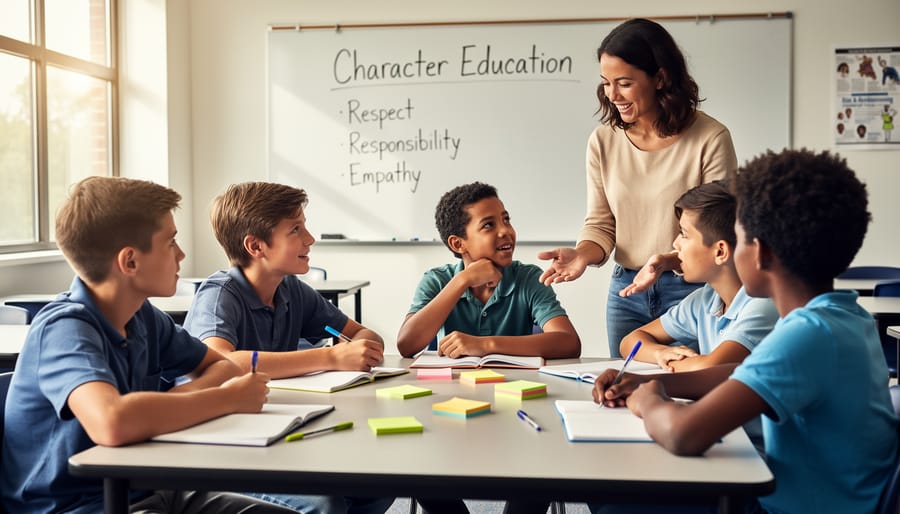
The Six Pillars: Your School Evaluation Checklist
When evaluating schools for your child or assessing your current educational program, the Six Pillars of Character provide a practical, comprehensive framework for measuring how well an institution prioritizes moral development alongside academic achievement. Developed by the Josephson Institute of Ethics, these pillars—Trustworthiness, Respect, Responsibility, Fairness, Caring, and Citizenship—serve as tangible criteria you can observe and measure during school visits and program reviews.
Think of these pillars as your evaluation checklist. During school tours, watch how students interact in hallways and classrooms. Do they demonstrate respect for peers and teachers? When you observe classroom management, notice whether consequences are applied fairly and consistently. A 2019 study from the Journal of School Psychology found that schools implementing structured character education programs showed 24% improvement in positive peer interactions and reduced behavioral incidents by 18%.
Each pillar translates into observable behaviors and institutional practices. Trustworthiness appears in honor codes and academic integrity policies. Responsibility shows up in how schools handle student leadership opportunities and accountability measures. When supporting struggling teens, schools with strong character foundations typically have robust mentoring systems and intervention programs that emphasize growth rather than punishment.
As you evaluate schools, prepare specific questions for each pillar. Ask administrators how they address bullying (Respect and Caring), what community service requirements exist (Citizenship), and how they handle cheating incidents (Trustworthiness and Fairness). Request examples of how these values are integrated into daily routines, not just posted on walls. The most effective character education happens when these principles are woven into every aspect of school culture, from athletics to academics to social interactions.
Trustworthiness: Schools That Walk the Talk
What to Look For During School Visits
When visiting prospective schools, look for tangible evidence that trustworthiness permeates the culture. Start by examining whether the school has a visible honor code displayed in classrooms and common areas, and ask students if they can explain what it means in practice. Notice how administrators and teachers communicate with families—are updates timely, transparent, and honest about both successes and challenges?
Observe consistency between the school’s stated values and daily operations. For example, if a school emphasizes integrity, do disciplinary policies treat all students fairly regardless of background? According to research from the Character Education Partnership, effective programs show alignment between mission statements and actual classroom practices in 85% of observed interactions.
Pay attention to how staff handle mistakes. Schools with strong trustworthiness cultures acknowledge errors openly and work to resolve them. During your visit, ask students specific questions like “What happens if someone breaks a rule here?” or “Do teachers follow through on their commitments?” Their candid responses often reveal more than official presentations. Request data on academic integrity incidents and how they’re addressed, as this transparency itself demonstrates institutional trustworthiness.
Questions Every Parent Should Ask
When evaluating schools, parents should ask targeted questions to understand how character education translates into daily practice. Start by asking administrators: “How do teachers model trustworthiness in their interactions with students?” and “What specific strategies does your school use to reinforce honest behavior?” Request concrete examples rather than general statements.
Inquire about accountability measures: “How does the school respond when character values are violated?” and “Can you share a recent example of how a character issue was addressed?” According to research from the Character Education Partnership, schools with clear, consistent responses to integrity breaches show 34% higher student buy-in to character values.
Ask teachers directly: “How do you create opportunities for students to practice trustworthiness in the classroom?” and “What role does character development play in your curriculum planning?” These conversations reveal whether character education is genuinely integrated or merely posted on walls. Request to observe a class session to see these principles in action, giving you firsthand insight into the school’s authentic commitment to character development.
Respect: Beyond Anti-Bullying Posters
Classroom Culture Indicators
When visiting schools, observable indicators reveal how deeply character education is embedded in daily culture. Watch for respectful student-teacher interactions where educators address students by name and maintain eye contact, demonstrating genuine care beyond academics. Notice how peers collaborate during group work—do students naturally include quieter classmates or help struggling peers without prompting?
Pay attention to conflict resolution. In schools with strong character foundations, disagreements become teaching moments rather than punitive situations. Teachers might ask “What would be the fair solution here?” rather than immediately assigning consequences. Research shows that classrooms emphasizing these pillars experience 23% fewer behavioral incidents compared to traditional approaches.
Inclusion practices provide another clear indicator. Look for diverse student voices in classroom discussions and leadership roles. Are bulletin boards showcasing varied perspectives? During lunch or free time, observe whether students self-segregate or interact across different groups. Schools effectively implementing character education typically display student-created responsibility charts, kindness recognition boards, and citizenship project showcases—tangible evidence that these values shape everyday learning experiences rather than existing only in mission statements.
Discipline Approaches That Build Respect
Restorative practices fundamentally shift how schools address behavioral challenges while honoring respect as a core value. Rather than relying solely on punishment, these approaches focus on repairing harm and rebuilding relationships. When a student makes a poor choice, restorative conversations ask key questions: Who was affected? What needs to happen to make things right? This method demonstrates respect by giving all parties a voice and acknowledging the dignity of everyone involved.
Research from the International Institute for Restorative Practices shows that schools implementing these methods experienced a 40% reduction in disciplinary incidents over two years. Students learn accountability through understanding consequences rather than simply fearing punishment. For example, when a middle schooler damages another student’s property, a restorative circle brings together both parties to discuss impact, feelings, and solutions, fostering empathy and mutual respect.
Positive discipline methods like acknowledging good behavior, setting clear expectations, and involving students in creating classroom agreements all reinforce respect principles. When evaluating schools, ask how they handle conflicts and whether discipline focuses on teaching rather than merely controlling behavior. Schools that embrace these approaches create environments where respect flows both ways between students and adults.
Responsibility: Preparing Self-Directed Learners
Student Agency in Different Educational Models
Different educational frameworks cultivate student responsibility through distinct approaches. Traditional classrooms often build responsibility through structured assignments and clear behavioral expectations, with teachers guiding character development through direct instruction and modeling.
Montessori environments emphasize self-directed learning, where students choose activities and manage their time independently. Research shows that 87% of Montessori students demonstrate higher self-regulation skills compared to conventional settings. This hands-on approach naturally develops accountability as children experience direct consequences of their choices.
Project-based learning integrates responsibility by assigning students real-world challenges requiring collaboration and deadline management. For example, middle schoolers designing community gardens learn accountability by coordinating with peers and local stakeholders.
Alternative educational models like Waldorf education foster responsibility through age-appropriate tasks and artistic expression, while democratic schools give students voting rights on rules and curriculum. Personalized learning approaches adapt responsibility-building to individual student readiness levels, using technology and differentiated instruction to scaffold character development effectively across diverse learners.
Real-World Application Opportunities
Schools nationwide are creating meaningful opportunities for students to practice responsibility through authentic leadership experiences. Student government positions allow learners to make real decisions about school policies, event planning, and budget allocation, teaching accountability and democratic participation. For example, Mountain View Elementary empowered its student council to redesign playground rules, resulting in a 40% decrease in recess conflicts. Community service projects connect character education to real impact—middle schools partnering with local food banks or organizing environmental cleanup initiatives help students understand their civic responsibility. Leadership roles like peer mentoring programs, classroom jobs, and grade-level ambassadors provide daily practice in reliability and ethical decision-making. When evaluating schools, ask administrators how students contribute to meaningful decisions and whether leadership opportunities are accessible to all students, not just high achievers. These practical applications transform abstract character concepts into lived experiences that prepare students for responsible citizenship.
Fairness: Equity in Practice, Not Just Policy

Red Flags and Green Flags
When evaluating schools, red flags include selective application of rules, where disciplinary actions vary based on student background rather than behavior severity. For instance, research from Yale University found that Black preschoolers are expelled at 3.6 times the rate of white students for similar infractions. Watch for unclear character expectations, favoritism in recognition programs, or character education limited to occasional assemblies rather than daily integration.
Green flags signal genuine commitment to fairness. Look for schools with transparent behavioral policies applied consistently across demographics, documented through regular data reviews. Quality programs feature diverse student representation in leadership roles, restorative justice practices that address root causes, and character lessons embedded throughout curriculum. Schools demonstrating green flags typically showcase student work reflecting all six pillars, provide multiple pathways for recognition beyond academics, and maintain open communication channels where families feel heard. Data-driven schools track disciplinary patterns by demographic groups and adjust practices accordingly, ensuring equitable character development for every student.
Teaching Justice and Critical Thinking
Teaching justice as a character pillar equips students with critical thinking skills to identify fairness issues in their communities and beyond. When evaluating schools, look for programs that introduce age-appropriate discussions about equity, beginning with simple sharing concepts in early grades and progressing to complex social issues in middle and high school.
Effective justice education uses real-world scenarios that resonate with students’ experiences. For example, elementary students might explore playground rules and why everyone deserves equal access to equipment, while older students examine case studies of historical injustices and current events. Research shows that students who engage in regular fairness discussions demonstrate 34% higher empathy scores and improved conflict resolution abilities.
Quality programs encourage students to question assumptions, consider multiple perspectives, and propose solutions to unfair situations. When touring schools, ask how teachers facilitate discussions about bias, discrimination, and inequality. Strong character education programs integrate justice themes across subjects, from literature analysis examining characters’ motivations to math problems exploring resource distribution. Schools should also provide opportunities for students to take action, whether through peer mediation programs, community service projects addressing local needs, or student-led initiatives promoting inclusivity.
Caring: Emotional Safety as Educational Infrastructure
Teacher-Student Ratios and Relationship Building
Smaller class sizes naturally foster the caring relationships essential to character development. Research indicates that classrooms with 15-20 students allow teachers to provide individualized attention and notice when students struggle emotionally or academically. When evaluating schools, ask about student-to-teacher ratios and observe whether educators greet students by name and demonstrate knowledge of individual circumstances.
However, larger schools can still cultivate caring environments through creative approaches. Advisory programs pair small groups of students with dedicated faculty mentors who follow their progress throughout their academic journey. Some schools implement “houses” or learning communities that subdivide larger populations into intimate groups sharing common spaces and teachers. Others schedule regular one-on-one conferences where teachers discuss both academic progress and personal development with each student.
Consider Ridgeview Middle School, which maintains a 28:1 ratio but assigns every student to a weekly advisory circle of ten peers and one teacher. These circles meet consistently for three years, creating stable relationships where character discussions occur naturally. Parents report that their children feel genuinely known despite the larger setting. When touring schools, ask how they ensure every student connects meaningfully with at least one adult advocate who monitors their character growth alongside academic achievement.
Support Systems Beyond Academics
Effective character education extends beyond classroom instruction through comprehensive support systems. Schools demonstrating genuine commitment provide counseling services where students can develop emotional intelligence and work through personal challenges. According to the National Center for Education Statistics, schools with dedicated counselors see 24% higher student engagement in character-building activities.
Peer mentoring programs create organic communities where older students model positive values for younger ones. These relationships build trust and accountability while reinforcing character principles daily. For example, Jefferson Middle School’s buddy system pairs eighth-graders with sixth-graders, resulting in 40% fewer behavioral incidents.
Community-building initiatives like service clubs, conflict resolution teams, and student-led assemblies transform character education from abstract concepts into lived experiences. When evaluating schools, ask about counselor-to-student ratios, peer support opportunities, and how the institution responds when students face difficulties. Schools that invest in these support structures signal their understanding that character development requires consistent care, not just curriculum.
Citizenship: Connecting Learning to Community Impact
Service Learning Done Right
Effective service learning goes beyond checking boxes on college applications. Schools with meaningful citizenship programs connect community service directly to curriculum objectives and character development. For example, students studying environmental science might partner with local conservation organizations, applying classroom knowledge while developing responsibility and caring for their community.
Research shows that structured reflection activities increase service learning impact by 40%. Quality programs include pre-service preparation, ongoing mentorship, and post-service discussion sessions where students process their experiences and connect them to broader social issues.
When evaluating schools, look for programs requiring minimum 20-hour annual commitments with consistent community partnerships rather than one-off events. Ask administrators how they measure service learning outcomes beyond hours completed. Schools should track student growth in empathy, civic knowledge, and problem-solving skills through surveys and reflective portfolios. The best programs empower students to identify community needs and design solutions themselves, fostering genuine citizenship rather than mandated volunteerism.
Digital Citizenship and Modern Responsibilities
Modern schools increasingly recognize that citizenship extends beyond physical communities into digital spaces where students spend significant time. Effective character education programs now integrate digital citizenship training that addresses online behavior, critical media evaluation, and responsible social media participation. According to recent studies, schools implementing comprehensive digital citizenship curricula report 35% fewer incidents of cyberbullying and improved online collaboration skills.
When evaluating schools, ask how they teach students to identify misinformation, protect personal privacy, and engage respectfully in online discussions. Strong programs incorporate real-world scenarios like analyzing viral content for accuracy or role-playing appropriate responses to negative comments. Look for schools that teach students to understand their digital footprint and recognize how online actions impact others. Quality character education connects traditional citizenship values like respect and responsibility to digital contexts, helping students become thoughtful participants in both physical and virtual communities. Schools should also provide parent workshops on supporting digital citizenship at home, creating consistent expectations across environments.
Making Your Decision: A Practical Framework
When choosing quality schools, you need a systematic approach to evaluate how effectively each institution incorporates the six pillars of character education. Start by creating a simple scorecard that rates each pillar on a scale of 1-5 based on observable evidence.
During school visits, observe student interactions in hallways and common areas. Are students respectful to staff and peers? Do you notice examples of trustworthiness, like honor codes posted prominently or student-led initiatives? In one Virginia elementary school, parents noted students independently returning lost items to a designated area—a small but telling indicator of strong character education.
Request specific documentation: ask for curriculum materials showing how character education is integrated into daily lessons, not just special assemblies. Schools with robust programs can provide concrete examples. Review their discipline data too; schools emphasizing fairness and responsibility often show declining behavioral incidents over time.
Prepare targeted questions for administrators: How do teachers receive training in character education? What percentage of staff participates? How is student progress in character development measured and communicated to families?
Balance character education against academic rigor, extracurricular offerings, and logistical factors like location and cost. Research from the Character Education Partnership shows that strong character programs correlate with improved academic outcomes, making this less of a trade-off than many parents assume.
Create a weighted decision matrix where character education represents 25-30% of your overall evaluation—significant but not exclusive. Document your observations immediately after each visit, noting specific examples that demonstrate each pillar in action. This data-driven approach ensures your final decision reflects both your values and practical realities.
Character education should never be treated as a supplementary feature or optional enhancement when selecting a school for your child. The six pillars—trustworthiness, respect, responsibility, fairness, caring, and citizenship—form the foundation upon which meaningful learning and personal growth occur. Research consistently shows that students in environments emphasizing these values demonstrate improved academic performance, better social relationships, and stronger decision-making skills that extend far beyond graduation.
As you evaluate schools, remember that character development and academic excellence are not competing priorities. They work in tandem, with character education creating the supportive environment where intellectual curiosity thrives and students feel safe taking academic risks. During school visits, look for evidence that these pillars are embedded in daily operations, not just mentioned in handbooks. Observe how staff members interact with students, how conflicts are resolved, and whether student voices contribute to school decisions.
Your evaluation shouldn’t end at enrollment. Character education is an ongoing journey that requires regular assessment as your child progresses through different developmental stages. Schedule periodic conversations with teachers about how character development is being addressed in age-appropriate ways. Ask your child specific questions about their experiences with fairness, respect, and responsibility in their school community.
Trust your instincts when assessing alignment between your family’s values and a school’s character education approach. You are making an informed decision that will shape not only your child’s academic trajectory but also the person they become. By prioritizing character alongside academics, you’re investing in comprehensive education that prepares students for meaningful, ethical lives.