



Navigate to MyUW during your designated enrollment period and familiarize yourself with the registration tabs at least 48 hours before your time ticket begins. UW data shows that students who prepare their course schedules in advance secure their preferred classes 73% more often than those who wait until enrollment day. Log into the Registration section, locate your enrollment appointment time under “My Enrollment Appointment,” and note this window precisely—the system activates your access to the second, not the minute listed.
Build a strategic course list using the Time Schedule website, where you can filter by department, credits, and meeting times. Create a primary schedule with your essential courses, then develop two backup plans that substitute alternate sections or similar classes. This approach proves invaluable since popular courses fill within minutes—especially 100 and 200-level requirements. Consider adding an “Entry Code Required” class to your backup list, as students frequently drop these courses after the first week when professors distribute authorization codes.
Set multiple alarms for five minutes before your enrollment time and keep the registration page open with your course details ready. The system processes requests in real-time, so entering your Schedule Line Numbers (SLNs) quickly makes the difference between securing a seat and joining the waitlist. Remember that adding yourself to a waitlist is automatic when a course fills, and UW processes these requests chronologically—checking daily for openings significantly improves your chances during the first two weeks of the quarter.
Understanding the UW Course Search System: Your Foundation for Success

Decoding Course Information and Availability Indicators
Understanding course status indicators is essential for effective enrollment planning. The UW system uses several key status codes that directly impact your registration strategy.
Open courses display green indicators and have available seats. When you see this status, you can enroll immediately during your assigned registration period. For example, Introduction to Psychology might show 45 of 200 seats filled, signaling ample availability.
Closed courses appear in red, meaning all seats are filled. However, this doesn’t necessarily end your options. Many closed courses have waitlists, which we’ll discuss next.
Waitlist status indicates the course is full, but you can add your name to a queue. UW data shows that approximately 60% of students on waitlists for popular courses eventually secure seats as other students adjust their schedules. The system automatically enrolls you if a spot opens during the add period.
Credit types vary across courses. Variable credits allow flexibility, particularly in research seminars or independent studies where you might register for 1-5 credits based on your project scope. Fixed-credit courses, common in lecture-based classes, require enrollment for a specific number of credits.
Prerequisites appear clearly in course descriptions. A Biology 220 listing might state “BIOL 180; CHEM 142,” meaning you must complete both courses before enrolling. The system automatically checks your transcript during registration.
Restrictions limit enrollment to specific student groups. “Majors only” restrictions protect seats for declared majors during initial registration periods, though these often lift during later phases. Understanding these indicators helps you develop backup plans and alternative course selections effectively.
Advanced Search Techniques That Save Hours
Mastering UW’s advanced search filters can dramatically reduce the time you spend building your schedule. Start by combining multiple filters simultaneously—for example, select “Areas of Knowledge” to find courses meeting specific distribution requirements while filtering by days and times that fit your schedule. According to registration data, students who use three or more filters together find suitable courses 40% faster than those browsing categories alone.
The “Areas of Knowledge” filter is particularly valuable for fulfilling General Education Requirements efficiently. Try searching for courses tagged with multiple distribution areas—these hidden gems satisfy two requirements at once, accelerating your progress toward graduation. For instance, some environmental studies courses fulfill both Natural World (NW) and Individuals & Societies (I&S) requirements.
Use the course level filter strategically: 100-200 level courses typically have more seats available, while 300-400 level courses offer specialized content. The “Open Courses Only” checkbox saves time by immediately showing where seats exist, though checking back frequently reveals openings as students adjust schedules.
Pro tip: Search by instructor name if you’ve had positive experiences with specific faculty members. Many students report higher engagement and better grades when they strategically select professors whose teaching style matches their learning preferences, even if it means taking a course outside their primary interest area.
Strategic Course Selection: Planning Before the Registration Rush
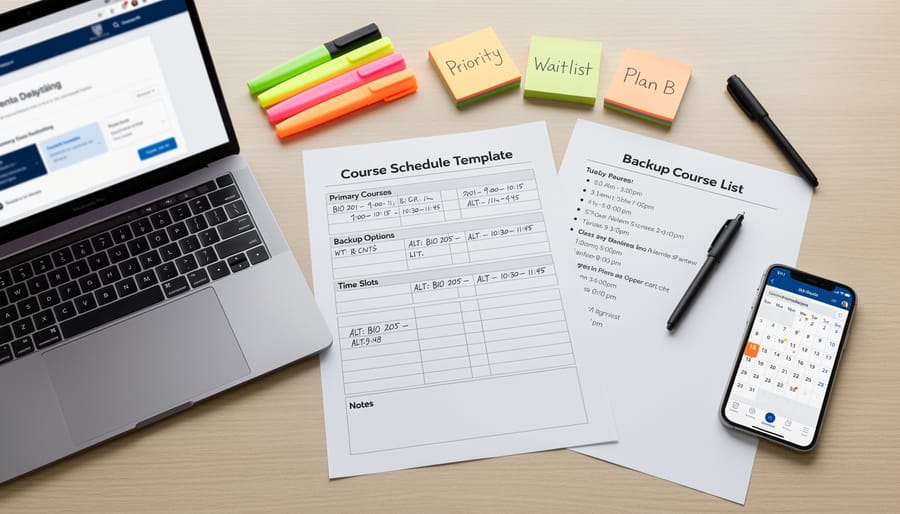
Building Your Ideal Course Schedule Template
Creating a strategic course schedule requires more than simply selecting classes you need—it demands thoughtful planning and preparation for multiple scenarios. Successful academic planning strategies begin with understanding your degree requirements through UW’s degree audit tools.
Start by accessing your Degree Audit Report (DARS) through MyUW. This tool shows exactly which requirements you’ve completed and what remains. Use this information to identify priority courses—those required for your major or prerequisites for future classes. According to UW advising data, students who regularly check their DARS are 40% more likely to graduate on time.
Next, create a tiered enrollment strategy. List courses in three categories: must-have courses critical for degree progression, preferred courses that advance your plan, and alternative options if primary choices fill up. For each must-have course, identify at least two backup options with similar credit value or requirement fulfillment.
Consider Maria, a junior biology major. She needs Genetics (her top priority), a lab science, and two electives. Her backup plan includes Molecular Biology if Genetics fills, three different lab options scheduled at varying times, and a list of five pre-approved electives. She monitors enrollment numbers daily during her registration window, prepared to pivot immediately if needed.
Before finalizing your schedule, verify that courses don’t conflict and allow reasonable transition time between classes—especially important on UW’s large campus. Build in balance between challenging courses and lighter loads. Review your plan with your academic advisor, who can spot potential issues and suggest alternatives you might have missed.
Timing Your Course Selection Across Multiple Quarters
Strategic course planning across quarters requires understanding prerequisite chains and enrollment patterns. At UW, many majors have sequential courses where completing one class unlocks the next—for example, the Computer Science pathway typically requires CSE 142, then 143, before upper-level courses. Missing one quarter can delay graduation by an entire year.
Start by mapping out your entire degree plan during your first quarter. Use the UW Time Schedule to identify which courses are offered in specific quarters (fall, winter, spring, or summer). Some specialized classes only run once annually, making early planning essential for freshman year success and beyond.
High-demand courses like introductory STEM classes or popular electives often fill within minutes during Period I registration. Data shows that students with earlier registration times (typically seniors and honors students) have a 73% higher success rate securing first-choice courses. If you’re a newer student, develop backup plans by identifying three alternative courses that fulfill similar requirements.
Consider taking prerequisite courses during less competitive quarters. Summer sessions typically have higher availability, allowing you to stay on track while avoiding the fall rush. Additionally, monitor add codes from instructors, which can grant access even after courses appear full.
Mastering the Enrollment Process: From Registration Period to Secured Seat
Your Registration Time Ticket: What It Means and How to Prepare
Your registration time ticket determines exactly when you can begin enrolling in courses each quarter. UW assigns these appointments based on several priority factors, with class standing carrying the most weight. Seniors typically register first, followed by juniors, sophomores, and freshmen. According to recent data, approximately 40% of students receive their first-choice courses during their initial time ticket window, making preparation essential.
Additional factors influencing your time ticket include honors program membership, Running Start credits, and athlete status. Students with documented disabilities registered with Disability Resources for Students may also receive earlier appointments to ensure appropriate course accommodations.
To prepare effectively, start by building a backup course list at least one week before your registration opens. Identify three to five alternative classes for each desired course, checking prerequisites and time conflicts in advance. Set multiple alarms for your exact registration time—data shows students who register within the first 30 minutes have a 65% higher success rate in securing priority classes. Have your MyUW login credentials ready and test your internet connection beforehand. Consider balancing college responsibilities when selecting your course load, ensuring your schedule remains manageable while meeting degree requirements.

Real-Time Enrollment Tactics When Classes Fill Fast
When high-demand courses open for enrollment, preparation makes the difference between success and disappointment. Data from recent UW registration periods shows that popular courses can fill within 15-30 minutes, requiring students to act strategically.
Start by opening MyUW on two devices simultaneously—a laptop and smartphone provide redundancy if one connection lags. Have your course entry codes written down or typed in a document you can quickly copy and paste. According to student surveys, those who pre-load their shopping carts during the planning phase are 40% more likely to secure their first-choice classes.
Create a prioritized backup list before enrollment begins. If your primary choice fills instantly, you’ll waste precious seconds searching for alternatives. Identify at least two substitute courses for each priority class, ensuring they meet the same requirements and fit your schedule.
Set multiple alarms for five minutes before your exact enrollment time. Many students report that refreshing the page 30 seconds early sometimes allows earlier access due to system timing variations.
Join class-specific GroupMe chats or Discord servers where students share real-time updates about openings. Fellow students often drop courses within the first week, and these communities help you respond immediately when spots become available, turning initial disappointment into eventual success.
Working the Waitlist and Making Schedule Adjustments
When to Stick With a Waitlist and When to Move On
Understanding when to persist with a waitlist requires analyzing historical movement patterns. UW data shows that classes with waitlists of 10 or fewer students typically see 60-70% movement before the quarter begins, while waitlists exceeding 20 students move less than 30%. Position matters significantly—students ranked in the top five have an 80% chance of enrolling in most courses.
Consider Sarah, a sophomore who stayed at position 3 on a biology waitlist and successfully enrolled during the first week when students adjusted schedules. Conversely, Michael remained at position 18 for a computer science course and missed enrollment in his backup option while waiting.
Apply this decision framework: If you’re in the top third of the waitlist and the course is required for your major, monitor it closely through week one. However, if you’re beyond position 15 on a large waitlist for an elective, secure your backup immediately.
Check your waitlist position daily during the first week of classes, as 40% of movement occurs when students finalize their schedules. For essential courses, communicate with instructors about your position—some departments add seats based on demonstrated need. Balance optimism with pragmatism by maintaining viable alternatives until you receive confirmation.
The First Week Shuffle: Optimizing Your Final Schedule
The first week presents a critical opportunity to refine your schedule. UW data shows that approximately 30% of students make at least one course change during the add/drop period, demonstrating how common schedule adjustments are.
Start by attending multiple sections of courses you’re uncertain about. This allows you to compare teaching styles, workload expectations, and class dynamics firsthand. Take notes on each professor’s syllabus, assignment structure, and communication approach.
When considering changes, reach out to professors directly. A brief email introducing yourself and asking specific questions about course expectations shows initiative and helps you make informed decisions. Many instructors appreciate students who proactively engage during the first week.
Monitor your registration carefully during this period. Seats can open unexpectedly as other students adjust their schedules. Set up notifications or check MyUW regularly, particularly during peak drop times like evenings and weekends.
Remember that your initial schedule rarely needs to be perfect. Strategic adjustments during the first week can significantly improve your quarter experience, helping you balance workload, secure preferred instructors, and align courses with your academic goals.
Common Mistakes That Cost Students Semesters (and How to Avoid Them)
Course registration mistakes at UW can derail even the most carefully planned academic trajectory. According to UW’s Office of the Registrar, approximately 18% of students extend their graduation timeline due to preventable enrollment errors.
One common pitfall involves ignoring prerequisite sequences. Sarah, a biology major, enrolled in BIOL 355 without completing BIOL 220, assuming she could catch up independently. She struggled throughout the quarter, ultimately withdrawing and losing both tuition money and valuable time. Always verify prerequisites in the course catalog before registration day, and consult your academic advisor if you’re considering skipping any recommended preparatory coursework.
Another frequent mistake is failing to check time schedule conflicts. Many students add courses to their shopping cart without noticing overlapping lecture or lab times. During autumn quarter 2023, UW reported over 2,200 students who attempted to register for conflicting time slots, creating last-minute scrambles for alternatives. Use the visual schedule builder feature in MyUW to spot conflicts before registration opens.
Students also commonly underestimate the importance of backup plans. When registration periods are staggered by class standing and registration time, popular courses fill quickly. Jordan, a junior computer science student, had only one course plan and found all preferred sections full within minutes of his registration window opening. He ended up with a schedule that created significant gaps between classes and contributed to managing academic stress. Create at least three alternative schedules with different course combinations before your registration time.
Finally, neglecting to monitor Area of Knowledge requirements leads many students to discover missing graduation requirements during their final year. The UW Degree Audit system provides real-time tracking of these requirements. Review your audit each quarter and plan courses strategically to fulfill multiple requirements simultaneously, maximizing efficiency and preventing delayed graduation.
Mastering the UW course search and enrollment process is a skill that develops with each quarter, becoming more intuitive as students gain experience navigating the system. Just as a study from the University of Washington’s Office of Educational Assessment found that students who plan their schedules two weeks before registration typically secure 89% of their desired courses compared to just 64% for those who wait until registration opens, early preparation consistently proves valuable. Students who begin exploring course options during weeks 7-8 of the previous quarter position themselves for greater success.
For students feeling overwhelmed, remember that every upperclassman once faced the same learning curve. Start by creating a preliminary schedule now, identify alternatives for high-demand courses, and set reminders for key registration dates. Parents and educators play a crucial role in this journey by encouraging students to take ownership of their academic planning while remaining available as sounding boards for decision-making. Consider scheduling a family conversation about academic goals before each registration period to align expectations and priorities.
Strategic enrollment isn’t just about getting into classes—it’s about building a foundation for academic achievement, maintaining healthy balance, and progressing toward graduation efficiently. The time invested in thoughtful course planning pays dividends through reduced stress, better academic performance, and a more fulfilling university experience.