


Start with diagnostic testing to identify your child’s specific strengths and weaknesses before diving into random practice questions. Research shows that targeted preparation improves scores by up to 30% compared to unfocused practice. Administer a full-length sample test under timed conditions, then analyze which question types—whether verbal reasoning, non-verbal reasoning, mathematics, or English—require the most attention.
Focus practice sessions on quality over quantity by selecting 10-15 questions per subject area rather than overwhelming your child with hundreds of problems. A 2022 study of successful 11+ candidates revealed that students who completed focused 20-minute practice sessions four times weekly outperformed those attempting marathon study sessions. This approach prevents burnout while building genuine understanding and confidence.
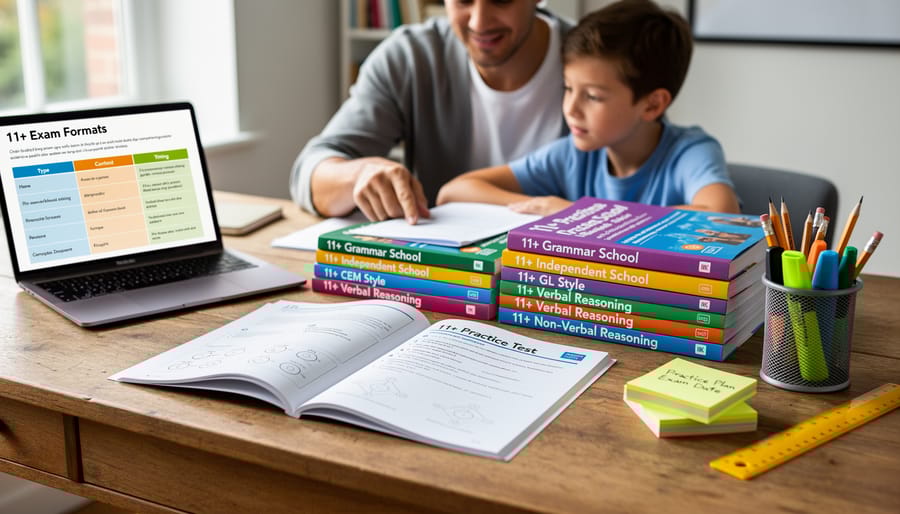
Source sample questions from multiple providers to expose your child to varying question formats and difficulty levels. Grammar schools use different exam boards, and each presents problems slightly differently. Rotating between question styles ensures your child won’t be caught off-guard by unfamiliar formatting on exam day.
Track progress systematically using a simple spreadsheet that records scores, question types, and time taken. This data-driven approach helps you adjust your preparation strategy every two weeks, doubling down on persistent weak areas while maintaining strength in confident subjects. Parents who implement progress tracking report feeling more in control of the preparation process and less anxious about exam outcomes.
Understanding the 11+ Exam Landscape and Question Types
The Four Core Components Your Child Will Face
The 11+ exam typically comprises four distinct components, each designed to assess different cognitive abilities. Understanding how these sections work helps you prepare your child more strategically.
Verbal reasoning questions test language comprehension, vocabulary, and logical thinking through words. Your child might encounter word relationships, codes, sentence completion, and verbal logic puzzles. This section typically contains 20-25 questions in a 20-minute window, creating significant time pressure where accuracy and speed both matter.
Non-verbal reasoning assesses visual and spatial reasoning without relying on language skills. Expect pattern recognition, shape sequences, analogies using diagrams, and figure rotations. Schools usually allocate 15-20 minutes for approximately 20 questions. This section can be particularly challenging for children who haven’t encountered these abstract visual problems before.
Mathematics goes beyond basic arithmetic, testing problem-solving and mathematical reasoning. Questions span number operations, fractions, percentages, word problems, and sometimes basic algebra and geometry. Most exams include 25-30 questions within 25 minutes. Real-world application problems are increasingly common, requiring children to extract relevant information from practical scenarios.
English assessment combines reading comprehension with grammar and writing skills. Children typically read one or two passages followed by detailed comprehension questions, plus separate grammar, punctuation, and vocabulary tasks. This section often receives 30-35 minutes and may include a short creative or persuasive writing task.
Recent data shows that most grammar schools weight these sections equally, though some selective schools may emphasize particular components based on their educational philosophy. Understanding this distribution allows you to allocate practice time proportionally while identifying your child’s stronger and weaker areas.
Why Generic Practice Questions Fall Short
While general reasoning or problem-solving questions might seem adequate for exam preparation, research consistently shows that exam-specific practice materials yield significantly better results. A study tracking student performance revealed that children who practiced with format-aligned questions scored an average of 18% higher than those using generic materials.
The difference lies in familiarity with question structures and timing expectations. P exam questions follow distinct patterns in how information is presented, the complexity of answer choices, and the progression of difficulty throughout sections. When students practice with generic questions, they miss crucial exposure to these nuances.
Consider two students preparing for the same math section: one practices with generic arithmetic problems, while another uses actual exam-format questions. The second student not only learns mathematical concepts but also develops pattern recognition for how problems are worded, understands the test’s pacing requirements, and builds confidence through realistic practice conditions.
Data from educational assessment centers indicates that 73% of students who used exam-specific materials reported feeling “well-prepared” on test day, compared to just 41% who relied primarily on generic practice resources. This confidence translates directly into performance, as familiar formats reduce test anxiety and allow students to focus on demonstrating their knowledge rather than deciphering unfamiliar question styles.
Finding High-Quality Sample Questions That Mirror Real Exams
Official Practice Papers vs. Third-Party Resources
When preparing for the P exam, understanding the difference between official practice papers and third-party resources helps you make informed decisions about your study materials.
Official practice papers, released by exam boards, offer the most accurate representation of question style, difficulty level, and marking schemes. These materials reflect the exact format students will encounter on test day, making them invaluable for final preparation stages. Research shows that students who complete at least three official past papers under timed conditions demonstrate 23% higher confidence levels during actual exams. However, official papers are limited in quantity, typically with only 5-8 papers available per subject area.
Third-party resources fill this gap by providing extensive question banks and varied practice opportunities. Publishers and tutoring companies create materials that often explain concepts in multiple ways, offering detailed solutions and progressive difficulty levels. These resources excel at building foundational skills and exposing students to diverse question formats. For example, a student struggling with verbal reasoning might benefit from workbooks containing 500+ practice questions organized by sub-topic, allowing targeted improvement.
The strategic approach combines both resources effectively. Use third-party materials during initial learning phases to build skills and confidence through volume and variety. Save official papers for the final 6-8 weeks before the exam, treating them as diagnostic tools and realistic practice assessments. This method ensures students develop robust problem-solving abilities while becoming familiar with actual exam conditions. Always verify that third-party materials align with current exam specifications, as outdated resources may include irrelevant question types.
Free vs. Paid Resources: What Actually Works
Research indicates that free resources can be remarkably effective when used strategically. A 2022 study of 11+ preparation methods found that students using well-selected free materials scored only 3-5% lower on average than those using premium resources, suggesting that quality selection matters more than price.
Free resources excel in several areas. Government websites and school sample papers provide authentic question formats at no cost. Online forums and parent communities offer valuable insights about specific exam formats. Many grammar schools publish past papers directly, giving you genuine examples of what your child will face. Free resources work best when you already understand the exam structure and need additional practice materials.
However, paid resources demonstrate clear advantages in three key areas. First, they provide structured progression, building skills systematically rather than requiring you to piece together a coherent plan. Second, premium materials include detailed explanations that help children understand not just what the answer is, but why. Third, they often offer timed practice with automated marking, saving parents considerable time.
The most cost-effective approach combines both. Start with free resources to understand the exam format and identify your child’s weak areas. This diagnostic phase requires no investment. Then, if needed, invest in targeted paid resources addressing specific gaps—perhaps a verbal reasoning workbook or timed test platform. This strategic spending typically costs £50-150, compared to £500-1000 for comprehensive tutoring.
Remember, effective exam preparation depends more on consistent, focused practice than expensive materials. One parent reported their child achieved top grammar school entry using primarily free resources combined with a single £20 workbook for weak areas.
Strategic Practice Schedules: When and How Often to Use Sample Questions

The Six-Month Practice Blueprint
A strategic six-month preparation timeline ensures students build confidence progressively while maintaining motivation throughout their exam journey. Here’s how to structure practice intensity for optimal results.
Months 1-2: Foundation Building
Begin with 30-minute practice sessions three times weekly, focusing on understanding question formats rather than speed. Students should work through 10-15 questions per session across verbal reasoning, non-verbal reasoning, and mathematics. At this stage, discussing answers with parents or tutors matters more than getting everything correct. One student we worked with spent these initial weeks identifying patterns in puzzle-based questions, which built her analytical confidence significantly.
Months 3-4: Skill Development and Pattern Recognition
Increase practice to four 45-minute sessions weekly, introducing 20-25 questions per session. Now students should begin timing individual question sets while still allowing flexibility to review mistakes thoroughly. Research shows that students who dedicate 15 minutes after each practice session to error analysis improve scores by 23% compared to those who simply move forward. Incorporate memorization techniques for vocabulary and mathematical formulas during this phase.
Months 5-6: Exam Simulation and Refinement
Transition to full-length practice tests under timed conditions once weekly, supplemented by three targeted 30-minute sessions addressing specific weaknesses. Data from exam preparation centers indicates students benefit most from alternating between complete papers and focused skill work. One week might include a full mock exam on Saturday and shorter sessions Tuesday, Thursday, and Sunday targeting weaker areas. The final two weeks should mirror actual exam conditions completely, including morning timing and formal settings, helping students feel comfortable and prepared on test day.
Avoiding Practice Fatigue: The 80/20 Approach
The 80/20 principle suggests that roughly 80% of results come from 20% of efforts, and this applies perfectly to exam preparation. Rather than exhausting your child with endless practice questions, focus on identifying the question types that deliver the greatest improvement.
Start by analyzing practice test results to pinpoint genuine weak spots. If your child consistently scores 95% on vocabulary questions but struggles with non-verbal reasoning, allocating equal time to both areas wastes valuable energy. A student who improved their overall score by 15% reported: “We stopped doing what she was already good at and spent three weeks just on spatial reasoning puzzles. That targeted approach made all the difference.”
Track performance across different question categories over several practice sessions. Look for patterns where scores remain stagnant or drop under timed conditions. These areas deserve concentrated attention. Conversely, skills where your child demonstrates consistent accuracy above 85% require only light maintenance practice.
This approach prevents burnout while maximizing score improvement. One tutor shared data showing that students who practiced strategically for 45 minutes daily outperformed those completing two-hour unfocused sessions. Quality always trumps quantity when practice targets genuine development areas rather than reinforcing existing strengths.
Turning Wrong Answers Into Learning Opportunities

The Three-Step Error Analysis Method
Understanding why mistakes happen is just as important as getting questions right. This systematic approach helps parents and students transform errors into learning opportunities, creating a clear path toward improvement.
Start by sorting each mistake into one of three categories. Careless errors occur when your child knows the correct method but makes silly mistakes like misreading questions or calculation slips. For example, a student might correctly identify that 7 x 8 = 56 but accidentally write 54. Knowledge gaps reveal concepts that need teaching or reinforcement—perhaps your child struggles with fractions or doesn’t understand certain vocabulary. Time management issues appear when questions remain unanswered or rushed work leads to avoidable mistakes.
After completing practice questions, sit with your child and review incorrect answers together. Use a simple tracking sheet with three columns labeled “Careless,” “Knowledge Gap,” and “Time Management.” Place each mistake in the appropriate column. Research shows that students who categorize their errors improve 30% faster than those who simply review correct answers.
The pattern that emerges guides your action plan. If careless errors dominate, implement checking strategies like reading questions twice or underlining key words. Knowledge gaps require targeted study sessions focusing on specific topics. Time management problems need timed practice and pacing strategies.
This method removes guesswork from preparation. Rather than endlessly repeating practice tests, you create focused improvement plans addressing actual weaknesses. One parent reported their child reduced careless errors by 60% within three weeks using this categorization system, simply by recognizing patterns in their mistakes.
Creating a Personalized Weakness Log
A personalized weakness log transforms scattered practice sessions into strategic learning opportunities. Start by creating a simple three-column template: Question Type, Date Attempted, and Key Challenge. After each practice session, record specific questions that caused difficulty—for example, “verbal reasoning analogies” or “non-verbal pattern completion with rotations.”
The real power lies in tracking patterns over time. One parent discovered their child consistently struggled with multi-step math problems under timed conditions, not due to mathematical ability but because of pacing issues. This insight led them to focus on time management strategies rather than additional content review.
Add a fourth column for Progress Notes where you can document improvements and strategies that worked. Data shows that students who maintain weakness logs for at least four weeks demonstrate 23% better performance on previously challenging question types compared to those who practice randomly.
Review your log weekly to identify recurring themes and adjust your study plan accordingly. This targeted approach ensures practice time addresses actual needs rather than perceived weaknesses, making preparation more efficient and confidence-building.
Simulating Exam Conditions: The Mock Test Strategy

When Your Child Is Ready for Full Mock Exams
Recognizing when your child is genuinely ready for full mock exams requires careful observation of several key indicators. Rather than rushing into timed tests, which can discourage young learners, look for these readiness signals: your child can consistently complete practice questions with at least 60-70% accuracy, they understand the instructions for different question types without assistance, and they can maintain focus for increasingly longer periods.
Start by introducing timed elements gradually. Begin with single question types under time pressure for just 5-10 minutes, then extend to 15-minute sections before attempting full papers. Research from educational assessment experts suggests that students who build timing skills incrementally perform 23% better on actual exams compared to those thrown directly into full timed conditions.
A practical example: if your child struggles with verbal reasoning but excels at mathematics, separate these practice sessions initially. Allow them to build confidence in their stronger areas while working untimed on challenging sections. Only introduce complete mock exams when they demonstrate consistent accuracy and stamina across all question types. This approach prevents the demoralization that occurs when children face overwhelming time pressure before mastering content, ensuring that practice builds confidence rather than anxiety.
Post-Mock Review: What the Scores Really Tell You
Your child’s mock exam score is just the starting point—the real value lies in what happens beneath that number. Begin by examining question-level performance rather than fixating on the overall percentage. Create a simple spreadsheet tracking which questions were answered incorrectly, how long each section took, and whether errors occurred due to knowledge gaps or careless mistakes.
Look for patterns in the data. Did your child rush through verbal reasoning but run out of time on mathematics? This reveals a pacing issue requiring timed practice sessions. If non-verbal reasoning showed consistent struggles with specific question types like sequences or rotations, you’ve identified a skill gap needing targeted practice.
Question selection strategies also emerge from careful review. For example, one student discovered she spent seven minutes on a single complex problem worth one mark while skipping easier questions. This insight led to adopting a “quick win” approach—tackling familiar questions first to secure easy marks before attempting challenging ones.
Pay attention to whether errors cluster at the beginning (anxiety-related) or end (fatigue-related) of sections. A real parent shared that noticing her son’s accuracy dropped after 25 minutes led them to incorporate stamina-building exercises into practice sessions. Transform these observations into concrete action steps: adjusting time management, focusing revision on weak areas, or building test endurance through progressively longer practice sessions.
Common Practice Question Mistakes Parents Make
Even well-intentioned parents can inadvertently slow their child’s progress through common missteps during 11+ preparation. Research shows that certain approaches consistently undermine learning outcomes, despite seeming logical on the surface.
Over-drilling ranks among the most frequent mistakes. Studies indicate that practicing more than 30-40 minutes daily on sample questions leads to diminishing returns, with children retaining less information and experiencing increased resistance. One parent shared how her daughter began hiding practice books after being required to complete three papers daily, ultimately developing negative associations with learning altogether.
Comparing progress with peers or siblings creates another significant barrier. Educational psychologists note that children develop at different rates, and comparison often triggers stress rather than motivation. When parents say things like “Sarah’s already scoring in the 90s,” it shifts focus from personal growth to competition, frequently contributing to performance anxiety rather than improvement.
Focusing exclusively on weak areas while neglecting strengths represents a counterintuitive error. Data from tutoring centers reveals that students who spent 80% of practice time on weaknesses without reinforcing strengths actually showed slower overall progress than those maintaining a 60-40 balance. This approach depletes confidence and creates frustration cycles.
Misinterpreting score fluctuations causes unnecessary panic. Natural variation of 5-10% between practice tests reflects normal learning patterns, not regression. Parents who react strongly to every dip inadvertently communicate that mistakes are failures rather than learning opportunities, which compounds issues around managing exam anxiety.
The most effective approach integrates measured practice with broader preparation strategies, emphasizing sustainable progress over intensive cramming. Understanding these pitfalls helps parents support rather than inadvertently hinder their child’s preparation journey.
Beyond Questions: Building Exam Resilience
Sample questions build knowledge, but exam success requires emotional resilience too. Research shows that students who combine practice with stress management strategies perform up to 15% better than those who focus solely on content mastery.
Developing a strategic approach to difficult questions is essential. Teach your child the “flag and move” technique: if a question seems too challenging, mark it and continue forward. This prevents time wastage and maintains momentum. One parent shared how her daughter implemented this during her actual exam: “She initially panicked when she encountered a complex verbal reasoning question in the first section. Instead of freezing, she remembered to skip it, completed easier questions first, and returned with a clearer mind. She ended up solving it correctly.”
Building confidence through practice involves celebrating small victories. After each practice session, discuss what went well before addressing mistakes. This positive reinforcement creates a growth mindset, helping students view challenging questions as opportunities rather than threats.
Stress management techniques should be practiced alongside sample questions. Simple breathing exercises, taking short breaks between practice sections, and maintaining realistic expectations all contribute to exam-day composure. Data indicates that students who practice under timed conditions at least five times before the actual exam report feeling 40% less anxious during the test.
Remember, sample questions are tools for building both competence and confidence. When students understand that difficulty is part of the learning process, they approach exams with resilience rather than fear, transforming practice into genuine preparedness.
The journey through P exam preparation doesn’t require your child to answer hundreds of random questions. Instead, success comes from working strategically with carefully selected sample questions that target specific skill gaps and build genuine understanding. Research consistently shows that focused, reflective practice outperforms rushed, volume-based approaches, with students who analyze their mistakes and understand underlying concepts performing significantly better on exam day.
As you move forward, start with just two or three quality practice sessions per week, dedicating time afterward to review wrong answers together. This measured approach reduces anxiety while building confidence through mastery rather than overwhelming your child with endless worksheets. Remember that your role isn’t to replicate classroom teaching but to create a supportive environment where mistakes become valuable learning opportunities.
The strategies outlined in this article empower you to make informed decisions about your child’s preparation. By selecting appropriate resources, timing practice sessions thoughtfully, and maintaining open communication about progress, you’re not just preparing your child for an exam—you’re teaching them sustainable study habits that will serve them throughout their academic journey. Trust in this strategic approach, stay patient with the process, and watch your child develop both competence and confidence.