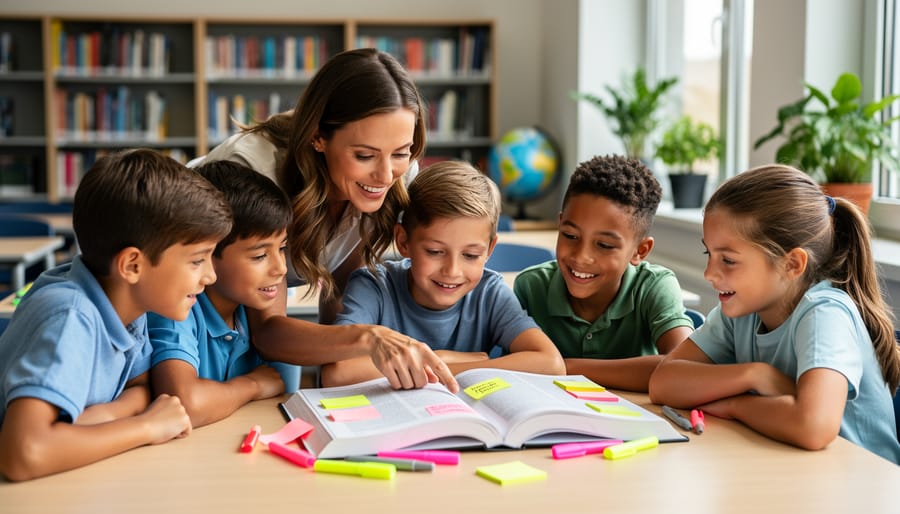



Reading comprehension doesn’t happen by accident. Research from the National Reading Panel reveals that students who apply specific cognitive strategies while reading show 15-20% higher comprehension rates than those who simply read text passively. Yet many educators and parents struggle to move beyond the instruction to “read more carefully” without providing learners with concrete tools they can actually use.
The seven evidence-based reading strategies transform how students interact with text by giving them a systematic framework for understanding, analyzing, and retaining information. These strategies—activating prior knowledge, questioning, visualizing, inferring, determining importance, synthesizing, and monitoring comprehension—work together to create active, engaged readers who can tackle increasingly complex material with confidence.
Consider two fifth-graders reading the same science article about ecosystems. One reads through once and recalls scattered facts. The other activates background knowledge before reading, asks questions throughout, visualizes the food chain relationships, and monitors understanding by pausing to clarify confusing sections. The difference in comprehension and retention is dramatic and measurable.
Whether you’re a classroom teacher developing lesson plans, a parent supporting homework, or a reading specialist working with struggling readers, understanding and implementing these seven strategies provides a proven roadmap for building stronger readers. Each strategy addresses a specific aspect of the comprehension process, and together they create a comprehensive toolkit that serves learners across all grade levels and content areas.
Why Reading Strategies Matter More Than Reading Skills
Many students can read words fluently yet struggle to understand what they’ve read. This gap between mechanical reading ability and true comprehension reveals a critical truth: decoding words is just the beginning. Reading strategies bridge this divide by teaching learners how to actively engage with text, monitor their understanding, and extract meaningful information.
Research from the National Assessment of Educational Progress shows that while 67% of fourth-graders can read at a basic level, only 35% demonstrate proficient comprehension. This comprehension gap persists because students often lack systematic approaches to process information effectively. Simply reading more doesn’t solve the problem without strategic frameworks in place.
Consider Emma, a seventh-grade student who consistently scored low on reading assessments despite having strong decoding skills. She would read entire chapters but couldn’t answer basic questions about the content. After her teacher introduced the SQ3R reading method and other strategic approaches, Emma learned to preview texts, ask questions while reading, and summarize key points. Within three months, her comprehension scores improved by 40%, and she reported feeling more confident tackling complex materials.
The seven reading strategies matter because they transform passive reading into an active thinking process. They provide students with mental tools to organize information, make connections, and retain what they learn. These strategies aren’t innate abilities but teachable skills that dramatically improve outcomes across all subject areas. When students understand how to approach different texts strategically, they become independent learners capable of navigating increasingly complex academic demands throughout their education and beyond.

The 7 Essential Reading Strategies Every Reader Needs
1. Activating Prior Knowledge
Activating prior knowledge helps readers build bridges between what they already know and new information they encounter in texts. This foundational strategy enhances comprehension by creating mental connections that make content more meaningful and memorable. When students tap into their existing knowledge base, they’re better positioned to understand, analyze, and retain new concepts.
One highly effective technique is the KWL chart, which guides students through three phases: What I Know, What I Want to know, and What I Learned. Before reading a science text about ecosystems, for example, students list their current understanding of food chains and habitats in the K column, generate questions about predator-prey relationships in the W column, then complete the L column after reading. Research shows this structured approach increases retention by up to 40% compared to passive reading.
Think-alouds provide another powerful method where teachers verbalize their thought processes while reading. A fifth-grade teacher might say, “This paragraph about the Civil War reminds me of our discussion about states’ rights last week. That connection helps me understand why tensions escalated.” This modeling demonstrates how proficient readers naturally link new information to prior experiences, encouraging students to adopt similar metacognitive habits in their independent reading.
2. Questioning the Text
Questioning the text transforms passive readers into active investigators. This strategy encourages students to engage deeply with material by generating questions at three critical stages: before opening the book (What might this be about?), during reading (Why did the character make that choice?), and after completing the text (How does this connect to what I already know?).
Effective question stems guide this process. Before reading, students might ask: “What do I already know about this topic?” or “What does the title suggest?” During reading, prompts like “What is confusing me?” and “What might happen next?” maintain engagement. Post-reading questions include “What was the author’s purpose?” and “How can I apply this information?”
Consider a fifth-grade class reading a historical fiction novel. Before starting, students ask predictive questions based on the cover and synopsis. During reading, they pause to question character motivations and unfamiliar historical references. Afterward, they explore how the story reflects actual historical events.
Research shows that students who consistently question texts demonstrate 30% higher comprehension rates compared to passive readers. This strategy activates critical thinking by requiring students to analyze, evaluate, and synthesize information rather than simply absorb it. Teachers can model this by thinking aloud, demonstrating how proficient readers naturally question as they read.
3. Visualizing and Creating Mental Images
Visualizing transforms abstract text into concrete mental movies, significantly boosting comprehension and long-term retention. Research indicates that students who create mental images while reading demonstrate up to 30% better recall compared to those who don’t employ this strategy.
This strategy works by engaging multiple brain regions simultaneously. When readers visualize characters, settings, or concepts, they create neural connections that make information more memorable and meaningful. For example, when reading about photosynthesis, a student might picture sunlight streaming through leaves, converting energy into food.
For younger learners (grades K-2), start with picture-rich texts and have them draw what they imagine during read-alouds. Ask guiding questions like “What colors do you see?” or “How big is the character?” This builds foundational visualization skills.
Elementary students (grades 3-5) benefit from “sketch-to-stretch” activities where they create quick drawings at different points in a story, then explain their visual choices. This reinforces comprehension checkpoints throughout reading.
Middle and high school students can use visualization for complex texts by creating mental maps of abstract concepts. When reading historical documents or scientific explanations, encourage them to imagine themselves in the scenario or visualize processes step-by-step.
Visual learners naturally excel at this strategy, while auditory learners may need prompts to describe their mental images aloud, strengthening the visualization-comprehension connection.
4. Making Inferences
Making inferences involves reading between the lines to understand what authors imply but don’t explicitly state. This critical thinking skill requires students to combine text evidence with their prior knowledge and real-world experience to draw logical conclusions.
When reading a narrative, students might infer a character’s emotions from actions rather than direct statements. For example, if a story describes someone slamming a door and walking away quickly without speaking, readers can infer anger or frustration. In informational texts, students might read about melting ice caps and infer potential consequences for coastal communities, even if not directly mentioned.
Context clues help students deduce word meanings and deeper meanings. These include definition clues (where the text explains the term), example clues (providing instances), and contrast clues (showing opposites).
Grade-appropriate activities strengthen inference skills effectively. Elementary students can analyze picture books, identifying character feelings from illustrations and dialogue. Middle schoolers can practice with short articles, highlighting evidence that supports their inferences. High school students can examine political cartoons or advertisements, inferring the creator’s message and intended audience.
Research shows that students who regularly practice making inferences demonstrate 25% higher comprehension scores. Teachers should model their thinking process aloud, explaining how they connect clues to form conclusions, helping students develop this essential analytical skill.

5. Determining Importance
Determining importance empowers readers to distinguish essential information from supporting details, a critical skill for effective comprehension. Research shows that students who can identify main ideas retain 40% more content than those who attempt to remember everything equally.
Start by teaching readers to ask, “What does the author most want me to understand?” This simple question focuses attention on central concepts. Model the process by thinking aloud while reading, explaining why certain sentences carry more weight than others.
Annotation techniques provide immediate, practical tools. Encourage students to use a highlighter system: yellow for main ideas, pink for supporting details, and green for unfamiliar vocabulary. Alternatively, margin coding works well—stars for key points, question marks for confusions, and exclamation points for surprising information.
Graphic organizers transform abstract concepts into visual frameworks. The main idea web places the central concept in a circle with supporting details branching outward. Pyramid organizers work excellently for hierarchical information, with the most important idea at the top. For narrative texts, story maps help students identify essential plot elements versus descriptive details.
Teachers can implement these strategies during guided reading sessions, gradually releasing responsibility as students gain confidence. Parents can practice these techniques during homework time, making comprehension visible and discussable rather than mysterious.
6. Synthesizing Information
Synthesizing information is the process of combining details from different parts of a text or multiple sources to form new understanding and insights. This advanced strategy helps readers move beyond surface-level comprehension to create deeper meaning by connecting ideas, identifying patterns, and drawing original conclusions.
When readers synthesize effectively, they continuously adjust their interpretations as new information emerges. For example, while reading a biography, a student might initially view the subject as purely heroic. However, as they encounter information about the person’s mistakes and controversies, they synthesize these details to develop a more nuanced, balanced perspective. This evolving understanding reflects genuine engagement with the material.
Research shows that students who practice synthesis demonstrate 34% better retention of complex information compared to those who focus only on isolated facts. This strategy proves particularly valuable when reading informational texts, comparing multiple viewpoints, or conducting research projects.
Practical synthesis activities include creating comparison charts that highlight similarities and differences across texts, writing summary paragraphs that integrate information from various sources, and engaging in Socratic discussions where students build upon each other’s ideas. Teachers can also encourage students to maintain reading journals where they track how their understanding changes throughout a book, documenting key moments when new information shifted their perspective. These concrete practices transform synthesis from an abstract concept into an actionable skill.
7. Monitoring Comprehension
Monitoring comprehension is the metacognitive process where readers actively track their understanding while reading. This self-awareness strategy enables students to recognize when meaning breaks down and take corrective action. Research shows that skilled readers continuously evaluate whether the text makes sense, while struggling readers often continue reading without realizing they’ve lost comprehension.
Teaching students to monitor their understanding begins with helping them recognize confusion signals. These include encountering unfamiliar words, losing track of characters or concepts, or reaching the end of a page without remembering what they read. Students should learn to ask themselves questions like “Does this make sense?” and “Can I explain what I just read in my own words?”
Effective fix-up strategies include rereading difficult passages, adjusting reading speed, looking up unknown vocabulary, using context clues, and connecting information to prior knowledge. A practical self-monitoring checklist might include items such as: “I can summarize the main idea,” “I understand how this paragraph connects to previous information,” and “I know what to do when I don’t understand.”
Educators can help struggling students by modeling think-alouds that demonstrate how proficient readers notice and resolve comprehension breakdowns. According to classroom data, students who regularly practice self-monitoring techniques show 25-30% improvement in reading comprehension scores within one semester, making this an essential strategy for developing independent, confident readers.
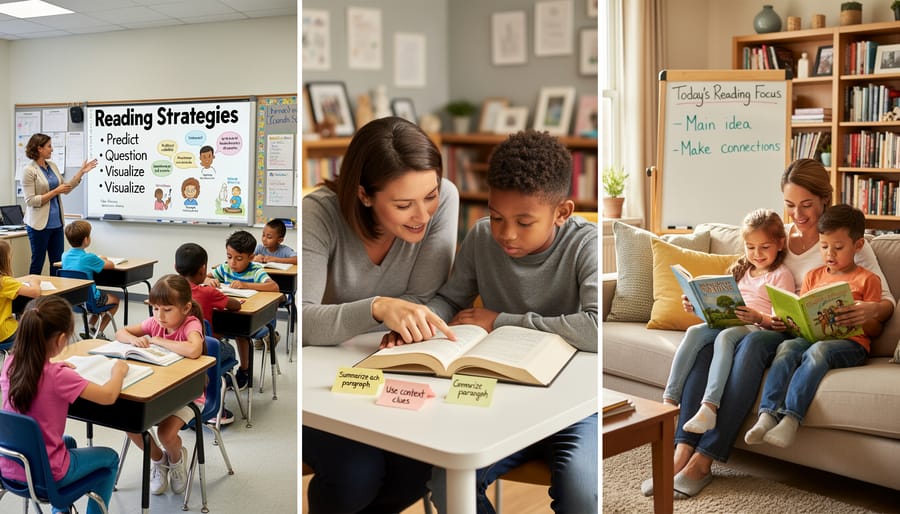
Implementing Reading Strategies in Different Learning Environments
Successfully implementing the seven reading strategies requires thoughtful adaptation to different learning environments and student needs. Understanding how to apply these techniques across various settings ensures maximum impact on reading comprehension.
In traditional classrooms, teachers can introduce strategies through whole-group instruction before transitioning to small-group practice. For example, modeling the making connections strategy with a shared text allows all students to observe the process before attempting it independently. Post anchor charts displaying each strategy as visual reminders, and create literacy centers where students practice specific techniques with leveled materials. Research shows that explicit strategy instruction improves comprehension scores by approximately 23% when consistently applied.
Homeschool settings offer flexibility for personalized pacing. Parents can select strategies matching their child’s current reading level and integrate them into daily reading time. Younger readers (ages 5-8) benefit from focusing on one strategy at a time, particularly predicting and visualizing, which feel more intuitive. Older students (ages 9-14) can handle combining multiple strategies simultaneously, such as questioning while making inferences.
During tutoring sessions, educators should conduct initial assessments to identify which strategies students already use and which need development. One-on-one instruction allows targeted practice with immediate feedback. AI tools for homework can supplement strategy practice by providing personalized reading passages and comprehension questions.
Common implementation challenges include student resistance and inconsistent application. Solutions include making strategies explicit through think-alouds, celebrating small wins to build confidence, and providing graphic organizers that scaffold the process. For struggling readers, begin with concrete strategies like predicting before advancing to abstract ones like synthesizing.
Differentiation is essential: advanced readers can analyze author’s purpose while applying strategies, while developing readers need simplified texts and guided practice. The key is consistent, patient instruction that gradually releases responsibility to students as they demonstrate mastery.
Mastering these seven reading strategies represents a transformative step toward building confident, capable readers. Research consistently shows that students who engage with multiple comprehension strategies score 15-20% higher on standardized reading assessments compared to those using traditional approaches. The beauty of these strategies lies in their flexibility—they work equally well whether you’re supporting struggling readers or challenging advanced learners.
Start small tomorrow. Choose one strategy that aligns with your current lesson plan—perhaps activating prior knowledge before introducing a new text or modeling a think-aloud during read-aloud time. Parents can begin by simply asking their child to make predictions about a story before reading together at bedtime. These seemingly modest steps create powerful neural pathways that strengthen comprehension.
The long-term impact extends far beyond improved test scores. Students equipped with these strategies become independent learners who approach complex texts with confidence rather than anxiety. They develop critical thinking skills applicable across all subjects and throughout their lives. By investing time in teaching these seven strategies today, you’re not just improving reading scores—you’re cultivating lifelong learners prepared to navigate an increasingly complex world with curiosity and competence.