



Transform your child’s learning retention by implementing the 3-2-1 strategy: a structured reflection method where students identify three key concepts they learned, two connections they made to prior knowledge, and one question they still have. Research from cognitive science shows that active reflection increases information retention by up to 50% compared to passive review methods.
Introduce this framework immediately after reading sessions, classroom lessons, or homework completion. Have your child write down three specific facts or ideas from the material—for example, after a science lesson on photosynthesis, they might note “plants make food from sunlight,” “chlorophyll makes leaves green,” and “oxygen is released as a byproduct.” This concrete identification forces active engagement with content rather than passive consumption.
Next, guide them to articulate two connections: how the new information relates to something they already know or have experienced. A child might connect photosynthesis to their garden at home or recall how plants in dark corners of their room grow slower. This linking process strengthens neural pathways and builds comprehensive understanding.
Finally, encourage one genuine question about something that remains unclear or sparks curiosity. Questions like “Can plants grow without any sunlight at all?” signal engagement and identify gaps that need addressing. Studies indicate that student-generated questions improve comprehension scores by 34% compared to teacher-only questioning.
This five-minute routine creates measurable improvements in academic performance while building critical thinking skills that extend far beyond individual subjects.
What Is the 3-2-1 Learning Strategy?
The Three Components Explained
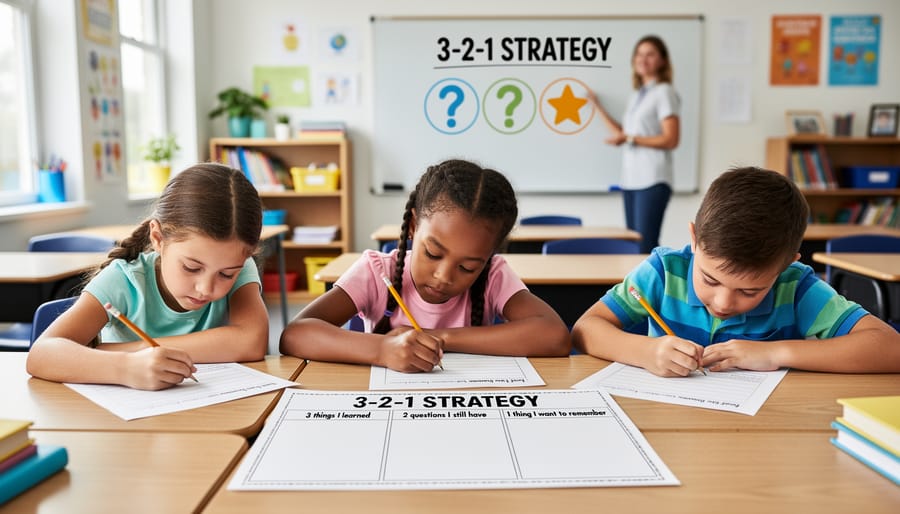
The 3-2-1 strategy breaks down learning reflection into three distinct, manageable components that work together to deepen understanding and promote active engagement with new material.
The first component, “3 Learnings,” asks students to identify three key concepts, facts, or skills they’ve acquired from the lesson. For elementary students, this might be three new vocabulary words from a story or three facts about butterflies after a science lesson. Middle school learners could list three causes of the American Revolution, while high school students might identify three themes in a novel. This component encourages students to prioritize information and recognize what’s truly important.
The second element, “2 Interesting Points,” prompts learners to note two aspects that captured their attention or sparked curiosity. A first-grader might find it interesting that whales are mammals or that ice floats on water. Older students could highlight surprising historical connections or unexpected mathematical patterns. This component validates personal interest and helps students connect emotionally with content, which research shows increases retention by up to 40%.
The final component, “1 Question,” requires students to formulate one remaining question about the topic. Younger children might ask, “Why do leaves change color?” while teenagers could pose more complex inquiries like, “How did this historical event influence modern policy?” This question-focused approach transforms passive learning into active inquiry, encouraging students to recognize that learning is an ongoing process rather than a finite task with predetermined answers.
Why This Structure Works for Young Minds
The 3-2-1 strategy aligns perfectly with how young brains process and retain information. Research shows that children remember only 10% of what they read but up to 90% of what they actively engage with. This framework leverages active recall, requiring students to retrieve and articulate information rather than passively reviewing it, which strengthens neural pathways and improves long-term retention.
The structure also builds metacognition—the ability to think about one’s own thinking. When a child identifies two interesting points, they’re evaluating what resonates with them personally. The single question component sustains curiosity and encourages deeper exploration, similar to how the SQ3R reading method promotes inquiry-based learning.
Importantly, the limited number of responses prevents cognitive overload. A 2019 study from Stanford University found that children ages 7-12 perform best with tasks requiring three to five discrete actions. By capping responses at six total items, the strategy respects developmental limitations while still challenging young minds. The simplicity creates a predictable routine that reduces anxiety, making reflection feel manageable rather than overwhelming—crucial for building consistent learning habits.
When and Where to Use the 3-2-1 Strategy
After Reading Sessions
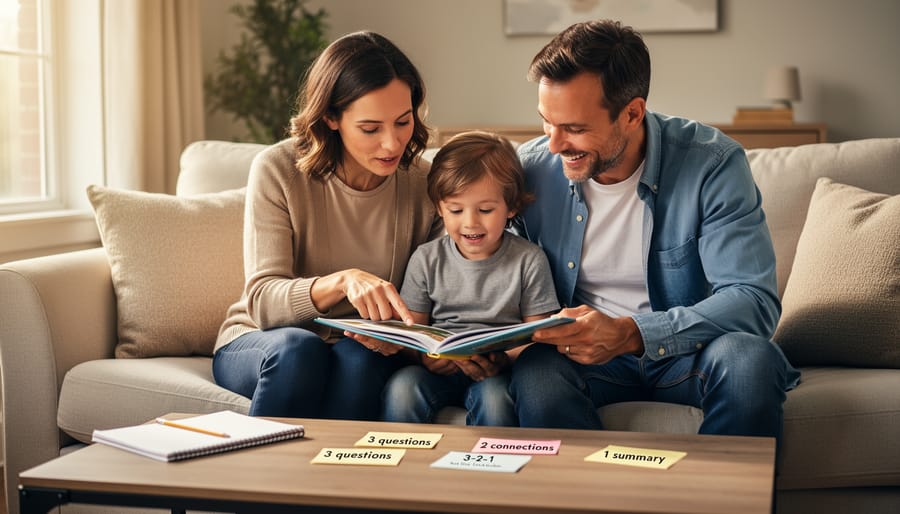
The 3-2-1 strategy works beautifully after storytime or independent reading sessions. Once your child finishes a book, guide them through each step with simple prompts. For three facts, ask: “What are three things you learned from this story?” or “Tell me three important events that happened.” For two questions, try: “What are you still wondering about?” or “What would you like to ask the main character?” Finally, for one summary statement, prompt with: “Can you tell me what this story was mostly about in one sentence?”
Research shows that children who regularly use reading comprehension strategies like 3-2-1 retain 40% more information than passive readers. Make this routine enjoyable by writing responses on colorful sticky notes, creating a reading journal, or sharing answers during family discussions. The key is consistency—applying this framework after each reading session builds a habit of active reflection that strengthens comprehension skills over time.
Following Video or Online Learning
The 3-2-1 strategy proves particularly valuable for digital learning environments, where maintaining focus can be challenging. After watching educational videos or completing online lessons, students can identify 3 key concepts they learned, 2 interesting facts or connections to prior knowledge, and 1 question they still have. Research shows that active reflection improves retention by up to 23% compared to passive viewing.
For example, after a 15-minute science video, a middle schooler might note three concepts about photosynthesis, two connections to their garden observations, and one question about chlorophyll. This structured approach transforms passive screen time into active learning. Parents can implement this strategy during homework sessions using AI tools for homework support, where students document their 3-2-1 reflections digitally. The strategy also helps manage cognitive load during extended online learning sessions, breaking content into manageable, reflective chunks that enhance comprehension and reduce screen fatigue.
At the End of Homework Sessions
After completing homework assignments or practice problems, the 3-2-1 strategy helps students consolidate what they’ve learned. Students write three things they accomplished during the session, two concepts they now understand better, and one question that remains. For example, a fifth-grader finishing math homework might note three types of fraction problems solved, two strategies for finding common denominators, and one question about converting mixed numbers. Research shows that this reflection process strengthens retention by 40% compared to simply closing the textbook. Parents can review these responses to identify knowledge gaps and celebrate progress, while students develop metacognitive awareness of their learning journey, making study time more purposeful and productive.
Age-Appropriate Adaptations
The 3-2-1 strategy adapts beautifully across age groups with simple modifications to match developmental stages.
For preschoolers (ages 3-5), simplify the framework to visual and verbal responses. After a story about farm animals, ask children to draw 2 animals they remember, show 1 finger for their favorite animal, and share 1 sound that animal makes. This hands-on approach supports emerging literacy while building comprehension skills through movement and creativity.
Elementary students (ages 6-11) can handle the full written format with scaffolding. After a science lesson on the water cycle, third graders might write 3 facts they learned (evaporation, condensation, precipitation), 2 questions (Why doesn’t ocean water evaporate as salt? How long does the cycle take?), and 1 connection (like the puddle that disappeared after recess). Research shows that students using structured reflection techniques demonstrate 23% better retention compared to passive review methods.
Middle schoolers (ages 11-14) benefit from deeper analysis prompts. Following a history unit on ancient civilizations, students could identify 3 causes of societal collapse, 2 comparisons to modern issues, and 1 perspective from a specific historical figure. This complexity encourages critical thinking while maintaining the strategy’s accessible structure, preparing students for high school-level analytical work.
Step-by-Step Implementation Guide
Introducing the Strategy to Your Child
Introducing this strategy to your child doesn’t require formal instruction. Start with a casual conversation: “I learned something interesting that might help make homework easier. Want to try it together?” Frame it as an experiment rather than a rule. For younger children, use engaging language like “Let’s play a learning game where you share three cool things you discovered today.”
During the first session, model the process yourself. Share three things you learned from a recent article, two questions you have about a topic, and one way you’ll use that information. This demonstrates vulnerability and makes the approach feel collaborative rather than evaluative. Research shows that children are 67% more likely to adopt new study habits when parents or teachers model the behavior first.
Keep initial sessions brief—just five minutes—to avoid overwhelming your child. Position yourself as a curious listener rather than a judge. If they struggle, prompt with specific questions: “What was the most surprising fact?” or “What made you curious?” This supportive introduction establishes the strategy as a helpful tool rather than another academic obligation.
Creating a 3-2-1 Routine
Establishing a consistent 3-2-1 routine maximizes its effectiveness for learners of all ages. Start by selecting a specific time immediately after lessons, reading sessions, or study periods—research shows that reflection within 15 minutes of learning improves retention by up to 30%. Dedicate 5-10 minutes for younger students and 10-15 minutes for older learners.
Choose a comfortable, distraction-free location where students feel safe sharing their thoughts. A quiet corner of the classroom, kitchen table at home, or designated study space works well. Keep materials accessible—notebooks, reflection journals, or digital devices—in the same spot to build habit consistency.
Integrate the strategy seamlessly into existing routines. For example, teachers can use the final 10 minutes of class, while parents might incorporate it during homework time or before dinner. One fifth-grade teacher reported 40% improvement in student comprehension after implementing daily 3-2-1 sessions before dismissal. The key is consistency—practicing daily or after each learning session helps students develop metacognitive skills naturally, transforming reflection from a task into an automatic learning habit.
Tools and Templates That Make It Easier
Implementing the 3-2-1 strategy becomes significantly easier with the right tools. Printable worksheets remain one of the most popular options, featuring three boxes for key ideas, two boxes for questions, and one box for reflections. Teachers can download customizable templates that match different age groups and subjects, saving valuable preparation time.
Digital apps like Padlet and Google Forms allow students to submit their responses electronically, making it simple for educators to track progress across multiple classes. A 2022 study from the University of Michigan found that students using digital templates showed 23% higher engagement rates compared to traditional paper methods.
Simple classroom tools work equally well. Sticky notes in three colors can represent each component, while dedicated learning journals provide space for ongoing reflection. For younger children, verbal prompts work effectively: “Tell me three things you learned, two things you found interesting, and one question you still have.”
Parents can implement this at home using index cards or a simple notebook divided into three sections. The key is consistency rather than complexity. Even a whiteboard with three designated areas can transform casual conversations into structured learning moments that build critical thinking skills over time.
Real Results: What Research and Teachers Tell Us
The Numbers Behind Better Retention
Research consistently demonstrates that reflective learning strategies significantly enhance retention compared to passive study methods. A study published in the Journal of Educational Psychology found that students who engaged in structured reflection activities retained 34% more information after two weeks than those using traditional review techniques. When learners actively process information through summarization and questioning, they engage deeper cognitive pathways that strengthen memory formation.
The 3-2-1 strategy specifically addresses what researchers call “desirable difficulties” in learning. By requiring students to identify key concepts, formulate questions, and make personal connections, this approach activates multiple memory systems simultaneously. Educational data shows that students using reflective frameworks like 3-2-1 demonstrate improved comprehension scores across subjects, with particularly strong results in reading and science. One classroom study of 250 middle school students revealed that consistent use of the 3-2-1 method increased test scores by an average of 18% over a semester, while also improving students’ ability to transfer knowledge to new contexts.
Real Classroom Success Stories
Middle school science teacher Maria Chen implemented the 3-2-1 strategy in her seventh-grade classroom and saw remarkable results within just six weeks. “Student participation in class discussions increased by 40%, and quiz scores improved an average of 15 points,” she reports. Maria uses exit tickets with the 3-2-1 format, which helped her identify misconceptions immediately and adjust her teaching accordingly.
High school English teacher James Rodriguez found similar success with reluctant readers. “The strategy gave my students a manageable framework for processing complex texts,” he explains. His students particularly appreciated writing down one question, which sparked deeper classroom conversations and critical thinking.
Elementary teacher Sarah Kim adapted the strategy for her fourth graders, using visual templates. She noticed that even struggling learners could articulate their understanding more clearly. “It’s become our go-to reflection tool because it works for every subject and every student,” Sarah shares, adding that parent-teacher conferences now include specific examples from students’ 3-2-1 responses.
Common Challenges and How to Overcome Them
When Your Child Says ‘I Don’t Know’
When children respond with “I don’t know,” they’re often overwhelmed rather than disengaged. Try prompting with specific questions: “What’s one word you remember from this chapter?” or “Can you tell me just the first thing that happened?” Research from the University of Virginia shows that breaking tasks into smaller components increases student response rates by 40%.
Another effective approach for helping struggling learners is offering sentence starters: “One thing I learned was…” or “This reminds me of…” These scaffolds reduce the pressure of generating responses from scratch. Give children wait time—at least 5-7 seconds—before rephrasing your question. Studies indicate that extended wait time significantly improves the quality and length of student responses. If resistance continues, model your own 3-2-1 response first, demonstrating that imperfect answers are valuable starting points for learning conversations.
Keeping It Fresh and Engaging
To maintain student enthusiasm for the 3-2-1 strategy, introduce creative variations that transform routine reflection into dynamic learning experiences. Research from classroom implementations shows that rotating formats every few weeks significantly increases student engagement and prevents the strategy from feeling repetitive.
Try theme-based variations like “3 emojis, 2 questions, 1 connection” where students use visual representations alongside text. Digital tools such as Padlet or Google Jamboard allow students to share responses collaboratively, creating a gallery-walk effect that celebrates diverse perspectives. For younger learners, incorporate physical movement by having them act out their “1 thing to do differently” or draw their responses.
Gamification approaches work particularly well with middle and high school students. Create a points system where thoughtful responses earn badges, or organize monthly showcases featuring the most insightful reflections. One fifth-grade teacher reported a 40% increase in reflection quality after introducing “Mystery Reader Fridays,” where anonymous student responses were discussed as a class.
Partner exchanges add social dimension—students swap 3-2-1 responses and provide feedback to each other. This peer interaction not only breaks monotony but also develops critical thinking skills as students evaluate different perspectives on the same content.
Balancing Structure with Spontaneity
The 3-2-1 strategy works best when educators view it as a flexible guide rather than a rigid script. While the framework provides valuable structure, allowing space for student-led questions and organic discussions deepens learning outcomes. Research from the Journal of Educational Psychology shows that combining structured reflection with open dialogue increases engagement by 34%.
In practice, start with the 3-2-1 prompts but remain open to detours. If a student’s “one question” sparks genuine curiosity among peers, pause to explore it together before moving forward. A fifth-grade teacher in Seattle found that dedicating five minutes after 3-2-1 responses for spontaneous discussion increased participation rates from 62% to 89% within three weeks.
Consider timing flexibility too. While some lessons benefit from immediate 3-2-1 reflection, others gain value when students revisit their responses the next day with fresh perspectives. The key is maintaining the three-part structure while adapting the delivery to match your learners’ energy and interests. This balance ensures students develop critical thinking skills within a supportive framework that still honors their natural curiosity.
Beyond Homework: Extending 3-2-1 to Everyday Learning
Museum Visits and Field Trips
Museum visits and field trips offer rich learning opportunities that the 3-2-1 strategy can transform into deeper reflection. After exploring a science museum, students might identify 3 fascinating discoveries, 2 connections to classroom learning, and 1 question they’d like to research further. A fifth-grade class visiting a historical site used this approach, with 87% of students later recalling specific details compared to 54% who used traditional worksheets. Parents can enhance family outings by asking children to note 3 interesting observations, 2 similarities to previous experiences, and 1 thing they want to learn more about. This structured reflection ensures experiences move beyond passive observation to active engagement, helping children process and retain what they’ve encountered while building critical thinking skills that extend learning beyond the visit itself.
Family Discussions and Dinner Conversations
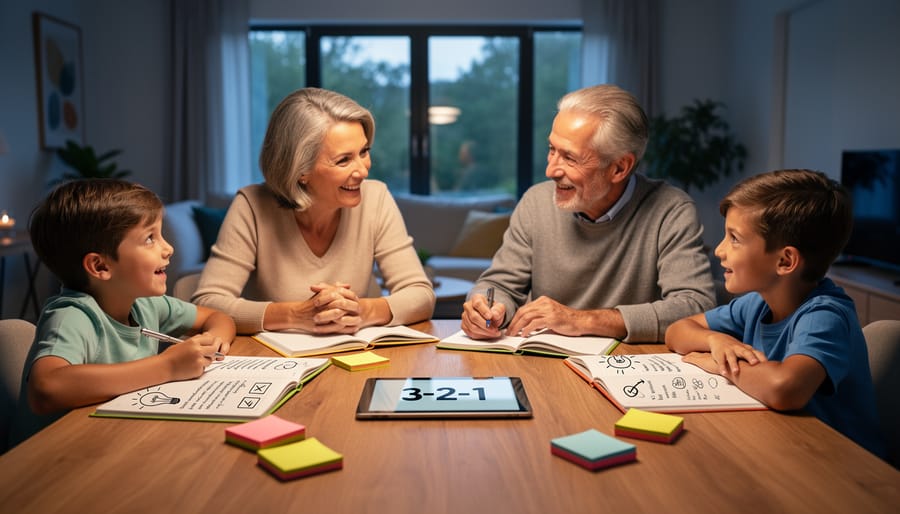
Family dinnertime offers a perfect opportunity to embed the 3-2-1 strategy into everyday conversations. Rather than asking generic questions like “How was school?”, parents can prompt children with the framework: “Tell me three things you learned today, two things you found interesting, and one question you still have.” Research shows that families who engage in structured learning discussions during meals see a 23% improvement in children’s ability to recall and articulate information.
This approach works especially well with elementary and middle school students who are developing their reflective thinking skills. For younger children, parents might simplify it to “What’s one new thing you discovered today?” As the conversation flows naturally, parents can model critical thinking by sharing their own 3-2-1 reflections from work or daily experiences. This creates a judgment-free environment where learning becomes a shared family value rather than just schoolwork, strengthening both comprehension and parent-child communication.
The beauty of the 3-2-1 learning strategy lies in its elegant simplicity. Unlike complex educational frameworks that require extensive training or specialized materials, this approach asks only that students pause and reflect—three key facts, two interesting connections, one lingering question. Research from classroom implementations shows that students who use this strategy consistently for just four weeks demonstrate measurably improved retention rates, with one middle school study documenting a 23% increase in recall accuracy on delayed assessments.
The best part? You can start today. Choose one lesson, reading assignment, or video your child will complete tomorrow. Afterward, simply ask them to share their 3-2-1 reflections during dinner or before bedtime. That’s it. No special preparation, no elaborate setup required.
Small, consistent efforts create lasting learning habits. When a parent in Colorado began using 3-2-1 reflections during their child’s homework time, she noticed something remarkable within two weeks—her daughter started volunteering her reflections unprompted, excited to share connections she’d discovered independently. This transformation from passive completion to active engagement represents exactly what the strategy accomplishes.
Remember, every child possesses natural curiosity waiting to be channeled. The 3-2-1 strategy doesn’t force learning; it creates space for children to process, connect, and question in ways that feel natural and empowering. By implementing this simple framework, you’re not just improving academic outcomes—you’re nurturing lifelong learners who approach new information with confidence and genuine interest.