



Canada welcomed over 800,000 international students in 2023, making it the third most popular study destination globally—and for good reason. International students consistently choose Canadian universities for their world-class education, affordable tuition compared to the US and UK, post-graduation work opportunities, and pathways to permanent residency.
If you’re an international student exploring Canadian universities, you’re facing a significant decision that will shape your academic future and career trajectory. With 96 universities offering diverse programs, understanding which institutions align with your goals, budget, and field of study requires careful research. The reasons to study in Canada extend beyond academic excellence—the country offers a multicultural environment where international students comprise 20-30% of enrollment at major universities, comprehensive support services, and practical work experience through co-op programs.
Canadian universities rank consistently in global top 200 lists, with institutions like University of Toronto, McGill University, and University of British Columbia competing with Ivy League schools. However, lesser-known universities such as University of Waterloo for engineering or Dalhousie University for marine biology offer equally exceptional programs at more accessible price points. Average annual tuition ranges from CAD 15,000 to CAD 35,000 depending on your program and institution, while living costs vary significantly between cities like Toronto (CAD 15,000-20,000 annually) and smaller university towns (CAD 10,000-12,000).
This comprehensive guide will help you navigate the application process, identify universities matching your profile, and make an informed decision about your Canadian education journey.
What Makes Canadian Universities Different for International Students

The Quality-to-Cost Advantage
Canada offers international students exceptional value for their education investment. Tuition fees at Canadian universities typically range from $15,000 to $35,000 CAD annually for undergraduate programs, positioning them as significantly more affordable than comparable institutions in the United States, where costs often exceed $50,000 USD per year. For instance, a Bachelor’s degree in Engineering at the University of Toronto costs approximately $58,000 CAD annually for international students, while similar programs at top US universities can reach $80,000 USD or more.
Beyond competitive tuition rates, Canadian universities provide robust scholarship opportunities specifically designed for international students. The University of British Columbia offers the International Leader of Tomorrow Award, covering full tuition for exceptional students demonstrating financial need. Similarly, the University of Alberta allocates over $3 million annually through its International Student Scholarships program. According to Universities Canada data, approximately 40 percent of international students receive some form of financial assistance.
The return on investment extends beyond the classroom. International students gain access to research facilities, co-op programs, and work opportunities through the Post-Graduation Work Permit program, allowing graduates to work in Canada for up to three years. When Sarah Chen from Malaysia compared her options, she chose McMaster University over US alternatives, saving $25,000 annually while accessing identical research opportunities. This combination of reasonable tuition, substantial scholarship availability, and post-graduation pathways creates a compelling financial proposition that continues attracting over 800,000 international students annually to Canadian campuses.
Post-Graduation Work Opportunities
Canada’s Post-Graduation Work Permit (PGWP) program stands as one of the most compelling reasons international students choose Canadian universities. This Canadian work visa allows graduates from designated learning institutions to work for up to three years after completing their studies, with the permit duration matching the length of their study program (minimum eight months required).
Recent Immigration, Refugees and Citizenship Canada data shows that approximately 90% of eligible graduates successfully obtain their PGWP, providing valuable Canadian work experience. For instance, engineering graduate Priya from India secured a position with a Toronto tech firm immediately after graduation, utilizing her PGWP to gain two years of experience that strengthened her permanent residency application.
The PGWP also serves as a strategic pathway to permanent residency through programs like the Canadian Experience Class and Provincial Nominee Programs. Students who gain skilled work experience can earn critical points under Express Entry, with many achieving permanent resident status within 18-24 months post-graduation. This clear immigration pathway makes Canada particularly attractive for career-minded international students planning long-term futures.
Top International Universities in Canada You Should Know
Research-Intensive Universities
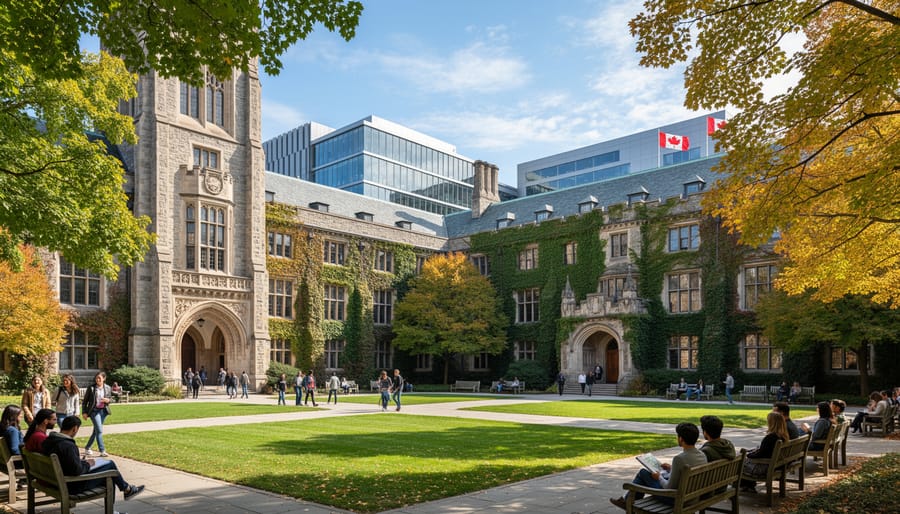
Canada’s research-intensive universities consistently rank among the world’s best, offering international students access to cutting-edge facilities, renowned faculty, and globally recognized credentials.
The University of Toronto stands as Canada’s highest-ranked institution, typically placing in the top 25 globally across major rankings. With over 23,000 international students from 160+ countries, U of T excels in computer science, engineering, business, and health sciences. International students benefit from the university’s $1.4 billion annual research budget, accessing opportunities in artificial intelligence, biotechnology, and sustainable energy. Real-world example: Engineering student Priya from India contributed to groundbreaking AI research in her second year, leading to a co-authored publication and valuable industry connections.
The University of British Columbia, ranked among the top 40 worldwide, attracts students to its Vancouver and Okanagan campuses. UBC’s strengths include environmental science, forestry, oceanography, and business programs. The university’s research output generates approximately 50 patents annually, providing international students hands-on experience in innovation labs. Data shows that 82% of UBC international graduates secure employment within six months.
McGill University in Montreal combines European academic traditions with North American innovation, ranking consistently in the global top 50. Known for medicine, law, and natural sciences, McGill hosts 12,000+ international students representing 150 countries. The university’s bilingual setting offers unique cultural immersion while maintaining English-language instruction for most programs.
These research-intensive institutions provide international students with more than degrees—they offer mentorship from world-class researchers, access to multimillion-dollar labs, and collaborative projects that build impressive portfolios. Graduate programs particularly benefit from extensive funding opportunities, with many doctoral students receiving full financial support plus living stipends.
Universities with Strong International Support Services
International students navigating life in a new country need more than academic excellence—they require comprehensive support systems to thrive. Several Canadian universities stand out for their exceptional international student services.
The University of Toronto operates the Centre for International Experience, which provides year-round programming including airport pickup services, multi-day orientation sessions, and a dedicated International Student Experience team. In 2023, they served over 23,000 international students from 168 countries, offering one-on-one advising appointments and workshops on everything from cultural adjustment to immigration regulations.
McGill University’s International Student Services hosts a robust buddy program pairing incoming students with current international students. Their orientation includes city tours, banking workshops, and healthcare navigation sessions. The office also provides crisis support and maintains partnerships with local community organizations to facilitate social integration.
The University of British Columbia features the Go Global initiative, which assigns each international student a peer advisor during their first year. Their International Student Advising office processed over 4,000 individual consultations in 2022, addressing concerns from study permit renewals to mental health resources.
York University distinguishes itself with the York International Student Internship Program, connecting international students with Canadian work experience opportunities while still studying. Their International Student and Scholar Services also offers cultural transition workshops in multiple languages.
These institutions recognize that strong support services directly correlate with student success and retention. When researching universities, examine the breadth and accessibility of their international student offices, peer mentorship opportunities, and practical integration programs.
Emerging Universities Attracting Global Talent
Beyond the traditional powerhouses, several emerging Canadian universities are rapidly gaining recognition for their innovative approaches and strong international support systems. Thompson Rivers University in British Columbia, for instance, has seen a 40% increase in international enrollment over the past five years, thanks to its flexible pathways programs and dedicated career services. Similarly, Toronto Metropolitan University (formerly Ryerson) stands out with its entrepreneurship-focused curriculum and industry partnerships, offering international students direct connections to Canada’s startup ecosystem.
These institutions often provide competitive advantages including smaller class sizes, personalized mentorship, and lower tuition costs compared to larger universities. Mount Royal University in Calgary combines academic excellence with cooperative education opportunities, where 85% of participating students secure employment within six months of graduation. Vancouver Island University attracts students seeking environmental studies and marine biology programs in stunning natural settings.
What makes these emerging universities particularly appealing is their agility in responding to global job market demands. They frequently update programs to reflect current industry needs, from AI and data analytics to sustainable development. International students also benefit from closer faculty relationships and more accessible support services, creating welcoming communities where they can thrive academically and personally while building valuable professional networks.
The Real Costs: What International Students Actually Pay
Finding Scholarships and Financial Aid
Navigating scholarship opportunities requires strategic planning and understanding the diverse funding sources available. International students in Canada can access government-funded programs like the Vanier Canada Graduate Scholarships, offering $50,000 annually for doctoral students, or the Canadian Commonwealth Scholarship Program for students from member countries. Recent data shows that approximately 60% of international graduate students receive some form of financial support.
University-specific scholarships represent significant opportunities. The University of Toronto’s Lester B. Pearson International Scholarship covers tuition, books, and living expenses for outstanding students, while the University of British Columbia offers the International Major Entrance Scholarship worth up to $10,000. Many institutions automatically consider applicants for entrance scholarships, but competitive awards require separate applications with specific deadlines often falling between December and February.
Private organizations and external foundations also provide substantial funding. The Trudeau Foundation Scholarships support social sciences and humanities students with $60,000 over three years. Provincial programs like Ontario’s Trillium Scholarship offer $40,000 annually for PhD students at participating universities.
To maximize success, start researching at least 12 months before your intended start date. Create a detailed spreadsheet tracking deadlines, requirements, and application components. Strong applications include compelling personal statements demonstrating academic excellence and community impact. Many successful applicants apply proven financial aid strategies including highlighting unique perspectives and aligning research interests with institutional priorities. Remember that smaller scholarships of $1,000-$5,000 are less competitive and collectively can significantly reduce educational costs.
How to Choose the Right Canadian University for Your Goals
Understanding Program Accreditation and Recognition
Before committing to a Canadian university, it’s essential to verify that your degree will be recognized both internationally and in your home country. All reputable Canadian universities are provincially regulated, as education falls under provincial jurisdiction rather than federal oversight. However, this doesn’t diminish quality—Canadian universities consistently rank among the world’s best.
To verify accreditation, start with Universities Canada (formerly AUCC), which lists all recognized degree-granting institutions. Their database includes 97 public and private universities that meet rigorous academic standards. For international recognition, check if your chosen university appears in global rankings like QS World University Rankings or Times Higher Education, which validate institutional quality.
For country-specific recognition, contact your home country’s education ministry or credential evaluation service. For example, students from India should consult the Association of Indian Universities, while European students can reference the ENIC-NARIC network. Many professional fields require specific accreditation—engineering programs should hold accreditation from Engineers Canada, while business schools might carry AACSB certification.
A real-world example: Maria from Brazil verified that her University of Toronto engineering degree was recognized by CREA (Brazil’s engineering council) before enrolling, ensuring smooth professional registration upon returning home. Taking these verification steps protects your educational investment and career prospects.
The Application Process Simplified

Study Permit Essentials
Securing a study permit is your gateway to studying at Canadian universities, and understanding the process can significantly improve your chances of approval. As of 2024, Immigration, Refugees and Citizenship Canada (IRCC) has implemented several policy changes that international students must navigate carefully.
The application process begins with receiving your Letter of Acceptance from a Designated Learning Institution (DLI). You’ll need to demonstrate financial capacity, typically showing proof of at least CAD $20,635 beyond your first year’s tuition (increased from previous requirements). This amount covers living expenses for one year. Additional documents include a valid passport, recent photographs, a Statement of Purpose explaining your study plans, proof of ties to your home country, and sometimes language test results like IELTS or TOEFL.
Processing times vary considerably by country, ranging from 4 to 16 weeks, though some applications may take longer. Applying at least 3-4 months before your program start date is advisable. Recent data shows that complete applications with all supporting documents receive faster processing and higher approval rates.
For success, ensure your financial documents are recent and clearly show available funds. Your Statement of Purpose should authentically explain why you chose your specific program and how it aligns with your career goals. Be transparent about your intentions to return home after studies, as this addresses one of the primary concerns for visa officers.
Consider biometrics requirements, which cost an additional CAD $85 and must be completed at designated collection points. Medical examinations may also be required depending on your country of origin and program duration.
A real example: Maria from Brazil applied five months ahead, provided bank statements covering 18 months of expenses, and included a detailed study plan. Her thorough preparation resulted in approval within six weeks, allowing ample time for travel arrangements.
What Student Life Really Looks Like in Canada
Adjusting to student life in Canada involves navigating several practical realities that shape your daily experience. Understanding these aspects beforehand helps you prepare for a successful transition.
The Canadian climate requires genuine adaptation, particularly if you’re from a warmer region. Winter temperatures can drop to -30°C in cities like Winnipeg or Edmonton, while coastal Vancouver experiences milder, rainier conditions. Most universities provide orientation sessions on winter preparedness, and investing in proper winter gear—insulated jackets, waterproof boots, and thermal layers—becomes essential. According to student surveys, 78% of international students report adjusting to winter weather within their first semester, though the initial months can feel challenging.
Cultural integration happens gradually through campus involvement. Universities offer over 300 student clubs on average, ranging from cultural associations to academic societies and recreational groups. Meera Patel, an Indian student at McGill University, shares: “Joining the South Asian Students Association helped me find community immediately, while the debate club pushed me outside my comfort zone and helped me make Canadian friends.”
Part-time work opportunities provide both financial support and practical experience. International students can work up to 20 hours weekly during academic sessions and full-time during scheduled breaks without a separate work permit. Campus positions in libraries, cafeterias, and administrative offices typically pay $15-17 per hour, while off-campus retail and hospitality roles offer similar rates. Data shows that 65% of international students work part-time, with earnings helping offset living expenses.
Finding suitable student accommodation in Canada significantly impacts your daily comfort and budget. Options include on-campus residences ($8,000-15,000 annually), shared apartments ($600-1,200 monthly per person), and homestays ($700-900 monthly with meals).
Building a support network proves crucial for long-term success. Universities provide dedicated international student advisors, mental health counseling, and peer mentoring programs. Chen Wei from the University of Toronto notes: “My assigned peer mentor helped me navigate course registration, banking, and even finding grocery stores. These small things matter when everything feels unfamiliar.”
Most students report feeling settled within three to four months, though homesickness and cultural adjustment remain ongoing processes that require patience and proactive engagement with campus resources.

Canada stands as an exceptional destination for international students, offering a compelling combination of world-class education, cultural diversity, and promising career pathways. With over 640,000 international students choosing Canadian institutions in 2023, the numbers reflect what many already know: studying in Canada represents a transformative investment in your future.
The journey from researching universities to settling into campus life may seem complex, but thousands of students navigate this path successfully each year. Whether you’re drawn to the research excellence of institutions like the University of Toronto, the innovation hubs in Vancouver, or the welcoming francophone culture in Montreal, Canada’s universities provide environments where academic achievement and personal growth flourish together.
Now is the time to take concrete action. Start by shortlisting three to five universities that align with your academic goals and budget. Connect with current international students through university social media groups to gain firsthand insights. Review scholarship deadlines carefully, as many fall six to eight months before program start dates.
Remember that studying abroad is more than earning a degree. It’s about developing global perspectives, building lifelong networks, and discovering capabilities you never knew you had. Your Canadian education journey awaits, and the first step begins with informed, confident decision-making today.