



Prioritize user research before writing a single line of code. The most innovative EdTech products emerge from deeply understanding classroom realities, teacher pain points, and student learning challenges. Conduct observational studies in actual learning environments, interview educators across different contexts, and test early prototypes with real users to validate assumptions before investing in full development.
Build cross-functional teams that bridge pedagogy and technology. Developing successful EdTech products requires collaboration between instructional designers, subject matter experts, developers, and practicing teachers. A 2023 study found that EdTech products developed with ongoing educator input showed 67% higher adoption rates than those built by technology teams alone.
Implement iterative testing cycles with measurable learning outcomes. Rather than launching fully-formed products, create minimum viable products that address specific educational challenges, then gather quantitative data on student engagement, learning gains, and teacher satisfaction. This evidence-based approach allows you to refine features based on actual impact rather than assumptions.
Design for diverse learning environments and accessibility from day one. Effective R&D innovation accounts for varying technology infrastructure, different learning abilities, and multiple use cases. Products that work seamlessly whether students access them on tablets, laptops, or smartphones, and that meet WCAG accessibility standards, reach broader audiences and create more equitable learning experiences.
These research and development practices distinguish transformative educational technology from tools that simply digitize existing materials without adding genuine pedagogical value.
What Makes EdTech R&D Different From Traditional Product Development
The Educational Context Challenge
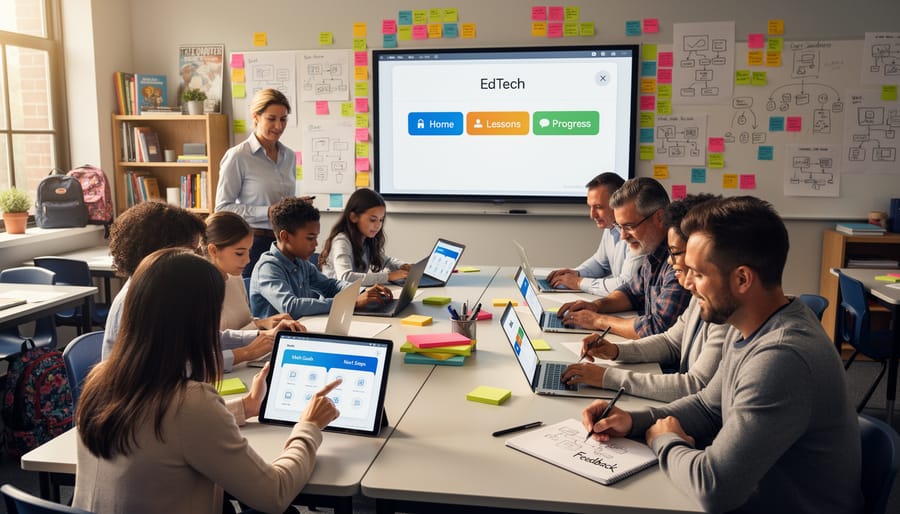
Unlike consumer apps that operate in controlled environments, EdTech products face the messy reality of actual classrooms. A brilliant digital learning platform means little if it crashes on five-year-old Chromebooks or requires bandwidth that half your schools don’t have.
Research from the Consortium for School Networking reveals that 35% of U.S. schools still struggle with inadequate internet connectivity, making cloud-dependent solutions impractical. Successful R&D teams recognize these constraints early. For example, Khan Academy deliberately designed their platform to function on low-bandwidth connections and older devices, ensuring accessibility across diverse school districts.
Budget realities further complicate matters. While a corporate client might readily invest in premium software, schools operate on tight budgets with lengthy procurement cycles. Products requiring expensive hardware upgrades or per-student licensing fees above $15 annually face significant adoption barriers.
The technical infrastructure challenge extends beyond connectivity. Schools use varied learning management systems, student information systems, and authentication protocols. An EdTech product that doesn’t integrate smoothly with existing tools creates administrative headaches, regardless of its educational merit.
Effective R&D processes include testing products in actual classrooms with real constraints rather than idealized lab settings. This means partnering with schools representing different socioeconomic contexts, piloting during actual class periods with typical student-teacher ratios, and measuring performance on the devices schools actually use, not just the latest models.
User-Centered Design in Education
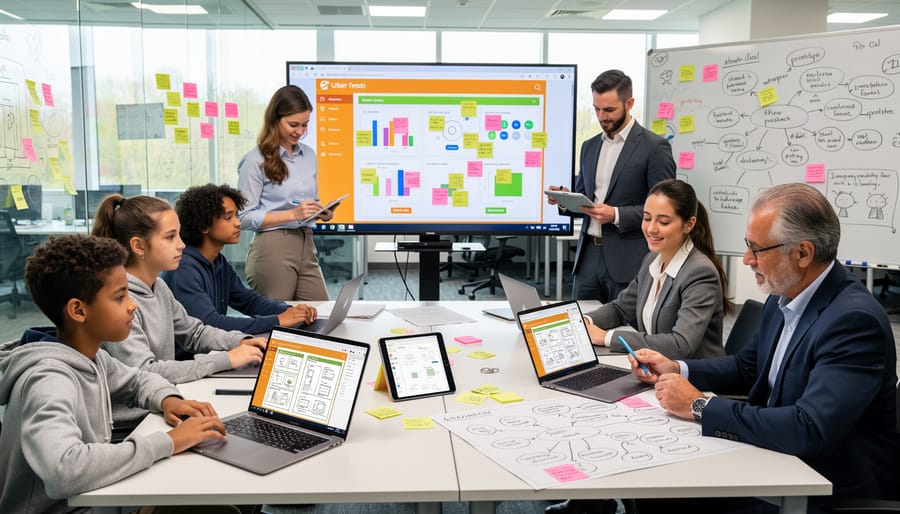
Successful EdTech innovation emerges from a collaborative R&D approach that actively involves all stakeholders in the development process. Rather than designing in isolation, effective product teams gather insights from students, teachers, administrators, and parents to create solutions that address real classroom challenges.
Students provide invaluable feedback on usability and engagement. For example, when developing a math learning platform, one EdTech company discovered through student testing that gamification elements actually distracted from learning objectives, prompting a redesign focused on clear progress indicators instead. This early input prevented a costly product launch failure.
Teachers offer practical perspectives on classroom implementation and curriculum alignment. A recent survey found that 73% of educators report that EdTech tools lacking teacher input during development require significant workarounds to function effectively in actual teaching scenarios.
Administrators contribute insights on scalability, data privacy requirements, and budget constraints, while parents highlight concerns about screen time, age-appropriateness, and learning outcomes that matter beyond test scores.
This multi-stakeholder approach requires structured feedback mechanisms such as focus groups, beta testing programs, and advisory boards. Companies like Duolingo regularly conduct classroom pilots, collecting data from all user groups before releasing new features. This investment in user-centered design reduces development costs long-term and significantly increases adoption rates among educational institutions.
The Four Pillars of Successful EdTech R&D Innovation
Evidence-Based Learning Science
Effective EdTech products are built on a foundation of learning science, not just impressive technology. Research in cognitive load theory, spaced repetition, and active learning should directly shape product features. For example, Duolingo’s success stems from applying spaced repetition algorithms that present vocabulary at scientifically optimized intervals, resulting in 34% better retention rates compared to traditional methods. Similarly, Carnegie Learning’s math platform incorporates cognitive tutors based on decades of research at Carnegie Mellon University, leading to measurable gains in student achievement.
When developing educational products, teams must understand how working memory limitations affect interface design. Platforms that reduce extraneous cognitive load through clean layouts and focused activities consistently outperform feature-heavy competitors. The integration of AI in online learning should also follow evidence-based principles, using adaptive algorithms that respond to individual learning patterns rather than simply automating existing practices.
Products that succeed long-term invest in partnerships with educational researchers and conduct rigorous efficacy studies. Khan Academy’s collaboration with education scientists led to features like mastery-based progression, which research shows improves conceptual understanding by 20-30%. This data-driven approach ensures that innovation serves genuine learning needs rather than merely introducing novelty.
Rapid Prototyping and Classroom Testing
The most valuable insights in EdTech development emerge not from laboratory conditions but from actual classrooms with real students and teachers. Rapid prototyping allows development teams to quickly create functional versions of their products and test them in authentic learning environments, where unexpected challenges and opportunities reveal themselves.
Consider a math app designed to improve engagement. Lab testing might show impressive completion rates, but classroom pilots often uncover different realities. Teachers at one middle school discovered students were rushing through problems to unlock game features, missing the learning entirely. This real-world feedback led developers to redesign the reward system, ultimately creating reliable online education tools that balanced motivation with meaningful practice.
Pilot programs consistently reveal practical constraints that developers miss. A reading platform tested beautifully on high-speed connections but failed in schools with limited bandwidth. Teacher feedback highlighted the need for offline functionality, a feature that became essential for widespread adoption.
Iterative testing also captures diverse learning needs. When a science simulation was piloted across different demographics, students with visual processing differences struggled with certain color schemes. Quick adjustments based on this feedback made the tool accessible to significantly more learners, demonstrating how classroom testing drives inclusive design that benefits everyone.
Accessibility and Inclusive Design
Inclusive design cannot be an afterthought in EdTech R&D. Research shows that products designed for accessibility from the outset benefit all learners, not just those with identified needs. Effective R&D teams must include diverse perspectives during every development phase, from initial concept testing through final implementation.
Begin by incorporating Universal Design for Learning (UDL) principles early in the product roadmap. This means building multiple means of representation, engagement, and expression into core features rather than adding accommodations later. For example, Bookshare integrated text-to-speech and adjustable fonts from its inception, making it valuable for students with dyslexia, visual impairments, and English language learners simultaneously.
Test prototypes with students representing diverse learning needs. Include students with disabilities, multilingual learners, and those from varied socioeconomic backgrounds who may access technology differently. Data from Microsoft’s inclusive design initiatives reveals that involving diverse testers early reduces costly retrofitting by 60 percent.
Consider connectivity limitations and device access. Products requiring high-speed internet or premium devices exclude students from low-income communities. Duolingo’s offline mode exemplifies thoughtful design, allowing continued learning without consistent connectivity. Partner with special education teachers, English as a Second Language specialists, and families to identify barriers your team might overlook. Their insights transform good products into truly innovative, equitable learning tools that serve every student effectively.
Data Privacy and Ethical Considerations
In today’s educational landscape, student data protection isn’t optional—it’s fundamental. EdTech developers must integrate privacy safeguards and ethical considerations from the initial design phase, treating them as core features rather than compliance checkboxes added later.
When building educational products, R&D teams should follow privacy-by-design principles. This means collecting only necessary student data, implementing strong encryption, and ensuring transparent data practices that parents and educators can easily understand. For example, when ClassDojo redesigned their platform, they made privacy settings accessible and visual, allowing parents to control what information teachers could see and share.
Ethical considerations extend beyond legal compliance. R&D teams must consider algorithmic bias in adaptive learning systems. A 2022 study found that some math tutoring algorithms performed differently across demographic groups because training data wasn’t representative. Responsible developers actively test for these disparities during the research phase.
Building trust requires transparency. Companies like Khan Academy publish detailed documentation about their data practices and involve educators in ethics discussions during product development. This collaborative approach ensures that privacy protections align with real classroom needs.
By embedding these values early, EdTech developers create products that schools can confidently adopt, knowing student welfare remains the top priority throughout the innovation process.
Real-World Success Stories: R&D Innovation That Transformed Learning
Effective R&D innovation in educational technology translates directly into measurable improvements in learning outcomes. These three case studies demonstrate how rigorous research and development processes created products that genuinely transformed educational experiences.
Duolingo’s gamification approach emerged from five years of university research combining linguistics, cognitive science, and machine learning. The company’s R&D team analyzed over 30 billion student answers to understand exactly how people acquire languages. This data-driven approach led to their spaced repetition algorithm, which adapts to individual learning patterns. The results speak volumes: users who complete five units have reading and listening proficiency equivalent to four university semesters. The key lesson here is that continuous data collection and analysis during development creates products that evolve with user needs rather than remaining static after launch.
Carnegie Learning’s MATHia platform exemplifies research-based product development done right. Built on 25 years of cognitive science research at Carnegie Mellon University, the team spent thousands of hours observing students solving math problems before writing a single line of code. They identified specific misconceptions students develop and designed interventions addressing each one. Schools implementing MATHia reported average gains of 57 percent on standardized assessments compared to traditional instruction. The critical takeaway: investing time in understanding the problem before building the solution prevents costly redesigns and creates products that address real educational challenges.
Newsela transformed reading instruction by applying R&D principles to content accessibility. Their team included literacy researchers, educators, and developers who collaborated to create technology that adjusts text complexity while maintaining meaning and engagement. They tested their leveling algorithm with over 100,000 students across diverse reading abilities. Teachers using Newsela reported 73 percent of students showed improved reading comprehension within one academic year. Districts noted particular success with English language learners and struggling readers who previously felt excluded from grade-level content. This case illustrates how involving educators throughout the development cycle ensures products solve classroom problems rather than creating new ones.
These success stories share common threads: extensive user research before development, continuous testing with real students and educators, data collection informing iterative improvements, and multidisciplinary teams bringing diverse expertise. Companies that invest in robust R&D processes create products delivering tangible learning improvements rather than simply digitizing existing materials.

Common R&D Pitfalls and How to Avoid Them
Building Technology First, Education Second
One of the most common pitfalls in EdTech development is creating products that showcase impressive technology without delivering measurable learning improvements. This technology-first approach often results in tools that dazzle during demonstrations but fail to enhance student outcomes in real classroom settings.
Consider the case of virtual reality learning platforms that promised immersive educational experiences. While the technology was groundbreaking, research showed that many students retained less information compared to traditional instruction methods because the novelty overshadowed the learning objectives. The engagement metrics looked impressive, but assessment scores told a different story.
The warning signs of technology-first development include features added simply because they’re possible rather than necessary, complex interfaces that distract from content, and products designed to impress investors rather than serve learners. A 2022 study found that 64% of schools abandoned EdTech tools within two years because they didn’t improve student performance despite their technological sophistication.
Effective R&D requires starting with clearly defined learning goals and working backward to determine which technologies best support those objectives. The technology should be invisible to users, seamlessly facilitating learning rather than becoming the focus itself. When educators can’t articulate how a tool improves specific learning outcomes, that’s a red flag worth heeding.
Ignoring Teacher Workflow and Training Needs
Even the most innovative EdTech products fail when they ignore the practical realities teachers face daily. A 2022 study found that 64% of educators cite lack of time as the primary barrier to adopting new educational technology. Teachers typically have less than 45 minutes weekly for professional development, yet many products require hours of training to implement effectively.
Consider interactive whiteboard software that demands extensive setup before each lesson. While the technology offers impressive features, teachers working with back-to-back classes simply cannot spare 15 minutes per period for configuration. The product gathers dust despite its potential.
Successful tech integration in education requires designing for teacher workflows from the start. This means creating intuitive interfaces that require minimal training, providing quick-start guides under five minutes, and offering flexible implementation paths that respect varying comfort levels with technology.
Products must also include accessible professional development options: bite-sized video tutorials, peer mentoring resources, and ongoing support rather than one-time training sessions. When developers conduct classroom observations and shadow teachers throughout their day, they gain crucial insights into time constraints and workflow patterns that directly inform better product design.
Practical Steps to Strengthen Your EdTech R&D Process
Whether you’re an educator evaluating new tools or a developer building the next breakthrough product, strengthening your R&D process starts with intentional collaboration and rigorous measurement. Here are practical steps that bridge the gap between innovation and impact.
For educators, forming an advisory board is your first line of defense against ineffective products. Create a small team of 3-5 teachers representing different grade levels and subject areas who can provide ongoing feedback on potential EdTech purchases. When ClassDojo developed their classroom management platform, they worked closely with teacher advisors who identified that simple parent communication features mattered more than complex analytics dashboards. This insight shaped their entire product direction.
Before any school-wide adoption, conduct meaningful pilot programs that go beyond surface-level testing. A successful pilot involves 2-4 classrooms using the tool for at least 6-8 weeks, with structured feedback sessions every two weeks. Teachers at Lincoln Elementary in Portland piloted three math apps simultaneously, tracking not just test scores but also student engagement levels and teacher preparation time. They discovered that the app with the flashiest interface actually increased teacher workload by 40 percent, leading them to choose a simpler alternative.
Developers should embed educators into every stage of the R&D process, not just at the end. Schedule monthly co-design sessions where teachers interact with prototypes and provide real-time feedback. Summit Learning did this effectively, revising their personalized learning platform 47 times in the first year based on teacher input about workflow and student needs.
Measure what truly matters by tracking multiple indicators. Beyond academic outcomes, monitor implementation fidelity (are teachers using the tool as intended?), student engagement patterns, and sustainability factors like required training time. Research from Stanford University shows that products with strong implementation support see 3.5 times better learning outcomes than those without it.
Finally, create feedback loops that inform continuous improvement. Establish quarterly check-ins where users share what’s working and what isn’t. This ongoing dialogue ensures that R&D doesn’t end at launch but evolves with real classroom needs.
R&D innovation serves as the essential bridge between promising educational technology and meaningful classroom impact. Without rigorous research and thoughtful development, even the most exciting ideas remain disconnected from the real needs of learners and educators. When done correctly, R&D transforms potential into practice, ensuring that products genuinely enhance learning outcomes rather than simply adding digital noise to educational environments.
As you evaluate EdTech products or consider developing your own, demand evidence-based innovation. Ask vendors for research validation, request pilot data, and seek testimonials from educators who’ve used products in authentic classroom settings. Better yet, participate in product development processes yourself—many companies actively seek educator input through beta testing programs and advisory panels. Your frontline insights are invaluable to creating tools that truly work.
The future of EdTech is bright when R&D prioritizes pedagogical soundness alongside technological advancement. Products built on solid research foundations, tested with real users, and refined through continuous feedback loops will reshape education for the better. By championing rigorous R&D processes, we ensure that innovation serves learning—not the other way around.