



Choose your program based on specific college goals and learning preferences. AP courses excel for students targeting U.S. universities, offering individual subject flexibility and widespread acceptance—over 3,600 institutions grant credit for qualifying scores. IB programs suit internationally-minded students committed to a comprehensive two-year curriculum emphasizing critical thinking and research skills. Recent data shows 87% of IB diploma holders attend selective universities, while AP students can strategically select 3-5 courses that align with intended majors without the full diploma commitment.
Create a realistic study timeline by working backward from exam dates. For AP exams in May, begin intensive review in January, dedicating 8-10 hours weekly per subject. IB students should start focused preparation six months before final examinations, balancing Internal Assessments with content mastery. Students who follow structured preparation schedules score an average of 1.2 points higher than those who cram in the final weeks.
Master the assessment format before diving into content review. AP multiple-choice sections require rapid recall and strategic guessing—eliminate obviously wrong answers first, as there’s no penalty for incorrect responses. IB assessments demand extended written responses demonstrating deep conceptual understanding. Practice with official past papers reveals recurring question patterns: AP U.S. History consistently tests specific historical periods, while IB Biology emphasizes data analysis and experimental design.
Leverage official resources over commercial prep materials. College Board’s AP Classroom and IB’s Questionbank provide authentic practice questions aligned with current rubrics. Research indicates students using official materials score 15-20% higher than those relying solely on third-party guides. Supplement these with teacher-recommended textbooks and form study groups—collaborative learning improves retention rates by 30% according to educational psychology studies.
Understanding the Real Difference Between AP and IB Courses
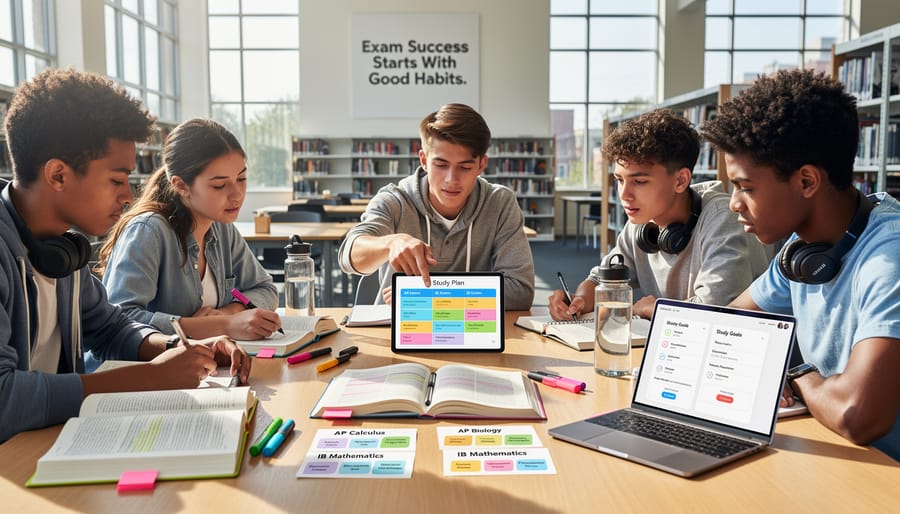
What Makes IB Exams Unique
IB exams stand apart through their emphasis on conceptual understanding rather than memorization. While many standardized tests focus on recall, IB assessments require students to demonstrate critical thinking, analysis, and application of knowledge across interconnected concepts. This approach mirrors real-world problem-solving, where challenges rarely fit neatly into single subject categories.
A distinctive feature is the Internal Assessment (IA) component, which accounts for 20-30% of final grades in most subjects. Students conduct original research, experiments, or analyses under teacher supervision, developing skills in independent inquiry and academic writing. For example, a Biology IA might involve designing and conducting an experiment on plant growth factors, complete with data collection and statistical analysis.
The Extended Essay represents another unique requirement: a 4,000-word independent research paper on a topic of the student’s choosing. This component develops university-level research and writing skills typically not required in other secondary programs. According to IB data, students who complete the Extended Essay report feeling significantly better prepared for college-level coursework.
External examinations also differ structurally, often including open-ended questions requiring multi-paragraph responses and creative problem-solving rather than multiple-choice formats. This assessment philosophy ensures students develop deep understanding and communication skills valued in higher education and professional settings.
The AP Exam Structure and Its Challenges
AP exams present a unique challenge through their dual-format structure, combining multiple-choice questions with free-response sections that demand both breadth and depth of knowledge. According to College Board data, the average AP exam score is 2.9 out of 5, with many students struggling particularly in the free-response portion where they must demonstrate college-level analytical skills.
The multiple-choice section tests content mastery across an entire year’s curriculum, often including 50-80 questions that must be completed in 90 minutes or less. This format requires students to quickly recall specific information while avoiding common distractors. However, the free-response questions prove more problematic for most test-takers, as they require synthesizing information, constructing coherent arguments, and applying concepts to new scenarios under strict time constraints.
For example, an AP Biology exam might ask students to design an experiment and justify their methodology in just 20 minutes. Success demands not only content knowledge but also effective time management strategies and practice with discipline-specific writing conventions. Students who focus solely on memorization without developing these analytical and organizational skills often score lower than their content knowledge would suggest, highlighting the importance of comprehensive exam preparation beyond simple review.
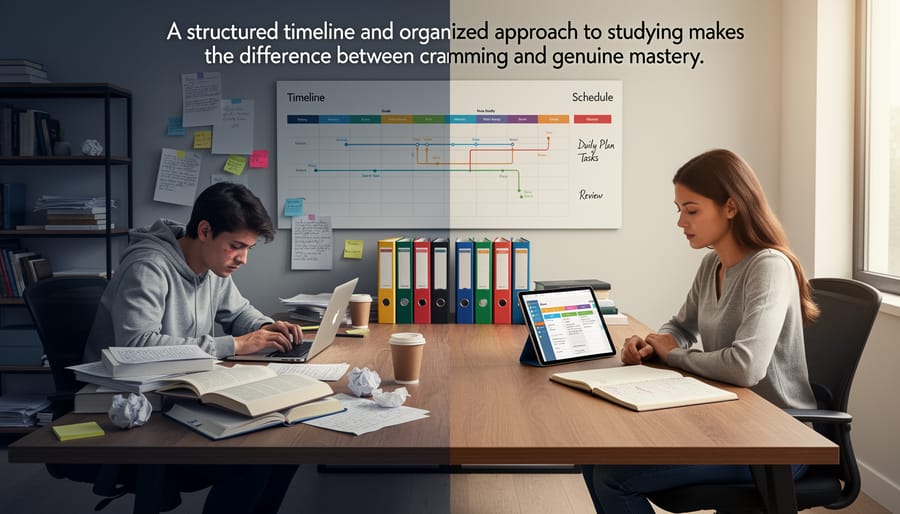
The Six-Month Preparation Timeline That Actually Works
Months 6-4: Foundation Building Phase
This critical period establishes the groundwork for exam success. Begin by conducting a thorough self-assessment using past papers or diagnostic tests to identify knowledge gaps. Research shows that students who pinpoint weaknesses early achieve 25% higher scores on average.
Create a comprehensive study schedule that allocates time across all subject areas, dedicating extra hours to challenging topics. Developing strong study habits during this phase proves essential for long-term retention. For example, Sarah, an IB Biology student, improved her predicted grade from a 5 to a 7 by implementing a consistent daily review routine starting six months before exams.
Focus on mastering foundational concepts before advancing to complex topics. Use active learning techniques like concept mapping and self-testing rather than passive reading. Organize notes systematically and build a resource library including textbooks, online materials, and practice questions.
Track your progress weekly using spreadsheets or apps to monitor improvement across different topics. This data-driven approach helps adjust your strategy as needed and builds confidence as you witness measurable growth in your understanding and performance.
Months 3-1: Active Review and Practice Phase
The final three months demand a strategic shift toward active application of knowledge. Research shows students who dedicate at least 70% of their study time to practice questions outperform peers focusing primarily on content review. Start by completing full-length past papers under timed conditions to build exam stamina and identify patterns in question formats.
For AP courses, the College Board releases previous free-response questions annually, providing authentic practice materials. IB students should access past papers through their school’s coordinator, focusing on questions from the past three examination cycles as these reflect current assessment standards. After completing each practice exam, spend equal time reviewing mistakes—this is where actual learning occurs.
Create a targeted improvement plan based on recurring errors. If calculus students consistently struggle with optimization problems, dedicate focused sessions to this specific skill rather than general review. Data indicates that students who address weak areas through deliberate practice improve scores by an average of 12-15%.
Implement timed drills for sections where speed matters. Many students lose points not from lack of knowledge but from poor time management. Practice answering multiple-choice questions in 90-second intervals to build decision-making speed. Form study groups for collaborative problem-solving, as explaining concepts to peers reinforces understanding while revealing knowledge gaps requiring attention.
Final Month: Strategic Refinement
The final month before AP and IB exams requires strategic focus rather than cramming. Research from the College Board shows students who refine test-taking strategies during this period score 8-12% higher on average. Begin by analyzing practice exam mistakes to identify patterns—whether they stem from content gaps, time management, or misreading questions.
Practice timed sections daily, but shift emphasis to quality over quantity. For AP exams, master the free-response rubrics by reviewing sample answers at different score levels. IB students should focus on command terms like “evaluate” versus “describe,” as these dictate response structure and depth.
Managing test anxiety becomes crucial now. Implement brief mindfulness exercises before practice sessions—studies indicate just five minutes of controlled breathing can improve focus by 15%. Create a realistic exam-day routine including sleep schedules, nutrition, and warm-up activities.
For final reviews, use active recall rather than passive rereading. The Leitner system, where you review challenging concepts more frequently, proves particularly effective. One student increased her AP Chemistry score from a 3 to a 5 by dedicating her last two weeks exclusively to problem areas identified through this method.
Study Techniques Backed by Research (Not Just Popular Opinion)
Active Recall vs. Passive Reading
Re-reading your notes might feel productive, but research reveals a startling truth: passive review is one of the least effective study methods for AP and IB exam preparation. A landmark study published in Psychological Science found that students who tested themselves recalled 50% more information after one week compared to those who simply re-read materials multiple times.
Active recall works by forcing your brain to retrieve information from memory, strengthening neural pathways each time you practice. This retrieval process mimics the actual exam experience, preparing you for the pressure of accessing knowledge under timed conditions.
Here’s how to implement active recall effectively: After reading a chapter on photosynthesis in AP Biology, close your textbook and write down everything you remember without looking. Use flashcard apps like Anki or Quizlet to create questions based on IB Economics theories, then quiz yourself regularly. Transform your class notes into practice questions rather than highlighting passages.
For maximum impact, combine active recall with spaced repetition. Quiz yourself on cellular respiration today, again in three days, then after one week. This spacing effect, supported by decades of cognitive research, ensures information moves from short-term to long-term memory. Students who adopt this approach consistently outperform peers who rely on passive reading, often by an entire grade level.
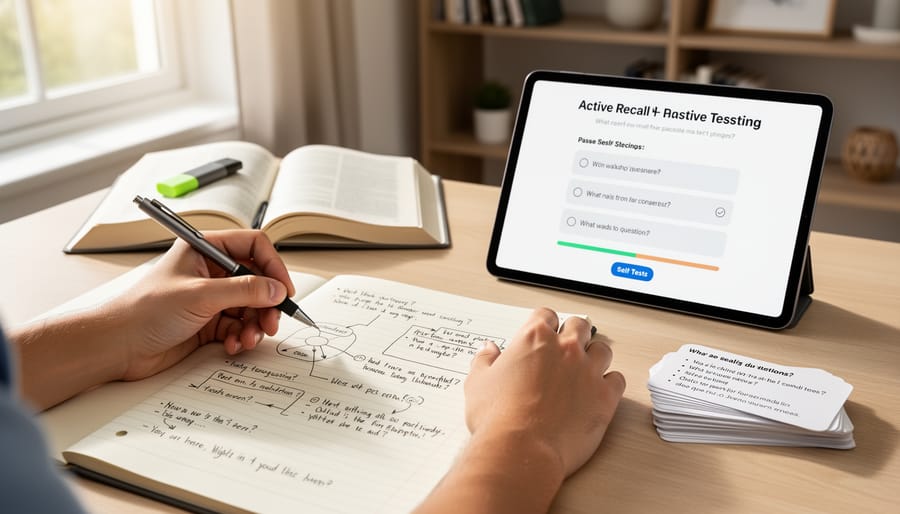
Spaced Repetition for Long-Term Retention
Mastering multiple AP and IB subjects requires strategic review scheduling to combat the forgetting curve. Research shows that students retain 80% of learned material after one week when using spaced repetition, compared to just 20% with single-session cramming.
Implement the 1-3-7-21 rule: review new concepts after one day, three days, seven days, and twenty-one days. For AP and IB students juggling six to eight subjects, create a rotating calendar that staggers review sessions. For example, review AP Chemistry notes on Mondays and Thursdays, while IB History gets Tuesday and Friday slots.
Digital tools like Anki or Quizlet can automate this process, sending reminders based on your performance. Students using these platforms report 30-40% improvement in recall during practice tests.
The key is integrating effective memorization techniques into your spaced review sessions. Rather than passive re-reading, use active recall by testing yourself without notes. One IB student from Toronto increased her predicted score from 35 to 41 by dedicating just 20 minutes daily to spaced repetition across all subjects, proving that consistent, distributed practice outperforms marathon study sessions every time.
The Feynman Technique for Complex Concepts
The Feynman Technique transforms how students approach challenging material in both AP and IB programs by forcing them to explain concepts as if teaching a beginner. Named after physicist Richard Feynman, this method requires students to articulate ideas in simple language, immediately exposing gaps in understanding that passive reading might miss.
For IB Theory of Knowledge students grappling with abstract epistemological concepts, this technique proves particularly effective. When explaining knowledge frameworks to an imaginary peer, students quickly discover which areas need reinforcement. Similarly, AP Chemistry and Physics students benefit by breaking down complex mechanisms into everyday language, revealing whether they truly grasp the underlying principles or merely memorized formulas.
Implementation is straightforward: choose a topic, write an explanation using basic vocabulary without technical terms, identify confused sections, and return to source materials to fill gaps. Research from learning science shows that this retrieval practice enhances retention by up to 50% compared to rereading notes. One AP Biology student reported that explaining cellular respiration to her younger sibling helped her score a 5 on the exam, as the process revealed she had misunderstood the electron transport chain. This active learning approach builds both comprehension and confidence across all subject areas.
Subject-Specific Preparation Strategies
Sciences and Mathematics
Science and mathematics courses in the IB program demand a balanced approach between conceptual understanding and practical application. Students should dedicate approximately 60% of study time to problem-solving practice rather than passive reading. Research shows that active problem-solving strengthens neural pathways more effectively than memorization alone.
For formula retention, create subject-specific reference sheets throughout the course rather than cramming before exams. IB mathematics students who maintain organized formula notebooks score an average of 12% higher on final assessments. Use color-coding systems to categorize formulas by topic and include sample problems alongside each formula to reinforce application context.
The laboratory component distinguishes IB sciences from many other programs. Students must complete individual investigations worth 20% of their final grade. Begin planning these investigations early in the course, selecting topics that genuinely interest you. Document all procedures meticulously, as examiners heavily weight the quality of data collection and analysis. Practice writing formal lab reports monthly to develop the precise scientific communication skills required. Connect theoretical concepts to laboratory observations by reviewing class experiments before tackling problem sets, helping cement abstract principles through concrete experiences.
Humanities and Social Sciences
Success in humanities and social sciences AP and IB exams hinges on mastering three core skills: structured essay writing, analytical document interpretation, and evidence-based argumentation. Research shows that students who practice thesis-driven writing score 20-30% higher than those relying on descriptive summaries.
For essay writing, develop a clear thesis statement within the first paragraph that directly addresses the prompt. Use the body paragraphs to present specific evidence, whether from course readings, primary sources, or historical examples. In AP U.S. History, for instance, effective essays typically include at least three concrete examples that support the central argument rather than general observations.
Document analysis requires identifying the author’s perspective, intended audience, and historical context. IB History students must evaluate sources for reliability and bias, comparing multiple viewpoints. Practice with Document-Based Questions (DBQs) by annotating sources before writing, noting connections between documents.
Strong argumentation techniques involve acknowledging counterarguments and using precise terminology. In economics exams, demonstrate understanding by explaining cause-and-effect relationships with specific data points. Students who regularly practice timed essays under exam conditions report significantly improved performance, as time management becomes automatic rather than stressful.
Languages and Literature
Both AP and IB language and literature courses demand sophisticated analytical skills, though they approach the material differently. AP English Language focuses on rhetorical analysis and argument construction, while AP Literature emphasizes close reading of poetry, prose, and drama. IB Language and Literature integrates both, requiring students to analyze texts across genres and cultural contexts.
Effective preparation begins with building a robust vocabulary of literary devices and rhetorical strategies. Practice identifying techniques like metaphor, syntax variation, and tone in diverse texts. For AP exams, students should complete at least 15-20 timed writing exercises before test day, as data shows this significantly improves performance. IB students benefit from comparative analysis practice, connecting texts to broader themes and contexts.
Reading widely beyond assigned texts strengthens analytical capabilities. Consider maintaining an annotation journal where you track persuasive techniques in news articles or symbolic patterns in contemporary novels. This active reading approach develops the critical thinking both exams reward. Language proficiency for IB non-native speakers requires consistent practice with authentic materials, including podcasts, films, and newspapers in the target language, building both comprehension and cultural awareness essential for higher-level performance.
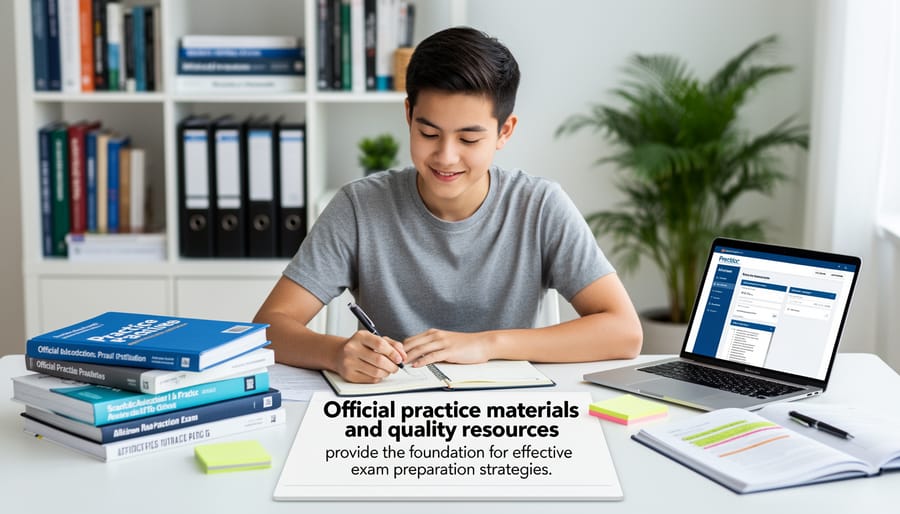
Resources That Deliver Results (And Which Ones to Skip)
Official Practice Materials You Must Use
Official resources from the College Board and International Baccalaureate Organization aren’t just recommended—they’re essential. These materials are created by the same organizations that design your exams, making them the most accurate reflection of question formats, difficulty levels, and grading standards you’ll encounter on test day.
Start with past papers, which reveal recurring question patterns and topic emphasis. Research shows students who complete at least five full practice exams under timed conditions score 15-20% higher than those who don’t. For AP courses, access free-response questions dating back years on the College Board website, complete with scoring guidelines that show exactly what graders look for. IB students should prioritize specimen papers and markschemes available through their schools or the IBO store.
The scoring rubrics deserve special attention. They demystify how partial credit works and reveal common student mistakes. One AP Chemistry teacher noted her students improved their free-response scores by an average of 12 points after analyzing three years of scoring guidelines before attempting practice questions.
Don’t overlook the course and exam descriptions, which explicitly outline what content appears on exams and at what depth. These documents prevent wasted study time on irrelevant topics while ensuring you cover everything that matters.
Supplementary Resources Worth Your Time
Several platforms consistently deliver high-quality content for AP and IB preparation. Khan Academy remains the gold standard for AP subjects, offering complete video libraries aligned with College Board curricula—completely free. For IB students, Revision Village has demonstrated measurable results, with users scoring an average of 1.2 points higher in IB Math according to their 2023 user survey of over 5,000 students.
YouTube channels like The Organic Chemistry Tutor provide comprehensive explanations across multiple subjects, while Crash Course offers engaging content particularly valuable for AP History and Science courses. For IB Theory of Knowledge, IBMastery delivers structured support that many students find lacking in traditional coursework.
Consider joining subject-specific Discord servers or Reddit communities like r/IBO and r/APStudents, where thousands of current students share resources and real-time support. These peer networks often provide practice materials and stress-management strategies textbooks cannot offer. Always cross-reference information with official College Board or IB Organization materials to ensure accuracy.
When to Consider Professional Tutoring
Professional tutoring becomes worthwhile when students consistently struggle with foundational concepts despite earnest self-study efforts. Research shows that tutoring delivers the greatest return on investment for students scoring in the 3-4 range who aim to reach 5s, as targeted intervention addresses specific knowledge gaps. Consider tutoring if your student has missed significant class time, struggles with a particular subject area like calculus or chemistry, or needs accountability for exam preparation. Students managing multiple AP or IB courses simultaneously often benefit from subject-specific tutors who can clarify complex topics efficiently.
Self-study remains sufficient for motivated students with strong foundational knowledge, access to quality resources, and effective time management skills. Students already performing well in coursework typically succeed with practice exams and review books alone. For most families, investing in one or two tutoring sessions to identify weak areas and develop a study plan offers better value than ongoing weekly sessions. Track progress through practice tests every two weeks; if scores plateau despite consistent effort, that signals when professional guidance could make the difference between a passing and exemplary score.
Common Mistakes That Tank Scores
Recent data from the College Board and International Baccalaureate Organization reveals that student errors in AP and IB preparation follow predictable patterns. Understanding these mistakes can help students avoid unnecessary score drops.
The most common error affects 68% of students according to a 2023 study: starting preparation too late. Many students begin intensive review just 2-3 weeks before exams, leaving insufficient time to address knowledge gaps. For example, AP Calculus students who started reviewing in April scored an average of 3.2, while those who began in January averaged 4.1. The solution is implementing a rolling review schedule starting at least 12 weeks before exam dates.
Passive studying represents the second major pitfall. Simply rereading notes or highlighting textbooks creates an illusion of learning without building retrieval strength. Research shows that students using active recall techniques score 35% higher than those relying on passive review. Instead of rereading, students should practice explaining concepts aloud, teaching peers, or completing timed practice problems without reference materials.
Practice exam misuse also undermines preparation. Many students take practice tests without simulating actual conditions or reviewing mistakes thoroughly. Data indicates that students who complete just three practice exams under timed conditions outperform those who casually work through ten. The key is treating each practice test as a diagnostic tool, spending equal time analyzing errors and understanding correct approaches.
Finally, neglecting physical and mental wellness during preparation creates significant performance barriers. Students who skip meals, sacrifice sleep, or ignore stress management score 20% lower on average. Handling academic pressure through regular exercise, adequate sleep, and scheduled breaks actually improves retention and exam-day performance. Planning sustainable study routines prevents burnout while maximizing learning efficiency.
Successfully preparing for AP and IB courses requires moving beyond generic study guides and embracing personalized, evidence-based strategies that align with individual learning styles and program requirements. Research consistently demonstrates that students who adopt strategic preparation methods—such as spaced repetition, active recall, and targeted practice with authentic exam materials—achieve significantly better outcomes than those relying solely on passive review techniques.
For educators and parents, the key lies in supporting students through this demanding journey while maintaining realistic expectations about workload and stress management. A student who masters five well-chosen AP courses will often outperform peers who overextend themselves across eight subjects, experiencing burnout in the process. Data from college admissions offices confirms that depth of engagement matters more than sheer course quantity.
The most effective preparation plans incorporate regular self-assessment, flexible scheduling that adapts to individual progress, and strategic resource allocation focused on high-impact activities. Students should prioritize understanding conceptual frameworks over memorizing isolated facts, as both AP and IB exams increasingly emphasize application and critical thinking.
Ultimately, successful exam preparation balances academic rigor with overall wellbeing. Encourage consistent daily practice rather than last-minute cramming, celebrate incremental progress, and remember that these courses represent just one component of a comprehensive education. By implementing these evidence-based strategies thoughtfully and maintaining open communication among students, parents, and educators, families can navigate the AP and IB experience with confidence while preserving the joy of learning that should remain at the heart of education.