



Recognize multilingual students as assets to your classroom—they bring cognitive flexibility, cross-cultural perspectives, and enhanced problem-solving skills that research shows benefit all learners. These students speak, understand, or are learning multiple languages, representing approximately 10.4 million children in U.S. schools alone, with numbers growing annually. Their experiences range from recent arrivals navigating a new language system to students who have spent years balancing multiple languages in academic settings.
Build on their existing language strengths rather than viewing their home language as a barrier. Studies from Stanford University demonstrate that students who maintain their first language while learning English show stronger literacy development across both languages. This approach mirrors effective strategies for helping struggling students—meeting learners where they are and scaffolding from their strengths.
Focus on the reality that these students face unique challenges: simultaneously mastering content and language, navigating cultural differences, and often carrying the weight of family expectations. Yet they consistently demonstrate remarkable resilience and adaptability. Data from the National Education Association reveals that when educators implement targeted, research-backed strategies, multilingual students match or exceed their monolingual peers’ academic achievement within five to seven years.
The following strategies transform these challenges into opportunities, offering concrete approaches that respect linguistic diversity while accelerating academic growth. These methods work because they address both language development and content mastery simultaneously, creating classrooms where every student’s background strengthens the learning community.
Understanding the Multilingual Student Experience
Who Are Multilingual Students?
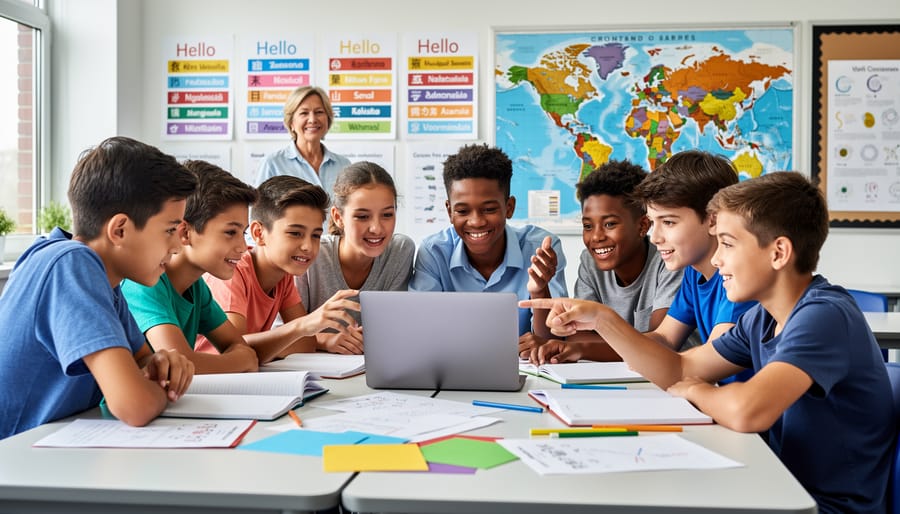
Multilingual students are learners who speak, understand, or are exposed to more than one language in their daily lives. This diverse group includes English Language Learners (ELLs) who are actively developing English proficiency while maintaining their home language, heritage speakers who grew up hearing a language at home but may have limited formal training in it, and students from bilingual or multilingual households where multiple languages are used interchangeably.
According to the National Center for Education Statistics, approximately 5.1 million students, or about 10.4% of all public school students in the United States, are classified as English learners. However, the actual number of multilingual students is significantly higher when we include heritage speakers and bilingual students who are already proficient in English.
Consider Maria, a fifth-grader who speaks Spanish at home with her parents and English at school, seamlessly switching between both languages depending on context. Or Ahmed, whose family speaks Arabic at home, but who has attended English-medium schools since kindergarten. These students bring valuable linguistic and cultural assets to the classroom, yet they may face unique challenges in academic settings that require specific support strategies.
Multilingual students come from hundreds of different language backgrounds, with Spanish, Arabic, Chinese, Vietnamese, and Somali being among the most common home languages in U.S. schools. Understanding this diversity is the first step toward creating inclusive, effective learning environments that honor students’ linguistic identities while supporting their academic growth.
The Hidden Strengths Multilingual Students Bring
While multilingual students may face language-related challenges in the classroom, research consistently shows they possess remarkable cognitive advantages that often go unrecognized. Understanding these strengths allows educators to build on existing capabilities rather than focusing solely on perceived deficits.
Studies from leading universities demonstrate that students who speak multiple languages develop enhanced executive function skills. A 2019 study published in the Journal of Educational Psychology found that multilingual learners outperformed their monolingual peers in problem-solving tasks requiring mental flexibility. These students regularly switch between language systems, which strengthens their ability to shift perspectives and adapt strategies when facing complex challenges.
The metacognitive benefits are equally impressive. Multilingual students develop heightened awareness of how language works, making them more analytical about communication patterns and meaning. For example, a fifth-grade student fluent in Spanish and English might recognize that the word order in questions differs between languages, demonstrating sophisticated linguistic analysis that enhances overall literacy skills.
Cultural awareness represents another powerful asset. These students navigate multiple cultural frameworks daily, developing nuanced understanding of diverse perspectives. Research from Stanford University indicates that this cultural flexibility correlates with improved collaboration skills and creative thinking. In group projects, multilingual students often bridge communication gaps and suggest innovative solutions by drawing from different cultural problem-solving approaches.
Memory and attention benefits also emerge consistently in research. The cognitive workout of managing multiple languages strengthens working memory capacity. A 2020 study tracking 3,000 students across ten schools found that multilingual learners demonstrated 15% better performance on tasks requiring sustained attention and information retention.
These strengths represent valuable classroom assets. When educators recognize and leverage these cognitive advantages, they create learning environments where multilingual students thrive while enriching the educational experience for all learners.
Core Multilingual Education Strategies That Work
Translanguaging: Letting Students Use Their Full Language Toolkit
Translanguaging is a teaching approach that recognizes all languages a student knows as valuable resources rather than separate systems. Unlike traditional methods that insist on English-only instruction, translanguaging encourages students to flexibly use their entire linguistic repertoire to make sense of new concepts and demonstrate understanding.
Research from the City University of New York shows that when students engage in translanguaging, they achieve deeper comprehension and retain information more effectively. This happens because students can access prior knowledge stored in any language and build cognitive connections across their linguistic experiences.
In practice, translanguaging might look like a middle school science teacher allowing students to discuss photosynthesis with a partner in their home language before writing a lab report in English. Or an elementary teacher creating a word wall that includes key vocabulary in multiple languages, helping students see connections between cognates and build metalinguistic awareness.
One high school math teacher in Texas saw remarkable results when she permitted students to work through word problems using both Spanish and English. Students who previously struggled suddenly participated actively, explaining their reasoning by drawing on whichever language best expressed the mathematical concept.
To implement translanguaging effectively, start small. Designate specific activities where students can use any language, such as brainstorming sessions, peer discussions, or initial drafts. Create bilingual anchor charts and welcome multilingual responses during class discussions. Partner students who share a home language for collaborative tasks, and consider allowing bilingual dictionaries or translation apps during independent work.
The key is intentionality. Communicate clearly when and how students can use their languages, and help them understand that this approach strengthens rather than replaces English development. When students see their home languages valued in academic spaces, engagement increases and learning deepens across all subject areas.
Scaffolding Content Without Watering It Down
Making grade-level content accessible to multilingual students doesn’t mean simplifying the curriculum or lowering expectations. Instead, effective scaffolding provides structured support that helps students engage with rigorous material while developing both content knowledge and language skills simultaneously.
Visual supports serve as powerful tools for comprehension. Charts, diagrams, photographs, and graphic organizers help students grasp complex concepts without relying solely on language proficiency. For example, when teaching the water cycle, a labeled diagram allows students to understand evaporation and condensation even while they’re still mastering the vocabulary. Research from Stanford University shows that students who receive visual scaffolding demonstrate 34% higher comprehension of grade-level science content compared to text-only instruction.
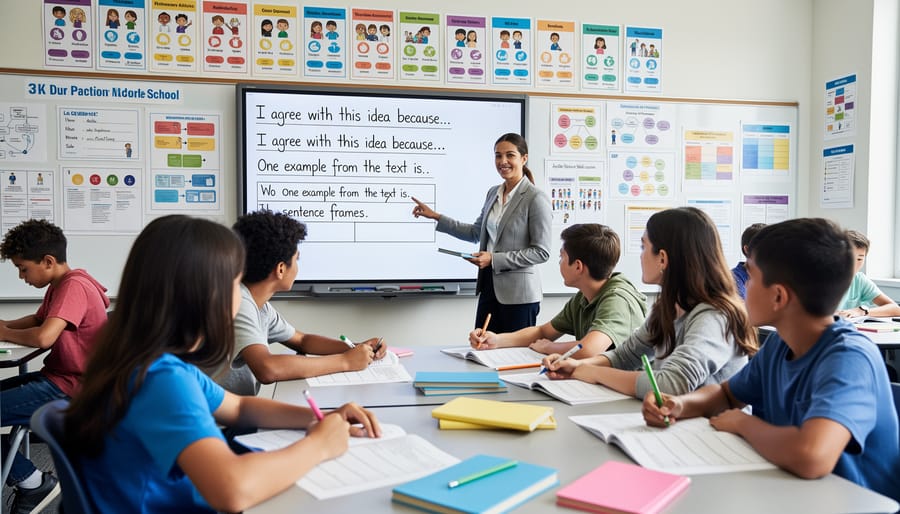
Sentence frames and stems provide language structures that enable students to participate in academic discussions and writing tasks. Rather than asking open-ended questions that might overwhelm emerging English speakers, frames like “I believe ____ because ____” or “The evidence shows ____ which means ____” give students the linguistic architecture to express sophisticated ideas. These supports help multilingual learners improve in difficult subjects by removing language barriers while maintaining cognitive challenge.
Graphic organizers such as Venn diagrams, T-charts, and concept maps break down complex information into manageable chunks. They help students organize their thinking visually before translating ideas into written or spoken language.
Strategic collaborative grouping amplifies learning opportunities. Pairing multilingual students with peers creates natural language practice while ensuring all students engage with grade-level content. Intentional grouping by complementary strengths rather than language proficiency alone fosters genuine academic collaboration where all members contribute meaningfully to shared learning goals.
Building Academic Language Across Subjects
Multilingual students need explicit instruction in academic language to succeed across all content areas. Each subject has unique vocabulary, sentence structures, and ways of communicating that differ significantly from everyday conversation.
In mathematics, teachers should pre-teach terms like “sum,” “product,” and “quotient” before introducing new concepts, while also addressing confusing words with multiple meanings, such as “table” or “difference.” Sentence frames help students articulate their reasoning: “I know this because…” or “The pattern shows that…” Research from Stanford University indicates that multilingual learners who receive explicit instruction in mathematical language show 23% higher achievement on problem-solving tasks.
Science instruction benefits from visual supports paired with technical vocabulary. When teaching photosynthesis, for example, use labeled diagrams alongside words like “chlorophyll” and “glucose.” Encourage students to practice using complete sentences: “The plant absorbs sunlight through its leaves” rather than single-word responses. Data from the National Science Teachers Association shows that combining visual and linguistic support increases retention by 40% for multilingual learners.
In social studies, focus on discourse patterns like cause-and-effect relationships and comparing perspectives. Provide sentence starters such as “One consequence was…” or “From this viewpoint…” to help students organize historical thinking.
Language arts instruction should emphasize literary terms and text structures. Teach words like “protagonist” and “metaphor” explicitly, and model how to discuss themes using academic phrases: “The author suggests that…” Regular practice with these language structures builds confidence and competence across all academic contexts.
Creating a Culturally Responsive Classroom Environment
Creating a culturally responsive classroom environment begins with validating students’ linguistic and cultural identities as assets rather than obstacles. Display multilingual welcome signs, student work in home languages, and culturally diverse books that reflect your students’ backgrounds. Research shows that when students see their cultures represented, engagement increases by up to 40%.
Incorporate diversification in learning by selecting curriculum materials that feature diverse authors, perspectives, and examples from students’ home countries. For instance, a teacher in Toronto incorporated folktales from students’ native cultures into literacy lessons, resulting in improved participation and storytelling skills.
Family engagement proves essential. Provide translated communications, invite families to share cultural traditions, and create opportunities for parents to contribute expertise. One elementary school in Vancouver established monthly cultural celebration days where families presented traditions, languages, and foods, strengthening the home-school connection.
Most importantly, explicitly validate home languages as valuable resources. Encourage students to use their first language for thinking, discussing with peers, and expressing complex ideas. This practice, called translanguaging, supports cognitive development and maintains cultural identity while building English proficiency.
Assessment Strategies for Multilingual Learners
Alternative Assessment Methods
Traditional tests often mask what multilingual students truly understand, particularly when language barriers interfere with content knowledge demonstration. Research from Stanford University shows that alternative assessment methods can reveal up to 40% more of these students’ actual comprehension compared to standardized testing alone.
Formative assessments provide ongoing feedback without high-stakes pressure. Quick checks like exit tickets with visual options, thumbs-up/thumbs-down responses, or drawings allow students to show understanding without extensive writing. For example, a fifth-grade science teacher in Texas uses daily sketch-and-label activities where students draw the water cycle stages and add simple vocabulary, accommodating various language proficiency levels while assessing content mastery.
Performance-based assessments let students demonstrate knowledge through action. These include science experiments with observation checklists, math problem-solving using manipulatives, or oral presentations with visual aids. A middle school social studies teacher reports that allowing students to create video presentations about historical events, rather than written essays, increased assessment scores by an average of 25% among her multilingual learners.
Portfolio approaches track growth over time, showcasing progress rather than isolated performance. Students compile work samples, self-reflections, and multimedia projects that highlight their learning journey. This method particularly benefits newcomers who may show rapid development that single assessments miss.
Key modifications include extended time, bilingual dictionaries, sentence frames, and allowing responses in students’ native language when assessing content rather than English proficiency. One elementary principal implemented these changes district-wide and observed a 30% improvement in multilingual students’ demonstrated content knowledge within one academic year.
Avoiding Common Assessment Pitfalls
Many educators unintentionally disadvantage multilingual students through common assessment mistakes. One frequent error is confusing language proficiency with content knowledge. For example, a student who understands complex mathematical concepts may score poorly on a word-heavy math test simply due to language barriers, not mathematical ability. Research shows that 65% of multilingual students perform better on assessments when language demands are reduced without compromising academic rigor.
Another pitfall is relying solely on standardized tests that don’t account for cultural and linguistic diversity. A student from a different educational system may be unfamiliar with multiple-choice formats or specific testing conventions used in their new country.
To avoid these issues, implement multiple assessment methods including portfolios, oral presentations, and visual demonstrations. Provide extra time for reading and processing, use simplified language in instructions without dumbing down content, and allow students to demonstrate knowledge in various ways. Consider partnering bilingual assessments where students can show understanding in their home language initially. Regularly review assessment data disaggregated by language background to identify patterns suggesting bias. These practical adjustments create fairer evaluation systems that accurately measure what multilingual students truly know and can do.
Technology Tools That Support Multilingual Education
Technology has revolutionized how educators support multilingual students, offering innovative solutions that bridge language gaps and personalize learning experiences. These digital tools provide practical pathways for students to access content in multiple languages while developing proficiency in their target language.
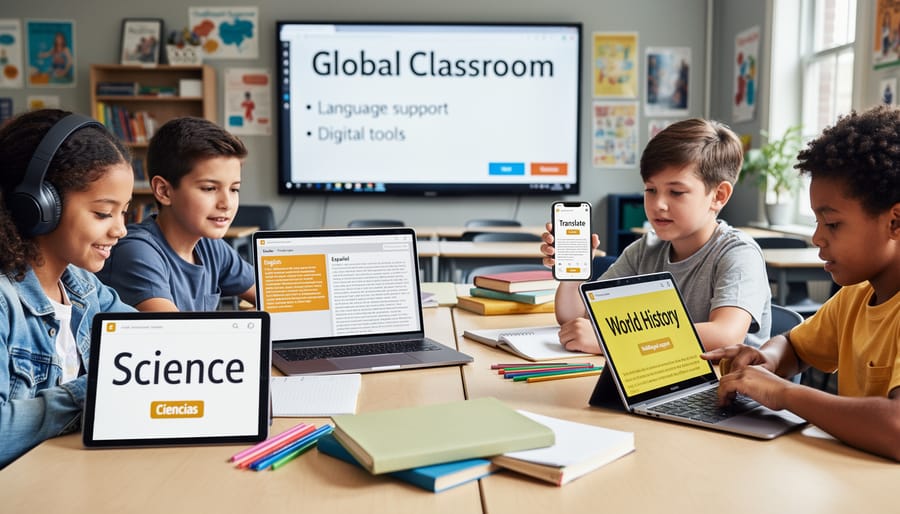
Translation and language learning platforms stand at the forefront of multilingual education. Google Translate for Education enables real-time translation of instructional materials, while apps like Duolingo and Babbel offer structured language acquisition programs. Research from the University of California found that students using translation apps alongside traditional instruction showed 23% faster vocabulary retention compared to those without digital support.
AI-powered learning tools have transformed personalized instruction for multilingual learners. Platforms like Rosetta Stone and Language Muse adapt to individual proficiency levels, providing targeted practice in areas where students struggle. Microsoft’s Immersive Reader, integrated into many learning management systems, offers text-to-speech in multiple languages, adjustable reading speeds, and picture dictionaries that support comprehension across content areas.
Communication platforms such as Flipgrid enable multilingual students to respond to prompts in their preferred language, building confidence while practicing new language skills. Meanwhile, collaborative tools like Padlet and Google Workspace allow students to contribute to group projects using translation features, ensuring full participation regardless of language proficiency.
Specific classroom applications include using Seesaw for multilingual family engagement, where parents receive updates and assignments in their home language. Khan Academy and educational YouTube channels offer content in dozens of languages, allowing students to preview concepts in their native language before tackling them in English. One Texas elementary school reported 40% improvement in parent participation after implementing multilingual communication tools.
For vocabulary development, Quizlet supports flashcard creation in multiple languages, while apps like Explain Everything allow teachers to create annotated lessons with multilingual audio narration, ensuring students can access content repeatedly at their own pace.
Partnering With Families of Multilingual Students
Effective partnerships with families of multilingual students create powerful support systems that enhance learning outcomes. Research shows that when schools actively engage multilingual families, students demonstrate higher academic achievement and improved social-emotional development. However, building strong relationships requires intentional strategies that acknowledge linguistic and cultural differences.
Start by addressing communication barriers directly. Provide translated materials in families’ home languages for important documents, newsletters, and school updates. When translation services aren’t available, leverage technology tools or community volunteers who speak the language. Schedule parent-teacher conferences with interpreters present, and consider offering flexible meeting times to accommodate different work schedules.
View families as valuable assets rather than obstacles to overcome. Multilingual families bring rich linguistic and cultural knowledge that enhances classroom learning. For example, a Chicago elementary school invited parents to share traditional stories in their home languages, which teachers then incorporated into literacy lessons. This approach resulted in a 23% increase in family engagement over one year.
Create multiple channels for family involvement beyond traditional volunteering. Some families may feel more comfortable contributing through video recordings, sharing cultural artifacts, or participating in virtual events. Survey families about their preferred communication methods and involvement opportunities.
Consider hosting informal gatherings like coffee mornings or cultural celebration events where families can connect with each other and school staff in low-pressure settings. These interactions build trust and demonstrate that the school values their presence and perspectives as essential partners in their children’s education.

Multilingual students are not learners with deficits to be remedied, but rather individuals with rich linguistic and cultural assets that enrich our classrooms. Research consistently shows that when educators implement intentional, culturally responsive strategies, these students don’t just survive—they thrive academically while maintaining their valuable home languages. A 2022 study found that schools using asset-based approaches saw multilingual students achieve academic gains 40% faster than those using deficit-focused models. The key is recognizing that supporting multilingual learners doesn’t require overhauling your entire teaching practice overnight. Start small by choosing one strategy that resonates with your classroom context—perhaps incorporating visual supports, allowing collaborative learning opportunities, or greeting students in their home languages. As you witness the positive impact, gradually build your repertoire. Remember, every step you take toward honoring linguistic diversity sends a powerful message that all students belong and can succeed in your classroom.