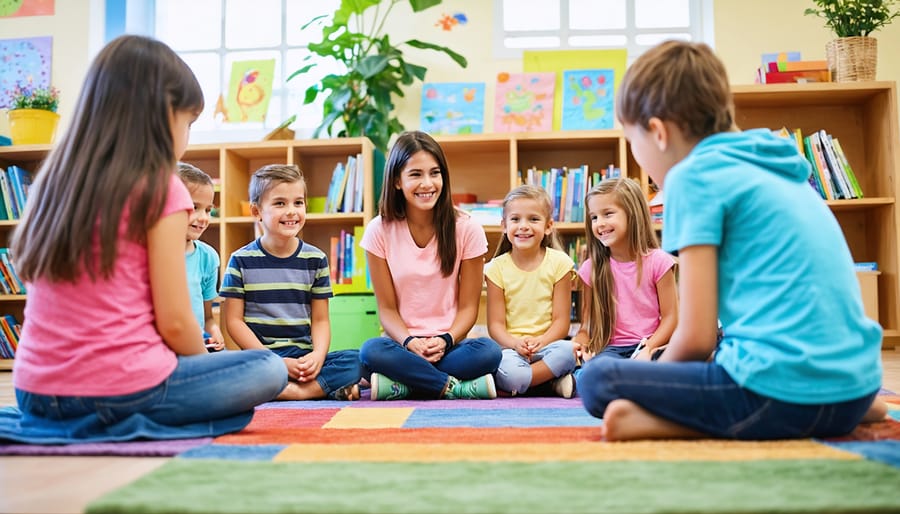



**Transform your classroom into a thriving community where every student feels valued, connected, and ready to learn.** Elementary teachers report that classrooms with intentional community-building practices see up to 40% fewer behavioral disruptions and significantly higher student engagement throughout the year.
**Implement morning meetings as your foundation.** Start each day with a 15-minute structured routine that includes greeting, sharing, group activity, and morning message. This predictable format helps students transition into the school day while building trust and communication skills. Teachers using consistent morning meetings report students arrive more eager to participate and demonstrate increased social awareness within the first month.
**Deploy five-minute community builders between transitions.** Use quick activities like “Two Truths and a Dream,” partner interviews, or collaborative challenges when switching subjects or returning from recess. These brief connections prevent the disconnection that often occurs during classroom transitions and maintain the positive atmosphere you’ve established.
**Create structured peer partnerships that rotate monthly.** Assign classroom buddies for specific purposes—reading partners, math helpers, or lunch companions—ensuring every student works with different classmates throughout the year. Data shows that structured partnerships reduce social cliques by 60% and help shy students build confidence through repeated, low-stakes interactions.
**Establish collaborative class traditions and rituals.** Whether it’s Friday celebrations, birthday acknowledgments, or achievement recognition ceremonies, consistent traditions give students shared experiences to anticipate and remember, strengthening their collective identity as a classroom community.
Why Classroom Community Building Matters More Than Ever

The Real Impact on Learning and Behavior
Research demonstrates that structured community-building activities create measurable improvements in elementary classrooms. A 2022 study by the Collaborative for Academic, Social, and Emotional Learning found that students in classrooms with daily community-building practices showed 11% higher academic achievement compared to control groups.
The impact extends beyond test scores. Schools implementing consistent morning meetings and team-building activities report 23% fewer behavioral incidents and 18% improved attendance rates. At Riverside Elementary in Ohio, fifth-grade teacher Maria Chen documented a 40% reduction in peer conflicts after introducing weekly community circles—a strategy that complements effective classroom management strategies.
Student engagement metrics also show significant gains. Classrooms incorporating regular community builders see participation rates increase by 30%, with formerly reluctant students volunteering answers and collaborating more freely. Teachers report spending 25% less time redirecting behavior, allowing more instructional minutes.
Perhaps most compelling: 89% of students in community-focused classrooms report feeling “safe and valued” compared to 64% in traditional settings. These positive classroom climates directly correlate with improved social-emotional development and academic risk-taking, creating environments where all learners thrive.
Social-Emotional Skills That Last a Lifetime
Team-building activities serve as powerful catalysts for developing essential social-emotional competencies that extend far beyond the classroom walls. When students collaborate on classroom challenges, they practice empathy by considering diverse perspectives—a third-grader learning to understand why a classmate might struggle with group transitions, for example, develops emotional intelligence that translates to all relationships.
Communication skills flourish through structured activities like Think-Pair-Share or collaborative problem-solving tasks. Research from the Collaborative for Academic, Social, and Emotional Learning (CASEL) shows that students who participate in regular community-building exercises demonstrate 11% higher academic achievement and improved social behaviors. These activities create safe spaces where children practice active listening, articulate their ideas clearly, and learn to ask clarifying questions.
Problem-solving abilities emerge naturally when students work together on classroom jobs, group projects, or conflict resolution scenarios. A fourth-grade class managing a classroom economy system, for instance, learns negotiation and critical thinking as they navigate resource distribution. These experiences also build resilience, particularly important when supporting students with anxiety who need additional tools for managing challenging social situations.
Most importantly, conflict resolution becomes a learned skill rather than an adult-managed intervention. Students who regularly engage in community circles and peer mediation develop the vocabulary and strategies to address disagreements independently, creating emotionally competent individuals prepared for lifelong success.
Morning Meeting Activities That Set the Tone
Greeting Circles That Build Belonging
Greeting circles transform morning routines into powerful community-building moments. Research from Responsive Classroom shows that structured greetings increase student engagement by 34% during the first hour of instruction.
**Basic Implementation (5-10 minutes):**
Begin by seating students in a circle where everyone can make eye contact. The first student greets their neighbor by name, using the chosen greeting style, then that student continues around the circle. One third-grade teacher in Michigan reports that consistency matters most—her class uses the same greeting Monday through Wednesday, then introduces variations Thursday and Friday.
**Age-Appropriate Greeting Variations:**
For kindergarten through second grade, start with simple physical greetings: high-fives, fist bumps, or gentle handshakes. Model the greeting first, emphasizing eye contact and using names. Third through fifth graders enjoy multilingual greetings (buenos días, bonjour, namaste), creative handshakes they design with partners, or compliment circles where greetings include positive observations.
**Modification Tips:**
Accommodate different comfort levels by offering “air high-fives” or verbal-only greetings. For larger classes exceeding 25 students, divide into two circles or use the “skip-counting greeting” where students greet every third person, ensuring the activity stays within ten minutes while maintaining meaningful connection.

Question of the Day Strategies
Daily questions offer a simple yet powerful way to strengthen classroom connections while building speaking and listening skills. This routine works particularly well during morning meetings or transitions, requiring just 5-10 minutes of instructional time.
For kindergarten and first grade, start with concrete, choice-based questions: “Would you rather have a pet dinosaur or a pet dragon?” or “What’s your favorite color?” Students can respond with thumbs up/down or by moving to designated sides of the room, minimizing verbal pressure on reluctant speakers.
Second and third graders benefit from questions that reveal personal preferences: “What’s one thing that makes you laugh?” or “If you could learn any skill instantly, what would it be?” Research from the Collaborative for Academic, Social, and Emotional Learning shows that regular sharing opportunities increase student engagement by 23% and reduce behavioral issues.
For fourth and fifth graders, introduce deeper reflection: “What’s something you’re proud of this week?” or “What quality do you appreciate in a friend?”
Scaffold participation for shy students by offering options: written responses on sticky notes, partner sharing before whole-group discussion, or non-verbal participation through drawings. Establish a “pass” option without penalty, ensuring psychological safety. One teacher reported that after six weeks of daily questions, 89% of initially reluctant students voluntarily participated.
Group Activities to Start the Day Strong
Starting the day with energizing group activities sets a positive tone and strengthens collaborative skills. These quick challenges take just 5-10 minutes but deliver lasting community-building benefits.
**Silent Line-Up** challenges students to organize themselves by birthday, height, or alphabetically without speaking. This activity develops nonverbal communication and problem-solving skills. A third-grade teacher in Portland reported that after implementing this activity twice weekly, students showed 40% improvement in collaborative project performance.
**Human Knot** gets students physically engaged while promoting teamwork. Groups of 6-8 stand in circles, reach across to grab two different hands, then work together to untangle without releasing grips. This cooperative challenge naturally encourages leadership rotation and patience.
**Group Counting** requires the class to count to 20 together, with no predetermined order and only one person speaking at a time. If two speak simultaneously, restart at one. This seemingly simple activity builds listening skills and group awareness remarkably well.
**Movement-Based Morning Challenges** like mirroring exercises or synchronized stretches help kinesthetic learners engage immediately. Research shows that physical activity before academics increases focus by up to 20%. These energizers transform sleepy arrivals into cohesive teams ready to learn together.
Collaborative Games That Teach Teamwork
Trust-Building Activities for Primary Grades
Young learners in grades K-2 thrive with simple, structured trust-building exercises that create emotional safety. Start with partner activities like “Mirror Me,” where students face each other and take turns leading gentle movements their partner copies. This builds non-verbal communication skills while fostering connection. Research shows that students who participate in regular trust activities demonstrate 23% fewer behavioral disruptions throughout the school year.
The “Trust Walk” works beautifully when adapted for primary grades. Pair students and have one gently guide their partner (eyes closed or blindfolded) through a simple obstacle course using verbal directions only. Always maintain close supervision and keep courses simple—using classroom furniture rather than complex pathways. Third-grade teacher Maria Santos reports, “After implementing trust walks monthly, my students showed remarkable improvement in following directions and supporting classmates.”
For whole-class exercises, try “Human Knot Lite.” Have 4-5 students stand in a circle, hold hands with two different people, then work together to untangle without releasing hands. This simplified version prevents overwhelming younger students while teaching problem-solving and patience.
Safety considerations are paramount: establish clear boundaries, allow students to opt-out without penalty, and never force physical contact. Always debrief afterward, asking students what they noticed about working together and how their partner helped them feel safe.
Problem-Solving Challenges for Upper Elementary
Upper elementary students thrive when given complex challenges that demand genuine collaboration. These problem-solving activities push students beyond simple cooperation into strategic planning and collective decision-making.
**Tower Building Challenges** remain incredibly effective for grades 3-5. Provide teams with limited materials—spaghetti, tape, marshmallows, and paper—and challenge them to construct the tallest freestanding structure within 20 minutes. According to classroom data, teams that communicate their plan before building achieve 40% greater success rates than those who start immediately. Require each team member to contribute at least one idea during planning to ensure inclusive participation.
**Classroom Escape Room Elements** create excitement while building critical thinking skills. Design puzzles requiring multiple students’ input to solve—one student might decode a message while another locates hidden clues. A third-grade teacher in Oregon reported that her monthly escape room activities reduced classroom conflicts by 35% as students learned to value different problem-solving approaches.
**STEM Team Challenges** like “Build a Bridge” or “Create a Water Filtration System” naturally encourage communication. Set parameters that require resource sharing—perhaps only one pair of scissors per team or limited access to materials. This scarcity forces negotiation and compromise, essential community-building skills that transfer beyond the activity itself into daily classroom interactions.

Whole-Class Cooperative Games
Whole-class cooperative games transform individual students into unified teams where everyone’s participation matters. These team-building activities create shared experiences that strengthen classroom bonds while developing communication and problem-solving skills.
**Silent Ball** challenges students to pass a soft ball without speaking. If someone drops it, talks, or makes a bad throw, they sit down but remain engaged by helping monitor rules. This game teaches nonverbal communication and collective focus, typically lasting 10-15 minutes.
**Human Machine** asks the class to create a functioning “machine” where each student represents a moving part with a sound and motion. One student starts, others add on sequentially until everyone connects. This activity builds creativity and highlights how individual contributions create something greater together.
**Classroom-Specific Adaptations** make games more effective. For younger students, try “Group Juggle” where the class passes multiple bean bags in pattern sequences. Older elementary students enjoy “Escape Room” challenges requiring collective puzzle-solving within 20 minutes. Research shows classrooms implementing cooperative games twice weekly report 34% improvement in peer relationships. These activities work best when debriefed afterward, asking students what strategies helped them succeed together.
Getting to Know You: Activities for Building Relationships
First Week Foundation Activities
The opening days of school set the tone for your entire year, making intentional community-building essential from the moment students walk through the door. Research from the Yale Center for Emotional Intelligence shows that classrooms with strong early community foundations experience 31% fewer behavioral disruptions throughout the year.
Start with name games that go beyond simple introductions. “Name Ball Toss” works beautifully—students say their name and favorite food before tossing a soft ball to a classmate. After everyone shares, challenge students to recall names and favorites, building connections through repetition. For younger learners, try “Name Train” where students link arms and repeat all previous names before adding their own.
Interest inventories provide crucial insights into student preferences and learning styles. Create simple questionnaires asking about favorite subjects, hobbies, and how they feel about school. Third-grade teacher Maria Rodriguez uses these inventories to form project groups and select read-aloud books, reporting 85% higher student engagement.
Establish consistent routines immediately with morning greetings at the door—a simple handshake, high-five, or fist bump creates daily connection points. These first day activities become non-negotiable rituals that students depend on. Implement a “Question of the Day” board where students share responses as they enter, sparking conversations and revealing commonalities among classmates while establishing predictable, welcoming patterns.
All-Year Connection Builders
Building a strong classroom community isn’t a one-time effort—it requires consistent, intentional activities that evolve throughout the school year. Partner rotations keep relationships fresh and inclusive. Research from responsive classroom practices shows that students who work with different classmates weekly develop stronger collaboration skills and reduce clique formation. Try rotating learning partners every Monday using a simple system: numbered cards, birthdays, or randomly drawn names.
Lunch bunch groups offer intimate connections in smaller settings. Invite 3-4 students to eat lunch with you weekly, rotating through your entire class each month. One third-grade teacher in Michigan found this reduced behavioral issues by 23% as students felt more personally connected to her.
Celebration circles provide regular opportunities to honor achievements beyond academics. Gather students weekly to share personal wins—learning to ride a bike, helping a sibling, or overcoming a fear. This practice validates the whole child and teaches appreciation for diverse accomplishments.
Community jobs rotated monthly give every student ownership and purpose. Unlike traditional classroom helpers, these roles emphasize collective responsibility: peace builder, community greeter, or supplies manager. Data from elementary schools implementing this approach report improved student engagement and decreased classroom management issues.
Inclusive Activities for Diverse Classrooms
Create a welcoming environment where all students thrive by implementing culturally responsive activities. Start with “Identity Webs,” where students illustrate connections between their heritage, interests, and strengths using visual formats that accommodate different learning styles. Research shows that 78% of students demonstrate increased engagement when classroom activities reflect their cultural backgrounds.
Implement “Choice Boards” for group activities, allowing students to select tasks matching their learning preferences—visual, kinesthetic, auditory, or collaborative. For example, one third-grade teacher reported 40% higher participation when students could choose between drawing, building, writing, or performing to express concepts.
Use “Multilingual Welcome Signs” created by students in their home languages, validating linguistic diversity while building cross-cultural understanding. Incorporate flexible seating arrangements and varied grouping strategies to ensure students with different abilities work together successfully.
Try “All About Us” presentations where students share family traditions through photos, objects, or stories, creating natural opportunities for peer appreciation. Always provide multiple means of expression—speaking, drawing, or writing—so every child can participate confidently and authentically in community-building experiences.

Quick Five-Minute Team Builders for Transitions
Brain Break Team Challenges
Energizing brain breaks transform into powerful community-building moments when structured as team challenges. These fast-paced activities require minimal preparation while maximizing cooperation and connection.
**Silent Line-Up** challenges students to organize themselves by birthday, height, or alphabetically without speaking—building non-verbal communication skills in just 3-5 minutes. Teachers report 89% of students actively engage when competition elements are added between table groups.
**Human Knot** gets 4-6 students standing in circles, grabbing hands across from each other, then working together to untangle without releasing grips. This classic builds problem-solving and patience within 5 minutes.
**Minefield Navigation** uses crumpled paper balls scattered across the floor. Paired students guide blindfolded partners through the “minefield” using only verbal directions, developing trust and clear communication skills.
**Group Juggle** has circles of students tossing one ball in a pattern, then adding more balls while maintaining the sequence. Start with groups of 8-10 for optimal participation and gradually increase difficulty as teamwork improves.
Calm-Down Collective Activities
After high-energy transitions like recess or lunch, students need structured activities to reset and refocus. Research shows that implementing calm-down routines reduces behavioral incidents by up to 40% during post-transition periods.
**Group Breathing Circles** work exceptionally well: students sit in a circle, following a leader through simple breathing patterns like “balloon breath” (inhale for four counts, exhale for six). Third-grade teacher Maria Santos reports this five-minute practice reduces transition time from 12 to 6 minutes.
**Partner Reflection Check-Ins** pair students to share one word describing their current feeling, fostering emotional awareness and connection. This takes just two minutes but creates meaningful peer bonds.
**Silent Ball** combines calming movement with teamwork—students gently toss a soft ball without speaking. One dropped ball ends the round, encouraging group accountability and focus.
**Calming Color Breathing** has students visualize breathing in their favorite calm color while releasing a stress color. This visualization technique helps 85% of students report feeling “ready to learn” within three minutes, according to classroom data from Lincoln Elementary.
Making It Work: Implementation Tips for Busy Teachers
Scheduling and Time Management
Finding time for community-building activities doesn’t mean sacrificing academic instruction—it actually enhances it. Research from the Collaborative for Academic, Social, and Emotional Learning shows that students in classrooms with strong SEL programs demonstrate an 11-percentile-point gain in academic achievement compared to peers without such programs.
Start by embedding community-building into existing routines. A five-minute morning meeting before math instruction can improve focus and reduce behavioral disruptions, actually saving instructional time. One fourth-grade teacher in Portland reported that implementing brief check-ins reduced classroom conflicts by 40%, reclaiming nearly 30 minutes of daily instruction previously lost to redirection.
Consider transition times as natural opportunities. A quick partner appreciation activity while lining up for lunch or a one-minute gratitude share during material distribution transforms “dead time” into relationship-building moments. These micro-activities accumulate significant impact without adding to your schedule.
Additionally, integrate community-building directly into academic lessons. Collaborative problem-solving in math, peer editing partnerships in writing, and literature circles in reading simultaneously build both academic skills and classroom connections. This dual-purpose approach maximizes every instructional minute while creating the supportive environment where all learning thrives. When students feel safe and connected, they engage more deeply, ask more questions, and take academic risks—making your teaching more effective overall.
Adapting Activities for Your Classroom
Every classroom is unique, so successful community-building requires thoughtful adaptation. For smaller classes (10-15 students), activities like paired sharing work beautifully, while larger classes (25-30 students) benefit from breaking into smaller groups of 4-5 to ensure everyone participates. A teacher in Austin, Texas reported that dividing her 28-student class into six teams transformed chaotic circle time into productive discussions.
Physical space limitations needn’t stop you. If movement activities feel cramped, try seated variations—students can pass a ball while sharing instead of walking around. For mixed-age classrooms, assign older students as “community helpers” who model behaviors for younger peers, creating natural mentorship opportunities.
Students with sensory sensitivities may need modifications: offer alternatives to loud applause (silent cheers or thumbs-up), provide fidget tools during circle time, or allow standing rather than sitting. One second-grade teacher found that giving anxious students a “pass option” during sharing activities actually increased their eventual participation by 40% over the semester.
Time-strapped? Start with just one five-minute activity daily rather than abandoning community-building altogether. Research shows that consistent brief interactions build stronger connections than occasional lengthy activities. Adjust based on what works—your students’ engagement will guide you toward the most effective approaches.
Building a strong classroom community isn’t just another item on your teaching checklist—it’s the foundation that makes everything else possible. Research from the Collaborative for Academic, Social, and Emotional Learning shows that students in classrooms with intentional community-building practices demonstrate 11% higher academic achievement and significantly improved behavior. When students feel connected and valued, they take more risks in their learning, support their peers, and develop resilience that extends far beyond your classroom walls.
The beauty of community-building is that it doesn’t require elaborate programs or extensive preparation. Small, consistent efforts create the lasting change you’re seeking. A five-minute morning greeting, a weekly compliment circle, or a simple teamwork challenge can transform your classroom culture over time.
Here’s your challenge: Choose one activity from this article and implement it this week. Start small—perhaps a morning meeting routine or a quick team-building game. Observe how your students respond, then build from there. One third-grade teacher in Oregon began with just “rose and thorn” sharing on Mondays and gradually expanded to daily community circles that became her students’ favorite part of the day.
Remember, building community is an ongoing process, not a one-time event. Some activities will resonate immediately with your students, while others may need adjustment. Stay patient and consistent. Your investment in these relationships will pay dividends in engagement, behavior, and academic growth throughout the entire school year.