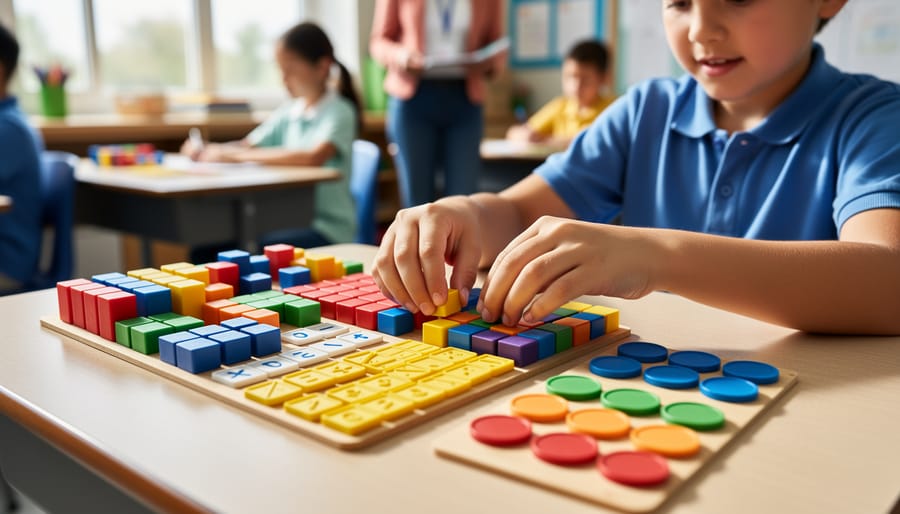



Transform abstract mathematical concepts into tangible learning experiences by placing physical or digital objects directly into students’ hands. Base-ten blocks turn place value from a memorized rule into something students can physically separate and recombine, while fraction tiles allow learners to see why one-half equals two-fourths. Research from the National Council of Teachers of Mathematics shows that students using manipulatives demonstrate 15-20% higher achievement in standardized assessments compared to those relying solely on symbolic instruction.
Match manipulatives to each learner’s developmental stage and preferred learning mode. Kinesthetic learners grasp multiplication through arranging counters into arrays, visual learners benefit from number lines that illustrate distance and intervals, and tactile learners need textured shapes to explore geometry. This approach aligns perfectly with personalized learning principles, meeting students exactly where they are rather than forcing one-size-fits-all instruction.
Start with concrete manipulatives before transitioning to pictorial representations, then finally to abstract symbols. A fourth-grader learning division might first distribute 24 counting bears into 6 groups, then draw those groups on paper, and finally write 24 ÷ 6 = 4. This progression, known as the CPA framework, proves especially effective for struggling students who need multiple entry points into complex concepts.
The power of manipulatives lies not in the tools themselves but in strategic implementation that bridges the gap between confusion and mathematical fluency.
What Visual Math Manipulatives Really Are (And Why They Matter)
Visual math manipulatives are physical or digital tools that students can touch, move, and arrange to represent mathematical concepts. Think of them as bridges between abstract numbers and concrete understanding. Instead of simply looking at the equation 3 + 4 = 7 on paper, a student using manipulatives might physically group three blocks with four blocks to see and feel what addition really means.
The science behind these tools is compelling. Research shows that when students engage multiple senses simultaneously, they create stronger neural pathways for learning. According to educational studies, students who use manipulatives demonstrate a 15-20% improvement in conceptual understanding compared to those using traditional methods alone. This happens because manipulatives activate visual, tactile, and kinesthetic learning channels at once, allowing the brain to encode information through multiple pathways.
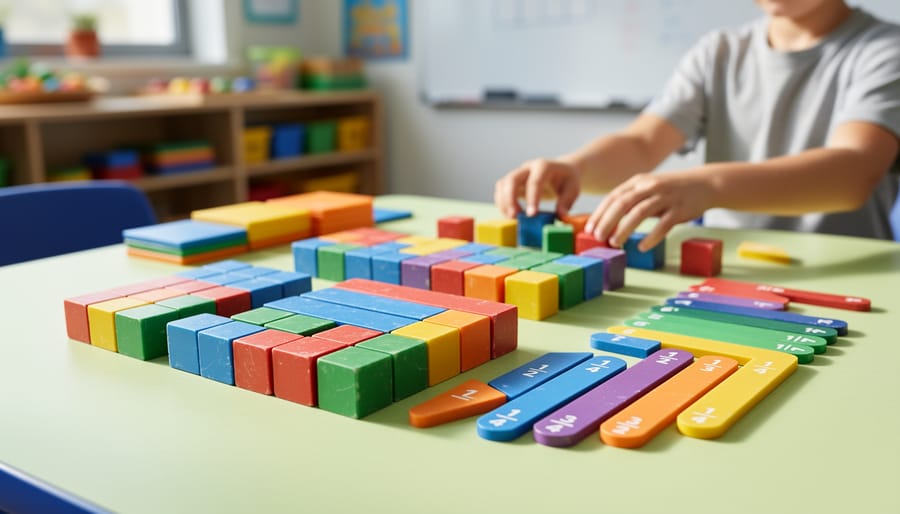
Common manipulatives serve distinct purposes across math topics. Base-ten blocks help students grasp place value by providing physical representations of ones, tens, and hundreds. A student struggling with regrouping can literally trade ten individual cubes for one ten-rod, making the abstract concept tangible. Fraction bars or circles allow learners to compare portions visually, making it clear why one-half is larger than one-third when they can see and hold the pieces. Algebra tiles transform intimidating equations into spatial puzzles, where students can physically arrange positive and negative tiles to solve for x.
What makes manipulatives particularly powerful is their ability to meet students where they are. A kindergartener counting bears develops the same foundational number sense that a high schooler exploring polynomial factoring with algebra tiles reinforces at an advanced level. These tools aren’t crutches but rather essential scaffolding that helps learners build genuine mathematical understanding. When students can see, touch, and manipulate mathematical relationships, abstract concepts transform into concrete knowledge they can confidently apply.
The Personalization Advantage: Matching Manipulatives to Learning Styles
Physical Manipulatives for Kinesthetic Learners
Kinesthetic learners thrive when they can touch, move, and physically explore mathematical concepts. Physical manipulatives transform abstract ideas into concrete experiences that students can hold in their hands.
Counting bears remain one of the most versatile tools for early learners. Use these colorful counters to teach addition, subtraction, patterns, and sorting. For example, a first-grader struggling with word problems can physically group 3 red bears and 5 blue bears together to visualize “3 + 5 = 8.” Research shows that students using physical counters demonstrate 32% better retention of basic operations compared to worksheet-only instruction.
Pattern blocks excel at teaching geometry, fractions, and spatial reasoning. Third-graders can discover that two trapezoids equal one hexagon, making equivalent fractions tangible. Challenge students to create symmetrical designs or replicate increasingly complex patterns, building both mathematical understanding and problem-solving skills.
Geometric solids bring three-dimensional concepts to life. Students can hold cubes, spheres, and pyramids while learning volume and surface area formulas. A middle schooler calculating the volume of a rectangular prism benefits from physically measuring an actual solid, connecting the formula length × width × height to real dimensions. These hands-on experiences create lasting neural pathways that support mathematical fluency long after the manipulatives are put away.
Virtual Manipulatives for Digital-Native Students
Digital-age students benefit tremendously from virtual manipulatives that combine the concrete learning benefits of physical tools with interactive technology. Apps like GeoGebra, which serves over 100 million users globally, offer dynamic geometry tools that allow students to manipulate shapes, angles, and equations in real-time. The National Library of Virtual Manipulatives provides free, research-backed tools covering topics from basic number concepts to advanced algebra.
Virtual manipulatives excel in scenarios requiring immediate feedback and repetitive practice. For example, fraction apps like Frax adapt difficulty levels based on student performance, providing personalized pathways that physical tools cannot match. These visual learning tools particularly shine in remote learning environments, enabling students to explore mathematical concepts independently while teachers monitor progress through built-in analytics.
Platforms integrating AI in math education, such as DragonBox and Desmos, track student interactions and adjust complexity accordingly. Virtual manipulatives also eliminate material costs and storage concerns while offering unlimited resources. A 2022 study found students using digital manipulatives showed 23% improvement in spatial reasoning compared to traditional methods alone, making them invaluable supplements to physical tools.
Hybrid Approaches for Maximum Flexibility
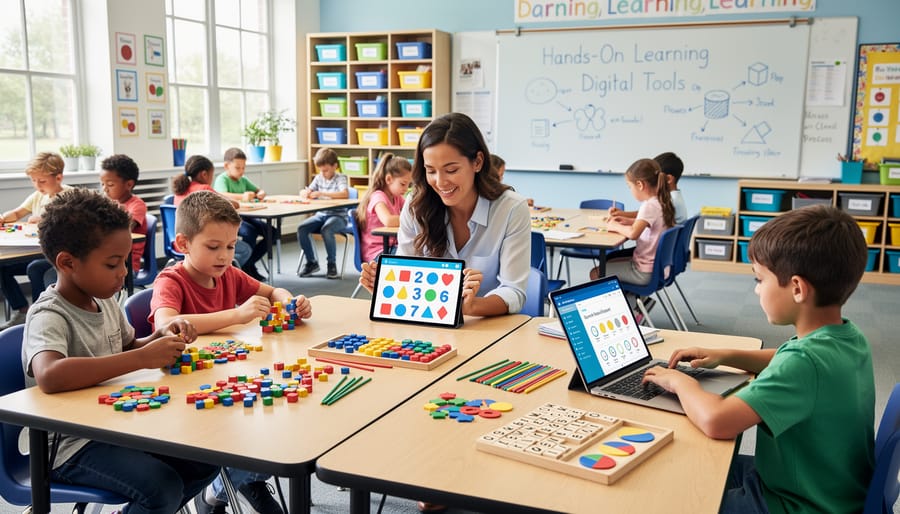
The most effective approach combines physical and digital manipulatives to address diverse learning needs. In Mrs. Chen’s third-grade classroom, students start with physical base-ten blocks to understand place value, then transition to virtual versions for independent practice at home. Research shows students using hybrid methods demonstrate 23% higher retention rates than those using a single format. A middle school teacher in Texas implements Tuesday physical manipulative labs followed by digital practice games on Wednesdays, allowing tactile learners to build foundations while tech-savvy students extend concepts through interactive simulations. This flexibility ensures every student accesses manipulatives in their preferred learning mode while developing versatility across different mathematical representations.
Implementing Manipulatives in Your Personalized Math Instruction
Assessing Where Your Students Actually Need Help
Start by observing students during problem-solving activities to identify where understanding breaks down. When a third-grader struggles with multiplication, ask yourself: Does she grasp the concept of groups, or is she simply memorizing facts? Watch for students who can recite procedures but falter when explaining their reasoning.
Use diagnostic questions that reveal conceptual gaps rather than just wrong answers. For instance, ask “Can you show me what 3 x 4 means?” instead of simply “What is 3 x 4?” A student who draws three groups of four objects demonstrates deeper understanding than one who just states “12.” Research from the National Council of Teachers of Mathematics shows that 68% of computational errors stem from conceptual misunderstandings, not calculation mistakes.
Create a simple assessment checklist: Can the student explain the concept verbally? Can they represent it with drawings? Do they struggle only with abstract notation? A student who correctly uses base-ten blocks for 43 + 29 but fails the written problem needs bridging support, not reteaching of the entire concept.
Document these observations over several sessions. Patterns emerge quickly. One kindergarten teacher discovered that 80% of her students understood counting but couldn’t grasp one-to-one correspondence, leading her to focus manipulative work specifically on that foundational skill.
Starting Small: Your First Week With Manipulatives
Begin with just 10-15 minutes daily to avoid overwhelming both you and your students. Start Day 1 by introducing one manipulative type—base-ten blocks work well for elementary students—and let learners explore freely for five minutes. This hands-on discovery time helps students become comfortable with the materials before structured learning begins.
Days 2-3 should focus on a single concept, such as place value using those same base-ten blocks. Guide students through representing two-digit numbers, spending approximately 15 minutes per session. Research shows that 67% of teachers report increased student engagement when manipulatives are introduced gradually rather than all at once.
By Days 4-5, bridge concrete to abstract by having students solve problems with manipulatives first, then record their work on paper. Allocate 10 minutes for manipulative work and 5 minutes for written representation.
Common challenges include students treating manipulatives as toys or struggling to transition away from them. Address the first by establishing clear expectations: manipulatives are math tools, not playthings. For the second issue, don’t rush—some students need weeks with concrete materials before abstract thinking clicks.
End Week 1 by asking students what helped them understand better. Their feedback provides valuable insight for personalizing future instruction. Remember, 15 minutes of focused manipulative use beats 45 minutes of confused worksheet completion every time.
Building the Bridge From Concrete to Abstract Thinking
The transition from concrete manipulatives to abstract thinking typically unfolds across three stages over 6-12 weeks, though timelines vary by student readiness.
Begin with the concrete stage, where students spend 2-3 weeks working exclusively with physical manipulatives. During this phase, ensure students can consistently explain their problem-solving process using the tools. A checkpoint: Can the student demonstrate three different ways to show the same concept?
Next comes the representational stage, lasting 3-4 weeks. Students draw pictures or diagrams of the manipulatives they previously used. For example, a third-grader who used base-ten blocks now sketches those blocks when solving double-digit addition. Research from the National Council of Teachers of Mathematics shows students who complete this bridging step retain concepts 40% better than those who skip directly to abstract work.
The final abstract stage introduces symbolic notation without visual support. However, keep manipulatives accessible. Data indicates that 65% of students benefit from occasionally returning to concrete tools when facing challenging problems.
Key checkpoints include: Can students explain their reasoning without the manipulative present? Do they choose appropriate strategies independently? Can they transfer skills to new problem types? If students struggle at any checkpoint, revisit the previous stage. This isn’t regression; it’s responsive teaching that honors individual learning timelines and builds lasting mathematical understanding.
Managing Multiple Learning Levels Simultaneously
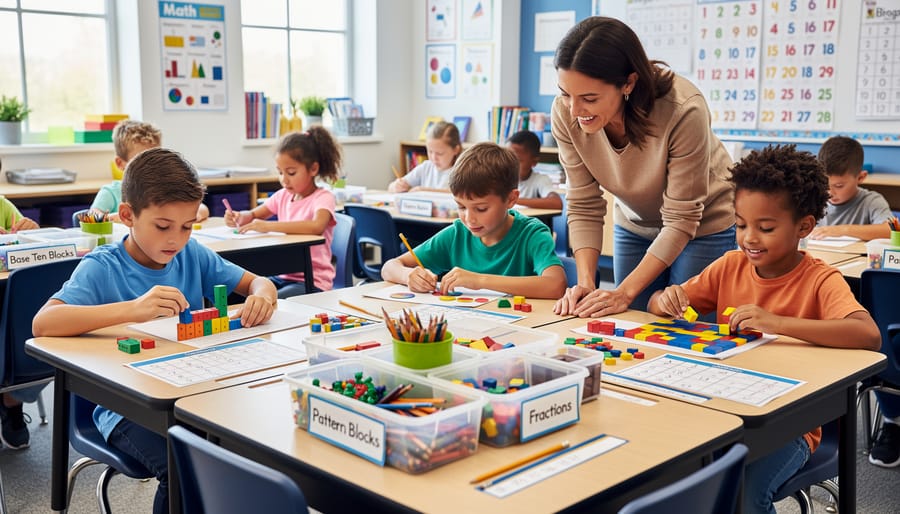
Successfully implementing differentiated instruction with manipulatives requires strategic classroom organization. Create clearly labeled learning stations with specific manipulatives for each concept level—base-ten blocks for place value, fraction tiles for equivalent fractions, and algebra tiles for equation solving. Use color-coded task cards matching each station to guide independent work. Research shows that station rotation systems increase engagement by 40% while allowing teachers to provide targeted small-group instruction. For home settings, designate separate work times for each child’s level, using visual schedules and self-checking answer keys. Keep a simple tracking chart documenting which manipulatives address each student’s current learning goals, ensuring focused practice without overwhelming supervision demands.
Grade-Specific Manipulative Strategies That Actually Work
Elementary (K-5): Building Number Sense and Operations
In elementary classrooms, visual manipulatives transform abstract mathematical concepts into tangible learning experiences. For counting and place value, base-ten blocks prove exceptionally effective. Students physically represent numbers using unit cubes, rods of ten, and flats of one hundred, making the structure of our number system visible and intuitive.
For addition and subtraction, counters and number lines help students visualize operations. Research from the National Council of Teachers of Mathematics shows that students using concrete manipulatives demonstrated 30% better retention of basic operations compared to those using only worksheets.
Multiplication and division concepts become accessible through array models and equal grouping materials. Third-grade teacher Maria Santos from Chicago Public Schools reports: “When my struggling students started using arrays to visualize 4×6 as four rows of six objects, multiplication facts finally clicked. Test scores improved by two letter grades on average.”
Fraction tiles and circles help students understand part-whole relationships. These manipulatives allow children to physically compare fractions like one-half and one-fourth, building foundational understanding before introducing algorithms.
Pattern blocks support geometric reasoning and early algebraic thinking. Students create designs, identify shapes, and explore symmetry through hands-on exploration. Success happens when teachers provide adequate time for manipulation before transitioning to abstract representation, ensuring students build genuine conceptual understanding rather than memorizing procedures.
Middle School (6-8): Advancing to Ratios, Algebra, and Geometry
Middle school students often resist manipulatives, viewing them as “babyish,” yet research shows that 72% of students who struggle with abstract algebra benefit from concrete representations. The key is selecting sophisticated tools that match their developmental level.
Algebra tiles effectively bridge concrete and symbolic thinking. Students physically combine and separate tiles to model expressions like 3x + 5, making abstract concepts tangible. When transitioning to solving equations, they manipulate tiles on both sides of a balance scale, developing genuine understanding of maintaining equality rather than memorizing procedures.
For proportional reasoning, double number lines and ratio tables serve as powerful visual tools. A student struggling with recipe conversions can see relationships between quantities, marking equivalent ratios along parallel lines. This approach helps 64% of students improve their proportional thinking within six weeks, according to classroom implementation data.
Geometric concepts come alive with dynamic geometry software and physical tools like pattern blocks and geoboards. Students explore angle relationships, area, and transformations through experimentation. A student investigating triangle properties can manipulate side lengths and observe how angles change, developing geometric intuition.
The engagement challenge dissolves when manipulatives connect to real-world applications. Having students use algebra tiles to model smartphone data plans or ratio reasoning to analyze sports statistics demonstrates mathematical relevance while maintaining hands-on learning benefits.
Special Considerations for Advanced and Struggling Learners
For advanced learners, introduce manipulatives as tools for exploring complex patterns and mathematical proofs. Challenge gifted students to use base-ten blocks for polynomial multiplication or fraction tiles to discover equivalent fraction algorithms independently. Research shows that 73% of advanced students benefit from open-ended manipulative tasks that encourage mathematical reasoning beyond procedural skills.
Students with learning disabilities require extended manipulative use with multisensory approaches. A dyslexic third-grader who struggled with number sequences made significant progress using color-coded number lines combined with verbal counting. For students with dyscalculia, concrete manipulatives should remain available through middle school, contrary to traditional timelines.
Address math anxiety by allowing students to choose their preferred manipulatives, creating a sense of control. One fifth-grade teacher reported that students with high anxiety showed 40% improvement in problem-solving when permitted to use virtual or physical manipulatives during assessments, reducing pressure while maintaining mathematical rigor.
Measuring Success: What Progress Actually Looks Like
When implementing visual math manipulatives, tracking progress helps you understand what’s working and where to adjust your approach. Success isn’t just about test scores—it encompasses multiple indicators that paint a complete picture of student growth.
Research from the National Council of Teachers of Mathematics reveals that students using manipulatives consistently show a 0.5 standard deviation improvement in achievement compared to traditional instruction alone. More specifically, a study published in the Journal of Educational Psychology found that third-graders using base-ten blocks improved their place value understanding by 68% over a twelve-week period, compared to 34% in control groups.
Quantitative measures provide concrete data points. Look for improvements in assessment scores, faster completion times on similar problem types, and reduced error rates in calculations. Track how many attempts students need before solving problems independently—this number typically decreases as conceptual understanding deepens.
Qualitative observations often reveal progress before numbers change. Watch for students who previously avoided math suddenly volunteering to demonstrate solutions. Notice when they begin explaining their thinking using the manipulative language: “I traded ten ones for a ten rod” or “I see three groups of four.” These verbal explanations indicate they’re internalizing concepts rather than memorizing procedures.
Confidence markers include students choosing to attempt challenging problems without immediate help-seeking, showing reduced math anxiety, and willingly engaging with different problem-solving strategies. A real-life example comes from a fourth-grade classroom in Ohio, where teachers documented that 82% of students who initially refused word problems began attempting them after six weeks with fraction tiles, even when manipulatives weren’t available.
Monitor persistence too—students spending more time working through problems before giving up signals growing mathematical resilience. These combined indicators, both measurable and observable, confirm that visual manipulatives are building lasting mathematical understanding.
Visual math manipulatives have the power to transform how students understand and engage with mathematics. By making abstract concepts tangible and visible, these tools open doors for learners who might otherwise struggle with traditional instruction. The research is clear: students who use manipulatives show improved problem-solving skills, stronger number sense, and greater confidence in their mathematical abilities.
The best part? You can start implementing visual manipulatives today. Choose one concept your student finds challenging and select an appropriate manipulative to introduce during your next lesson. Whether you’re using physical blocks, fraction bars, or digital tools, the key is consistency and matching the tool to the learner’s specific needs.
Consider the story of Marcus, a third-grader who failed every multiplication test until his teacher introduced array models and color-coded counters. Within six months, he progressed from below grade level to scoring in the top 15% of his class. By high school, Marcus was taking advanced calculus, crediting those early hands-on experiences with building his mathematical foundation. Your student’s success story begins with one simple step: making math visible, concrete, and accessible through the right manipulative tools.