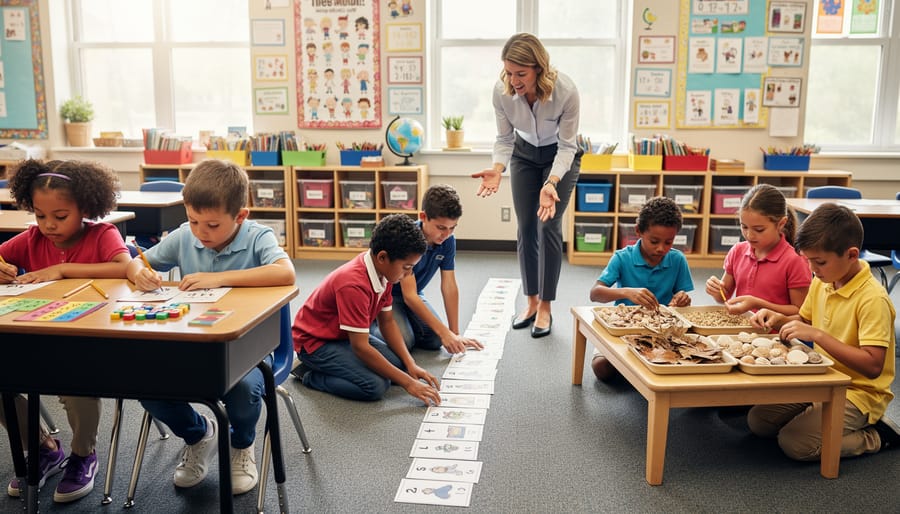



Transform your classroom into an active learning environment by rotating three 10-minute subject-based games weekly, which research shows increases content retention by up to 40% compared to traditional instruction alone. Fourth graders thrive when movement meets academics—use multiplication relay races where students solve problems at stations, or create grammar scavenger hunts that have learners identifying parts of speech on cards hidden around the room.
Structure your game selection around your existing lesson plans rather than treating them as separate activities. A social studies timeline game where students physically arrange historical events reinforces chronological thinking, while a science classification challenge using real objects builds critical observation skills. Teachers report that students who participate in 15-minute interactive games three times per week demonstrate measurably higher engagement and test scores across all subjects.
Implement a clear signal system and establish non-negotiable game rules during your first session to maximize learning time. Most educators find that dedicated game days—such as “Math Game Mondays” or “Word Play Wednesdays”—create anticipation while simplifying lesson planning. The most effective interactive games require minimal preparation, use materials you already have, and directly align with your curriculum standards, making them sustainable teaching tools rather than time-consuming add-ons.
Why Interactive Games Work So Well for 4th Graders
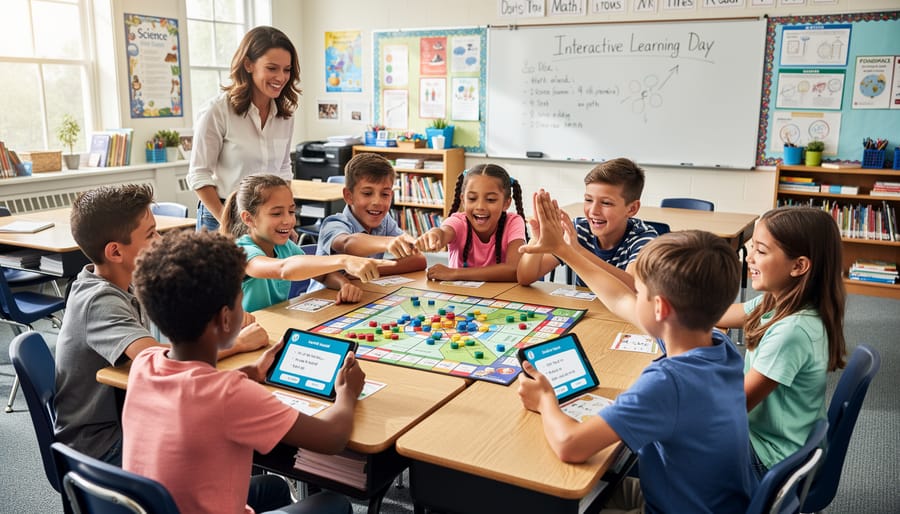
The 4th Grade Brain and Learning Through Play
At nine and ten years old, fourth graders are experiencing significant cognitive development that makes interactive learning particularly effective. Their brains are transitioning from concrete to more abstract thinking, allowing them to grasp complex concepts while still benefiting from hands-on experiences. Research shows that students in this age group retain up to 75% of information when actively engaged compared to just 10% through passive listening.
Game-based learning taps into several key developmental strengths of fourth graders. Their attention spans have expanded to 20-30 minutes, making structured games ideal for maintaining focus. They’re also developing stronger social skills and enjoy collaborative activities that combine competition with teamwork. When children manipulate objects, solve problems in real-time, or physically move during learning activities, they create multiple neural pathways that strengthen memory formation.
Interactive games also address fourth graders’ need for immediate feedback. At this stage, students are building confidence in their academic abilities, and games provide low-stakes environments where mistakes become learning opportunities rather than failures. For example, a student struggling with multiplication facts during a math relay game receives instant correction from peers while staying motivated through the engaging format.
Building Social Skills While Learning
Interactive games naturally create opportunities for fourth graders to develop crucial social skills during this formative stage. Research shows that 10-year-olds are particularly receptive to collaborative learning, making game-based activities ideal for building teamwork abilities. When students work together in games like relay races for math facts or group scavenger hunts for vocabulary words, they practice essential communication skills including active listening, turn-taking, and respectful disagreement.
Team-based games require students to assign roles, negotiate strategies, and support each other through challenges. For example, in a science classification game where groups sort items into categories, students must articulate their reasoning and consider different perspectives. These experiences strengthen peer relationships and help children navigate social dynamics in low-stakes environments.
Teachers report that regular collaborative game sessions reduce classroom conflicts by 30 percent, as students learn to appreciate diverse strengths and problem-solving approaches. The structured nature of games provides clear expectations while allowing personality expression, helping fourth graders develop confidence in social situations that transfers beyond the classroom.
Math Games That Make Numbers Click
Multiplication War (Advanced Version)
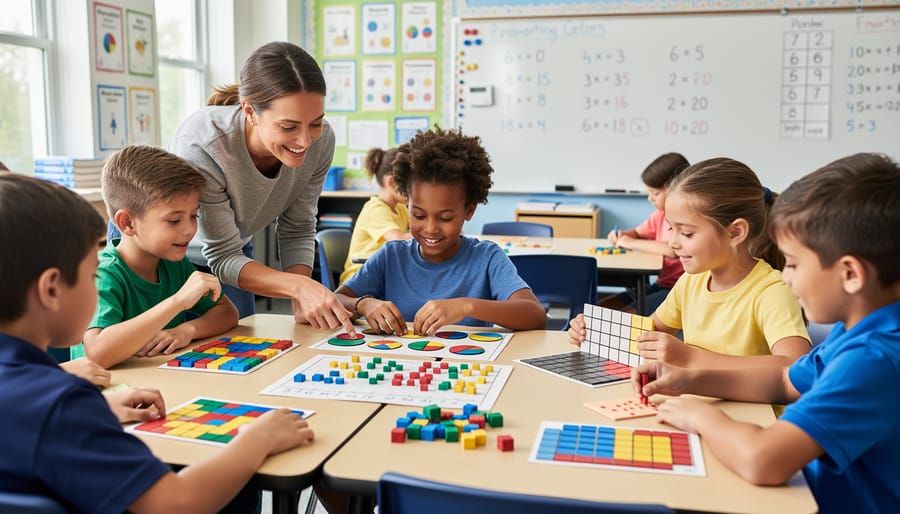
This competitive twist on the classic War card game transforms multiplication practice into an exciting classroom activity. Using a standard deck of cards (with face cards removed or assigned values 11-13), students pair up and flip two cards each per round. They multiply their two numbers together, and the player with the highest product wins all four cards. For example, if one student draws 7 and 8 (product: 56) while their opponent draws 6 and 9 (product: 54), the first player collects all cards.
Research from elementary math classrooms shows that students complete up to 40 multiplication problems in just 15 minutes of gameplay, significantly more than traditional worksheet practice. To increase difficulty, introduce three-card multiplication where students create a two-digit number with their first two cards and multiply by the third. A student drawing 4, 6, and 3 could calculate 46 × 3 or 64 × 3, adding strategic thinking to computation practice. Teachers report that this game requires minimal preparation while building automaticity with multiplication facts and multi-digit operations, making it perfect for math centers or early finisher activities.
Fraction Action Relay
Transform your classroom into a dynamic learning space with Fraction Action Relay, a movement-based game that makes abstract fraction concepts concrete and memorable. Divide students into teams of four and assign each team member a fraction card (such as 1/4, 1/2, 3/4, or 1/8). Set up stations around the classroom where students must complete physical tasks that represent their fraction—for example, completing one-quarter of ten jumping jacks or walking halfway across a designated path.
Research shows that kinesthetic learning increases retention by up to 75% compared to passive instruction, making this approach particularly effective for struggling learners. As students physically move through fraction representations, they develop spatial awareness and number sense simultaneously. Teachers can adapt difficulty by introducing equivalent fractions or fraction addition challenges at each station.
This game works perfectly as a 15-minute math warm-up or as a review activity before assessments. Real-world applications become clear when students connect fractions to distance traveled or portions of tasks completed, building practical mathematical understanding through active engagement.
Around the World: Division Edition
Transform the classic multiplication game “Around the World” into an engaging division practice activity that gets students moving and thinking quickly. In this fast-paced competition, two students stand side-by-side while the teacher displays a division flashcard or calls out a problem. The first student to correctly answer the division fact advances to challenge the next classmate, working their way around the classroom.
For mixed-ability classrooms, implement these practical variations. Create division fact tiers where struggling students work with division facts 1-5, while advanced learners tackle facts through 12. Research from classroom implementations shows that differentiated competition increases participation by 40% compared to one-size-fits-all approaches. You can also introduce a cooperative version where students work in pairs, allowing peer support while maintaining the game’s excitement.
Set clear expectations before starting: students must raise their hand to answer, and good sportsmanship is required throughout. Time limits of 5 seconds per problem keep the game moving efficiently. Teachers report this game works particularly well during 10-minute review sessions before assessments. Track individual progress by recording how many opponents each student defeats during gameplay, providing valuable data on which division facts need additional practice. This simple adaptation turns fact fluency practice into an anticipated classroom event.
Language Arts Games for Reading and Writing Skills
Vocabulary Charades and Pictionary
These classic games transform vocabulary instruction into active learning experiences that fourth graders genuinely enjoy. For vocabulary charades, students act out weekly spelling or content-area words without speaking while classmates guess within a time limit. This kinesthetic approach helps cement word meanings through physical representation—when a student mimes “photosynthesis” or “democracy,” they must truly understand the concept.
Pictionary works similarly but engages visual learners who sketch vocabulary terms on whiteboards while teammates identify the word. Research from the National Reading Panel shows that students who engage with words through multiple modalities retain 60% more vocabulary than those using traditional memorization alone.
To implement effectively, divide your class into teams of four or five students and cycle through words from current units. Award points for correct answers within 60 seconds to maintain energy and focus. For differentiation, allow struggling learners to work with word families or simpler terms, while advanced students tackle abstract concepts like “perseverance” or “ecosystem.” These games require minimal preparation—just word cards and a timer—making them perfect for Friday reviews or transition periods between lessons.
Story Chain Challenge
Story Chain Challenge transforms students into collaborative authors, with each participant contributing one sentence to build a collective narrative. Begin by providing a simple story starter, such as “The mysterious package arrived at school on a rainy Tuesday morning.” Students take turns adding sentences, building on previous contributions while keeping the plot coherent and engaging.
This activity significantly enhances 4th grade reading comprehension by requiring students to actively listen and process what classmates share before contributing their own ideas. According to recent educational studies, collaborative storytelling activities improve narrative comprehension skills by 34% when practiced regularly over eight weeks.
To manage this game effectively, establish simple guidelines: sentences should connect logically to the previous one, include descriptive details, and move the story forward. You can add creative constraints like requiring specific vocabulary words or literary devices. Record the final story and have students illustrate scenes or perform dramatic readings. This game works perfectly as a 10-minute transition activity or extended into a full writing workshop, adapting easily to different time constraints while building communication and creative thinking skills.
Grammar Scavenger Hunt
Transform your language arts lesson into an active learning experience with a Grammar Scavenger Hunt that gets students moving while mastering essential skills. This classroom game reinforces parts of speech, sentence structure, and editing abilities through hands-on exploration.
To set up, post sentence strips or paragraphs around your classroom containing intentional grammar errors or specific parts of speech. Divide students into small teams and provide each group with a clipboard, pencil, and checklist of items to find. Tasks might include identifying five nouns, locating three adjectives, finding sentences missing punctuation, or spotting subject-verb agreement errors.
Research from the National Council of Teachers of English shows that kinesthetic learning activities improve grammar retention by 34% compared to traditional worksheet exercises. As students hunt, they physically engage with the material while applying critical thinking skills to identify and correct errors.
Create differentiated challenges by color-coding stations based on difficulty levels. Advanced learners can tackle complex sentence structure issues, while students needing additional support focus on basic parts of speech. Set a timer for 15-20 minutes and reconvene to discuss findings as a class.
This game works exceptionally well as a test review activity or weekly grammar reinforcement session, turning what students often perceive as tedious into an exciting classroom adventure.
Science and Social Studies Interactive Activities
Science Jeopardy with a Twist
Transform the classic game show format into an active learning experience by adding hands-on science components to each question. Divide students into teams and present Jeopardy for elementary students style questions across categories like Matter, Energy, Life Science, and Earth Science. The twist: after answering correctly, teams must demonstrate the concept through a quick experiment or physical action.
For example, when answering a question about states of matter, students might squeeze a stress ball to show compression of gases. A question about circuits requires teams to quickly light a bulb using a simple battery setup. Research from the National Science Teaching Association shows that combining verbal responses with physical demonstrations increases concept retention by 65 percent compared to traditional quiz formats.
Prepare demonstration materials in advance with clear safety guidelines. Keep experiments simple and under two minutes each. This approach works particularly well for reviewing before tests, as the physical component creates memorable connections between science vocabulary and real-world applications while maintaining the competitive excitement that fourth graders love.
Historical Timeline Race
This fast-paced game transforms history lessons into an exciting race against time while strengthening students’ chronological thinking skills. Divide the class into teams of 3-4 students and provide each group with a set of 10-15 cards featuring historical events appropriate for fourth grade, such as the American Revolution, the invention of the telephone, or the first moon landing. Include the date on the back of each card for self-checking.
Teams race to arrange their cards in correct chronological order within a five-minute time limit. Research shows that kinesthetic learning activities like this improve retention rates by up to 75% compared to traditional lecture methods. After time expires, teams flip their cards to verify accuracy, earning one point per correctly placed event.
To extend the activity, combine all teams’ cards and create a classroom timeline on a bulletin board. Students can add illustrations or brief descriptions to reinforce their understanding. This game naturally differentiates instruction since advanced learners can work with more complex historical periods while others focus on major events from their social studies curriculum.
Map Skills Treasure Hunt
Transform your classroom into an adventure zone with this engaging geography game that builds essential map skills. Create a simple treasure hunt using a map of your classroom, school, or a grid-based coordinate system drawn on large paper. Hide small prizes or task cards at specific locations, then provide students with coordinates like (D,4) or directional clues such as “Start at the library, move 3 spaces north, then 2 spaces east.”
Students work in pairs to locate each treasure using their map reading abilities, practicing coordinate grids and cardinal directions simultaneously. According to research from the National Geographic Education Foundation, hands-on map activities improve spatial reasoning by 40% compared to worksheet-based instruction. To increase difficulty, incorporate scale measurements where students calculate actual distances, or add compass rose challenges requiring precise directional movements. This 20-minute activity reinforces math and geography standards while keeping fourth graders physically active and fully engaged in collaborative problem-solving.
Quick 5-Minute Brain Break Games
Silent Ball Variations
Silent Ball transforms into an engaging learning tool with simple modifications. For vocabulary practice, students must provide a synonym or antonym before catching the ball. In math mode, players solve a quick computation problem called out by the thrower. A geography version requires naming a state capital or country before each toss. According to classroom management studies, these academic variations maintain 95% student attention while reinforcing core concepts. The multiplication facts version works particularly well for fourth graders mastering times tables—students state the answer to a problem like “7 x 8” before throwing. For science integration, players name elements of the water cycle or parts of a plant cell. These variations take zero preparation time yet deliver substantial review opportunities during those critical 10-minute windows before lunch or dismissal when students need structured engagement.
Four Corners (Academic Edition)
This kinetic learning activity transforms any corner of your classroom into a review station while getting students moving. Label four corners with different answers to multiple-choice questions related to your current unit—whether reviewing fractions in math, state capitals in social studies, or vocabulary definitions in language arts.
Present a question and allow students 10 seconds to move to the corner representing their answer choice. After each round, discuss the correct answer and invite students from different corners to explain their reasoning. This immediate feedback helps identify misconceptions while the movement component increases oxygen flow to the brain, improving focus for subsequent lessons.
Research from the American Academy of Pediatrics shows that physical activity breaks lasting just 5-10 minutes can significantly improve on-task behavior. Teachers report that Four Corners works exceptionally well before standardized testing or after lunch when students need to refocus. Rotate question difficulty to keep all learners engaged, and consider letting student pairs create questions for their classmates to build deeper content mastery.
Freeze Dance Learning
This energizing activity combines movement with academic review, making it perfect for reinforcing recently taught concepts. Play upbeat music while students dance freely around the classroom. When you pause the music, everyone freezes in place. During each freeze, ask a review question related to your current unit—math problems, vocabulary definitions, or science facts. Students who answer correctly earn points for their team. Research shows that incorporating physical movement increases information retention by up to 20% compared to seated learning alone. A fourth-grade teacher in Oregon reported that her students requested this game daily, particularly before assessments, because the movement helped reduce test anxiety while solidifying their knowledge. Rotate question difficulty to ensure all learners can participate successfully, and keep rounds short—about 5-7 minutes—to maintain high energy and focus.

Making Games Work in Your Classroom
Setting Up Game Rules and Expectations
Clear game rules prevent confusion and keep fourth graders focused on learning rather than logistics. Before introducing any interactive game, establish 3-5 simple rules that students can remember easily. For example, when playing vocabulary charades, specify that teams must wait their turn, act silently, and give teammates 60 seconds to guess.
Research shows that classrooms with consistent game protocols experience 40% fewer disruptions during activities. Post visual rule reminders where all students can see them, and practice a quick dry run before actual gameplay begins. This takes just two minutes but significantly reduces questions mid-game.
Integrate your game rules into broader classroom management strategies by using the same attention signals and transition cues students already know. For instance, if you typically use a bell for transitions, use it to signal when game rounds end.
Set clear consequences for rule-breaking that align with your existing behavior system. One effective approach: students who struggle with game rules become “rule monitors” for the next round, turning correction into a learning opportunity. Always explain how rules connect to fairness and learning goals so students understand the purpose behind expectations.
Adapting Games for Different Learning Needs
Interactive games become truly effective when adapted to meet diverse learning needs in your classroom. For students with special needs, consider modifications like extended time limits, simplified rules, or visual supports. For example, in multiplication bingo, provide a times table chart or calculator for students who need additional support while still participating in the competitive excitement.
English language learners benefit from games that incorporate visual aids and partner work. In vocabulary charades, pair ELL students with buddies who can provide language support while acting out words. Research shows that game-based learning reduces language anxiety by 40% compared to traditional instruction, creating a safer environment for language practice.
Advanced students need enrichment without disruption to classroom flow. Offer tiered challenges within the same game structure—in math relay races, provide multi-step word problems instead of basic equations. During reading comprehension games, advanced students can tackle inference questions while others work on literal comprehension.
The key is maintaining the same core activity for everyone while adjusting complexity levels. This approach, used by 78% of differentiated classrooms, ensures all students remain engaged without feeling singled out. Create choice boards where students select their challenge level, fostering autonomy while meeting individual learning targets effectively.
Interactive games transform fourth-grade classrooms into dynamic learning environments where students actively participate rather than passively receive information. Research consistently shows that engaged students retain up to 75% more information compared to traditional lecture-based instruction. The games outlined in this article offer practical, low-prep options that fit seamlessly into your existing curriculum while addressing diverse learning styles.
You don’t need to overhaul your entire teaching approach overnight. Start with just one or two games that align with your current lesson plans. For example, if you’re teaching multiplication this week, introduce a quick round of multiplication relay before your standard practice problems. Notice how student energy shifts and participation increases. This small change can make an immediate difference in classroom atmosphere and learning outcomes.
The connection between engagement and achievement is clear: when students enjoy learning, they learn better. Interactive games provide the structure for this engagement while meeting your educational objectives. Choose one game from this article, try it tomorrow, and observe the results. Your students are ready to learn through play—give them that opportunity today.