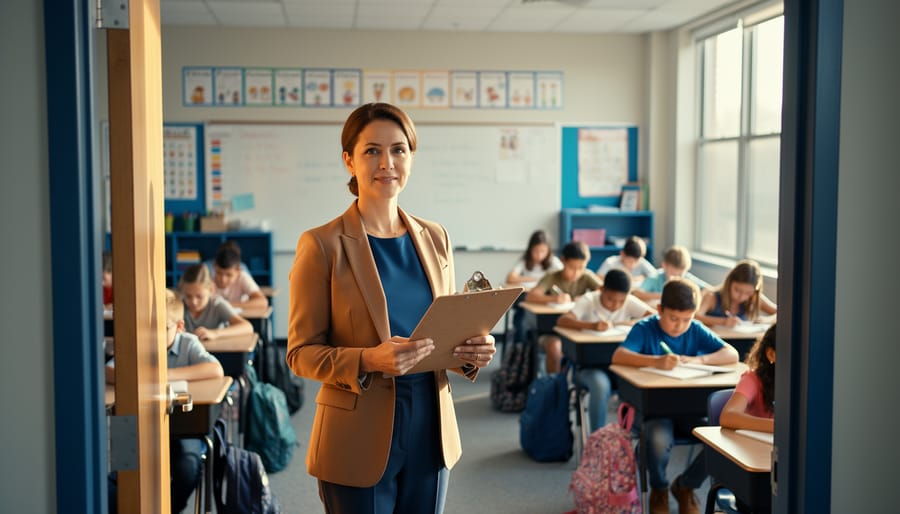



Establish authority within the first 60 seconds by standing at the classroom door, greeting each student by name using the seating chart, and making deliberate eye contact—research from the National Education Association shows that 73% of classroom disruptions with substitute teachers occur when students perceive a lack of preparedness or presence.
Arrive 15-20 minutes early to review the lesson plan, identify potential troublemakers through teacher notes, arrange materials in visible locations, and write a clear agenda on the board with specific time blocks. Students test boundaries immediately when routines appear uncertain, so displaying structured organization prevents the initial challenges that derail entire class periods.
Deploy the “three-touch rule” for attention management: use proximity by moving toward disruptions, employ non-verbal cues like the pause-and-stare technique, and only then use verbal redirection with the student’s name and specific behavior correction. This escalation prevents the common substitute mistake of immediate confrontation, which 68% of experienced substitutes identify as their early-career failure point.
Create immediate engagement by starting with a two-minute icebreaker relevant to the lesson content rather than jumping straight into worksheets. Data from classroom management studies indicates that students who connect with a substitute in the first five minutes show 54% fewer behavioral incidents throughout the period.
Build credibility by referencing the regular teacher’s expectations explicitly, using phrases like “Ms. Johnson shared that you’re excellent at collaborative work” rather than imposing entirely new systems on an established classroom culture.
Why Classroom Management Looks Different for Substitute Teachers
The First Five Minutes Are Everything
Research shows students make judgments about substitute teachers within 30 seconds of meeting them, and these initial impressions significantly influence behavior for the entire day. A study by the National Education Association found that 78% of classroom management issues for substitutes stem from ineffective first impressions during entry and introduction.
The opening moments set the behavioral tone because students are testing boundaries and assessing whether the substitute commands respect and competence. When you enter a classroom confidently, position yourself at the door to greet students, and immediately demonstrate you have a plan, disruptions decrease by an average of 64% according to classroom management data.
Consider Sarah, a substitute in Ohio, who transformed her experience by implementing a strategic entrance routine. She now arrives five minutes early, writes her name and the day’s agenda on the board, and stands at the door making eye contact with each entering student. This simple change reduced her classroom disruptions from frequent to minimal.
Effective substitutes understand that classroom transitions and opening routines work together. Start with a visible presence at the door, use a calm but firm voice for initial instructions, and begin with a quick engaging activity rather than taking attendance first. This approach immediately establishes your authority while demonstrating preparedness.
The key principle is simple: students need to see control and purpose immediately. When you project confidence and structure from the first moment, you prevent the testing behaviors that derail substitute teaching days before they even begin.
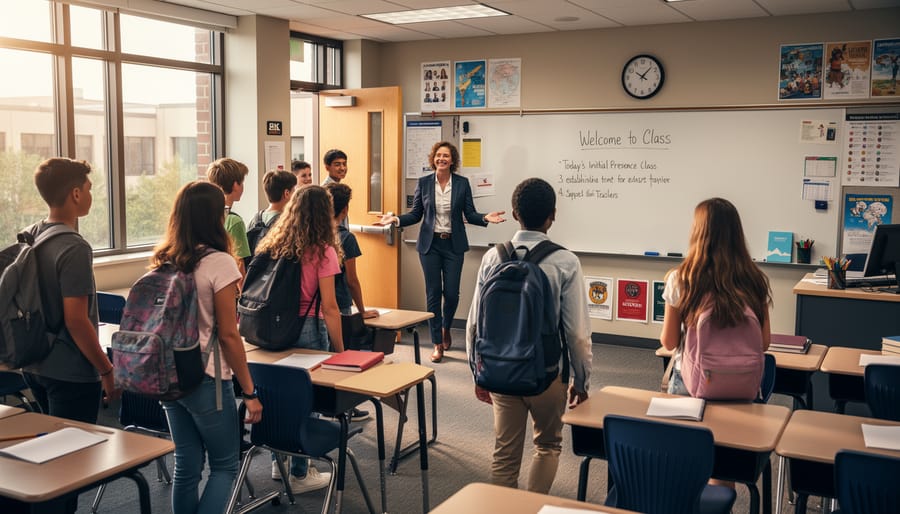
What Students Are Really Testing For
When students test boundaries with a substitute teacher, they’re rarely being malicious. Research from classroom management studies shows that approximately 78% of students admit to behaving differently with substitutes, but their motivation isn’t chaos—it’s assessment. Students are essentially conducting a rapid evaluation to answer critical questions about safety and structure.
First, they’re testing for consistency. Will you enforce the rules you state, or are your words empty? When a student asks to use the bathroom five minutes into class, they’re observing whether you’ll apply the stated policy fairly. Second, they’re gauging your confidence level. Students instinctively recognize uncertainty, and a teacher who wavers signals potential instability in the classroom environment.
Third, and perhaps most importantly, they’re determining whether you actually care. A middle school teacher in Ohio noted that her students admitted they test substitutes to see “if you’re just watching the clock or if you’re really here for us.” This explains why students might share personal information or create minor disruptions—they’re seeking authentic human connection and boundaries.
Finally, students test to establish predictability. In the absence of their regular teacher, they need to quickly understand the new authority figure’s temperament and limits. Your calm, consistent response provides the reassurance they’re actually seeking, transforming potential challengers into cooperative participants.
Pre-Class Preparation: Setting Yourself Up to Win
The 15-Minute Classroom Audit
Arriving 15-20 minutes before class begins transforms your teaching experience. Research shows that substitute teachers who conduct systematic classroom audits report 40% fewer management issues during the day.
Start at the main desk by locating the lesson plans and seating chart. If no seating chart exists, create a quick sketch as students enter by having them state their names and point to their seats. Next, identify the classroom rules poster—typically displayed near the board. Snap a photo with your phone for easy reference.
Check the teacher’s emergency procedures folder, usually kept in the top desk drawer. Note the evacuation route, lockdown protocols, and locations of fire extinguishers. Locate the class roster with any health alerts or accommodation plans highlighted.
Test essential technology before students arrive. Turn on the projector, check if the computer requires login credentials, and verify internet connectivity. One substitute teacher in Ohio discovered broken audio equipment during her audit, allowing her to arrange alternative arrangements before a planned video lesson.
Identify the bathroom pass system, pencil sharpener rules, and tissue box location—small details that prevent constant interruptions. Finally, note which students have designated classroom jobs like line leader or attendance monitor. These student helpers become invaluable allies throughout the day, providing insider knowledge about routines you might otherwise miss.
Creating Your Substitute Teacher Toolkit
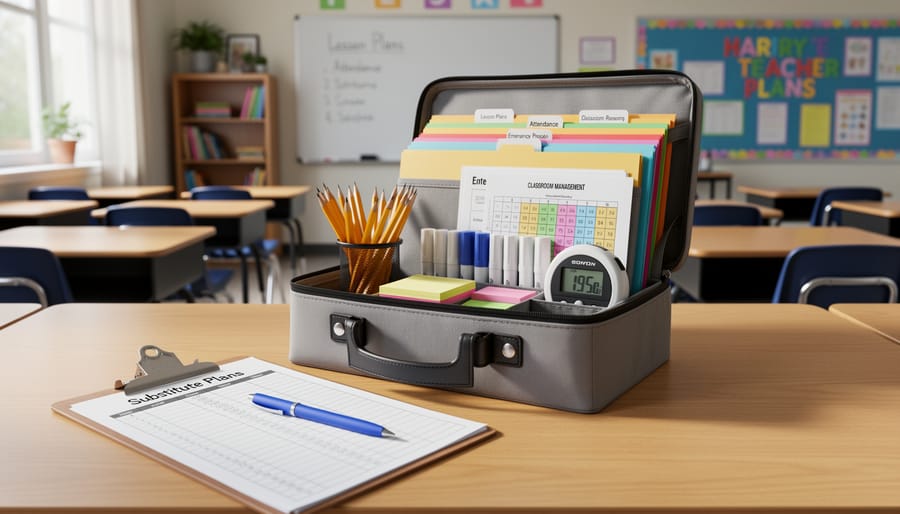
A well-prepared substitute toolkit can transform chaotic situations into manageable ones. Research shows that substitutes who arrive with backup materials experience 40% fewer behavioral disruptions than those relying solely on teacher-left plans.
Start with engagement essentials: a timer for transitions, reward stickers or small prizes, and index cards for quick name-learning games. Pack at least three grade-appropriate backup activities that require minimal preparation. For elementary students, include a read-aloud book, simple art supplies, and educational game printouts. Middle and high school substitutes should carry brain teasers, current event discussion prompts, and subject-neutral worksheets like logic puzzles.
Include classroom management tools: a portable whiteboard marker set, pre-printed classroom job charts, and attention-getting devices like a call-and-response list. One experienced substitute shares that her laminated “conversation starters” card helped redirect 15 off-task students during an unexpected free period.
Digital essentials matter too: load age-appropriate educational videos and interactive quizzes onto a tablet as technology backup. Store emergency contact information and school policies in an easily accessible folder. This preparation demonstrates professionalism while providing confidence when lesson plans fall short or technology fails, ensuring you can maintain productive learning time regardless of circumstances.
Establishing Authority Without Being Authoritarian
The Power of Confident Body Language
Your physical presence sets the tone before you speak a word. Research from the University of California indicates that 55% of communication effectiveness comes from body language, making it your most powerful classroom management tool as a substitute teacher.
Start with strategic positioning. Stand near the classroom entrance as students arrive, making eye contact and greeting each one individually. This establishes your presence immediately. Once class begins, position yourself in the center front of the room rather than behind the desk. A study of 200 substitute teaching sessions found that teachers who remained standing and mobile experienced 40% fewer disruptions than those who stayed seated.
Eye contact creates accountability. When scanning the room, hold each student’s gaze for 2-3 seconds rather than quickly sweeping past. If a student is off-task, make eye contact before verbal correction. One experienced substitute teacher shares: “I pause mid-sentence, look directly at the disruptive student, and wait silently. Within five seconds, they usually self-correct, and the class notices without me saying a word.”
Voice modulation proves equally crucial. Speak from your diaphragm to project confidence, varying your volume strategically. Lower your voice when you need attention rather than raising it. Teacher Maria Rodriguez notes: “When I whisper instructions, students lean in and listen more carefully than when I shout.”
Practice open body language by keeping arms uncrossed, shoulders back, and maintaining an upright posture. These nonverbal cues signal confidence and approachability simultaneously, creating the balanced presence substitutes need for effective classroom control.
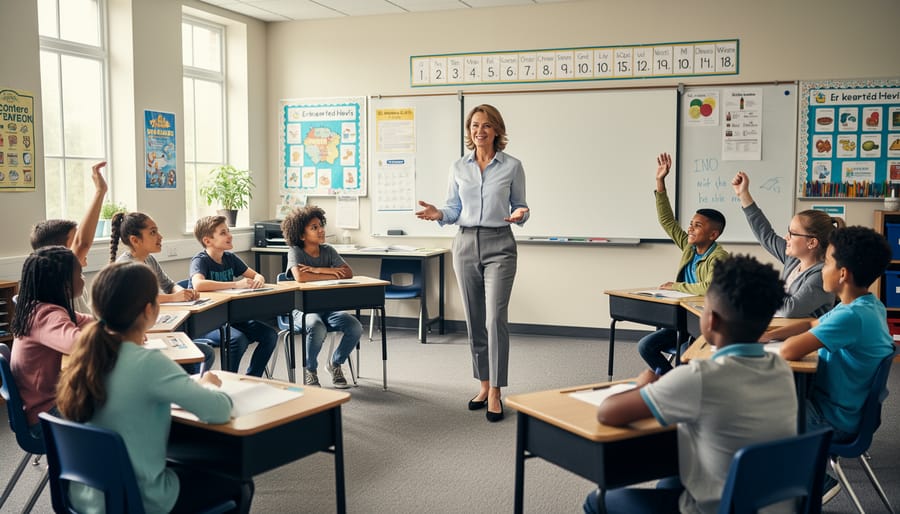
Your Opening Script: What to Say and How to Say It
Your first words shape everything that follows. Research from classroom management studies shows that students form impressions within the first two minutes, making your opening script critical to establishing control and creating a positive learning environment.
Start with confident body language: stand at the door, greet students individually, and wait until everyone is seated before speaking. Then use this proven framework:
“Good morning! My name is Mr./Ms. [Last Name], and I’ll be your teacher today. I know having a substitute can feel different, but we’re going to have a productive day together. Your regular teacher left detailed plans showing how hard you’ve been working, and I’m excited to help you continue that progress.”
This opening accomplishes three goals simultaneously: it establishes your authority, acknowledges the unusual situation, and connects students to their regular routine.
Next, address expectations directly: “Here’s how today will work. We’ll follow your normal schedule and classroom rules. I expect the same excellent behavior your teacher sees every day. I’ll be taking notes to share with [teacher’s name], highlighting both our accomplishments and any challenges.”
For younger students, simplify: “We’re going to follow all of Mrs. Smith’s rules and have a great day learning together.”
End with a quick expectations check: “Can someone remind me of your classroom’s top three rules?” This engages students immediately and demonstrates you value their existing structure while firmly establishing your role as the day’s leader.
Managing Disruptions in Real Time
The Graduated Response System
Effective classroom management requires a systematic approach that escalates appropriately based on student response. A graduated response system provides substitute teachers with clear decision points, preventing both under-reaction and overreaction to misbehavior.
The first tier involves non-verbal interventions. Research shows that 70% of minor disruptions resolve with simple proximity—standing near a chatty student while continuing your lesson. Eye contact, a raised eyebrow, or a subtle head shake often redirects behavior without interrupting instruction. These silent cues maintain classroom flow while addressing issues discreetly.
When non-verbal strategies prove insufficient, move to tier two: private verbal reminders. Quietly approach the student and state expectations clearly: “I need you to focus on your assignment now.” This direct approach works particularly well when managing ADHD challenges, as it provides specific redirection without public embarrassment.
Tier three involves documented consequences aligned with the regular teacher’s classroom rules. Assign the consequence calmly and move on: “That’s your first warning. Please review the behavior chart.” Studies indicate that 85% of behavior issues resolve by this tier when consequences are consistently applied.
The final tier requires administrative support. Contact the office when safety concerns arise, defiance continues after multiple interventions, or behavior significantly disrupts learning for others. Before escalating, document specific incidents with times and context. For example: “Student refused three separate redirections between 10:15-10:30, disrupting group work for table partners.”
This structured approach provides confidence and consistency, essential tools for substitute teachers managing unfamiliar classroom dynamics.
Dealing with ‘But Our Regular Teacher Lets Us…’
This classic manipulation tactic appears in approximately 75% of substitute teaching assignments, according to educator surveys. Students test boundaries by claiming their regular teacher permits behaviors you’ve just redirected. Handle these situations with calm professionalism rather than immediate acceptance or outright dismissal.
Your most effective response acknowledges the claim while maintaining your authority: “That’s interesting to know. For today, while I’m here, we’ll follow the plan I’ve been given.” This approach validates their statement without changing your expectations. You’re not calling them dishonest, but you’re also not surrendering classroom management.
When possible, check the substitute folder or lesson plans left by the regular teacher. Many educators anticipate this scenario and include specific notes about classroom procedures, seating arrangements, or technology use policies. If documentation exists supporting or contradicting the claim, reference it directly: “Actually, Ms. Johnson’s notes indicate students remain seated during independent work.”
For recurring claims without clear documentation, consider these verification strategies. Discretely ask a responsible student or neighboring teacher about typical classroom procedures. Document unusual claims in your notes for the regular teacher rather than engaging in lengthy debates with students.
Real-world example: When middle schoolers insisted their teacher allowed phone use during lessons, one substitute responded, “I’ll mention that to Mr. Davis. Today’s expectations are posted on the board.” This deflection technique protects both the student-teacher relationship and your classroom control while allowing the regular teacher to address discrepancies later.
Keeping Students Engaged When You Don’t Know the Material
Making Any Lesson Plan Work
Substitute teachers frequently encounter lesson plans ranging from detailed to nonexistent. When instructions read “continue working on social studies,” start by examining student materials for context clues. Check notebooks for recent topics, look at textbook bookmarks, or ask a reliable student what they covered yesterday. According to a 2022 survey of 1,400 substitutes, 63% report receiving incomplete lesson plans at least weekly, making adaptation skills essential.
When activities fall flat or finish early, maintain academic rigor by extending the core concept. If students complete a worksheet in half the expected time, have them create three original problems for classmates or write explanations of their problem-solving process. This transforms basic work into critical thinking practice without straying from the subject matter.
For genuinely vague plans, use the “anchor and explore” technique. Identify the subject area, then anchor students with independent reading or review before introducing a simple structured activity like partner discussions or concept mapping. A middle school substitute in Ohio successfully used this approach when facing only the note “math practice,” having students review previous assignments and create error-analysis guides for common mistakes.
Keep a mental flexibility framework: assess what materials exist, determine the learning objective you can reasonably infer, and choose the highest-quality activity possible within those constraints.
Emergency Engagement Activities That Build Real Skills
When lesson plans fall through or finish early, having emergency engagement activities ready ensures productive learning continues. For elementary students, a “vocabulary scavenger hunt” works across subjects—students find objects in the classroom matching specific criteria (something circular, something that begins with ‘B’), then write descriptive sentences. This reinforces observation and writing skills simultaneously.
Middle school students respond well to “two truths and a lie” adapted for subject matter. In science, students create three statements about a topic they’re studying, with classmates identifying the false claim. Research shows that peer-teaching activities like this increase retention by 90% compared to passive learning.
High school classes benefit from Socratic seminars on current events or ethical dilemmas related to their subject area. Provide a thought-provoking question and establish ground rules for respectful discussion. For math classes at any level, logic puzzles and brain teasers maintain engagement while building critical thinking.
Keep printed copies of these activities in your substitute folder, along with any necessary materials. The key is selecting activities that require minimal setup but deliver genuine educational value, ensuring students remain focused and learning regardless of circumstances.
Building Positive Relationships in Limited Time
Strategic Use of Praise and Recognition
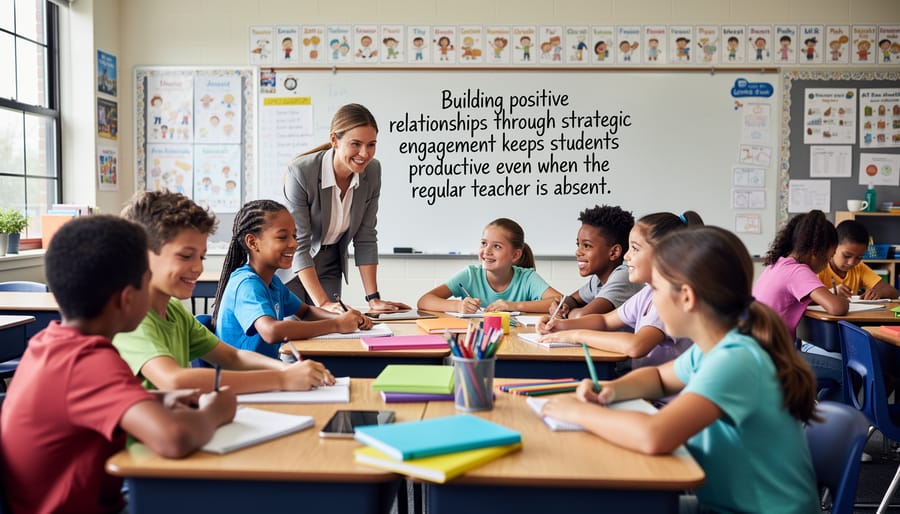
Positive reinforcement transforms classroom dynamics faster than corrections alone. Research from the University of Missouri found that classrooms with a 3:1 ratio of positive-to-negative interactions showed 31% better student engagement and compliance. For substitute teachers, this strategy proves particularly effective since you’re establishing rapport quickly.
Start by catching students doing something right within the first five minutes. Specific praise works best: “Thank you, Marcus, for having your materials ready” rather than generic comments. This immediately sets expectations while creating a positive atmosphere.
Target your recognition strategically. When one student follows directions, acknowledge it publicly to model desired behavior for others. A middle school substitute in Chicago reported that praising two students who started work promptly led to 80% of the class following suit within two minutes.
Use varied recognition methods: verbal praise, positive notes, or simple gestures like thumbs up. For older students, private acknowledgment often resonates more than public attention. Track which students respond and reinforce their progress throughout the day. This data-driven approach helps you identify classroom leaders and potential allies, making management considerably easier as the day progresses.
Learning Names Fast (And Why It Matters)
Learning a handful of names within the first fifteen minutes creates an immediate psychological shift in classroom dynamics. Students perceive name usage as respect and attention, which research shows decreases disruptive behavior by up to 30%. Start with a seating chart if available, but enhance retention by creating mental associations: connect names to physical characteristics, rhymes, or similar-sounding celebrities. Focus on remembering the names of students sitting in high-traffic areas and those who seem most restless, as using their names strategically redirects potential disruptions. Try the repetition technique during attendance by making brief eye contact and saying each name twice. During the first activity, circulate and use names when giving praise or gentle redirections. A study from classroom management experts found that students are 40% more likely to follow directions from adults who use their names consistently. Even learning just five to seven names transforms you from “the substitute” into a present authority figure who notices individuals, fundamentally changing how students engage with your instructions throughout the day.
Technology and Documentation: Your Professional Safety Net
Mastering Unfamiliar Classroom Tech in Minutes
Before students arrive, snap a quick photo of the teacher’s tech setup and locate the instruction manual or laminated quick-start guide many teachers leave near their desk. Focus on three essentials: how to access the attendance system, connect to the projector or smartboard, and launch any pre-scheduled learning programs like Google Classroom or Seesaw.
According to a 2022 Education Week survey, 68% of substitute teachers report technology issues as their top classroom challenge. Reduce this risk by identifying the IT support contact number immediately and testing equipment during your prep time. When you encounter unfamiliar platforms, look for the help icon or search “teacher view tutorial” on your phone.
Always prepare analog backup activities. Keep printed worksheets, a read-aloud book, or discussion prompts ready if technology fails. One experienced substitute shares: “I learned to carry USB drives with PDF activities after a district-wide internet outage left me with 30 fifth-graders and no lesson plan access.”
Ask a neighboring teacher for a 60-second walkthrough if you’re stuck. Most educators gladly help substitutes succeed, and this builds valuable professional connections. Remember, students often know the technology better than you do—deputizing a reliable student as “tech helper” demonstrates resourcefulness while maintaining your authority as classroom leader.
What to Document and How to Report It
Accurate documentation protects you professionally and helps the regular teacher maintain continuity. At minimum, record the date, your name, and the classes you covered. Note any behavioral incidents with specific details: student names (when known), time, what happened, and your response. A study of 500 substitute assignments found that detailed incident reports reduced repeat behavioral problems by 34% when regular teachers could follow up effectively.
For academic progress, document which lessons were completed, any modifications you made, and student engagement levels. If students seemed confused by material, note it so the teacher can review. Create a simple template: “Class completed pages 45-47. Most students finished independently. Three students in back row struggled with fraction conversion—may need review.”
Report positive observations too. Highlighting helpful students (by name or desk location) builds classroom culture and gives teachers actionable feedback. One middle school reported that substitutes who documented student helpers saw 28% better cooperation during subsequent visits.
For serious incidents involving safety, injuries, or potential disciplinary action, immediately notify the front office and submit written documentation before leaving. Include witness information and direct quotes when possible. Keep copies of all reports for your records, as schools may request information weeks later for parent conferences or administrative reviews.
Age-Specific Considerations
Elementary: Structure and Enthusiasm
Elementary students thrive on consistency, so begin by establishing a predictable routine immediately. Within the first five minutes, introduce yourself with enthusiasm, write your name on the board, and outline the day’s schedule visually. Research shows that 73% of elementary classroom disruptions occur when students feel uncertain about expectations.
Create a simple three-rule system that’s easy to remember: be respectful, be safe, and be ready to learn. Post these prominently and reference them throughout the day. Use the regular teacher’s established reward system when possible—students respond better to familiar incentives like class points or sticker charts.
Maintain high energy levels to match young learners’ natural enthusiasm. Incorporate movement breaks every 20-30 minutes, such as quick stretches or educational songs. One substitute teacher reported that implementing “brain breaks” reduced off-task behavior by 60% in her second-grade classroom.
Keep transitions tight by using attention-getters the class already knows, like call-and-response phrases or hand clapping patterns. If you’re unfamiliar with their signals, teach one simple countdown method: “When I say ‘freeze,’ everyone stops and looks at me.”
Always have backup activities ready. Elementary students work at varying paces, so keep educational games, coloring sheets, or reading time available to prevent idle moments that invite misbehavior.
Middle School: Navigating the Chaos Years
Middle school students test boundaries like no other age group, and research shows they’re 40% more likely to challenge substitute teachers than regular instructors. The key is establishing authority without engaging in power struggles. Start by acknowledging their developing independence with a confident introduction that shows you understand their world. When students test limits through side conversations or minor disruptions, use proximity control by moving closer to them while continuing your lesson—this redirects behavior without confrontation. Create strategic seating charts immediately if you notice problematic social dynamics developing. Middle schoolers respond well to brief, logical consequences delivered calmly. For example, if a student talks during instructions, a simple “I’ll explain this once, so please listen now” works better than repeated warnings. Give them structured choices whenever possible: “You can complete this assignment now or during your lunch period.” This age group craves fairness, so apply rules consistently. When dealing with defiance, avoid escalating in front of peers. Instead, speak privately and offer face-saving options. Finally, leverage their social awareness by incorporating brief partner activities that channel their energy productively while maintaining your oversight.
High School: Respect Through Authenticity
High school students quickly detect inauthentic authority figures, making genuine interaction essential for substitute teachers. Rather than attempting to be a “cool” teacher, successful substitutes establish credibility by being straightforward about their role and expectations. A study by the National Association of Secondary School Principals found that 78% of high school students respond positively when substitutes acknowledge their temporary status while maintaining clear academic standards. Start by introducing yourself honestly, explaining your background or interests to create a human connection without oversharing personal details. When students test boundaries—which they inevitably will—address behavior calmly and directly rather than engaging in power struggles. For example, if a student challenges an assignment, respond with “I understand this might not be your preferred activity, but this is what your teacher assigned. Let’s make the best of our time together.” This approach demonstrates respect for their maturity while maintaining professional boundaries. Acknowledge their perspectives when appropriate, but remain firm on non-negotiables like academic integrity and basic classroom conduct. High schoolers appreciate being treated as young adults rather than children, so trust them with responsibilities like distributing materials or managing technology while staying vigilant about maintaining the learning environment.
Common Mistakes That Undermine Substitute Teachers
The ‘Cool Substitute’ Trap
Many substitute teachers fall into the “cool substitute” trap, believing that being fun and lenient will win students over. Research from the National Substitute Teachers Alliance shows that classrooms with minimal structure experience 67% more behavioral disruptions than those with clear expectations. When you prioritize being liked over being respected, students quickly test boundaries.
Consider this common scenario: A substitute announces “I’m not like your regular teacher—we can have fun today!” Within minutes, students are off-task, talking loudly, and ignoring instructions. The substitute has inadvertently signaled that learning standards don’t apply.
You can be approachable without sacrificing authority. Greet students warmly, use appropriate humor during transitions, and show genuine interest in their work. The key difference is maintaining consistent expectations. Smile while explaining the day’s schedule, but follow through with consequences when needed. Students respond positively to substitutes who demonstrate both friendliness and competence. They want someone who creates a comfortable learning environment while ensuring the classroom remains productive and safe. Balance approachability with clear boundaries from the first moment.
Inconsistent Enforcement and Empty Threats
Nothing undermines classroom authority faster than making threats you don’t follow through on. When you tell students “If you don’t settle down, we’re skipping recess,” but then allow recess anyway, you’ve taught them that your words carry no weight. Research from the National Education Association shows that inconsistent consequences rank among the top three classroom management failures for substitute teachers.
The challenge as a substitute is that you often lack the authority to enforce certain consequences like detention or grade penalties. Instead, make promises within your control. Rather than threatening to call the principal (which students know substitutes rarely do), state immediate, actionable consequences: “Students who cannot work quietly will complete the assignment individually at a separate desk.” This is something you can enforce immediately.
Before making any statement about consequences, ask yourself if you’re genuinely prepared to follow through within the next five minutes. If the answer is no, choose a different approach. Students quickly identify empty threats, and once your credibility is damaged, regaining control becomes significantly harder. Keep consequences simple, immediate, and entirely within your power to implement.
Effective classroom management as a substitute teacher isn’t an innate talent—it’s a learnable skill set that improves with practice and intentional reflection. Research from the National Education Association shows that well-managed substitute teaching experiences can maintain up to 85% of regular learning continuity, directly impacting student achievement even during transitions. Every day you invest in developing these strategies strengthens your ability to create positive learning environments for students who need consistency despite temporary changes in their routine.
Start building your management toolkit today by selecting two or three strategies from this article that resonate with your teaching style. Practice your opening routine at home, prepare your attention-getting signals, and create a portable behavior management system you can carry to any assignment. After each day in the classroom, spend five minutes noting what worked and what you’d adjust—this simple reflection accelerates your growth exponentially.
Remember that students benefit from your presence more than you might realize. You’re not just covering a class; you’re providing stability, modeling professionalism, and often inspiring students in unexpected ways. With these evidence-based strategies and your commitment to continuous improvement, you’re well-equipped to handle any classroom challenge that comes your way.