



Charlemagne’s educational reforms, launched through the founding of the palace school at Aachen in 781 and formalized in the Admonitio generalis decree of March 23, 789, created the blueprint for Western educational systems that still influences how we structure learning today. His mandate to restore schools and promote literacy across his empire transformed education from an exclusive privilege of the elite into a more organized, accessible system tied to institutional development.
For educators and educational professionals, understanding Charlemagne’s approach offers more than historical context. It reveals foundational principles about systematic curriculum design, the role of centralized standards, and the relationship between education and broader societal goals. The Carolingian Renaissance, sparked by these reforms, demonstrated how coordinated educational policy could revitalize an entire civilization’s intellectual capacity.
The palace school at Aachen became the model for cathedral and monastic schools throughout medieval Europe, establishing patterns we recognize in modern educational institutions: structured curricula, qualified instructors, and the preservation and transmission of knowledge through organized teaching. Charlemagne’s insistence on educational standards, even without the technological tools we have now, proved that strong leadership and clear vision could democratize learning.
This article examines both the historical specifics of Charlemagne’s educational vision and its practical applications for contemporary education. Whether you’re designing curriculum, advocating for educational policy, or simply seeking to understand how modern schooling evolved, the Carolingian reforms provide tested frameworks for creating systematic, impactful educational change.
The Birth of Systematic Education: What Charlemagne Actually Did

Before Charlemagne, education in Europe was chaotic at best. Learning happened sporadically in scattered monasteries, with no common standards and access limited almost entirely to those training for religious life. What made Charlemagne revolutionary wasn’t that he valued education, plenty of rulers did, but that he created systems to deliver it consistently across his vast empire.
In 781, Charlemagne established the palace school at Aachen, Germany. This wasn’t just another monastery school. It became the model for organized learning, drawing scholars from across Europe and teaching children of the court alongside promising students from lower social ranks. The school demonstrated that education could be structured, intentional, and replicated, a radical departure from the haphazard approach that had dominated for centuries.
But Charlemagne’s most significant contribution came on March 23, 789, when he promulgated the Admonitio generalis, a capitulary that fundamentally reshaped European education. This legislative decree addressed two intertwined goals: advancing Christianization and restoring schools throughout the empire. The document didn’t simply suggest that education might be valuable. It mandated that cathedral and monastery schools be established, prescribed what should be taught, and set expectations for teacher competence.
| Year | Initiative | Educational Purpose |
|---|---|---|
| 781 | Palace school founded at Aachen | Create model institution demonstrating structured, systematic learning for diverse students |
| 789 | Admonitio generalis promulgated | Mandate school establishment across empire; standardize curriculum and teacher expectations |
| 789 onward | Cathedral and monastery school expansion | Advance Christianization while ensuring literacy and learning accessibility beyond nobility |
The genius of Charlemagne’s approach lay in recognizing that sporadic, inconsistent education served no one well. By creating centralized expectations through the Admonitio generalis and demonstrating what organized learning looked like through the Aachen palace school, he transformed education from an accidental byproduct of monastic life into a deliberate, replicable system. Schools were no longer places where learning might happen if the right monk happened to be present. They became institutions with defined purposes, expected standards, and clear connections to both religious and civic life.
This shift from sporadic to systematic represents the true birth of education as we understand it today, not just teaching, but a structured framework designed to produce predictable, widespread results.
The Carolingian Blueprint: Core Principles of Charlemagne Education
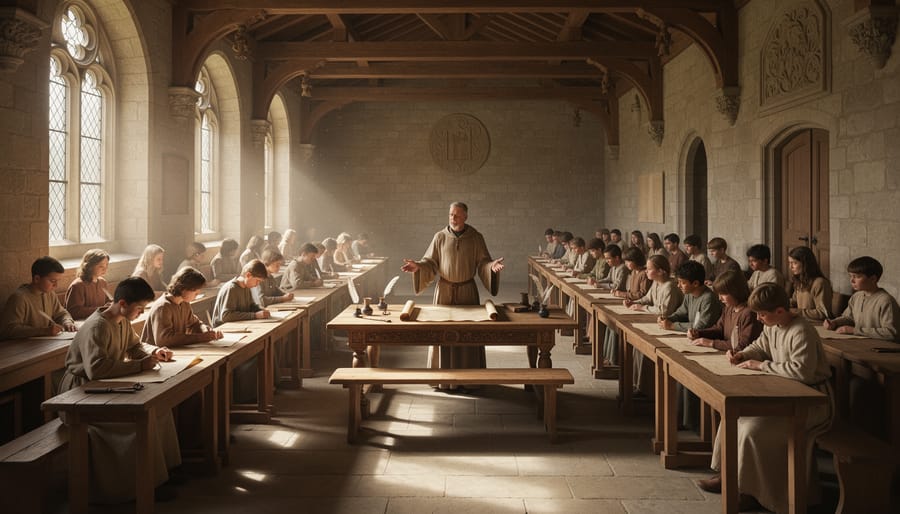
Charlemagne didn’t just build schools; he created a blueprint for how education should work. Four principles emerged from his reforms between 781 and 789 that sound remarkably familiar to anyone working in education today.
First, he established the idea that what students learn shouldn’t vary wildly from place to place. The Admonitio generalis of March 789 set specific expectations for what monasteries and cathedral schools should teach, creating one of the earliest attempts at curriculum standardization. While limited to religious institutions, this represented a shift from education as scattered, individual efforts to something coordinated across a vast empire. Today’s debates about common core standards or national curricula are essentially the same conversation Charlemagne started 1,200 years ago.
Second, Charlemagne recognized that teaching required trained, qualified individuals. He didn’t assume anyone could walk into a classroom and succeed. The palace school at Aachen, founded in 781, became a training ground where scholars like Alcuin of York developed teaching methods and prepared others to lead schools throughout the empire. This created an early model of professional development for educators, a concept now fundamental to every modern school system.
Third, he expanded who deserved education. While far from universal access by today’s standards, Charlemagne pushed for education beyond the highest nobility, arguing that literacy served both spiritual and practical purposes for administrators, clergy, and even some common people. This planted the seed that education wasn’t merely for elites, a radical notion that eventually grew into universal schooling movements.
Finally, Charlemagne integrated religious instruction with practical skills like reading, writing, and basic arithmetic. His reforms balanced spiritual formation with the secular competencies needed to run an empire, creating a model where schools serve multiple societal functions simultaneously. Modern public schools still navigate this balance between values education and practical skill-building, though the specific values have shifted from purely religious to civic and social.
From Aachen to Your School: Direct Lineages in Modern Education

Curriculum Standardization: Then and Now
When Charlemagne issued the Admonitio generalis on March 23, 789, he did something no European ruler had attempted in centuries: he defined what every church school should teach. The capitulary didn’t just encourage learning, it prescribed specific subjects including grammar, calculation, and liturgical chant, creating expectations that reached from Aachen across the empire.
This was curriculum standardization in its earliest form. Before 789, education varied wildly between monasteries and churches. One school might focus entirely on Scripture memorization while another emphasized Latin grammar. The Admonitio generalis changed that by establishing baseline requirements, much like how modern common core standards or national curricula outline what students should master at each level.
The parallel is striking. Just as Charlemagne’s decree specified content areas to ensure consistency across his empire, today’s curriculum frameworks aim to guarantee that a student in California learns similar foundational skills as one in Maine. Both systems emerged from the same impulse: the belief that educational quality shouldn’t depend entirely on local circumstance, and that some shared standards benefit society as a whole.
The Teacher as Authority Figure
Before Charlemagne’s reforms, teaching was a scattered occupation practiced mainly by scattered clergy with wildly varying competence. Charlemagne transformed this by establishing explicit standards for who could teach and what they needed to know. The Admonitio generalis of March 789 mandated that teachers must themselves be literate and morally upright, revolutionary criteria that formalized teaching as a profession rather than an informal role.
This elevation created lasting expectations. Teachers became gatekeepers of approved knowledge, charged with standardizing instruction across Charlemagne’s empire. The palace school at Aachen, founded in 781, became a model where select scholars taught under royal authority, establishing the template of the teacher as institutional representative rather than freelance instructor.
We still live with this framework. Modern teachers derive authority from credentials, institutional backing, and standardized training, all concepts Charlemagne pioneered. The expectation that teachers should be both knowledgeable and morally exemplary, that they represent something larger than themselves, traces directly to eighth-century reforms that recognized effective education required elevating those who delivered it.
Literacy as a Right, Not a Privilege
Charlemagne’s reforms broke with centuries of precedent by establishing that education shouldn’t be reserved for aristocratic families. While the nobility had long employed private tutors, his 789 capitulary directed churches and monasteries to create schools accessible to children from multiple social strata. This wasn’t yet universal education in the modern sense, peasant children still rarely attended, but it represented a fundamental shift in thinking about who deserved literacy.
The Admonitio generalis framed basic reading and writing as tools necessary for spiritual life, not markers of social status. By positioning literacy as a religious duty rather than an elite privilege, Charlemagne created the intellectual foundation for arguments that would emerge centuries later: if reading matters for salvation, then everyone needs access regardless of birth. This logic ultimately fueled movements for compulsory education across Europe and beyond, even as the religious justification faded and civic rationales took its place.
What Today’s Educators Can Learn from Charlemagne’s Approach
Charlemagne’s systematic approach to education reform offers surprisingly relevant lessons for contemporary classrooms. His insistence on consistency across teaching sites mirrors what research shows about high-performing school systems: when teachers collaborate on a shared lesson plan outline rather than working in isolation, student outcomes improve measurably. Studies from the National Center for Education Statistics demonstrate that schools with aligned curriculum frameworks see 23% higher proficiency rates than those where each teacher operates independently.
The Carolingian emphasis on qualified instructors speaks directly to today’s professional development debates. Charlemagne didn’t just demand schools; he established expectations for who could teach and what they needed to know. Modern districts implementing similar standards-based teacher preparation programs report significant gains. When educators receive ongoing training in evidence-based methods including scaffolding strategies achievement gaps narrow by an average of 18 percentage points over three years.
Parents and administrators can draw practical insights from Charlemagne’s clarity of purpose. He articulated specific goals for education rather than vague aspirations, then built structures to achieve them. Today’s most effective schools follow this pattern: they define concrete literacy and numeracy benchmarks, train staff to meet them, and monitor progress systematically. The 2024 PISA rankings show that countries with clear, centralized learning standards combined with local implementation flexibility consistently outperform those with either rigid top-down mandates or complete decentralization.
Perhaps most relevant is Charlemagne’s recognition that education serves society beyond individual benefit. His reforms aimed to create a literate class capable of participating in civic and religious life. Modern research confirms this broader value: communities with higher educational attainment show stronger economic resilience, better health outcomes, and more engaged citizenship. When educators frame their work not just as skills transfer but as building the foundation for democratic participation, students demonstrate deeper engagement and retention.
The lesson isn’t to replicate 8th-century methods, but to apply Charlemagne’s core insight: education requires intentional structure, qualified teachers, clear standards, and a vision beyond immediate utility.
The Limitations: What Charlemagne Got Wrong (And What We Fixed)
Charlemagne’s reforms were revolutionary for the 8th century, but they came with serious blind spots that took centuries to correct. The system he built systematically excluded girls and women, confining education almost entirely to males destined for clergy or administrative roles. While the palace school at Aachen trained future leaders, it served perhaps a few dozen students, and the broader school network he envisioned through the Admonitio generalis of 789 reached only a fraction of the population.
Pros
- Established the first systematic approach to curriculum and teacher standards across an empire.
- Created infrastructure that made education a governmental responsibility rather than purely private.
- Preserved classical texts and learning methods that would have otherwise disappeared.
- Demonstrated that literacy and learning could be taught at scale with proper organization.
Cons
- Completely excluded women and girls from formal educational opportunities.
- Prioritized religious instruction so heavily that secular knowledge remained secondary for centuries.
- Limited access almost entirely to nobility and clergy, leaving peasants illiterate.
- Imposed Latin as the sole language of instruction, creating barriers for vernacular speakers.
Religious doctrine dominated every aspect of the curriculum, which meant scientific inquiry, critical thinking, and secular philosophy took a backseat for generations. Modern education has fundamentally addressed these failures. We’ve embraced coeducation, separated church and state in public schooling, and expanded access to become truly universal. Today’s debates around personalization vs standardization echo Charlemagne’s rigid approach, but we’ve learned to balance structure with individual needs. His framework gave us the skeleton, but we’ve built a body that serves all learners regardless of gender, class, or background.
Why Understanding Charlemagne Education Matters in 2026
Understanding Charlemagne’s educational legacy isn’t an academic exercise for 2026 educators, parents, and students, it reveals that the tensions defining modern schooling have existed for over 1,200 years. The debates consuming school board meetings and policy journals today essentially update the same fundamental question Charlemagne confronted in 789: how do we create systems that deliver consistent education while respecting individual needs and local contexts?
The standardization versus personalization debate directly echoes Charlemagne’s balancing act. His Admonitio generalis of March 23, 789 established what subjects schools should teach, creating one of history’s first centralized curriculum frameworks. Yet individual teachers still adapted content to their students. Today’s educators face identical pressures, meeting common standards while differentiating instruction. Recognizing this continuity helps frame current personalized learning initiatives not as radical departures but as refinements of a centuries-old tension.
Technology’s role in education carries similar historical parallels. When Charlemagne founded the palace school at Aachen in 781, books themselves were cutting-edge technology, expensive and rare. His reforms democratized access to written knowledge much as modern tech integration aims to democratize access to digital resources. Both revolutions prompted fears about quality control and equity, concerns that persist whenever new tools reshape learning.
The equity conversation proves especially illuminating. Charlemagne’s vision expanded education beyond nobility but remained limited by medieval social structures. Today’s universal education mandates represent the logical extension of his initial premise that learning shouldn’t be confined to elites. Understanding this trajectory clarifies why access debates remain central to educational policy, we’re still working to fulfill a promise initiated 1,245 years ago, applying it to contexts Charlemagne couldn’t imagine but principles he’d recognize.
When you walk into a classroom today, you’re entering a space shaped by decisions made over 1,200 years ago. The organized curriculum, the expectation that teachers hold specific qualifications, the very idea that education should be systematic rather than random, these aren’t modern inventions. They’re the legacy of an 8th-century king who understood something fundamental: structured learning transforms societies.
Charlemagne’s palace school at Aachen in 781 and his 789 capitulary didn’t just create schools. They established a template that persists in recognizable form across modern education systems. Every time a school district adopts curriculum standards, every time we debate teacher training requirements, every time we argue about educational access, we’re continuing conversations Charlemagne began.
For educators, recognizing this continuity offers perspective on current challenges. The tensions between standardization and flexibility, between religious and secular learning, between elite and universal access, these aren’t new problems. They’re the same fundamental questions, asked in different contexts.
Parents and students benefit from understanding that modern schooling isn’t arbitrary. Its structure reflects centuries of refinement, starting with Charlemagne’s insight that learning needed organization and consistency.
The foundation is solid, tested by time. Now the question becomes: what do we build next? How do we honor the best of this legacy while adapting to needs Charlemagne couldn’t have imagined? That’s the work ahead, and it starts with understanding where we came from.