



The six co-teaching models are One Teach, One Assist; Station Teaching; Parallel Teaching; Alternative Teaching; Teaming; and One Teach, One Observe. Each one gives two educators a different way to share a classroom, and the right choice depends on your lesson goal, your students’ needs, and how much planning time you have.
Think of them as a toolkit rather than a ranking. One Teach, One Assist is a gentle starting point for new partnerships. Station Teaching and Parallel Teaching shrink the group size so more students participate. Alternative Teaching targets a small group with focused support, Teaming has both teachers delivering one shared lesson, and One Teach, One Observe turns classroom data into your next instructional move.
A model only works when the planning behind it does. That’s why lesson planning important habits matter so much in a shared classroom: clear roles, agreed goals, and a plan for who does what and when. Below, you’ll find a quick explanation of each model, a real classroom example, a comparison table, and answers to common questions.
How These Six Models Were Chosen for Collaborative Lesson Planning
These six approaches are the ones you’ll see again and again in school co-teaching practice and in teacher-preparation programs. They aren’t a random collection. Each one is a widely recognized way for two educators to share a classroom, and each was weighed against the same practical planning questions, much like the ones in a 7-step lesson framework where goals, grouping, and timing get decided before the lesson begins.
Here’s what we looked at for every model:
- How much planning time it requires from both teachers
- How fully the two teachers share ownership of instruction
- How flexibly students can be grouped and regrouped
- How well it supports diverse learners in the room
- How easy it is for a new pair to get started
You’ll notice that none of these models wins on every criterion. One teach, one assist is quick to launch but offers less shared ownership, while teaming builds the deepest partnership but asks for the most prep time. That’s exactly why no single model is “best.” Strong co-teaching pairs rarely stick to one approach all year. They rotate among several, choosing whichever fits the day’s lesson goal and the students in front of them. Think of this list as a toolkit to draw from, not a ranking to climb.
1. One Teach, One Assist: A Simple Starting Point
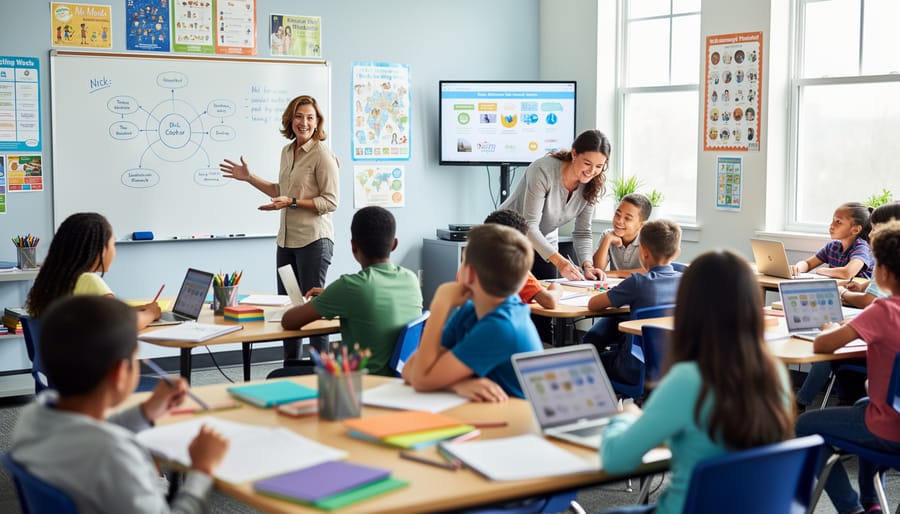
In one teach, one assist, one teacher leads the lesson while the other moves around the room, helping individual students as questions come up. It’s the easiest model to start with because it asks for very little extra planning and works in almost any lesson.
This model works best when you’re introducing new content, running a quick check-in, or building a brand-new co-teaching partnership. The lead teacher keeps the pace and the big ideas moving, while the support teacher catches confusion early, redirects off-task students, and offers a quiet word to anyone who’s stuck. Students get help the moment they need it, without stopping the whole class.
To plan it well, sit down beforehand and agree on who leads and who supports. Decide what the support teacher will watch for, such as students who often hesitate to ask questions, and how they’ll signal the lead if a concept needs a second explanation. A few minutes of shared planning keeps both teachers purposeful rather than guessing.
Picture a fifth-grade math lesson on adding fractions with unlike denominators. The classroom teacher walks through a worked example at the board and includes a few visuals; to make the steps stick, they might integrate visual aids like fraction strips. Meanwhile, the special educator circulates, kneels beside a student who is lost, and points back to the strips until the idea clicks.
That rotation matters. If the same person always supports, students may start treating them like an aide, and the partnership can lose its balance. Swapping roles keeps both teachers’ expertise visible and strengthens the shared classroom.
2. Station Teaching: Rotating Small Groups for Deeper Practice
Station teaching splits a lesson into parts and rotates students through them. Typically, one teacher leads one station, the second teacher leads another, and a third station gives students independent work or partner practice. Each group visits every station, so every student gets the same content, just in a different order.
Planning is where this model succeeds or stalls. Start by deciding how to divide the content so each station stands on its own, since groups arrive in different sequences. Next, agree on timing. Rotations of 10 to 15 minutes work well for many classes, and a visible timer keeps transitions calm. Finally, divide the prep: one teacher gathers materials for the independent station while the other drafts the task cards or questions. Sharing this load is a big part of what makes the model manageable.
Picture a Grade 3 reading block. At the first station, the classroom teacher guides a small group through a short passage and asks comprehension questions. At the second, the special educator works on vocabulary using picture cards and sentence building. At the third, students complete a matching task and a short response on their own. When the timer sounds, groups rotate. The same approach suits spelling, where one station can focus on word patterns and sound-it-out practice, a useful way to teach spelling effectively while the other stations build fluency and writing.
The payoff is a lower student-to-teacher ratio. Instead of 24 students facing one teacher, each leader works with a group of about eight, which makes it easier to spot misunderstandings and adjust on the spot. It also supports differentiation: each teacher can adapt pacing, prompts, and supports for the group in front of them without singling anyone out.
3. Parallel Teaching: Halving the Class for More Participation
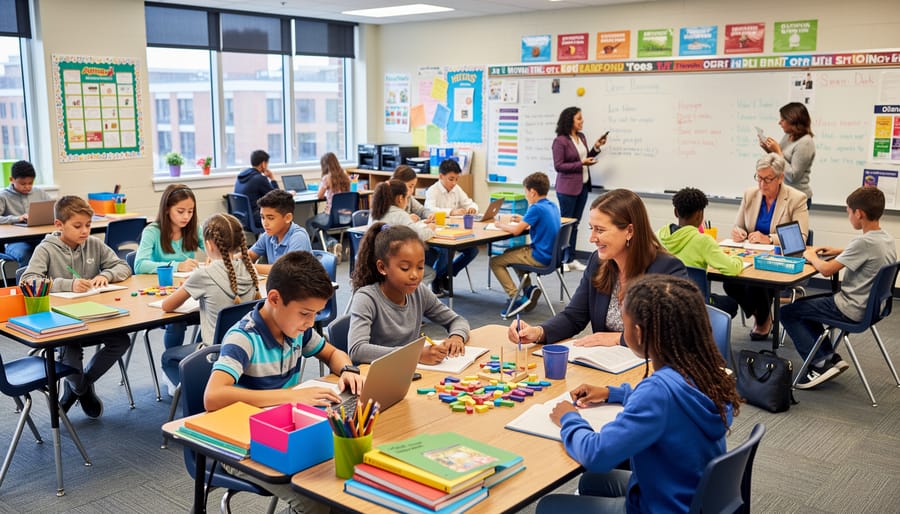
In parallel teaching, the class is split into two equal groups, and each teacher delivers the same content to one group at the same time. Think of it as turning one crowded room into two smaller, more responsive ones. With roughly half as many students per teacher, more students speak up, ask questions, and get immediate feedback.
This model only works if the two teachers are truly teaching the same lesson. That means planning together before the day arrives:
– Build one shared lesson plan, including the key questions, examples, and materials.
– Agree on pacing so both groups reach the same checkpoints at about the same time.
– Decide in advance how you’ll compare outcomes, such as a quick exit ticket or a short set of practice problems both groups complete.
Comparing results afterward is the quiet strength of this approach. If one group struggles with a concept the other grasped, you’ll see it right away and can adjust the next lesson.
Parallel teaching fits best when students benefit from talking and active participation. Review sessions, discussions, and vocabulary practice are all natural choices. It’s less suited to brand-new, complex content, where a single teacher’s explanation helps keep everyone on the same page.
Picture a seventh-grade science class preparing for a unit test on ecosystems. The general education teacher and the special educator split the class down the middle, each in a separate corner of the room or an adjoining space. Both use the same set of review questions about food webs and energy flow. In the smaller groups, quieter students answer aloud instead of waiting for others, and each teacher can spot misconceptions on the spot. At the end, both groups complete the same five-question check, and the teachers compare results over lunch to plan tomorrow’s reteaching.
4. Alternative Teaching: Targeted Support for Small Groups
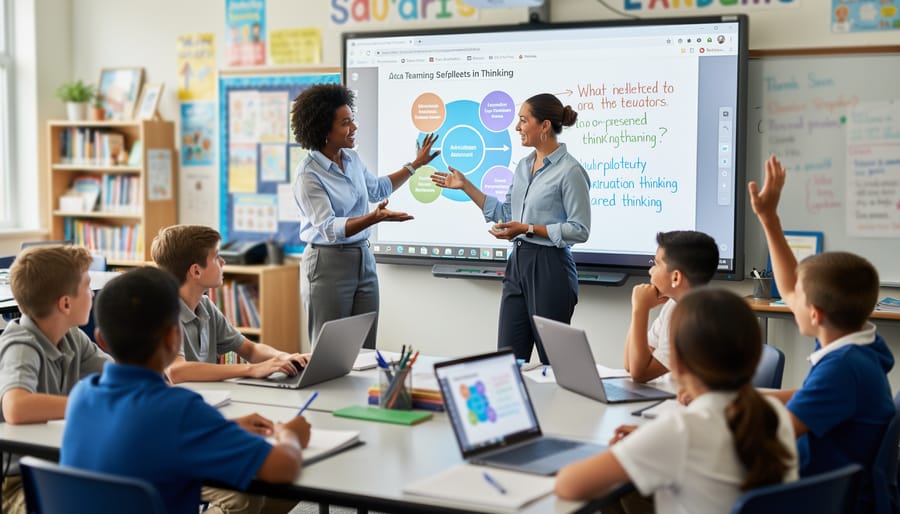
In alternative teaching, one teacher leads the larger group through the main lesson while the other pulls a smaller group aside for a different kind of work. That work usually falls into three buckets: pre-teaching background knowledge, offering enrichment, or reteaching a skill that didn’t land the first time.
The model shines when a handful of students need something specific that the whole class doesn’t. It also keeps the lesson moving for everyone else, since the large group isn’t waiting while one student gets extra help.
The planning is where this model succeeds or fails. During your shared planning time, decide what the small group will do and why before you decide who belongs in it. Start with the learning target, then use recent exit tickets, quick checks, or work samples to see who would benefit this time. Aim for groups that change from lesson to lesson, so no student becomes “the group that always leaves.” Sometimes the small group is made up of students ready for a challenge, and that mix helps normalize the idea that everyone gets pulled aside at some point.
Here’s a simple example. Before a reading lesson on a chapter about the ocean, one teacher takes six students to a corner table for ten minutes. They preview five key words, such as “current” and “habitat,” using pictures and quick sentences. Those students rejoin the class feeling ready, while the other teacher begins the read-aloud with everyone else. Next week, a different group might preview the vocabulary, depending on the text.
5. Teaming: Two Teachers, One Shared Lesson
In teaming, both teachers share the front of the room and deliver one lesson together. They trade explanations, ask each other questions, model thinking aloud, and respond to what the other says. Students see two adults working through ideas in real time, which is hard to replicate any other way.
This is the model that demands the most from a partnership. Because the lesson is a genuine back-and-forth, the pair needs a shared plan, a clear sense of who covers what, and enough trust to improvise when a student question pulls the conversation sideways. Expect to spend more planning time here than with any other model. Many teams save it for key lessons rather than using it every day.
The payoff is worth it. Students watch collaborative thinking happen: one teacher voices a misconception, the other gently corrects it, and the class learns that revising an idea is normal. The energy of two voices can also keep students engaged since the pace and perspective shift often.
Picture a paired writing demonstration. One teacher drafts an opening paragraph on the board while narrating choices, and the other plays the role of a reader, asking, “Where did that idea come from?” or “Could that sentence be stronger?” Together they revise live, showing the messy, iterative nature of writing. A debate works the same way, with each teacher arguing one side before inviting students to weigh in.
6. One Teach, One Observe: Using Data to Guide Instruction

In the one teach, one observe model, one teacher leads the lesson while the other steps back and collects specific information about what is happening in the room. The observer isn’t there to evaluate the lead teacher or to simply watch. The goal is to gather evidence that neither teacher can easily see while managing a class.
The model works best when the planning happens first. Before the lesson, agree on one clear focus. That might be which students participate in discussion, how long students stay on task during independent work, or how many students need a second explanation of directions. Then pick a simple data-collection tool to match. A seating chart with tally marks, a checklist of target behaviors, or a timed log of on-task moments all work well. Keep it small, because a tool that is too complicated will pull the observer’s attention away from students.
Picture a fifth-grade class working independently on math problems. The observer notes, every two minutes, which students are working, which are stuck, and which are off task. Afterward, the pattern might show that most students stall right after the first problem, which points to unclear directions rather than a behavior issue.
The real value comes in your next planning session. Review the data together and ask what it suggests. Then decide on one small change to try, such as clearer directions or a different grouping. Rotate who observes so both teachers see the classroom from both positions.
Common Questions About Co-Teaching Models and Planning Together
Teachers and parents often ask the same handful of questions about shared classrooms. Here are clear answers to the ones that come up most.
How do we decide which model to use for a lesson?
Start with the lesson goal. If students need small-group practice, station teaching or parallel teaching fits; if you need data on how students are doing, one teach, one observe is the better choice.
Can we combine models in one class period?
Yes, and many teaching pairs do. You might open with one teach, one assist for the mini-lesson, then shift to station teaching for practice.
How does co-teaching support students with diverse learning needs?
Two teachers can offer more flexible grouping, quicker feedback, and a mix of instructional approaches. Alternative teaching, for example, lets one teacher pre-teach or reteach skills without pausing the whole class.
What should we do if our teaching styles differ?
Treat those differences as a strength. Talk early about routines, expectations, and who leads which parts of the lesson, then revisit those agreements as you learn what works.
If you’re looking for a first step, pick the model that feels most comfortable and use it for a single lesson. A short debrief afterward, even just five minutes, helps both teachers decide what to keep, adjust, or try differently next time.
Final Takeaway: Match the Model to the Moment
Every model on this list works best when it fits the moment. One teach, one assist suits a quick check-in, station teaching and parallel teaching give students more voice, alternative teaching reaches the kids who need an extra pass, teaming models shared thinking, and one teach, one observe turns what you notice into your next plan. The thread running through all six is a planning conversation held before the lesson starts, where both teachers agree on the goal and then pick the structure that serves it.
At your next planning session, pick one model you haven’t tried yet and build a single lesson around it. Small experiments like that are how a shared classroom starts to feel like a true partnership.