



Content teams, educators, and hiring managers are all running into the same headache: text that looks polished but wasn’t written by a person. The best tools to detect AI-generated content in 2026 have gotten sharper, but so have the models producing the content. Which detector is right for you depends on what you’re scanning, how often, and what you plan to do with the result.
Why AI detection matters now
AI writing tools crossed a threshold where their output is genuinely hard to spot by eye alone. A professor reading 60 submissions can’t reliably flag which ones leaned on ChatGPT or Claude. A content editor vetting freelance work faces the same challenge at scale. Detection tools fill that gap by analyzing statistical patterns – sentence predictability, rhythm variation, word-choice consistency – that human readers don’t consciously track.
The catch is that no detector is definitive. Every tool on this list produces a probability signal, not proof of authorship. Worth keeping in mind before any high-stakes decision.
1. Quetext
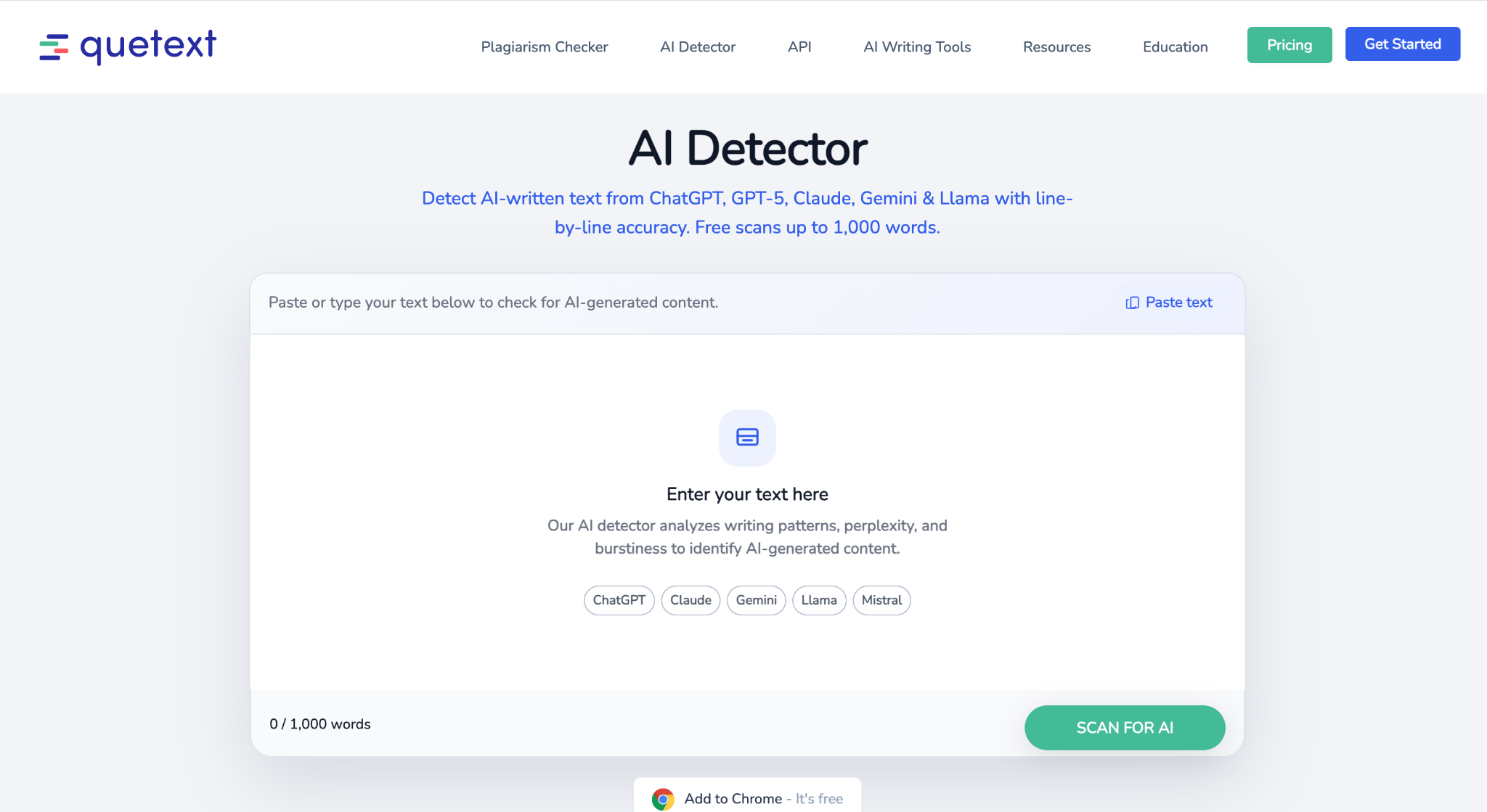
Quetext AI Detector scores text line by line for the likelihood it was machine-written, covering models including ChatGPT, GPT-5, Claude, Gemini, and Llama. The same scan also runs a plagiarism check against billions of sources using DeepSearch technology, so you’re not juggling two separate tools.
Results show a percentage AI score, color-coded sentences via ColorGrade, and the specific signals behind each flag: predictable word choice, repetitive sentence rhythm, low burstiness. Flagged sections connect directly to AITutorMe for in-place rewriting. Browser add-ons cover Chrome, Firefox, and Edge; an API returns per-sentence scores at $0.10 per 1,000 words (new accounts get 5,000 words free). Bulk file uploads cover AI detection as well as plagiarism checks.
Free scans cover up to 1,000 words with no account required. The AI Detector Only plan runs $7.99 a month or $4.49 billed yearly, for 50,000 words. Quetext Software LLC reports over 10 million students, teachers, and professionals have used the platform overall.
Where it fits: Students checking drafts before submission, professors reviewing work, and content teams that want AI and plagiarism checks in one workflow, particularly those on a tighter budget than GPTZero or Copyleaks.
2. Originality.ai
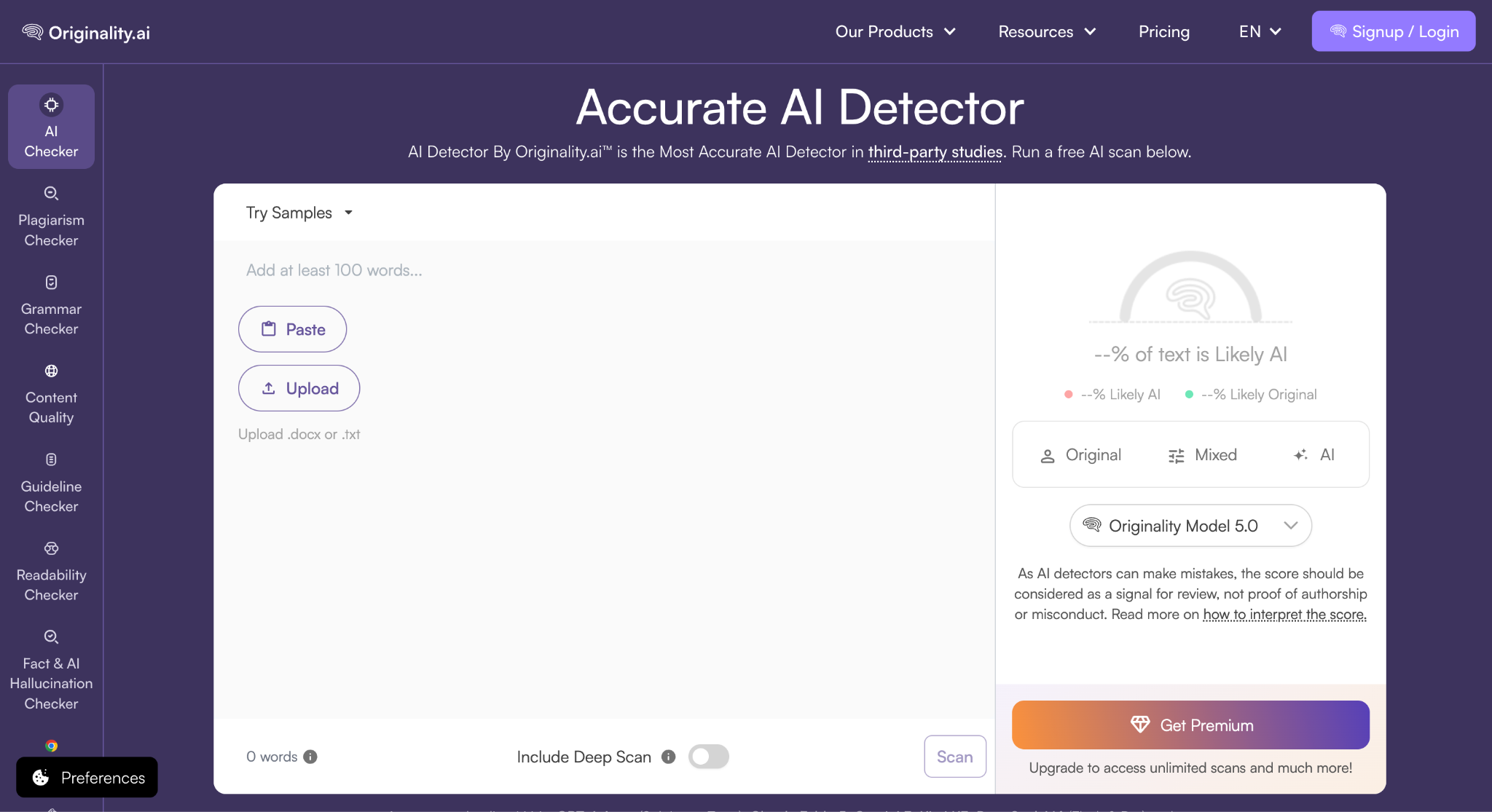
Founded in 2022 in Collingwood, Ontario, Originality.ai has built its reputation on third-party accuracy benchmarks. The company says it led six independent peer-reviewed studies as the most accurate AI detector, with a particularly low false-positive rate and strong performance on paraphrased content.
Version 5.0 and 5.0 Max break results into three categories – Likely AI, Original, or Mixed – and show the percentage of AI involvement across the text. The platform bundles AI detection with plagiarism checking, fact-checking, readability scoring, a grammar checker, and a content quality score. A Chrome extension and integrations with Google Docs and Moodle make it practical for both editorial and academic workflows.
Pricing is credit-based. Pay-as-you-go starts at a one-time $30 for 3,000 credits (one credit = 100 words). The Pro plan runs $14.95 a month for 2,000 monthly credits; Enterprise sits at $179 a month for 15,000 credits with API access and team management.
Where it fits: Publishers, agencies, and institutions that prioritize detection accuracy and need a documented accuracy record they can point to.
Worth checking: The credit model can feel expensive for high-volume individual users who’d rather pay a flat monthly rate.
3. Quillbot
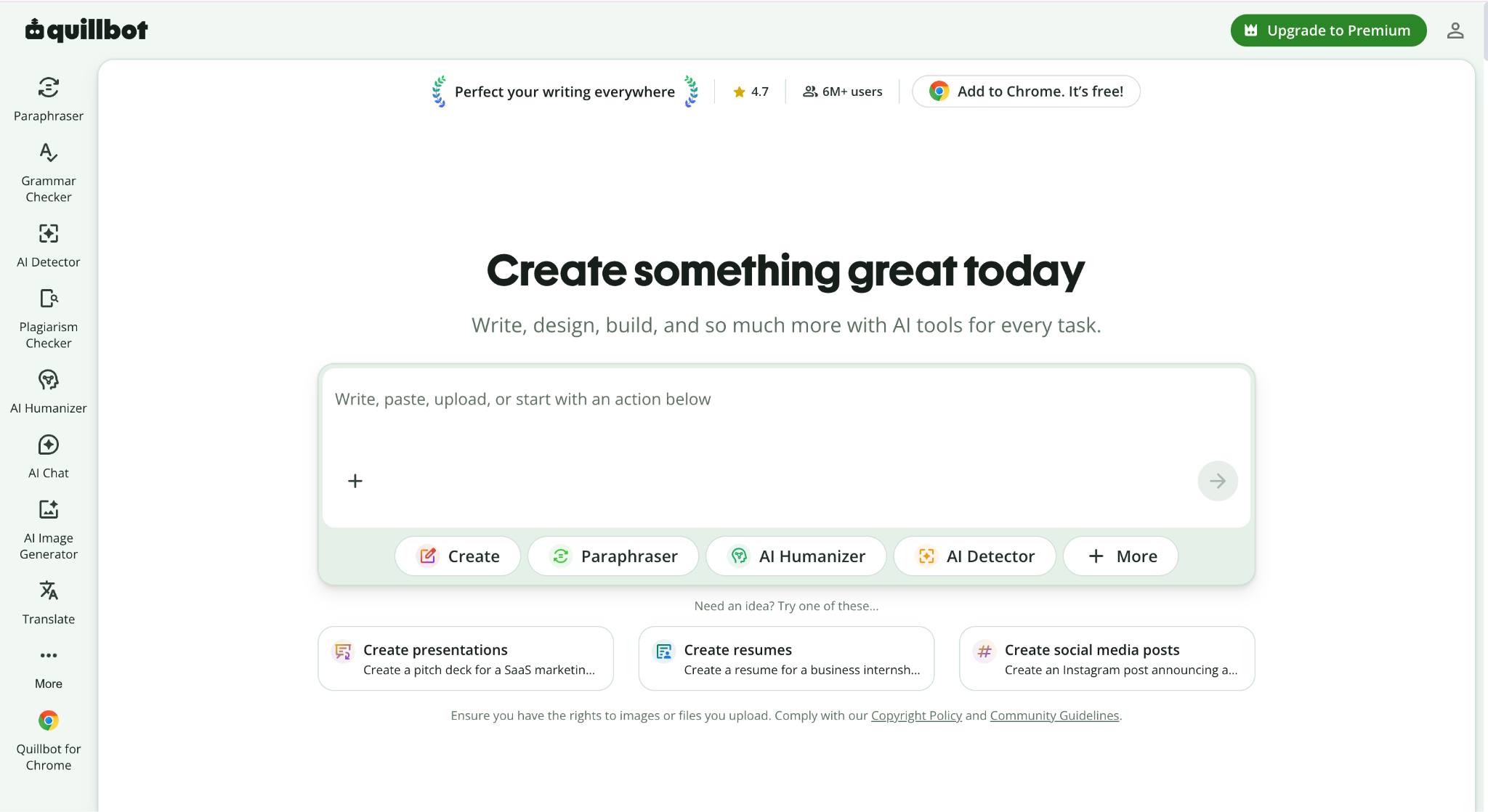
QuillBot launched in 2017 with a focus on paraphrasing, helping students still learning English improve their writing. Since its acquisition by Learneo (formerly Course Hero) and rebranding alongside Scribbr and LanguageTool, the product has expanded well beyond its original scope; it reached $27.4 million ARR by mid-2025.
The AI detector sits inside a broader writing suite, paraphrasing, grammar checking, summarizing, citation tools, the works. That bundle is genuinely useful for writers who want everything in one place. And the free plan includes functional paraphrasing and grammar features, not just a stripped-down preview. Team Plans start at $99.90 a year for two seats; the Premium plan runs $4.17 a month.
Where it fits: Students and freelancers already using QuillBot for paraphrasing or grammar who want AI detection without switching platforms.
Worth checking: The AI detector is one feature inside a large suite. Users who need dedicated, configurable detection at scale may find more focused tools better suited to that job.
4. EyeSift
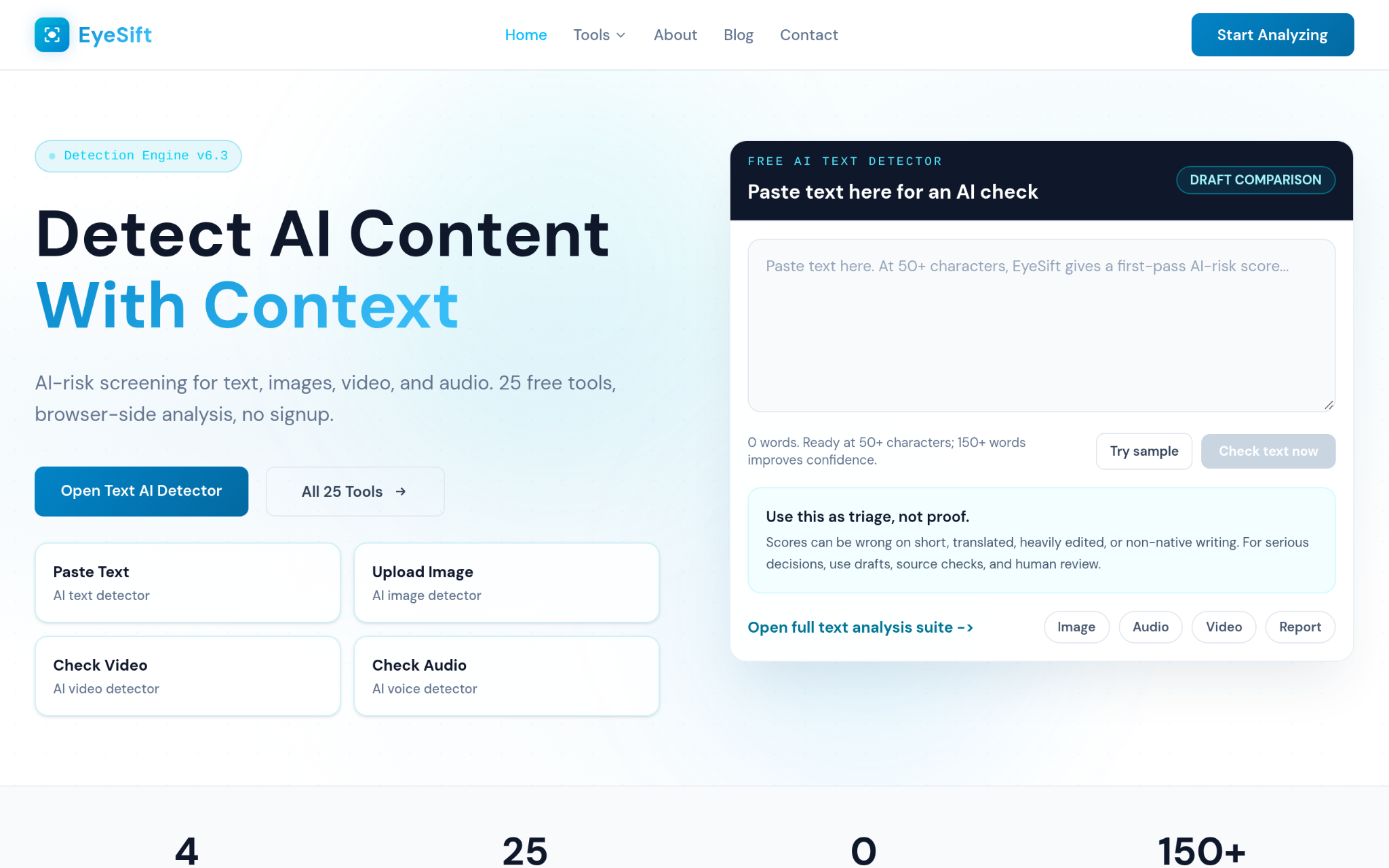
EyeSift launched in 2025 as a browser-first, no-account detection platform. All 25 tools – covering text, images, video, audio, and code – are free with no signup, no API keys, and no usage limits. Founded by Sasha Brenner, a software engineer with a background in data-intensive platforms and digital forensics, the product takes a privacy-first approach: analysis runs without server uploads.
The platform targets educators screening student submissions, journalists authenticating sources, HR teams reviewing cover letters, and legal professionals checking drafts. A humanized AI detector and plagiarism checker round out the text tools.
Where it fits: Anyone who needs a quick first-pass check and won’t pay for it, especially in professional settings where uploading content to a third-party server raises privacy concerns.
Worth checking: EyeSift is a young platform with a small team. Honestly, “free forever” tools without a clear revenue model carry real longevity questions. Treat it as a screening layer, not your sole verification method.
What to look for in an AI detector
Four things actually separate useful detectors from noisy ones.
- Detection method. The strongest tools analyze perplexity (how predictable each word is given the ones before it) and burstiness (how much sentence length varies). AI text scores high on both; human writing is messier and less predictable. Tools that show which signals triggered a flag give you something actionable, not just a score to puzzle over.
- False positive rate. Academic and technical writing naturally reads as “AI-like” because it’s formal and precise. A detector with a high false-positive rate will flag legitimate work; that creates real problems in grading or hiring contexts. Originality.ai markets its low false-positive rate, and it’s worth testing how any tool handles dense, formal prose before you commit to it.
- How it fits your workflow. A Chrome extension matters if you’re reviewing text in Google Docs or web forms. An API matters if detection needs to be built directly into a platform rather than handled through a manual paste step. Bulk upload matters for anyone reviewing more than a few documents at a time.
- Pricing structure. Credit-based models (Originality.ai) reward occasional users but get expensive at volume. Word-based monthly plans (Quetext) are more predictable for regular use. Free tools (EyeSift, QuillBot’s free tier) work for low-stakes screening but may lack the depth for institutional use.
Accuracy across different content types
Detection accuracy isn’t flat across all text types. Short passages under 150 words give detectors too little signal to work reliably, the API minimum for Quetext is 50 words, but accuracy drops sharply at the low end across every tool here. Heavily edited or paraphrased AI text is harder to catch on every platform; that’s just the reality right now.
So technical documentation, legal briefs, and ESL student work all carry higher false-positive risk. Academic writing sits in a similar zone. Any detector result on those content types should be treated as a starting point for human review, not a final call. But none of the tools here will tell you which model produced a piece of text, they report probability, not identity.
Bottom Line
The best tools to detect AI-generated content in 2026 are meaningfully more capable than those from two years ago, but they’re still probability engines. Originality.ai leads on documented accuracy benchmarks and is a strong fit for publishers and institutions. QuillBot suits writers already inside that ecosystem. EyeSift is the clearest option for free, private first-pass screening. The right choice comes down to volume, budget, workflow needs, and how the results will actually be used; a score without a review process behind it doesn’t accomplish much regardless of which tool produced it.