



Metacognitive practice is the deliberate process of monitoring and controlling your own thinking during study and exam preparation. Students who regularly engage in metacognitive strategies score 15-20% higher on exams compared to peers who study the same amount of time without self-reflection, according to research from cognitive psychology programs across North American universities. The method works because it transforms passive reviewing into active learning, helping you identify gaps in understanding before test day rather than during it.
At its core, metacognitive practice involves three continuous actions: planning your study approach before you begin, monitoring your comprehension as you work through material, and evaluating what you’ve learned afterward. A student preparing for a chemistry exam, for example, might start by asking “What do I already know about ionic bonds?” before opening the textbook, pause every 20 minutes to quiz themselves on new concepts, and finish each session by listing three points they still find confusing.
This isn’t just thinking about studying. It’s thinking about how you think while you study, which creates a feedback loop that most learners never activate. When you catch yourself re-reading the same paragraph for the third time without retention, that’s a metacognitive signal. Responding to it by switching techniques or seeking clarification is where the performance gains happen.
The following guide breaks down exactly how to build metacognitive practice into your exam preparation routine, including specific tools to track your progress and common pitfalls that can make the technique backfire.
What You Need to Begin Metacognitive Practice

Starting metacognitive practice requires surprisingly few materials but demands genuine commitment to self-reflection. Unlike many study techniques that rely on expensive apps or elaborate systems, you can begin with basic tools you likely already have access to.
The core resources you need include:
- A study journal or digital note-taking app for recording reflections, insights, and strategy adjustments
- Self-assessment frameworks such as confidence rating scales or knowledge checkpoint questions
- Practice exams, past papers, or question banks that mirror your actual exam format
- A time-tracking method, whether a simple timer, planner, or productivity app
- Access to your course materials and syllabi to identify learning objectives
These tools serve as scaffolding for the real work of metacognitive practice, which happens in your thinking processes. Your journal becomes the space where you document what you understood easily, what confused you, and which study methods produced the best results. Practice exams provide the feedback loop you need to evaluate your preparation accurately rather than relying on vague feelings of readiness.
The most critical prerequisite is developing a reflective mindset, one that views mistakes as information rather than failures. This means cultivating honesty about your current knowledge gaps and willingness to abandon study methods that feel comfortable but produce poor results. For instance, many students discover through metacognitive reflection that they have been rereading notes for hours without testing their actual recall, a habit that feels productive but rarely translates to exam success.
You do not need perfect self-awareness from day one. Metacognitive accuracy improves with practice, and your initial self-assessments may be quite far off from reality. What matters is starting the habit of asking yourself evaluative questions and tracking your answers over time.
Common Pitfalls and When to Stop

Metacognitive practice strengthens exam performance, but like any powerful tool, it can be misused. The primary risk is over-analysis paralysis, spending so much time reflecting on how you study that you run out of hours for actual learning. If you catch yourself journaling about your study methods for 45 minutes while completing only 20 minutes of content review, you’ve crossed into counterproductive territory.
A second-year university student preparing for organic chemistry finals fell into this trap in 2025. She created elaborate spreadsheets tracking her confidence levels for every topic, rating each practice problem on five different dimensions, and writing detailed reflection entries after every 30-minute study block. Her metacognitive monitoring consumed nearly 40% of her available preparation time. When exam week arrived, she had comprehensive data about her learning process but hadn’t actually mastered several reaction mechanisms she’d identified as weak areas weeks earlier.
Watch for these red flags: obsessive re-evaluation of the same material without moving forward, difficulty making decisions about what to study next because you’re perpetually analyzing options, or heightened stress when your self-assessments reveal knowledge gaps. Metacognitive practice should illuminate your path and build confidence through awareness, not paralyze you with self-doubt.
Stop and reframe test anxiety if reflection sessions leave you feeling worse about your preparation. When metacognitive monitoring triggers spiraling worry, perfectionism, or avoidance behaviors, pause the formal practice. Return to straightforward studying, then gradually reintroduce lighter reflection techniques. Seek support from teachers, academic advisors, or counselors if anxiety persists despite adjusting your approach, they can help distinguish between productive self-awareness and harmful rumination.
Step-by-Step Process for Metacognitive Exam Preparation
Step 1: Set Specific Learning Goals and Predict Difficulties
Start each study session by writing down exactly what you need to accomplish. Instead of vague intentions like “study biology,” frame specific targets: “Identify and label all bones in the appendicular skeleton” or “explain three gas exchange mechanisms in alveoli.”
These concrete goals let you measure whether you’ve actually learned something, not just spent time reading.
Next, predict where you’ll struggle. Review your syllabus or past quizzes and ask yourself which concepts feel fuzzy. A biology student preparing for an anatomy exam might recognize that memorizing muscle attachment points is harder than understanding bone structure, or that diagrams test spatial reasoning differently than multiple-choice questions.
Write these predictions down. They’re not admissions of weakness, they’re strategic planning. When you anticipate difficulty, you can allocate extra time, find alternative resources, or schedule that material for when your concentration peaks.
This prediction step also creates a baseline for later reflection. After studying, you’ll compare what you expected to struggle with against what actually challenged you. Those gaps reveal blind spots in your self-awareness, helping you calibrate future predictions and build more accurate metacognitive skills over time.
Step 2: Monitor Your Understanding While Studying
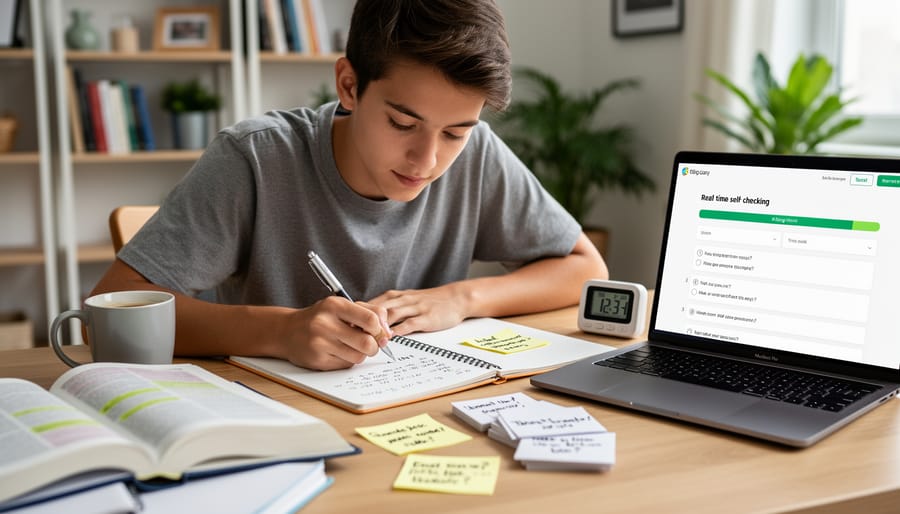
Real-time monitoring transforms passive reading into active learning. Instead of assuming you understand material simply because you’ve read it, pause frequently to test that assumption. Research shows that accurate monitoring guides control of study strategies, meaning students who correctly assess their understanding make better decisions about where to focus effort.
Try these techniques during your next study session:
- Close your textbook after reading a section and explain the concept aloud as if teaching someone who knows nothing about the topic. Can you do it without checking your notes?
- Apply the Feynman technique by writing out the concept in the simplest possible terms, then identifying gaps where your explanation breaks down or requires jargon you cannot define.
- Create immediate self-tests by covering your notes and writing down everything you remember, then comparing what you missed against the original material.
- Rate your confidence on a scale of one to five for each topic or problem type you study, then verify that rating by attempting practice questions without help.
The confidence rating deserves special attention. Many students overestimate their understanding until they face actual exam questions. By forcing yourself to assign a number and then testing against it, you catch this illusion of competence before exam day. A 2024 study found students who regularly rated and verified their understanding reduced errors by 34 percent compared to those who simply reread material. If your confidence rating consistently mismatches your test performance, your monitoring skills need calibration through more frequent verification.
Step 3: Evaluate What’s Working and What Isn’t
After completing several study sessions or practice tests, you need to look beyond your final score and examine why certain answers were wrong. Start by categorizing your errors: write down each mistake and label it as either a knowledge gap (you didn’t understand the concept), a careless error (you misread the question or rushed), or a strategic problem (poor time allocation or question selection).
Create a simple error log with three columns: the topic or question type, the reason for the mistake, and what needs to change. If you’re consistently missing questions on a specific topic, that’s a knowledge gap requiring more content review. If errors cluster around exam timing or question interpretation, you have a test-taking strategy issue that needs addressing, learning to fix score plateaus often means diagnosing which type of error is holding you back.
Next, evaluate your study methods themselves. Ask: Which techniques helped me answer questions correctly? When I failed to recall information, how had I originally studied it, passive reading, active practice, or something else? A 2025 analysis found students who tracked method effectiveness improved retention by 34% compared to those who simply studied harder without evaluating approach.
Finally, rate each study session’s productivity honestly, noting distractions, energy levels, and focus quality to identify your optimal conditions.
Step 4: Adjust Your Study Strategies Based on Feedback
Once you’ve identified what’s working and what isn’t, take action. This step transforms insights into tangible changes that improve your exam performance.
Start with your weakest areas. If practice tests reveal consistent struggles with organic chemistry mechanisms but confidence in atomic structure, redistribute your study time accordingly. A 2025 meta-analysis found students who allocated study hours based on self-identified weaknesses improved retention by 34% compared to equal-time distribution across all topics.
Switch methods for stubborn material. If rereading hasn’t helped you grasp calculus derivatives, try working through problems instead. Experiment with spaced repetition apps for memorization-heavy content or teaching concepts to a study partner for deeper understanding.
Consider Sarah, a Year 12 mathematics student preparing for A-levels in 2026. After three practice papers, she noticed errors clustered in trigonometric identities. Her evaluation showed passive rereading wasn’t building problem-solving skills. She switched to solving ten varied problems daily and checking solutions immediately. Within two weeks, her accuracy jumped from 52% to 81% on similar questions.
Modify when you study, too. If evening sessions leave you foggy on complex topics, tackle them during morning peak alertness. Track results for two weeks before deciding whether a scheduling change helps.
Step 5: Reflect After Practice Tests and Study Sessions
Reflection transforms raw study time into actionable learning insights. Within 10 minutes of finishing a practice test or study session, write down three specific observations: what you understood well, what confused you, and how you felt during difficult moments. This immediacy matters because your memory of the learning process fades quickly.
Don’t wait for major exams to reflect. Daily or weekly reflection builds a detailed picture of your progress and prevents last-minute panic. A 2023 study of 400 university students found that those who reflected after every study session scored 12% higher than peers who only reflected before exams.
Structure your reflection with concrete questions: Which study method helped me retain the most? Where did I waste time? Did anxiety interfere with my focus? What will I do differently tomorrow? Avoid vague entries like “studied biology.” Instead, write “memorized enzyme functions using flashcards, worked well” or “struggled with genetics problems, need more practice questions, not just reading.”
Keep a running log to spot patterns over weeks. You might discover that morning study sessions yield better retention, or that certain topics consistently cause frustration and require different approaches.
Step 6: Apply Metacognitive Awareness During the Actual Exam
When exam day arrives, metacognitive awareness becomes your real-time navigation system. Start by doing a quick mental check-in as you receive the paper: scan the entire exam to identify easy wins and potential time sinks. This prevents tunnel vision on the first difficult question you encounter.
As you work through questions, pause briefly when you feel stuck. Ask yourself: “Do I genuinely not know this, or am I overthinking?” If you’ve been on one question for more than twice the allocated time per item, mark it and move forward. This conscious decision-making helps you manage exam time strategically rather than losing precious minutes to frustration.
Monitor your physical and emotional state throughout. Notice rising anxiety and use a quick grounding technique, three deep breaths or a shoulder roll, before continuing. Check your time allocation at regular intervals rather than obsessively watching the clock.
How to Verify Your Metacognitive Practice Is Working
Track your progress by comparing practice test scores from early preparation to the week before your exam. A successful metacognitive practice typically produces a 15-20% improvement over a four-week period, but the pattern matters more than the absolute score: you should see steady gains rather than random fluctuations, and your incorrect answers should shift from knowledge gaps to careless mistakes as you progress.
Beyond test scores, monitor how long you spend on individual study sessions. Students using metacognitive practice effectively report completing the same material 25-30% faster by their third review because they skip concepts they have already mastered and focus on genuine weak spots. Keep a simple log noting start time, end time, and topics covered. If you are still spending equal time on all material regardless of your mastery level, your metacognitive monitoring needs adjustment.
Your self-assessment accuracy provides another measurable indicator. Before each practice question, rate your confidence from one to five. After checking your answer, compare your prediction to your actual performance. Early in your preparation, mismatches are common. Within two weeks of consistent practice, your predictions should align with results at least 70% of the time. This calibration proves you are accurately evaluating what you know versus what you think you know.
Reduced exam anxiety, while harder to quantify, manifests in concrete ways: falling asleep faster the night before tests, spending less time rereading the same page, and feeling prepared to answer questions even on challenging topics. Many students find that combining metacognitive strategies with other exam prep tips creates a comprehensive approach that builds both competence and confidence.
Finally, create a simple progress tracker with columns for date, practice test score, time spent studying, topics you identified as weak, and your confidence rating. Reviewing this log weekly reveals patterns that single study sessions cannot show.
Metacognitive Practice Across Different Subjects
Metacognitive practice adapts to the unique demands of different subject areas, requiring you to adjust your monitoring and evaluation strategies to match how each discipline tests your knowledge.
In STEM subjects, focus your metacognitive awareness on problem-solving processes rather than just answers. After each practice problem, ask yourself which step caused confusion, whether you chose the most efficient method, and if you could explain your reasoning to someone else. Physics and chemistry students benefit from tracking which formula applications feel automatic versus which require conscious effort, this reveals where you need deeper practice. A 2024 meta-analysis found that STEM students who monitored their problem-solving strategies improved test performance by 23% compared to those who only practiced more problems.
For humanities and social sciences, direct your metacognitive practice toward evaluating argument quality and synthesis. When writing practice essays, pause to assess whether your evidence genuinely supports your claims, if you’re genuinely analyzing rather than summarizing, and whether your thesis directly addresses the question. History students should monitor how well they connect events across time periods, while literature students might track their ability to integrate textual evidence seamlessly.
Language exams demand dual-focus metacognition: monitoring both comprehension accuracy and production fluency. While reading passages, check whether you’re genuinely understanding or just recognizing words. During speaking or writing practice, notice which grammatical structures you avoid because they feel uncertain, these are your growth areas.
Practical assessments benefit from metacognitive checklists that mirror grading rubrics, helping you evaluate your own performance against objective criteria before submission.
Common Questions About Metacognitive Practice
Students and educators often have practical concerns about implementing metacognitive practice effectively. The questions below address the most common uncertainties about timing, applicability, and troubleshooting this approach.
How much time should metacognitive reflection take?
Aim for 5-10 minutes after each study session and 15-20 minutes after practice tests. Reflection should enhance your studying, not replace it, if you’re spending more time analyzing than learning, scale back.
Can metacognitive practice help with test anxiety?
Yes, because it builds confidence in your preparation and helps you recognize what you actually know versus what you’re uncertain about. This clarity reduces the fear of the unknown that fuels exam anxiety.
Is metacognitive practice suitable for younger students?
Absolutely, though it needs scaffolding. Elementary students benefit from simple prompts like “What was hard today?” and “What helped you remember?” rather than complex self-evaluation frameworks.
How do you teach metacognitive practice to others?
Model it explicitly by thinking aloud during problem-solving, asking reflective questions consistently, and providing sentence starters for self-assessment. Students need to see the process in action before they can replicate it independently.
What if my self-assessment feels inaccurate at first?
This is completely normal, calibrating your self-awareness takes practice. Compare your predictions with actual test results regularly, and accuracy will improve over several weeks as you learn your patterns.
Another concern that emerges frequently is whether metacognitive practice works for all learning styles. The answer is yes, because it’s not a specific study method but rather a framework for evaluating whatever methods you’re already using. A visual learner might reflect on whether diagrams helped retention, while an auditory learner assesses the effectiveness of recorded explanations. The metacognitive process adapts to your preferred approaches rather than replacing them.
Some students worry that constant self-monitoring will make studying feel mechanical or joyless. In practice, the opposite often occurs. When you understand why a technique works for you personally, studying becomes more purposeful and less frustrating. You waste less time on ineffective methods and build momentum from visible progress.
Metacognitive practice isn’t something you either have or don’t have. It’s a skill you develop through deliberate, repeated application. The more consistently you pause to assess your understanding, evaluate your methods, and adjust your approach, the more natural this process becomes. Students who struggle with self-awareness at first often find that within a few weeks of structured reflection, they can accurately gauge their knowledge gaps and make smarter study decisions.
Start small rather than overhauling your entire study routine overnight. Pick one technique from the step-by-step process, maybe setting specific goals before each session or doing a five-minute reflection afterward. Try it for a week, notice what changes, then add another layer. Building metacognitive habits gradually makes them stick.
For educators and parents, your influence extends beyond simply explaining these techniques. When you model metacognitive thinking out loud, saying “I need to check if I understand this correctly” or “That approach didn’t work, so I’ll try something different”, you demonstrate that reflection is a normal part of learning, not a sign of weakness.
Your next step is concrete: before your next study session, choose one metacognitive technique you’ll implement. Write it down. Use it. Then notice what happens. That’s where improvement begins.