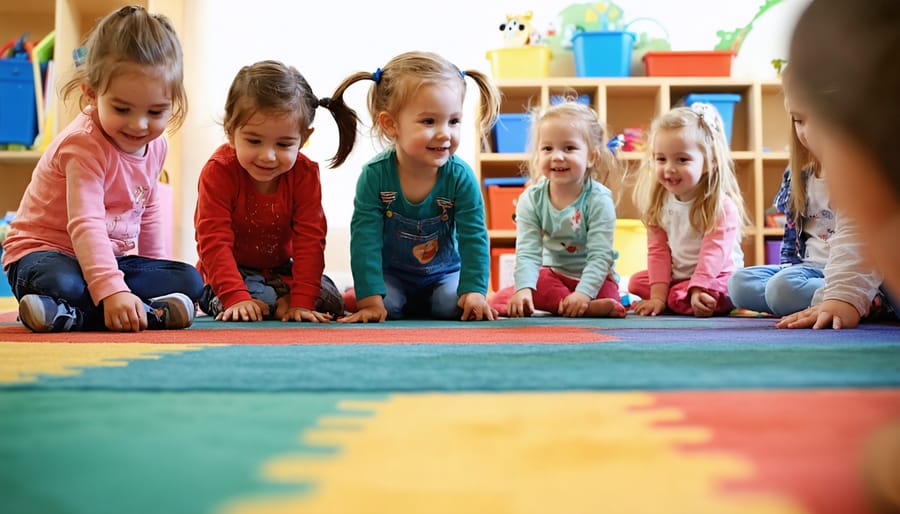


Transform your kindergarten classroom into a dynamic learning environment with engaging activities for little learners that combine play-based education with essential skill development. Strategic movement games like “Letter Hop” and “Number Line Jump” naturally integrate physical activity with foundational literacy and math concepts, keeping young minds actively engaged while building gross motor skills. Interactive circle time activities, including rhythm-based counting songs and show-and-tell sessions, strengthen social skills and verbal expression while maintaining structured classroom flow. Sensory-rich learning stations, featuring hands-on materials like counting bears, texture cards, and building blocks, provide self-directed exploration opportunities that support multiple learning styles and developmental stages.
These evidence-based approaches not only foster academic growth but also develop crucial social-emotional skills during the critical early learning years. Modern kindergarten education recognizes that movement, play, and structured activities create the most effective pathway to lasting learning outcomes, preparing children for academic success while nurturing their natural curiosity and enthusiasm for discovery.

Interactive Circle Time Quiz Games
Show and Tell Quiz
Transform traditional show and tell into an interactive learning experience by incorporating quiz elements that engage the entire class. Start by having each student present their item as usual, but follow up with three fun questions for the class. For example, if a child brings a stuffed elephant, ask questions like “What color was the elephant’s bow?” or “How many spots did it have?”
Create a simple point system where children earn stars for correct answers, encouraging active listening and observation skills. To make it more inclusive, use a mix of question types: visual details, counting elements, and memory-based queries. This helps develop different cognitive skills while keeping everyone involved.
Consider using a “Mystery Box” variation where the presenter gives three clues about their item before showing it. Classmates can make guesses, turning show and tell into an exciting guessing game. Keep track of correct guesses on a colorful classroom chart to build excitement throughout the week.
For younger kindergarteners, use simple yes/no questions or incorporate movement responses – students can stand up for “yes” answers and sit down for “no.” This adds a physical component that helps maintain attention and makes the activity more dynamic.
Remember to keep questions age-appropriate and celebrate all participation, focusing on engagement rather than competition. This approach transforms a traditional activity into an interactive learning experience that develops observation, memory, and critical thinking skills.
Mystery Box Questions
Transform your classroom into a sensory exploration zone with engaging mystery box activities that combine touch, curiosity, and learning. Start by placing familiar objects inside a decorated cardboard box with hand-sized openings on either side. Students take turns reaching in to feel an object while answering questions about its properties.
Create themed boxes for different subjects: shapes for mathematics, natural items for science, or textured materials for sensory development. Ask guided questions like “Is it smooth or rough?” “What shape do you feel?” or “Is it heavy or light?” to develop descriptive language skills and critical thinking.
To enhance engagement, incorporate collaborative elements by having students work in pairs. One child feels the object while the other asks questions, helping develop communication and teamwork skills. Keep a chart of correct guesses to maintain excitement and motivation.
For advanced learning, include seasonal items, letter-shaped objects, or numbers to reinforce current curriculum topics. Consider creating multiple boxes with varying difficulty levels to accommodate different learning speeds and abilities.
Remember to regularly rotate items to maintain interest and expand vocabulary. This activity naturally supports inclusive learning, as it relies on tactile exploration rather than visual cues, making it accessible for all students.

Movement-Based Quiz Activities
Number Hop Quiz
Number Hop Quiz transforms basic number recognition into an exciting physical activity that keeps kindergarteners engaged while reinforcing their mathematical skills. Create a hopscotch-style grid on the floor using masking tape or chalk, but instead of sequential numbers, mix them up to challenge students’ number recognition abilities.
To play, students take turns hopping to numbers as the teacher or leader calls them out. For example, “Hop to number 7!” The child must identify and jump to the correct number. This activity can be modified by using different movement patterns – jumping with both feet, hopping on one foot, or even tip-toeing to make it more entertaining.
For added complexity, incorporate simple math problems: “Hop to the number that comes after 5” or “Jump to the number that’s 2 more than 3.” This helps students practice basic addition and number sequencing while staying physically active.
To accommodate different skill levels, create multiple grids with various number ranges. Beginners can work with numbers 1-10, while more advanced students can practice with numbers up to 20. Consider using different colors for even and odd numbers to introduce these concepts playfully.
For safety, ensure adequate space between numbers and place non-slip mats or carpet squares under the tape markers if playing indoors. This activity works equally well outdoors using playground chalk on a smooth surface.
Letter Dance Freeze
Combine physical movement, music, and letter recognition in this engaging educational game that gets kindergarteners moving while learning their ABCs. When the music plays, students dance freely around the classroom. As soon as the music stops, the teacher calls out a letter, and students must quickly form that letter with their bodies, either individually or by working together in small groups.
To enhance the learning experience, incorporate themed music that relates to alphabet learning or use popular children’s songs that students already know and love. Teachers can adjust the difficulty by calling out letter sounds instead of letter names, or by asking students to form both uppercase and lowercase versions of the letters.
For added engagement, use visual aids like alphabet cards or a digital display to show the letter along with calling it out. This helps visual learners connect the sound with the written symbol. Consider introducing variations such as having students freeze in the shape of something that begins with the called-out letter.
Keep the game moving at a steady pace to maintain enthusiasm and participation. Typically, each round should last 30-45 seconds of dancing followed by the freeze and letter formation. This activity not only reinforces letter recognition but also promotes gross motor skills, listening comprehension, and social interaction through cooperative letter formation.

Visual Learning Quiz Games
Picture Card Matching Quiz
Picture card matching quizzes are a powerful tool for developing memory, recognition, and cognitive skills in kindergarten students. This engaging activity involves creating pairs of matching cards featuring images of animals, numbers, letters, shapes, or everyday objects that students need to find and pair together.
To set up the game, arrange the cards face-down in a grid pattern on a table or carpet area. Students take turns flipping over two cards at a time, trying to find matching pairs. When a match is found, the student keeps the cards and takes another turn. If no match is found, the cards are turned face-down again, and the next student takes their turn.
This activity can be adapted to various learning objectives. For example, use cards with uppercase and lowercase letters to reinforce alphabet recognition, or pair numbers with corresponding quantities of objects to strengthen counting skills. Teachers can also create themed sets focusing on specific units like seasons, community helpers, or transportation.
To increase engagement, consider incorporating these variations:
– Time trials for individual practice
– Team-based competitions
– Memory chains where students must remember and recite the locations of previously revealed cards
– Adding sound elements by having students make corresponding noises when finding animal matches
For best results, start with smaller sets of 6-8 pairs and gradually increase the difficulty as students improve their matching abilities. This progressive approach helps build confidence while maintaining interest in the activity.
Color and Shape Hunt
Transform your classroom into an exciting learning environment with this interactive scavenger hunt that reinforces color recognition and shape identification. Students can work individually or in small teams, making it ideal for supporting diverse learner needs.
Begin by providing each student with a simple checklist featuring pictures of basic shapes and colors. Include items like “red circle,” “blue square,” and “yellow triangle.” Encourage children to explore the classroom, identifying and checking off items as they discover them. To enhance engagement, incorporate both two-dimensional and three-dimensional objects.
Make the activity more challenging by adding specific requirements:
– Find three different objects that are the same color
– Locate shapes in unexpected places (like circular clock faces or rectangular windows)
– Match items to size categories (small, medium, large)
For added educational value, ask students to draw their discoveries in a special hunt journal. This reinforces fine motor skills and helps with shape recognition. Consider rotating the items regularly to maintain interest and create new learning opportunities.
To assess understanding, gather students afterward to discuss their findings. This promotes vocabulary development and social interaction while reinforcing the concepts learned during the hunt.
Making Quiz Time Special
Positive Reinforcement Strategies
Creating a positive learning environment is essential for kindergarteners’ success and engagement. Sticker charts and reward systems can effectively track progress and motivate young learners. When students complete activities or demonstrate good behavior, they receive stickers or stamps, working toward small rewards like extra playtime or special classroom privileges.
Verbal praise should be specific and immediate. Instead of general comments like “good job,” use detailed feedback such as “I love how you worked together with your partner to solve that puzzle!” This helps children understand exactly what behaviors are being celebrated.
A “Star Student of the Day” program gives each child opportunities to feel special and recognized. The chosen student can lead activities, help with classroom tasks, or share something special from home. This builds confidence and encourages participation from all students.
Achievement certificates and take-home notes keep parents involved in celebrating their child’s success. Weekly or monthly celebrations can recognize various accomplishments, from academic progress to showing kindness to classmates. Creating a “Celebration Wall” displays student work and achievements, making recognition visible and permanent.
Remember to celebrate small victories and progress, not just final outcomes. This helps maintain motivation and builds resilience in young learners. Group achievements should also be acknowledged, fostering a collaborative classroom culture where students support each other’s success.
Adapting Activities for Different Learning Styles
Every child learns differently, and adapting quiz activities to accommodate various learning styles ensures all students can participate and succeed. For visual learners, incorporate picture cards, colorful props, and demonstration-based activities. Create matching games where students pair images with words or concepts, or use interactive whiteboards for visual engagement.
Kinesthetic learners thrive with movement-based activities. Transform traditional quiz questions into active games where children hop to different corners of the room to indicate their answers, or use dance moves to respond to questions. Consider creating obstacle courses where each station features a learning challenge.
For auditory learners, include songs, rhymes, and verbal call-and-response activities. Record simple questions as audio clips, or create musical cues for different types of questions. These students often benefit from group discussions and peer-teaching opportunities.
Tactile learners need hands-on experiences. Provide manipulatives like letter blocks, counting bears, or texture cards during quiz activities. Create sensory bins related to the quiz topic where children can explore while answering questions.
Remember to mix different approaches within the same activity when possible. For example, a nature-themed quiz might include pictures to look at, objects to touch, sounds to identify, and movements to mimic animals. This multi-sensory approach not only accommodates different learning styles but also reinforces concepts through multiple channels of engagement.
Quiz activities in kindergarten classrooms offer invaluable benefits that extend far beyond simple knowledge testing. These engaging learning tools help develop critical thinking skills, boost confidence, and create an environment where children actively participate in their educational journey. Through varied quiz formats, from interactive group games to individual challenges, kindergarteners develop essential social skills while reinforcing their understanding of core concepts.
The beauty of quiz activities lies in their versatility and adaptability. Teachers can easily modify these games to accommodate different learning styles, skill levels, and subject matters. Whether it’s matching shapes, identifying colors, or practicing basic counting, these activities create memorable learning experiences that children genuinely enjoy.
Research shows that when learning is combined with play, information retention improves significantly. Quiz games provide immediate feedback, helping children understand their progress while maintaining their enthusiasm for learning. Additionally, these activities foster a collaborative classroom environment where students support and learn from one another.
We encourage educators to incorporate these quiz activities into their daily routines, starting small and gradually expanding their repertoire. Remember to maintain a positive, encouraging atmosphere and celebrate every achievement, no matter how small. By making quizzes fun and engaging, you’re not just teaching content – you’re nurturing a lifelong love for learning in your students.