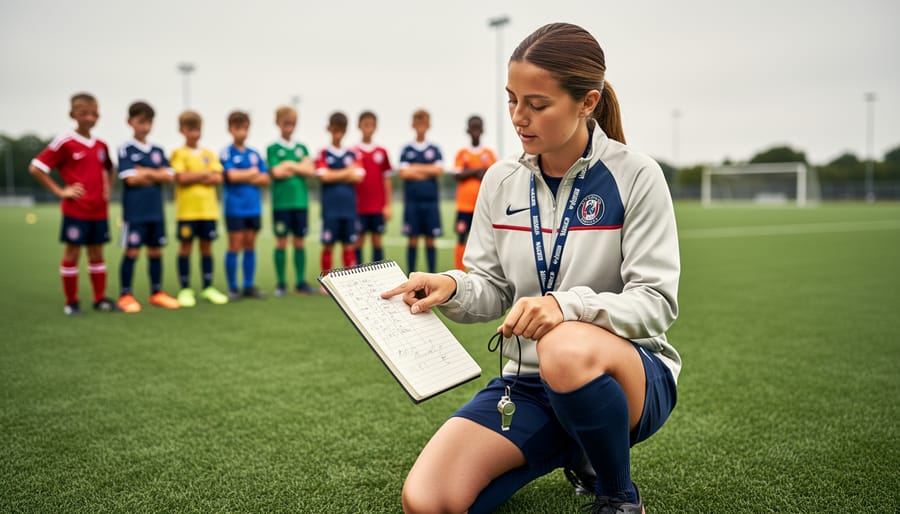



A youth soccer coach in Minnesota keeps a notebook, not of plays or drills, but of small details about each kid on her roster: who’s dealing with parents splitting up, who freezes when yelled at, who needs a joke before a game and who needs quiet. She’s not running a therapy practice. She’s just figured out something a lot of coaches never quite grasp, which is that you cannot motivate a group of ten-year-olds with the same speech you’d give a college team. The psychology of coaching young athletes is a different discipline entirely from coaching adults, and the coaches who understand that distinction tend to produce kids who stick with sports for years instead of quitting by middle school.
Motivation at Ten Looks Nothing Like Motivation at Twenty
Adult athletes often respond to competitive pressure, statistical feedback, and long-term goal framing. Young kids mostly don’t, at least not in the way coaches assume. A child’s motivation to keep showing up tends to hinge on whether practice feels fun, whether they feel noticed by the coach, and whether mistakes get treated as normal rather than shameful. Coaches who lean on the tactics that worked for them as adult athletes, harsh criticism, competitive shaming, pressure framed as toughness, often watch kids quietly disengage rather than rise to the challenge. The research on youth sport attrition backs this up consistently: kids don’t quit because a sport got too hard, they quit because it stopped feeling worth the emotional cost.
Building Character Requires More Than a Slogan on the Wall
Plenty of youth programs claim to build character, print it on a banner, and never actually design practice around it. Real character development in young athletes happens through structured, repeated experiences: being given real responsibility on a team, working through conflict with a teammate under a coach’s guidance rather than avoidance, and facing failure in a setting where an adult helps them process it instead of just moving on to the next drill. A coach who benches a struggling player without explanation teaches a very different lesson than one who benches the same player with a clear, respectful conversation about what needs to improve. Kids absorb far more from how a coach handles the hard moments than from anything said during a pep talk before a game.
Skill Development Depends on Psychological Safety First
Technical skill instruction doesn’t land well in a young athlete who’s anxious, embarrassed, or afraid of getting yelled at for a mistake. Sports psychology research on youth athletes consistently shows that kids attempt more, take more risks, and improve faster in environments where errors are treated as a normal part of learning rather than something to fear. That’s why the most effective youth coaches spend real energy on the emotional tone of practice, not just the technical content of drills. A few patterns show up repeatedly among coaches who get this right:
- Correcting technique privately rather than calling out mistakes in front of the whole group
- Framing effort and improvement as the measure of success rather than only wins and losses
- Giving kids some voice in practice structure, which builds ownership rather than pure compliance
- Checking in with quieter or struggling players individually, not just addressing the team as a whole
Coaches who skip these habits often produce technically decent players who burn out emotionally before they ever reach their ceiling.
Where This Understanding Actually Gets Built
Very few people walk into youth coaching already fluent in developmental psychology, and most learn through years of trial and error, sometimes at a real cost to the kids caught in that learning curve. That’s part of why more coaches and program directors are turning toward formal study of this material rather than relying purely on instinct built up over seasons. Someone pursuing an accelerated sports management degree online often encounters coursework in athlete development and sport psychology alongside the operational side of the field, giving them a grounded framework for the human side of coaching rather than picking it up haphazardly on the sideline. That kind of formal grounding tends to shorten the learning curve considerably, sparing both the coach and a few seasons’ worth of young athletes from mistakes that instinct alone would have taken years to correct.
The Long Game Nobody Sees on a Scoreboard
None of this shows up in a season’s win-loss record, which is exactly why it gets undervalued by programs chasing visible results. The kids who stay in sports through adolescence, who keep showing up even after a rough season, are almost always the ones who had a coach somewhere along the way who understood what they actually needed psychologically, not just athletically. That Minnesota coach with her notebook isn’t going to win a championship because of it, but she’s going to keep more of her players in the sport past age twelve than most of the coaches competing against her. In youth athletics, that quieter outcome is usually the one that matters most.