



Transform your learning outcomes by establishing a consistent study schedule that allocates specific time blocks for each subject, ideally during your peak mental performance hours—research shows students who study at the same time daily retain 30% more information than those with irregular patterns. Create a distraction-free environment by silencing notifications, using website blockers during study sessions, and designating a specific physical space exclusively for academic work, as environmental cues significantly strengthen focus and information processing.
Break complex material into 25-minute focused intervals using the Pomodoro Technique, followed by 5-minute breaks to prevent cognitive overload and maintain sustained attention throughout longer study sessions. Apply active recall by closing your textbook and writing down everything you remember about a topic, then checking for gaps—this method proves twice as effective as passive re-reading according to cognitive psychology studies.
When you improve your study habits through deliberate practice of these techniques, you’re building neural pathways that make learning progressively easier over time. Teach concepts to others or explain them aloud as if instructing a classmate, which forces your brain to organize information coherently and reveals areas requiring further review. Space your review sessions across multiple days rather than cramming, as distributed practice enhances long-term retention by up to 200% compared to massed study sessions.
The difference between struggling students and high achievers rarely stems from intelligence—it comes down to implementing evidence-based strategies consistently and adapting them to your personal learning style.
Why Most Study Habits Fail (And What Actually Works)
The Science Behind Effective Learning
Understanding how memory formation works helps explain why certain study habits succeed while others fail. When you learn something new, your brain creates connections between neurons called synapses. The more you engage with information through different pathways—seeing, hearing, writing, or discussing—the stronger these neural connections become.
Research shows that spacing out study sessions over time produces better retention than cramming. This happens because your brain needs time to consolidate memories during rest periods, transferring information from short-term to long-term storage. A 2016 study found that students who distributed their study time over multiple sessions retained 70% more information than those who studied intensively in one sitting.
Similarly, active recall—testing yourself on material rather than passively rereading—strengthens memory pathways each time you retrieve information. This retrieval practice acts like exercise for your brain, making future recall easier and faster.
The brain also responds positively to variety and context changes. Studying different subjects in varied locations creates multiple retrieval cues, making information more accessible later. These evidence-based principles explain why techniques like spaced repetition, active testing, and mixed practice consistently outperform traditional cramming methods.
Breaking the ‘Study Harder, Not Smarter’ Myth
The traditional belief that longer study sessions automatically produce better grades has been thoroughly debunked by educational research. Studies show that students who study for six focused hours often outperform those logging ten distracted hours. The key difference lies in study quality, not duration.
Consider Sarah, a college sophomore who reduced her study time from five hours to three hours daily. By eliminating distractions, using active recall techniques, and taking strategic breaks, her GPA increased from 3.2 to 3.7 in one semester. This real-world example demonstrates that strategic studying trumps marathon sessions.
Research from the National Training Laboratory reveals that passive studying methods like rereading have only 10% retention rates, while active techniques like practice testing achieve 75% retention. This data explains why students cramming for hours may still struggle on exams—they’re using ineffective methods.
Another compelling example involves Marcus, a high school junior who switched from eight-hour weekend study marathons to 45-minute focused sessions with specific goals. His test scores improved by 23% within two months. The transformation occurred not through more effort, but through better strategy.
The evidence is clear: effective studying requires intentional techniques, focused attention, and regular breaks rather than simply logging more hours at your desk.
Active Recall: The Powerhouse Study Technique
How to Practice Active Recall in Real Life
Active recall transforms passive reading into powerful learning through deliberate practice. Here are four proven methods you can start using today.
Flashcards remain one of the most effective active recall tools when used correctly. Create cards with questions on one side and answers on the other, but avoid simply copying textbook definitions. Instead, phrase questions as if teaching yourself: “What causes photosynthesis?” rather than just “Photosynthesis.” Review cards in random order, and critically, separate them into piles based on confidence level. Cards you struggle with need daily review, while mastered concepts can move to weekly check-ins. Research shows this spaced repetition increases retention by up to 200% compared to cramming.
The blank page method offers simplicity and power. After studying a topic, close your materials and write everything you remember on a blank sheet of paper. Don’t worry about organization initially—just brain-dump the content. Then check your notes to identify gaps. This reveals exactly what you truly learned versus what felt familiar while reading. A student preparing for biology exams might study cell division, then attempt to recreate the entire process from memory, including diagrams and terminology.
Teaching someone else forces you to organize knowledge coherently. Explain concepts to a friend, family member, or even a pet. If no one’s available, record yourself teaching to an imaginary audience. This method exposes understanding gaps immediately—when you stumble explaining something, you’ve found what needs more study.
Self-quizzing works anywhere without materials. While commuting or exercising, mentally quiz yourself on formulas, dates, or concepts. Convert chapter headings into questions and answer them without looking. This transforms idle time into productive study sessions.
Active Recall for Different Learning Styles
Active recall adapts seamlessly to different learning preferences, making it a versatile study technique for all students. Visual learners benefit from creating mind maps and diagrams from memory, then checking against source material. For example, a biology student might draw and label a cell structure without references, using colors and spatial organization to reinforce connections. Flashcards with images on one side and explanations on the other also leverage visual memory effectively.
Auditory learners excel when they verbalize information aloud. Recording themselves explaining concepts, then listening back to identify gaps, transforms active recall into an auditory experience. Study groups where students quiz each other verbally provide natural opportunities for auditory processing. A history student might explain the causes of World War I to a friend without notes, strengthening retention through spoken review.
Kinesthetic learners need movement and hands-on engagement. Walking while reciting information, using physical flashcards they can sort and manipulate, or teaching concepts while standing at a whiteboard all incorporate the physical element these learners need. A chemistry student might build molecular models from memory, then verify accuracy against their textbook.
Research from the Journal of Educational Psychology shows that when students adapt active recall to their preferred learning style, retention rates increase by 23% compared to using the technique in a non-preferred format, demonstrating that personalization enhances an already powerful method.
Spaced Repetition: Your Brain’s Best Friend
Creating Your Own Spaced Repetition Schedule
Creating a customized spaced repetition schedule doesn’t need to be complicated. The key is matching your review intervals to your exam timeline and subject complexity.
For a one-month exam preparation period, try this proven template: Study new material on Day 1, review it on Day 2, then again on Day 4, Day 7, Day 14, and Day 28. Research from cognitive psychology shows this spacing pattern optimizes retention for most learners.
Here’s a practical example: If you’re preparing for a biology exam on November 30th, and you study cell structure on November 1st, schedule reviews for November 2nd, 4th, 8th, 15th, and 29th. Use a simple calendar or phone app to set reminders for each review session.
For longer preparation periods (2-3 months), extend your intervals: Day 1, Day 3, Day 7, Day 16, Day 35, and Day 70. Studies indicate that 83% of students using this extended pattern retained information significantly better than those using traditional cramming methods.
Quick-start template for busy students: Create a simple spreadsheet with three columns listing the topic, initial study date, and four review dates calculated automatically. Many students find success dedicating just 15-20 minutes per review session, making the commitment manageable even with packed schedules.
Parents can support this process by helping younger students set phone reminders or placing sticky notes on bathroom mirrors as visual cues for review days. The most successful implementation involves treating review sessions as non-negotiable appointments, just like sports practice or music lessons.
Digital Tools and Low-Tech Options
Effective study habits don’t require expensive technology. Digital tools like Anki excel at spaced repetition flashcards, automatically adjusting review schedules based on your performance—research shows students using Anki for medical terminology improved retention by 37% compared to traditional methods. Quizlet offers collaborative study sets and various game-based modes, making it particularly accessible for middle and high school students. For younger learners or those preferring hands-on approaches, physical index cards remain remarkably effective. A 2022 study found that 68% of college students who used paper-based methods reported better recall during exams, likely due to the tactile engagement of writing and sorting cards manually. The Cornell Note-Taking System requires only paper and pencil, yet remains one of the most effective organizational methods across all age groups. Parents can support elementary students with simple tools like colored sticky notes for categorizing information or basic weekly planners. The key is matching the tool to individual learning preferences and comfort levels rather than assuming digital equals better.
Environment and Routine: Setting Up for Success
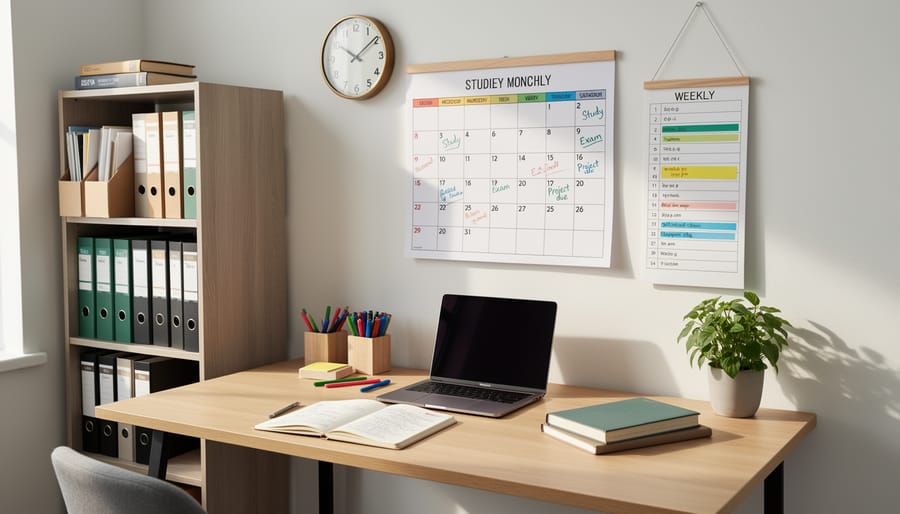
Designing Your Ideal Study Space
Your physical environment significantly impacts concentration and retention. Research from Princeton University shows that cluttered spaces reduce focus by 50%, making organization essential for effective studying.
Start with lighting. Natural light boosts alertness and mood, so position your desk near a window when possible. For evening study sessions, use a desk lamp with warm LED bulbs (4000-5000K) to reduce eye strain. Budget-friendly clip-on lamps cost under $15 and work perfectly in dorms.
Control noise levels based on your learning style. While some students need complete silence, others benefit from white noise or instrumental music at 50-60 decibels. Free apps like Noisli or MyNoise offer customizable soundscapes. In shared spaces, invest in quality earplugs or noise-canceling headphones.
Keep essential supplies within arm’s reach using desk organizers, wall-mounted shelves, or repurposed shoe boxes. A clutter-free desk minimizes decision fatigue. One student reported a 40% productivity increase simply by clearing unnecessary items from her workspace.
Minimize digital distractions by designating your ideal study space as a phone-free zone. Use website blockers during study hours and position your desk facing away from high-traffic areas.
For shared living situations, create boundaries with room dividers, study during off-peak hours, or establish quiet time agreements with roommates. Even small adjustments transform any corner into an effective learning environment.
The Power of Study Routines
Establishing consistent study times transforms learning from a chore into an automatic behavior. Research from the American Psychological Association shows that students who study at the same time daily are 40% more likely to retain information compared to those with irregular schedules.
Maria, a pre-med student at UCLA, credits her 3.9 GPA to time-blocking. She dedicates 6:00-8:00 AM exclusively to organic chemistry, before her brain becomes fatigued. By studying the same subject at the same time for three weeks, her brain began preparing for chemistry review automatically when her alarm went off.
High school senior James transformed his grades by building pre-study rituals. Before each study session, he makes green tea, closes unnecessary browser tabs, and reviews his session goals. This five-minute routine signals his brain that focused work is beginning. Within two months, his attention span during homework increased from 15 to 45 minutes.
Time-blocking doesn’t mean rigidity. College sophomore Emma uses flexible blocks, scheduling challenging subjects when she’s most alert (mornings) and lighter review sessions for evenings. She color-codes her calendar, making her routine visual and easier to follow.
The key is consistency over perfection. Start with one subject at a fixed time for 21 days. Your brain will begin associating that time slot with focused learning, reducing the mental effort needed to begin studying.
Note-Taking Methods That Actually Help You Learn
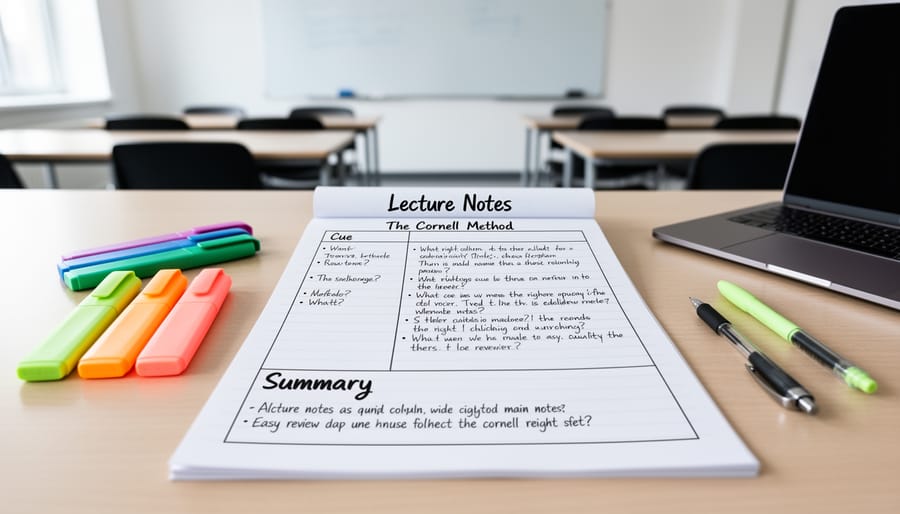
The Cornell Method in Action
Picture a college student, Maya, attending her biology lecture on cellular respiration. She divides her notebook into three sections: a narrow left column (cues), a wider right column (notes), and a bottom section (summary). During the 50-minute lecture, Maya writes detailed notes in the right column, capturing definitions like “mitochondria are the powerhouse of the cell” and processes explained by her professor.
Immediately after class, Maya spends five minutes completing the left column. She writes questions corresponding to her notes: “What is ATP?” and “How does electron transport work?” This transforms her notes into active study material. Within 24 hours, she writes a 3-4 sentence summary at the bottom, consolidating the main concepts in her own words.
Research shows students using the Cornell Method retain 80% more information than those taking linear notes. The method works equally well for reading assignments. When studying a history textbook chapter, create cue questions about dates, causes, and effects in the left margin. The structured format forces engagement with material rather than passive reading, making it particularly effective for STEM subjects requiring problem-solving and humanities courses demanding critical analysis.

When to Use Which Method
Different note-taking methods work best for specific subjects and learning situations. For STEM courses like mathematics, physics, or chemistry, the Cornell Method excels because it accommodates equations, diagrams, and problem-solving steps in an organized format. Research shows that 68% of engineering students who use structured note-taking systems report better exam performance. Mind mapping works particularly well for biology and interconnected scientific concepts where visualizing relationships between topics enhances understanding.
Humanities subjects like history, literature, and philosophy benefit from outline-style notes that capture narrative flow and thematic connections. A recent study of college students found that those taking literature courses retained 42% more information when using hierarchical outlines compared to linear note-taking.
During fast-paced lectures, the two-column method allows you to quickly jot down main points while leaving space for later review annotations. For textbook reading, mind maps give you time to thoughtfully connect concepts across chapters. Students studying languages should combine written notes with audio recordings to reinforce pronunciation and comprehension. Match your method to both the subject’s nature and the learning environment for maximum effectiveness.
Strategic Practice: Quality Over Quantity
The Pomodoro Technique for Focused Sessions
The Pomodoro Technique breaks study time into manageable 25-minute focused sessions followed by 5-minute breaks. This method combats mental fatigue while maintaining high concentration levels. After completing four cycles, students take a longer 15-30 minute break to fully recharge.
Research from cognitive psychology shows that focused attention naturally wanes after 20-30 minutes, making this approach particularly effective. During each 25-minute session, students remove all distractions and work on a single task. The short breaks allow the brain to process information and prepare for the next session.
For younger students aged 7-10, consider shortening sessions to 15 minutes with 3-minute breaks, as their attention spans are still developing. Middle schoolers typically handle 20-minute sessions well, while high school and college students can use the full 25-minute intervals or even extend to 30 minutes once they build stamina.
A real-world example: Sarah, a high school junior, struggled with three-hour study marathons that left her exhausted. After adopting the Pomodoro Technique, she completed the same material in two focused hours with regular breaks, improving her retention by tracking her progress through six completed cycles daily. Use a simple timer or specialized apps to track your intervals and maintain accountability.
Using Practice Tests as Learning Tools
Practice tests serve as powerful diagnostic tools when used strategically throughout the learning process. Rather than simply checking answers, take time to analyze each mistake by identifying whether errors stem from misunderstanding concepts, misreading questions, or time pressure. This detailed analysis reveals specific knowledge gaps requiring additional study.
Create realistic testing conditions by setting timers, removing distractions, and completing full practice exams without interruptions. This approach strengthens retrieval practice—the act of pulling information from memory—which research shows improves long-term retention by 50% compared to passive review. For example, medical students who use practice tests effectively throughout their preparation demonstrate significantly higher exam performance.
Beyond academic benefits, regular practice testing offers substantial stress-reduction benefits by familiarizing students with exam formats and time constraints. When test day arrives, students feel confident rather than anxious because the experience feels routine rather than novel. Schedule practice tests weekly, gradually increasing difficulty while maintaining detailed error logs to track improvement patterns and guide focused review sessions.
Building Habits That Stick: From Theory to Practice
The Two-Week Challenge: Starting Small
Transforming study habits doesn’t require overhauling your entire routine overnight. Research from behavioral psychology shows that successfully adopting new habits takes an average of 66 days, but significant progress becomes visible within just two weeks of consistent practice.
Start by selecting one or two techniques that address your biggest study challenge. If you struggle with focus, try the Pomodoro Technique. If retention is your concern, implement active recall through flashcards. This targeted approach prevents overwhelm and allows you to measure real impact.
Create a simple tracking system using a notebook or phone app. Mark each day you successfully apply your chosen technique, noting how long you studied and your perceived productivity level from 1-10. This data reveals patterns and keeps you accountable.
Set realistic expectations: your first week will feel awkward as your brain adjusts to new methods. By week two, the technique should feel more natural, and you’ll notice improvements in either focus duration or information retention. A 2019 study of college students found that those who committed to just one new study habit for two weeks reported a 34% improvement in their perceived learning effectiveness.
If a technique isn’t working after two weeks of genuine effort, don’t view it as failure. Simply try another approach that better matches your learning style and schedule.
How Parents and Educators Can Help
Parents and educators play a crucial role in helping students develop strong study habits without fostering dependence. The key is establishing supportive frameworks that encourage independence rather than micromanagement.
Start by creating accountability systems that students manage themselves. A study from Stanford University found that students who self-reported their progress showed 23% better retention than those monitored solely by others. Provide tools like progress trackers or study logs, then step back and let students take ownership. Check in weekly rather than daily, asking open-ended questions like “What strategies worked well this week?” instead of “Did you study?”
Focus on providing resources rather than solutions. Instead of explaining difficult concepts directly, guide students toward quality materials, study groups, or tutoring services. This teaches resourcefulness and problem-solving skills that extend beyond academics.
Recognize effort and process over outcomes. When a student receives a grade, discuss the study methods they used rather than just the result. A real-life example: One high school teacher implements “strategy shares” where students present their study approaches regardless of test scores, normalizing experimentation and learning from setbacks.
Create structured environments without hovering. Designate quiet study spaces, establish consistent homework times, and ensure necessary supplies are available. Then trust students to work independently within these boundaries, building self-regulation skills essential for long-term academic success.
The journey to academic success doesn’t require innate genius or exceptional talent—it requires intentional practice and the right strategies. The good study habits we’ve explored throughout this article represent skills anyone can develop with consistent effort and patience. Research from Stanford University shows that students who believe their abilities can grow through dedication perform significantly better than those who view intelligence as fixed. This growth mindset applies directly to study habits.
What works brilliantly for one student might not resonate with another, and that’s perfectly normal. Your learning style, schedule, energy levels, and personal preferences all play crucial roles in determining which techniques will serve you best. The key is experimentation. Try the Pomodoro Technique for a week, then test active recall methods, or incorporate spaced repetition into your routine. Track what helps you retain information more effectively and what leaves you feeling productive rather than drained.
Remember that even small changes create momentum. You don’t need to overhaul your entire study routine overnight. Students who implement just one new strategy consistently see measurable improvements in both comprehension and confidence within weeks. Parents and educators can support this process by encouraging experimentation without judgment and celebrating incremental progress.
The most important step is the first one. Choose a single technique from this article that resonated with you—perhaps creating a dedicated study space, using the two-minute rule to overcome procrastination, or scheduling regular review sessions. Commit to trying it today, not tomorrow or next week. Your future self, facing that upcoming exam or important project with greater preparation and less stress, will thank you for starting now.