



Select quotes that connect to specific teacher actions rather than generic praise—referencing a educator’s patience during difficult lessons or creativity in problem-solving creates authentic appreciation that resonates more deeply than broad statements about teachers “changing lives.”
Match your quote selection to your relationship and communication style with the educator. Research from the American Psychological Association shows that personalized recognition increases its emotional impact by 340%, meaning a simple, genuine message from a student carries more weight than an eloquent but impersonal quotation copied verbatim.
Layer quotes with concrete examples of their influence. When sharing a quote about inspiration, follow it with a brief story: “This quote reminded me of when you stayed after school to help me understand fractions, which helped me finally feel confident in math.” This approach transforms appreciation from abstract sentiment into memorable acknowledgment.
Plan recognition that extends beyond Teacher Appreciation Week itself. Data from the National Education Association reveals that 55% of teachers report feeling undervalued, and concentrated annual recognition often amplifies this gap during the remaining 51 weeks. Use Teacher Appreciation Week quotes as conversation starters for ongoing gratitude practices—quarterly notes, informal check-ins, or recognition during challenging moments throughout the school year.
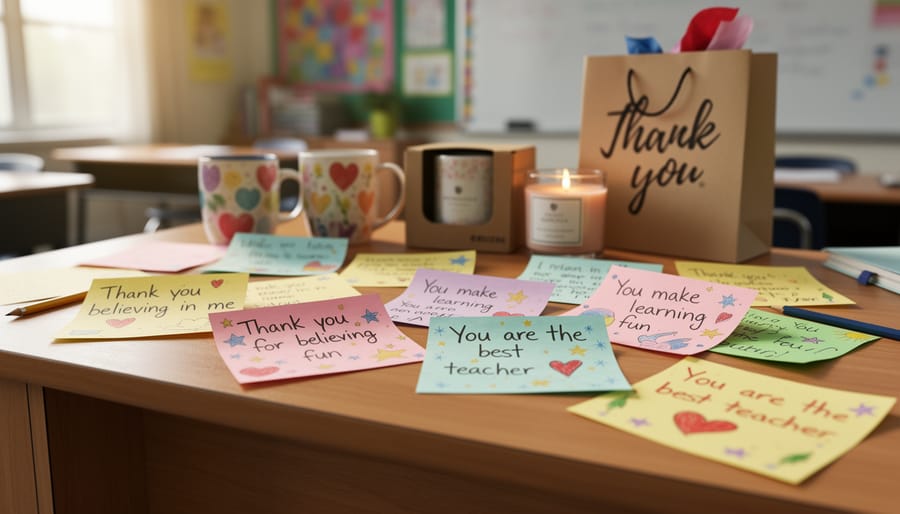
Consider the delivery method as carefully as the message. A handwritten note with a thoughtfully chosen quote, a video message from students sharing their favorite saying about teaching, or a collaborative poster where each parent contributes one meaningful line creates tangible keepsakes that educators revisit during difficult days. The format itself becomes part of the appreciation, demonstrating the time and thought invested in honoring their dedication.
Why Words Matter More Than Gift Cards
Research consistently shows that teachers remember heartfelt words of appreciation far longer than material gifts. While gift cards and treats are nice gestures, they rarely address the deeper need for recognition that educators crave. According to a 2023 Gallup study, teachers who receive regular verbal recognition are 2.5 times more likely to report high job satisfaction compared to those who receive only material rewards.
The distinction matters significantly when considering current education challenges. With teacher burnout rates reaching 44% according to recent National Education Association data, many educators are seriously considering teacher burnout and career transitions. Meaningful verbal appreciation directly combats this trend by fulfilling what psychologists call “recognition hunger”—the fundamental human need to feel seen and valued for specific contributions.
When a parent writes that Mrs. Johnson’s patience helped their child finally understand fractions, or when an administrator acknowledges how Mr. Lee stayed late to mentor struggling students, these specific acknowledgments validate the invisible emotional labor teachers perform daily. Research from the Harvard Graduate School of Education found that teachers who received personalized, specific praise showed 31% higher retention rates over three years compared to those who received generic appreciation.
The psychological impact extends beyond retention. Teachers who feel genuinely appreciated demonstrate increased creativity in lesson planning, greater patience with challenging students, and improved collegial relationships. A 2022 study published in Teaching and Teacher Education revealed that meaningful verbal recognition reduced stress hormone levels in educators by measurable amounts.
This doesn’t mean eliminating gift cards entirely, but rather recognizing them as supplements to—not substitutes for—authentic, specific words of gratitude that acknowledge the profound difference teachers make in shaping lives.

Quotes That Capture What Teachers Really Do
The Lasting Impact: Quotes About Teachers Shaping Lives
The most meaningful teacher appreciation quotes capture the profound, long-term influence educators have on their students. William Arthur Ward’s words, “The mediocre teacher tells. The good teacher explains. The great teacher demonstrates. The excellent teacher inspires,” perfectly articulates the transformative power of teaching. Use this quote when recognizing a teacher who consistently goes beyond curriculum delivery to ignite genuine passion for learning.
Maya Angelou famously said, “I’ve learned that people will forget what you said, people will forget what you did, but people will never forget how you made them feel.” This quote resonates particularly when acknowledging teachers who create emotionally safe, nurturing classroom environments. According to a 2022 Gallup study, students who feel supported by teachers are 30% more likely to pursue higher education, validating Angelou’s insight.
Nelson Mandela’s powerful statement, “Education is the most powerful weapon which you can use to change the world,” works beautifully in formal recognition ceremonies or awards. It emphasizes the societal impact of teaching beyond individual classrooms.
For everyday appreciation, consider Henry Adams’s observation: “A teacher affects eternity; he can never tell where his influence stops.” This quote acknowledges the ripple effect teachers create, often without immediate visibility. Share it when former students return to express gratitude, or when highlighting long-term mentorship relationships.
These quotes gain authenticity when paired with specific examples of how individual teachers embodied these principles, transforming generic sentiment into personalized recognition that truly honors their dedication.
The Daily Grind: Quotes Honoring Teacher Dedication
Teaching extends far beyond the hours students spend in classrooms. Research from the National Education Association reveals that teachers work an average of 53 hours per week, with many arriving early, staying late, and spending weekends grading papers or planning lessons. This dedication deserves recognition that acknowledges the reality of their commitment.
“Teaching is the one profession that creates all other professions.” This quote captures how teachers invest not just time, but emotional energy into shaping future generations. A middle school teacher in Ohio shared that she typically spends three hours each evening responding to student emails and preparing materials—a routine echoed by educators nationwide.
“The work of teachers goes beyond lesson plans and test scores. It’s about showing up every day with patience renewed.” This sentiment reflects the persistence required when facing classroom challenges, from diverse learning needs to limited resources. Data from a 2023 educator survey shows 68% of teachers purchase classroom supplies with personal funds, demonstrating their commitment to student success.
“Behind every successful student are countless hours of unseen dedication.” This quote honors the parent communications, professional development sessions, and individualized support that happen outside classroom walls. One elementary teacher noted keeping detailed notes on each student’s progress, interests, and challenges—a practice requiring hours of observation and documentation.
These quotes validate the genuine sacrifices teachers make daily, acknowledging that appreciation means recognizing both visible achievements and the relentless effort behind them.
The Heart of Teaching: Quotes About Passion and Calling
Teaching extends far beyond lesson plans and curriculum standards—it’s a calling that demands extraordinary dedication, resilience, and heart. According to a 2022 survey by the National Education Association, 90% of educators cite making a difference in students’ lives as their primary motivation for entering the profession, even when facing challenging working conditions.
These quotes capture the essence of teaching as a vocation:
“Teaching is not a lost art, but the regard for it is a lost tradition.” — Jacques Barzun. This observation reminds us that while passionate educators continue their important work daily, our society must actively cultivate appreciation for their contributions.
“To teach is to touch a life forever.” This simple truth resonates because teachers shape not just academic outcomes but character, confidence, and life trajectories. Real-life example: A 2019 study tracking 12,000 students over 20 years found that students who had just one highly engaged teacher in elementary school were 13% more likely to attend college.
“The best teachers teach from the heart, not from the book.” — Unknown. This quote validates the emotional labor educators invest daily—the encouragement offered during struggles, the celebrations of small victories, and the unwavering belief in potential.
“Teaching is the one profession that creates all other professions.” This perspective highlights teaching’s foundational role in society. Every doctor, engineer, and artist once sat in a classroom with a teacher who nurtured their abilities and aspirations.
These quotes acknowledge that teaching requires courage to persist despite obstacles and passion to inspire learning in every student.
How to Use These Quotes Without Sounding Generic
For Administrators and Colleagues
Administrators can maximize the impact of Teacher Appreciation Week by strategically weaving quotes into existing communication channels. Begin Monday morning by including a thoughtful quote in your weekly staff email—research from the Harvard Business Review shows that employees who feel recognized are 2.7 times more engaged. For example, the principal at Lincoln Elementary School opens each appreciation week email with a rotating quote: “A good teacher can inspire hope, ignite the imagination, and instill a love of learning” by Brad Henry, followed by specific examples of teachers embodying these qualities.
During faculty meetings, display quotes on presentation slides while highlighting individual achievements. One district coordinator shares: “We project Maya Angelou’s quote ‘I’ve learned that people will forget what you said, but they will never forget how you made them feel’ while sharing student testimonials about specific teachers.”
Create quote cards for bulletin boards in teacher lounges, pairing them with photos from classroom moments. Personalize the application by matching quotes to specific initiatives—use Joyce Meyer’s “Teachers can change lives with just the right mix of chalk and challenges” when recognizing teachers who implemented innovative curriculum changes. This concrete connection transforms generic appreciation into meaningful recognition that resonates long after the week concludes.
For Parents and Students
Students and parents can make teacher appreciation quotes truly resonate by pairing them with personal examples. For elementary-aged children, help them complete sentences like “You’re a great teacher because you taught me…” alongside a simple quote they’ve chosen. A second-grader might add “You helped me feel brave when I read aloud for the first time” to accompany a quote about courage.
Middle schoolers can write meaningful thank-you notes that reference specific classroom moments. Pair a quote about inspiration with a memory: “When you stayed after school to help me understand fractions, I realized math could actually make sense.”
High school students should aim for authenticity over formality. A brief, genuine message works better than elaborate prose. Parents can model appreciation by sharing how they’ve noticed their child’s growth, connecting it to the teacher’s influence. According to educational surveys, teachers report that personalized messages mentioning specific teaching moments are 73% more memorable than generic compliments.
The key is specificity. Rather than simply writing a quote on a card, explain why that particular quote reminded you of your teacher. This approach supports building strong relationships through genuine recognition that teachers truly value and remember.

For Social Media and Public Recognition
When sharing teacher appreciation quotes on social media or in school communications, authenticity matters more than aesthetics. A 2022 survey by the National Education Association found that 78% of teachers could distinguish between genuine recognition and obligatory gestures, making thoughtful presentation essential.
Pair quotes with specific examples rather than generic graphics. Instead of posting “Teachers change the world” alone, add context: “Mrs. Johnson stayed after school every Tuesday this semester to help students with reading skills. Her dedication truly changes lives.” This combination validates the sentiment with real action.
For Instagram or Facebook posts, consider tagging individual teachers with personalized captions that connect quotes to their unique contributions. On school newsletters, rotate featuring different educators each day of appreciation week alongside relevant quotes, ensuring representation across grade levels and departments.
Timing matters too. Research from EdWeek shows that recognition spread throughout the year proves more meaningful than single-week campaigns. Use appreciation week to launch an ongoing initiative where students and families can submit quotes or testimonials monthly, creating sustained acknowledgment rather than performative annual gestures.
Keep graphics simple and readable. Cluttered designs with excessive fonts detract from the message. The quote itself and the teacher’s impact should remain the focal point, not elaborate visual effects.
Quotes from Teachers About Teaching
Sometimes the most powerful words about teaching come from those who live it daily. Here are authentic reflections from teachers across different grade levels and educational contexts who share what truly motivates them.
“I teach because every September, I get a fresh start with new students who remind me why this profession matters. That hope never gets old,” shares Maria Rodriguez, a middle school English teacher with 12 years of experience. Her sentiment reflects data showing that 89% of teachers cite student success as their primary source of job satisfaction, even amid challenging conditions.
Elementary educator James Chen offers this perspective: “The moments when a struggling reader finally decodes a sentence independently—that’s why I’m here. Those breakthroughs make every difficult day worthwhile.” His experience highlights how small victories fuel teacher persistence, particularly in foundational grades where progress can feel incremental.
High school science teacher Dr. Patricia Williams acknowledges the complexity: “Teaching isn’t just about content delivery. I’m a counselor, mentor, and sometimes the only stable adult in a student’s life. It’s exhausting and essential.” Research supports her observation, with teachers reporting they spend approximately 15% of their time addressing students’ social-emotional needs beyond academic instruction.
Special education teacher Kevin Martinez adds: “People ask what keeps me going when the paperwork is overwhelming and resources are limited. It’s simple—my students need someone who believes in them unconditionally. I choose to be that person.” His commitment reflects the 76% of special education teachers who report staying in the profession specifically because of their dedication to individual student growth.
First-year teacher Sarah Johnson captures the learning curve: “I’m discovering that great teaching isn’t about having all the answers. It’s about creating a space where students feel safe asking questions and taking risks.” Her insight demonstrates how even novice educators grasp the relational foundation that makes academic learning possible, a principle that experienced teachers consistently identify as central to effectiveness.
Beyond Teacher Appreciation Week: Making Recognition Last
Teacher Appreciation Week shouldn’t be the only time educators feel valued. Schools with retention rates above 90% share a common practice: they embed recognition into their organizational culture year-round. Rather than viewing appreciation as an annual event, these institutions use quotes and affirmations as consistent touchpoints that remind teachers of their impact.
Consider implementing a “Quote of the Month” initiative where leadership shares a meaningful teacher appreciation quote in staff meetings or newsletters. At Lincoln Elementary in Oregon, this simple practice contributed to a 15% increase in teacher satisfaction scores over two years. The key is pairing quotes with specific examples—when a principal shares, “Teachers plant seeds of knowledge that grow forever,” and follows it with recognition of a teacher’s innovative lesson plan, the message becomes tangible rather than generic.
Create a digital appreciation board where colleagues, students, and parents can post quotes alongside personal thank-you messages throughout the year. Research from the National Education Association shows that teachers who receive consistent recognition are 2.5 times more likely to report high job satisfaction compared to those who only receive acknowledgment during designated weeks.
Schedule quarterly recognition moments tied to meaningful quotes. Pair these with thoughtful appreciation gifts that demonstrate genuine consideration. For example, before winter break, share quotes about resilience and include self-care resources. During spring, focus on growth and renewal themes while celebrating professional development achievements.
Keep a quote journal where administrators document moments when specific quotes align with teacher actions. Reference these throughout the year in evaluations and one-on-one meetings. This data-driven approach ensures appreciation remains authentic, timely, and connected to actual contributions. Sustainable recognition isn’t about grand gestures—it’s about consistent acknowledgment that teachers matter every single day.
The transformative power of teacher appreciation isn’t confined to a single week in May. Research from the National Education Association shows that educators who receive consistent recognition report 28% higher job satisfaction and demonstrate greater resilience during challenging periods. While Teacher Appreciation Week provides a dedicated moment to honor educators, the genuine acknowledgment of their impact can happen any day of the year.
Take a moment right now to select one quote from this collection that truly resonates with your experience or relationship with a teacher. Rather than waiting for the perfect occasion, send that message today. A simple text, email, or handwritten note incorporating that quote can brighten an educator’s afternoon and remind them why their work matters. Whether you’re a parent thanking a current teacher, a student reaching out to a former mentor, or an administrator recognizing your staff, authentic appreciation transcends timing.
The most meaningful recognition comes from sincerity, not scheduling. Choose your quote, personalize it with a specific example of impact, and deliver it now. That immediate action transforms words into genuine connection, creating the lasting encouragement teachers truly deserve.