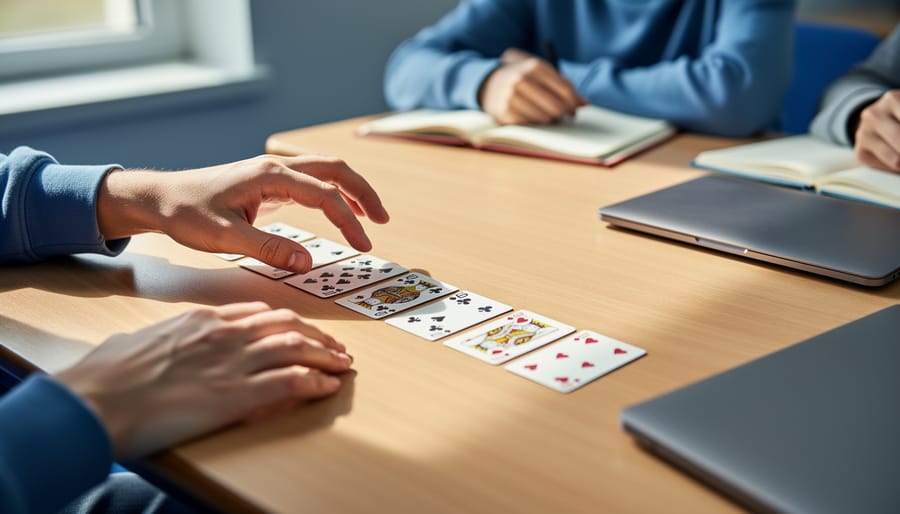



A student can choose a move in seconds and still struggle to say why it was a good choice. A familiar solitaire board makes that gap visible. Open a fresh game on PlaySolitaire, pause before moving a card, and ask the learner to describe what the move reveals, what it blocks, and what might change next. The point is not to make a card game into a graded subject. It is to give a tutor a small, shared problem in which reasoning can be heard rather than guessed from the final result.
Start With the Board Everyone Can See
A useful teaching example needs a common reference. In a solo puzzle, the tutor and student can look at the same layout and point to the same card. Begin with a face-up move, not a hidden-card prediction. Ask the student to name the card they want to move and its destination. Then ask what becomes available afterward. These questions are concrete enough for a learner to answer without being told that there is one clever solution.
A tutor might hear, “I can move this red seven onto a black eight.” That describes a legal action, but not yet a plan. The follow-up is more interesting: “What will that expose?” The student may discover that the move frees a hidden card, opens a column, or merely rearranges cards already visible. This distinction between a move that is allowed and a move that serves a purpose applies to many classroom tasks.
Ask for a Reason Before a Result
It is tempting to praise a quick decision when it works. Yet a lucky guess and a considered choice can look identical after the card moves. Pause the game before the click and invite a short explanation. A learner can say what information is known, what remains uncertain, and why one option seems more useful than another. If the next card turns out badly, the explanation can still have been sound.
The same habit can travel to a maths problem, a reading inference, or a piece of writing. A student who can explain why they chose an operation or interpretation gives the tutor something to respond to. The card board is valuable here because it lowers the stakes. Nobody’s exam mark depends on the turn, and the reasoning is visible in the arrangement of cards.
Let a Mistake Become a Question
When a move closes off an option, resist the urge to take over. Ask what changed on the board. Which card is now harder to reach? Was the lost option obvious beforehand, or did it depend on information nobody had? This avoids turning every setback into a lecture about being more careful. Sometimes the student simply learns that a plausible move had a cost.
If the game offers an undo control, use it as a comparison tool rather than an escape hatch. Return to the earlier arrangement and test the alternative. Comparing two sequences is more informative than telling the student that one was wrong. The tutor can ask what evidence would make the student choose differently next time, without claiming that every solitaire deal can be solved by a fixed rule.
Keep the Exercise Short and Voluntary
A five-minute board discussion can fit between lessons or at the beginning of a tutoring session. It should not replace subject teaching, and it should not be presented as proof that playing games raises grades. Its value is narrower and more practical: the tutor gets to hear a learner make a decision, revise it, and explain the revision in ordinary language.
For younger students, a tutor may model one move and invite the learner to explain the next. Older students can compare two possible moves without touching either card. A student who dislikes card games can use another small puzzle instead. The teaching method is the pause for explanation, not loyalty to a particular game.
Return the Language to the Lesson
The exercise earns its place only if it helps the next conversation. After the card game, use the same prompts in the real lesson: What do we know? Which choice follows from that? What would make us change our minds? A solitaire board cannot teach a curriculum on its own, but it can give tutor and learner a compact example of thinking aloud. The useful outcome is not a winning screen. It is a student who can tell you what they tried and why.