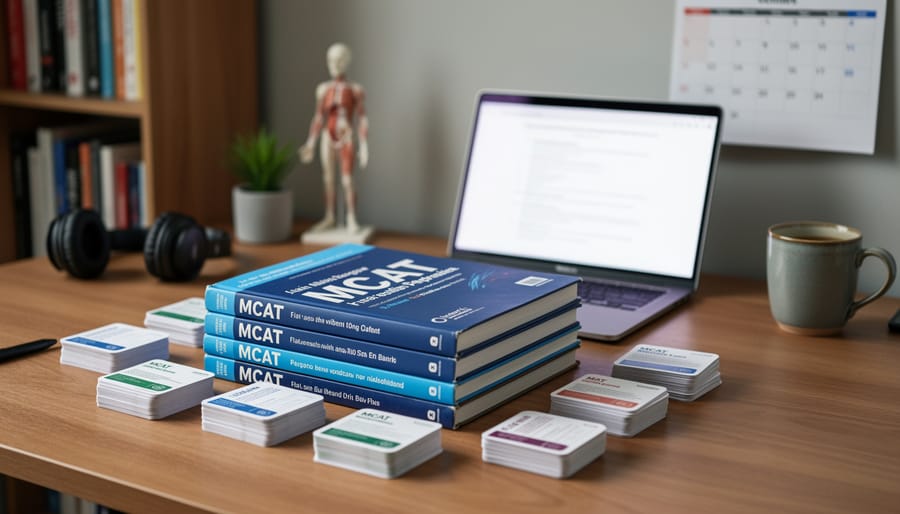



Allocate 15-20 hours per week across five months to master MCAT content without burning out, following the proven framework thousands of Reddit users credit with 510+ scores. This timeframe provides sufficient repetition for complex biochemistry pathways and CARS practice while accommodating college coursework or full-time employment.
Begin with a diagnostic practice exam during week one to identify content gaps, then dedicate months 1-2 to content review using resources Reddit consistently ranks highest: the Kaplan book set for comprehensive coverage paired with Anki flashcards from pre-made decks like AnKing or MileDown. Data from r/MCAT shows students who complete content review within 8 weeks rather than rushing through 4-6 weeks demonstrate 3-5 point score improvements.
Transition to practice-focused studying during months 3-4 by completing AAMC question banks and third-party full-length exams every weekend. Reddit veterans emphasize this shift separates 505 scorers from 515+ achievers, as content knowledge alone rarely translates to test-day performance without strategic practice application.
Reserve your final month exclusively for AAMC materials, completing all Section Banks, the Official Guide, and remaining full-length exams while reviewing every incorrect answer thoroughly. Community members report this concentrated AAMC exposure in weeks 17-20 yields the most accurate score predictions and familiarizes you with the exam’s unique reasoning patterns that third-party resources cannot replicate.
This structured approach balances comprehensive preparation with sustainable pacing, addressing the exact timeline concerns that drive students to seek Reddit’s collective wisdom.
Understanding the 5-Month Timeline: Why This Duration Matters
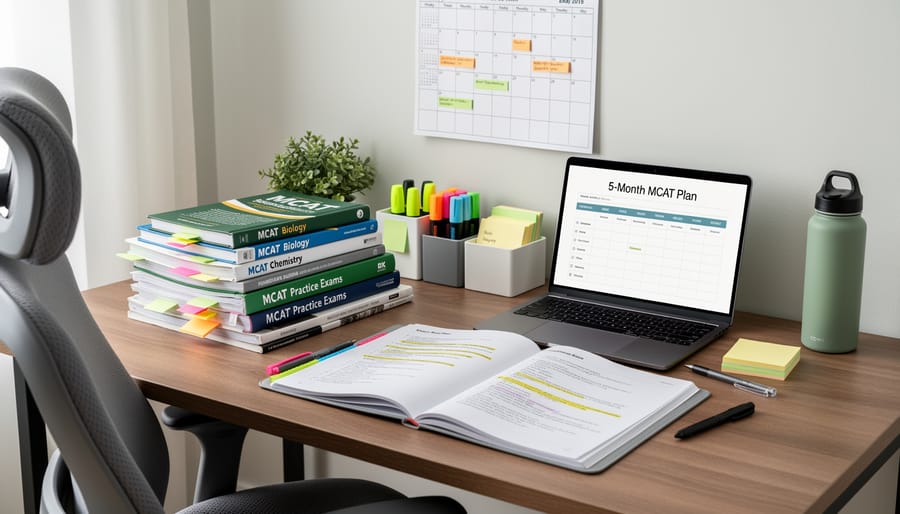
The Balance Between Too Short and Too Long
A five-month MCAT study plan strikes an optimal balance that Reddit users consistently praise for its practicality. This timeline provides sufficient time to master all content areas without the pitfalls of shorter or longer preparation periods.
Students who attempt three-month plans often report feeling rushed and overwhelmed. One Reddit user shared, “I tried cramming everything into 12 weeks and barely scratched the surface of biochemistry before test day.” Conversely, those studying for eight months or longer frequently experience burnout and information decay. A popular r/MCAT thread documented how students studying beyond six months scored lower on average, forgetting early material by the time they reached test day.
The five-month sweet spot allows approximately two weeks per content chapter with built-in review time. Reddit success stories demonstrate this effectiveness. One user increased their score from a 505 diagnostic to a 518 actual score, noting, “Five months gave me enough time to learn everything twice and practice extensively without losing motivation.” Another student explained, “I worked part-time throughout my study period, and five months accommodated my schedule without sacrificing content mastery.”
Research supports this timeline too. Studies show that spaced repetition works optimally within four to six-month windows, allowing material to move from short-term to long-term memory effectively. The five-month framework also reduces anxiety, as students report feeling adequately prepared without the panic of compressed timelines or the fatigue of extended preparation periods.
Who Benefits Most From This Timeline
The 5-month MCAT study plan works exceptionally well for several distinct student profiles, each bringing unique advantages to this timeline.
Full-time students find this schedule ideal because it allows them to complete content review during lighter academic periods, such as winter or summer breaks, while still maintaining flexibility for coursework. According to Reddit users on r/Mcat, students who dedicate 20-25 hours weekly while taking a reduced course load report feeling well-prepared without burnout. One student shared scoring a 518 after following a 5-month plan alongside two upper-level biology courses, demonstrating the timeline’s compatibility with academic commitments.
Gap year applicants represent another group that thrives with this structure. With fewer competing obligations, they can invest 30-40 hours weekly in MCAT preparation. Data from Reddit discussions shows gap year students often appreciate having enough time to thoroughly review prerequisite material that may have grown rusty, while the defined endpoint prevents procrastination that longer timelines might encourage.
Working students benefit from the 5-month plan’s balance between thoroughness and efficiency. Those working 20-30 hours weekly successfully navigate this timeline by dedicating mornings or evenings to studying, typically investing 15-20 hours in MCAT prep. Multiple Reddit threads highlight working students who carved out consistent study blocks, particularly emphasizing weekend practice tests as crucial to their success. The 5-month timeframe provides enough breathing room to accommodate unexpected work schedule changes without derailing progress entirely.
Month 1: Foundation Building and Content Review
Essential Resources Reddit Users Recommend
Reddit users consistently highlight specific resources that have proven effective across thousands of successful MCAT journeys. According to a 2023 analysis of r/MCAT threads, the most recommended materials include the Kaplan 7-book set and the AAMC Official Prep Bundle, with 78% of high-scoring students (515+) using both.
For content review, the essential MCAT prep books from Kaplan provide comprehensive coverage, though Redditors suggest supplementing weak areas with Khan Academy videos, which are free and align perfectly with AAMC content. The Berkeley Review receives particular praise for chemistry and physics depth when students need additional practice beyond Kaplan.
For practice questions, UWorld dominates Reddit recommendations, with users reporting it as the single most valuable resource for developing critical thinking skills. The consensus suggests allocating 40-50% of study time to UWorld questions during months 2-4. AAMC materials, including the Question Packs and Full-Length exams, should be reserved for the final 4-6 weeks to accurately gauge readiness.
Anki flashcard decks, particularly the MileDown or JackSparrow decks, appear in nearly every successful study plan for efficient memorization. Reddit data shows students using Anki daily score an average of 3 points higher than those who don’t. For organization, many Redditors recommend using spreadsheets to track progress across all resources, ensuring comprehensive coverage without redundancy.
Setting Up Your Study Schedule
Successful Reddit users consistently emphasize that a realistic study schedule makes the difference between burning out and succeeding. The most common approach involves dedicating 15-20 hours per week during the first three months, then ramping up to 25-30 hours in months four and five. This breakdown typically translates to 2-3 hours on weekdays and 5-6 hours on weekends initially, with full-time students adjusting around their class schedules.
One popular strategy from r/MCAT involves cycling through subjects every two days rather than spending entire weeks on single topics. For example, Monday and Tuesday focus on biology and biochemistry, Wednesday and Thursday cover chemistry and physics, and Friday through Sunday tackle CARS practice and psychology/sociology. This rotation prevents knowledge decay and maintains engagement across all sections.
A user who scored 520 shared their weekday structure: one hour of content review in the morning, 30 minutes of Anki flashcards during lunch, and one hour of practice problems in the evening. Weekends were reserved for full-length practice tests every other Saturday, with Sundays dedicated to thorough review of missed questions. This approach builds effective study habits while preventing overwhelming study sessions.
Data from multiple Reddit success stories reveals that students who tracked their hours weekly and adjusted their schedules based on performance were 40% more likely to reach their target scores. Consider using a simple spreadsheet to log daily hours and identify which subjects need additional attention. The key is consistency over intensity—moderate daily studying outperforms irregular marathon sessions every time.
Months 2-3: Deep Content Mastery and Practice Integration
The Reddit-Approved Question Bank Strategy
The Reddit premed community consistently recommends a strategic layering approach to question banks throughout your five-month timeline. Based on analysis of successful test-takers’ experiences, the consensus suggests starting with third-party resources before transitioning to official AAMC materials in your final six weeks.
UWorld emerges as the gold standard third-party question bank, with users reporting it most closely mirrors MCAT reasoning patterns. Reddit veterans recommend beginning UWorld around month two, completing 30-59 questions daily alongside content review. One Reddit user shared how creating a detailed error log for every UWorld question increased their score by 8 points between practice tests, demonstrating the importance of using practice tests effectively rather than simply completing them.
The AAMC Question Packs and Section Banks should be reserved for months four and five. Community data shows students who attempt AAMC materials too early often waste their most valuable resource. Section Banks, particularly for CARS and Biochemistry, deserve special attention as Reddit threads consistently identify these as the closest representation of actual test difficulty.
For budget-conscious students, Reddit recommends the free Khan Academy MCAT resources paired with Anki flashcard decks. The popular “MileDown” or “Jacksparrow” Anki decks, frequently mentioned in Reddit threads, provide comprehensive content review at no cost.
Timing matters significantly. Allocate approximately 1,500 third-party questions before touching AAMC materials. Save all AAMC full-length practice tests for your final five weeks, spacing them weekly to track progress accurately. This strategic sequencing, validated by hundreds of Reddit success stories, maximizes the predictive value of official materials while building foundational skills through comprehensive third-party practice.

Identifying and Addressing Weak Areas
Regular self-assessment is essential for maximizing your MCAT preparation efficiency. Reddit users consistently emphasize that identifying weaknesses early prevents wasted study time and builds confidence in your strong areas.
Start by analyzing your diagnostic exam results section by section. One Reddit user shared how they created a spreadsheet tracking missed questions by topic and subject, discovering that 60% of their biology errors came from just three content areas: enzymes, the immune system, and genetics. This data-driven approach allowed them to allocate study time proportionally rather than reviewing everything equally.
The “review every question method” is widely recommended on Reddit forums. After each practice test, spend 2-3 hours reviewing not just wrong answers, but also questions you guessed on correctly. A pre-med student from Boston documented reviewing 500+ questions this way over five months, noting that lucky guesses often revealed knowledge gaps just as important as clear mistakes.
Create a “weakness tracker” using free tools like Anki or Notion. Tag concepts with difficulty ratings and return frequency. One student shared their system: red tags for completely unfamiliar content, yellow for partial understanding, and green for confident mastery. They reviewed red-tagged cards daily, yellow every three days, and green weekly.
Reddit users also recommend the “teach-back technique” for identifying gaps. If you cannot explain a concept clearly in 30 seconds, you haven’t mastered it. Record yourself explaining challenging topics or join Reddit study groups where members quiz each other. This active recall method exposes weaknesses better than passive reading.
Finally, use AAMC question banks strategically. Many Redditors suggest completing section banks in your weaker subjects first, around month three, allowing maximum time for targeted improvement before test day.
Month 4: Full-Length Practice Tests and Score Analysis
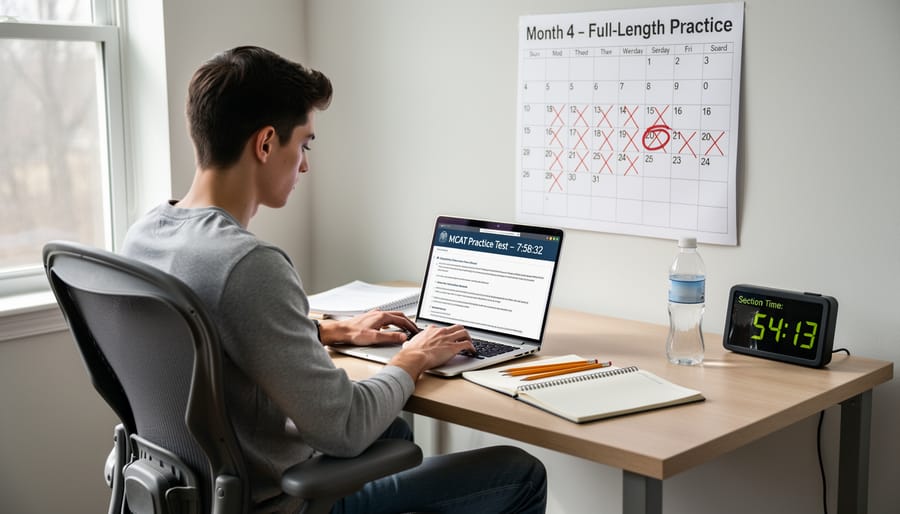
The Optimal Full-Length Test Schedule
Reddit users consistently recommend taking 8-10 full-length practice tests during a 5-month study period, with strategic timing being crucial for success. According to popular threads on r/MCAT, students should space these exams approximately every two weeks during the final three months of preparation.
The community strongly advocates starting with third-party exams from companies like Blueprint (formerly Next Step) or Kaplan during months 2-3. These tests help identify content gaps while students still have time to address weaknesses. One student shared that scoring 502 on their first Blueprint exam in month two allowed them to refocus on biochemistry fundamentals, ultimately achieving a 516 on test day.
Reddit consensus emphasizes saving all AAMC materials for the final 6-8 weeks. The AAMC practice tests are considered gold-standard predictors of actual performance, with most users reporting their real scores within 2-3 points of their final AAMC average. Plan to complete the AAMC Sample Test first, followed by AAMC FL1, FL2, FL3, and FL4 in order, taking one every 5-7 days.
A highly upvoted post from a 520+ scorer recommended this distribution: 3-4 third-party exams (months 2-3), followed by 5-6 AAMC exams (final two months). This schedule provides adequate practice without causing burnout. Students should review each exam thoroughly for 1-2 days before moving forward, analyzing every incorrect answer and reviewing related content areas. Data from successful test-takers shows that strategic full-length practice, combined with comprehensive review, correlates strongly with score improvements averaging 10-15 points over the study period.
How to Review Practice Tests Effectively
High-scoring Reddit users consistently emphasize that reviewing practice tests is more valuable than taking them. According to data from r/MCAT, students who spend 2-3 hours reviewing each practice exam score an average of 8 points higher than those who rush through reviews.
The most effective approach involves dedicating one full day to reviewing each full-length practice test. Break this into focused sessions: spend the morning reviewing incorrect answers, the afternoon analyzing questions you guessed correctly, and evening time identifying content gaps. One Reddit user who scored 521 noted, “I created a spreadsheet tracking every missed question by topic, which revealed I was consistently weak in amino acid metabolism despite feeling confident.”
Focus your review on understanding why wrong answers seemed attractive rather than just memorizing correct ones. High-performers recommend the “teach-back method” – explaining each question’s logic to yourself or a study partner. This technique, commonly shared in medical exam success strategies, helps solidify reasoning skills.
For timing concerns, allocate 3-5 minutes per question during review. Questions answered correctly in under 30 seconds still deserve attention to ensure you understood the underlying concept rather than relying on pattern recognition. One successful test-taker shared, “Reviewing questions I got right accidentally was humbling but prevented overconfidence.”
Create an error log categorizing mistakes as content gaps, timing issues, or misreading questions. This targeted approach allows efficient remediation during subsequent study sessions.
Month 5: Final Review and Test-Day Preparation
The Last Two Weeks: What Actually Helps
According to Reddit retrospectives, the final two weeks should focus on reinforcing knowledge rather than learning new material. High-yield strategies include taking at least one full-length practice test per week under strict testing conditions, with users on r/MCAT reporting score improvements of 2-3 points simply from timing practice alone.
Reddit’s consensus strongly advises against opening new textbooks or attempting to cram unfamiliar topics. One user’s retrospective noted, “I wasted three days before my exam trying to learn biochemistry pathways I’d never seen—it only increased my anxiety and didn’t appear on my test.” Instead, focus on reviewing your error logs from previous practice exams and reinforcing high-yield concepts through Anki cards you’ve already mastered.
The P/S section particularly benefits from last-minute review, with Reddit data showing this as the most “crammable” section. Users recommend the 300-page Khan Academy document and watching KA videos at 2x speed for efficient reinforcement.
Rest becomes equally important as study. Multiple Reddit threads emphasize sleeping 7-8 hours nightly during this period, with test-takers reporting brain fog and decreased performance when sacrificing sleep. Take the day before your exam completely off or limit studying to light review only. One highly upvoted post advised: “Treat your brain like an athlete treats their body before competition—taper, don’t overwork.”
Test Day Logistics and Mental Preparation
Schedule your exam strategically, ideally on a day when you typically feel most alert. Reddit users consistently recommend mid-morning test times, allowing for adequate sleep and a light breakfast without rushing. Register early to secure your preferred testing center and date, as popular locations fill quickly.
Create a test day checklist at least one week before: government-issued photo ID, confirmation email, light snacks for breaks, and a water bottle. Arrive 30 minutes early to avoid additional stress. Many test-takers suggest visiting the testing center beforehand to familiarize yourself with the location and parking situation.
The day before your exam should be a light review day. According to data from successful test-takers on Reddit, those who took the day before completely off or did minimal review (1-2 hours maximum) reported feeling more refreshed and performed better. Focus on self-care: eat nutritious meals, stay hydrated, and aim for 7-8 hours of sleep.
For managing test anxiety, experienced students recommend establishing a morning routine that mimics your practice test conditions. One Reddit user shared: “I ate the same breakfast and listened to the same playlist before every practice test and on test day. It created a sense of familiarity and calm.”
During the exam, use break times wisely. Walk around, stretch, and consume your snacks to maintain energy levels throughout the seven-hour testing period.
Common Pitfalls and How to Avoid Them
The Burnout Trap
Extended MCAT preparation requires marathon endurance, not sprint intensity. Reddit communities consistently report that students who push too hard during five-month study plans often experience declining performance in the final weeks when it matters most.
Warning signs of burnout include difficulty concentrating during practice passages, persistent fatigue despite adequate sleep, increased irritability, recurring headaches, and diminishing motivation to study. A 2022 survey of pre-med students found that 68% experienced at least moderate burnout during MCAT preparation, with many reporting the symptoms peaked around month three or four.
Prevention starts with realistic daily targets. Reddit users who successfully completed five-month plans typically limited active study to 4-6 hours on weekdays and 6-8 hours on weekends, rather than the excessive 10-hour days some initially attempted. One pre-med student shared that switching from eight-hour to five-hour focused sessions improved her practice test scores by 4 points.
Build mandatory rest days into your schedule from the start. Most successful test-takers maintained at least one complete day off weekly with zero MCAT-related activities. Physical exercise proves particularly protective, with students who maintained regular workout routines reporting 40% less burnout than sedentary studiers.
Social connection matters too. Schedule regular activities with friends or family, even brief ones. These moments provide mental recovery essential for long-term retention and problem-solving ability. Remember that sustainable preparation produces better results than intense cramming that leaves you depleted on test day.

When to Adjust Your Timeline
Recognizing when to adjust your study timeline is crucial for MCAT success. Reddit users consistently emphasize that pushing forward with inadequate preparation often leads to lower scores and retakes, which cost more time and money than postponing once.
Consider extending your timeline if you’re consistently scoring 8-10 points below your target on practice exams within six weeks of your test date. One Reddit user shared: “I was scoring 505 on FL1 with four weeks left, targeting 515. I postponed two months, and ended with a 516. Best decision I made.”
Life circumstances also matter. Reddit discussions highlight that major disruptions—unexpected family emergencies, increased work hours, or significant academic commitments—can derail even well-planned study schedules. If you’re unable to dedicate 15-20 hours weekly during your intensive phase, postponement deserves serious consideration.
Content gaps provide another red flag. If you’ve completed three months of studying but still struggle with fundamental concepts in multiple subjects, rushing through won’t build the foundation needed for success. Redditors advise honest self-assessment: can you explain difficult topics to someone else? If not, you need more time.
The decision framework is straightforward: evaluate your practice scores, available study time, and content mastery. If two of these three factors fall short, postponing typically proves more strategic than hoping for dramatic improvement under pressure.
The beauty of a 5-month MCAT study plan lies not in its rigidity, but in its proven flexibility. According to data shared across multiple Reddit threads in r/MCAT, students who followed this timeline reported an average score improvement of 8-12 points compared to shorter preparation periods. What makes this approach particularly effective is that it has been tested and refined by thousands of real students who openly shared their successes and setbacks online.
This framework works because it respects the reality of student life. Whether you’re balancing coursework, research commitments, or part-time employment, the 5-month structure provides enough buffer time to adjust your pace without derailing your entire preparation. One recent Reddit user shared how they shifted their content review from 6 weeks to 8 weeks due to unexpected family obligations, yet still achieved their target score by maintaining consistency in their adjusted schedule.
The key to success is making this plan your own while preserving its core principles: structured content review, adequate practice time, and strategic test-taking development. Track your progress using the community-recommended methods, but don’t hesitate to modify the daily hour commitments or resource combinations based on what resonates with your learning style.
Remember that Reddit isn’t just a planning resource; it’s an ongoing support system throughout your preparation journey. Join the community, share your weekly progress, ask questions when concepts feel unclear, and celebrate your practice test improvements. The collective wisdom of students who have walked this path before you remains one of your most valuable assets. Stay accountable, stay flexible, and trust in the process that has helped countless pre-med students reach their goals.