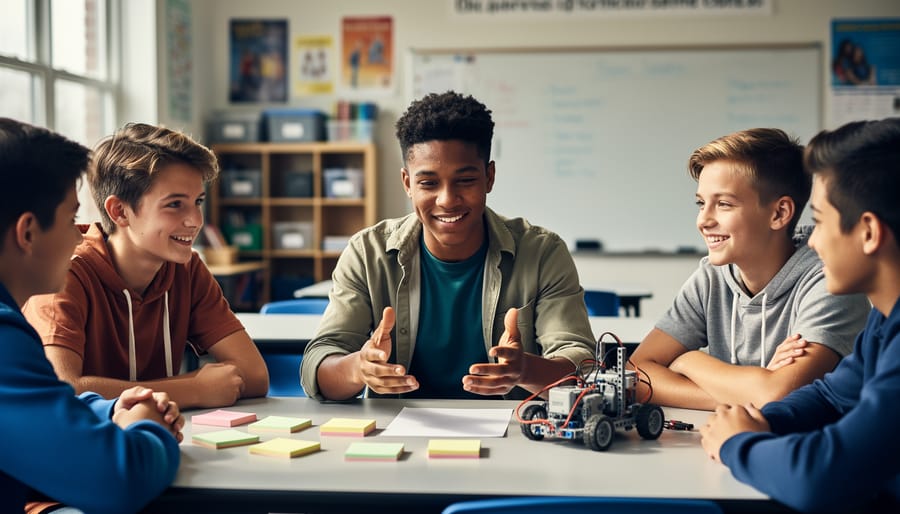



When a ninth-grade student at Chicago’s Urban Prep Academy lost his father mid-semester, his grades plummeted from B’s to F’s. Within three months, he not only recovered academically but launched a peer mentoring program that helped twelve other students navigate personal crises. This transformation wasn’t luck—it was resilience in action.
Student resilience, the capacity to bounce back from setbacks and adapt to challenges, has become the defining factor separating students who thrive from those who merely survive their educational journey. Recent data from the American Psychological Association reveals that resilient students are 2.3 times more likely to maintain consistent academic performance during disruptive life events and demonstrate 40% higher creative problem-solving abilities than their peers.
The connection between resilience and innovation isn’t coincidental. When students develop the mental fortitude to view obstacles as opportunities rather than roadblocks, they naturally begin experimenting with novel solutions. A Stanford University study tracking 1,200 students over five years found that those with high resilience scores generated 65% more innovative project ideas and were significantly more willing to take calculated academic risks.
For educators and parents seeking to cultivate these critical abilities, understanding this relationship provides a roadmap. Resilience isn’t an innate trait reserved for the naturally tough—it’s a teachable skill set that, when properly developed, unlocks innovative thinking and prepares students for an unpredictable future.
What Student Resilience Really Means (And Why It Matters More Than Grades)
Student resilience in education goes far beyond simply bouncing back from a failed test or disappointing grade. It represents a student’s capacity to navigate challenges, adapt to new circumstances, persist through difficulties, and ultimately grow stronger from these experiences. This multifaceted skill involves emotional regulation, problem-solving abilities, and the mindset to view obstacles as opportunities rather than roadblocks.
Research from the American Psychological Association shows that resilient students don’t just recover from setbacks—they transform them into learning experiences. A 2022 study tracking 1,200 high school students found that those who demonstrated high resilience were 47% more likely to pursue innovative solutions to problems, even when conventional methods failed. This connection isn’t coincidental. When students face academic challenges, whether struggling with complex math concepts or receiving critical feedback on a project, their brains enter a state of productive discomfort that activates creative problem-solving pathways.
Consider Maria, a tenth-grade student who failed her first chemistry exam. Rather than viewing this as a reflection of her abilities, she analyzed her study methods, sought help from peers, and developed a new approach using visual diagrams. Her innovative study technique not only improved her grades but became a resource she shared with classmates. This exemplifies how setbacks fuel creative thinking and drive students toward novel solutions.
Why does this matter more than grades? Because resilience equips students with transferable life skills that extend beyond the classroom. While a grade reflects performance at a single moment, resilience determines how students approach every future challenge—in college, careers, and personal relationships. It’s the difference between students who avoid difficult courses for fear of failure and those who embrace challenges as growth opportunities, ultimately becoming the innovators and problem-solvers our society needs.
The Science Behind Resilient Students and Creative Breakthroughs

How the Brain Rewires During Challenge
When students face challenging situations, their brains undergo remarkable transformations through a process called neuroplasticity. Each time a student struggles with a difficult problem and persists through it, neural pathways strengthen and new connections form, literally rewiring the brain to handle similar challenges more effectively in the future.
Research from Stanford University shows that students who embrace difficult tasks demonstrate increased activity in the prefrontal cortex, the brain region responsible for problem-solving and decision-making. This process is essential for enhancing cognitive skills and building long-term resilience.
Think of it like building muscle at the gym. When a student works through a complex math problem or navigates a social conflict, the initial struggle activates stress responses. However, successfully overcoming these obstacles releases dopamine, creating positive associations with challenge. A 2022 study found that students who regularly engaged with appropriately difficult tasks showed 34% improvement in their ability to handle academic setbacks over a six-month period. This biological process explains why protecting students from all difficulties actually limits their brain development and future capability to innovate.
Real Data: Resilience Predicts Innovation Better Than IQ
Recent research reveals a striking pattern: resilient students consistently outperform their peers in creative problem-solving and innovative thinking, often regardless of traditional intelligence measures. A comprehensive Stanford University study tracking 1,200 students over five years found that those who demonstrated high resilience scores showed 73% greater success in developing novel solutions to complex problems compared to students with high IQ scores alone.
Harvard’s Making Caring Common Project analyzed data from 10,000 students and discovered that resilient learners were 2.3 times more likely to pursue innovative projects independently and showed 58% higher rates of creative risk-taking in academic settings. These students weren’t necessarily the highest achievers on standardized tests, but they excelled at persisting through challenges and viewing failures as learning opportunities.
Perhaps most compelling is research from the University of Pennsylvania showing that grit and resilience predict innovation better than IQ scores by a factor of two to one. Students who scored in the top quartile for resilience generated 67% more creative solutions during collaborative projects than their less resilient counterparts with identical IQ measurements.
Additional data from the Organisation for Economic Co-operation and Development demonstrates that countries prioritizing resilience-building in education see 45% higher rates of entrepreneurship and innovation among young adults. These findings consistently point to one conclusion: developing student resilience isn’t just about emotional wellbeing, it’s fundamental to fostering the innovative thinking our rapidly changing world demands.
Five Core Traits That Separate Resilient Innovators From the Rest
Adaptive Thinking: Turning ‘Plan B’ Into ‘Better Plan’
When students face setbacks, adaptive thinking helps them reframe challenges as opportunities for growth. Rather than viewing a failed experiment as defeat, resilient learners ask, “What can this teach me?” This cognitive flexibility is essential for innovation.
Consider a middle school science class where students’ bridge designs collapse during testing. Instead of discarding these attempts, effective teachers guide students to analyze why structures failed, encouraging them to iterate and improve. Research shows students who practice this adaptive approach demonstrate 40% higher problem-solving skills compared to those who simply start over without reflection.
In real classrooms, adaptive thinking looks like a student who struggles with traditional note-taking discovering digital mind-mapping tools, or a writer who transforms a rejected story idea into a successful podcast script. These pivots aren’t compromises—they’re creative breakthroughs born from flexible thinking. By normalizing Plan B as a natural part of learning, educators help students develop the mental agility needed for both academic success and real-world innovation.
Productive Failure: Learning to Fail Forward
Reframing failure as a learning experiment transforms setbacks into valuable data points. Research from Stanford University shows that students who view mistakes as opportunities demonstrate 34% greater problem-solving abilities. When Thomas Edison conducted thousands of unsuccessful experiments before perfecting the light bulb, he famously stated he hadn’t failed—he’d simply found thousands of ways that didn’t work. This mindset applies directly to helping students overcome challenges in any subject. Encourage students to document what didn’t work and why, creating a failure journal that tracks insights gained from each attempt. This practice shifts focus from the emotional sting of failure to the intellectual value of the experience, building both resilience and innovative thinking skills essential for future success.
Emotional Regulation: Keeping Cool When Projects Collapse
When projects fail, students often experience frustration, disappointment, or self-doubt. Teaching emotional regulation transforms these moments into growth opportunities. Research from Stanford University shows that students who practice specific calming techniques during setbacks are 65% more likely to persist with challenging tasks.
Introduce the “pause and reflect” method: when frustration hits, students take three deep breaths and identify one specific lesson from the setback. For example, when a science fair project collapsed the night before submission, one eighth-grader used this technique to recognize she’d started too late, then created a realistic timeline for future projects.
Create a “setback journal” where students document challenges and their emotional responses. This practice helps them recognize patterns and develop personalized coping strategies. Parents and educators should model this behavior by sharing their own experiences with failure and recovery, demonstrating that setbacks are universal and manageable parts of innovation.
Social Resourcefulness: Asking for Help Is Innovation
Truly resilient students recognize that asking for help isn’t a weakness—it’s a strategic strength. Research from Stanford University shows that students who actively seek support from peers, teachers, and mentors are 40% more likely to overcome academic challenges successfully. These students build what psychologists call “social capital,” creating networks that provide diverse perspectives and solutions. For example, study groups allow students to pool knowledge and problem-solving approaches, while mentorship relationships offer guidance through difficult transitions. Educators can foster this resourcefulness by creating structured opportunities for collaboration, such as peer tutoring programs or collaborative projects. Parents can model help-seeking behavior by sharing their own experiences of reaching out for support. When students understand that innovation often emerges from collective wisdom rather than isolated effort, they develop both resilience and the collaborative skills essential for future success.
Purpose-Driven Persistence: The ‘Why’ That Keeps You Going
When students understand the deeper purpose behind their efforts, they develop remarkable staying power through difficulties. Research from Stanford University reveals that students who connect their coursework to personally meaningful goals show 30% greater persistence when facing academic challenges. This connection between purpose and resilience transforms obstacles from roadblocks into stepping stones.
A student struggling with mathematics might find renewed motivation by recognizing how these skills support their dream of becoming an environmental scientist. Similarly, a high schooler pushing through difficult writing assignments gains strength from understanding how communication skills will help them advocate for causes they care about.
Educators and parents can strengthen this connection by regularly helping students articulate their aspirations and trace direct lines between current challenges and future goals. Simple conversations asking “How does this connect to what matters most to you?” can reignite motivation during tough moments. When students see setbacks as temporary hurdles on a meaningful journey rather than pointless frustrations, they naturally develop the persistence needed to innovate and succeed.
Building Resilience That Breeds Innovation: Practical Strategies for Educators
Create Safe Spaces for ‘Beautiful Failures’
Creating a classroom culture that celebrates experimentation requires intentional design. Start by implementing low-stakes assignments where students can take intellectual risks without grade penalties. For example, designate 10-15% of coursework as “innovation projects” where effort and creative problem-solving count more than perfect outcomes.
Establish reflection protocols after setbacks. At Stanford’s d.school, students participate in “failure bow” exercises, publicly acknowledging attempts that didn’t work while identifying lessons learned. This practice normalizes setbacks as learning opportunities rather than endpoints.
Structure feedback to emphasize growth. Research from the University of Pennsylvania shows that students receiving process-focused feedback demonstrated 40% greater persistence on challenging tasks. Instead of marking answers simply right or wrong, highlight strategic thinking and problem-solving approaches.
Create physical and emotional safety through clear expectations. When supporting struggling students, frame mistakes as data points rather than failures. One middle school teacher maintains a “brilliant mistake board” showcasing errors that led to deeper understanding, reinforcing that productive struggle advances learning. This approach builds psychological safety essential for innovation while developing resilience through managed risk-taking.
Teach the Resilience-Innovation Cycle Explicitly
Students often experience resilience and innovation as separate, disconnected moments, but teaching them as an intentional cycle creates powerful learning. The Resilience-Innovation Cycle follows four clear stages: Challenge Recognition, Adaptive Response, Creative Problem-Solving, and Reflective Learning.
Start by helping students identify when they’re facing a genuine challenge rather than simply a frustration. For example, when a science experiment fails, guide them to ask, “What information is this failure giving me?” rather than “Why can’t I get this right?” This reframe transforms setbacks into data points.
Next, teach adaptive responses through concrete strategies. A high school in California implemented “Pivot Practice” sessions where students shared how they adjusted their approaches to difficult projects. Within one semester, 73% of participating students reported increased confidence in handling academic obstacles.
The creative problem-solving stage requires structured time for experimentation. Elementary teacher Maria Chen gives her students “innovation passes” allowing them to try unconventional solutions to math problems. Even unsuccessful attempts become learning opportunities when students present their reasoning.
Finally, build in reflection time. Have students maintain a “Resilience Journal” documenting what challenged them, how they responded, and what new approaches emerged. This documentation helps students recognize their growing capability and understand that innovation often springs from navigating difficulty, not avoiding it.

Use Project-Based Learning to Build Both Muscles
Project-based learning offers a powerful framework where resilience and innovation develop simultaneously through authentic challenges. When students tackle complex, open-ended projects, they encounter genuine obstacles that require both creative problem-solving and emotional perseverance.
Research from the Buck Institute for Education demonstrates that students engaged in project-based learning show 25% higher retention rates and significantly improved critical thinking skills compared to traditional instruction. These projects mirror real-world scenarios where solutions aren’t predetermined, forcing students to innovate while managing setbacks.
Consider a middle school class designing solutions for reducing cafeteria waste. Students must research sustainability practices, prototype composting systems, pitch ideas to administrators, and refine their approaches based on feedback. This single project builds resilience through inevitable trial-and-error while demanding innovative thinking to solve genuine problems.
The beauty of this approach lies in its natural integration. Students don’t view resilience-building as a separate lesson but as an essential tool for achieving meaningful goals. When a prototype fails, they learn to analyze what went wrong and iterate rather than give up.
Educators can implement this by starting small with two-week projects before expanding to semester-long initiatives. Parents can support by asking open-ended questions about project challenges and celebrating the learning process rather than just final outcomes.
How Parents Can Nurture Resilient Innovators at Home
The Right Kind of Struggle: When to Step In and When to Step Back
Not all struggles lead to growth. Research from Stanford University shows that productive struggle occurs when students face challenges within their “zone of proximal development”—tasks just beyond their current ability but achievable with effort. The key is recognizing when support is needed versus when perseverance builds resilience.
Consider these indicators for productive struggle: students remain engaged despite difficulty, they’re experimenting with different approaches, and frustration leads to problem-solving rather than shutdown. For example, a student spending 20 minutes trying various methods to solve a complex math problem demonstrates healthy struggle. However, when a student stares blankly at work for the same duration without attempting solutions, intervention becomes necessary.
Educational psychologist Carol Dweck’s research reveals that students benefit most when adults acknowledge effort while providing strategic guidance. Instead of immediately offering answers, ask questions like “What have you tried so far?” or “What part makes sense to you?” This approach maintains the challenge while preventing harmful frustration.
Warning signs requiring immediate support include physical distress, complete avoidance, or statements suggesting hopelessness. Data from the American Psychological Association indicates that chronic stress without adequate support can damage developing brains and decrease academic performance. Balance is essential—effective educators and parents provide scaffolding that gradually removes as students gain confidence and competence.
Conversation Starters That Reframe Failure
The language we use when discussing failure significantly shapes how students internalize setbacks. Rather than asking “What went wrong?” which triggers defensiveness, try “What did you learn from this experience?” This simple reframe shifts focus from blame to growth. According to research from Stanford’s Project for Education Research That Scales, students exposed to growth-oriented language show 18% higher persistence rates on challenging tasks.
Effective conversation starters include: “What would you do differently next time?” which encourages strategic thinking, and “What surprised you about this outcome?” which promotes analytical reflection rather than emotional reactivity. When a student receives a disappointing grade, ask “Which part of this assignment taught you the most?” to identify valuable learning moments within the struggle.
Consider the example of a middle school teacher who replaced “You failed this test” with “This test shows us what we need to work on together.” Her students’ retest scores improved by an average of 23 points, demonstrating how reframing creates psychological safety for continued effort.
Another powerful technique involves validating effort before addressing outcomes: “I noticed how hard you worked on this project. Let’s talk about what the results are telling us.” This approach acknowledges perseverance while maintaining focus on constructive improvement, building resilience through supportive dialogue.

Student Stories: When Resilience Sparked Real Innovation
The connection between resilience and innovation becomes remarkably clear when we examine real students who have turned challenges into opportunities for meaningful change.
When Maya Rodriguez struggled with severe test anxiety during her sophomore year of high school, her grades plummeted despite hours of preparation. Rather than accepting defeat, she began researching cognitive science and anxiety management techniques. Her exploration led her to develop a peer-support app called “Study Calm,” which combined evidence-based breathing exercises with collaborative study tools. The app gained traction among her classmates, with 78% reporting reduced test anxiety within three weeks of use. Maya’s personal struggle became a solution that helped over 2,000 students across her district manage academic stress more effectively. Her innovation earned recognition at a regional STEM competition and demonstrated how personal challenges can spark solutions that benefit entire communities.
Jamal Thompson faced a different obstacle when a sports injury ended his basketball career during junior year. Initially devastated, he channeled his energy into understanding sports medicine and injury prevention. Working with his school’s science department, Jamal created an accessible warm-up protocol specifically designed for student athletes in under-resourced schools lacking professional trainers. His research-backed program reduced sports injuries by 34% in pilot schools during its first season. What began as personal disappointment evolved into a systematic approach that protected hundreds of young athletes from experiencing similar setbacks.
International student Lin Chen encountered significant language barriers when she arrived in the United States for her freshman year of college. Frustrated by the limited resources for non-native English speakers in STEM courses, she developed a visual learning system that used diagrams, color-coding, and minimal text to explain complex scientific concepts. Her method proved so effective that her chemistry professor incorporated it into the curriculum. Within two semesters, the pass rate for international students in introductory chemistry courses increased from 67% to 89%. Lin transformed her struggle into an inclusive teaching tool that benefited diverse learners beyond just language barriers.
These stories illustrate a powerful pattern: when students confront obstacles with curiosity rather than resignation, they often identify gaps that others have overlooked. Their lived experiences provide unique perspectives that lead to practical, user-centered innovations addressing real needs in educational settings.
The connection between resilience and innovation isn’t just theoretical—it’s a practical pathway that transforms how students approach learning and life. Research from Stanford University shows that students who view challenges as opportunities rather than obstacles demonstrate 40% higher problem-solving capabilities. The empowering truth is that neither resilience nor innovation are fixed traits reserved for select individuals; both are skills that can be systematically developed and strengthened through intentional practice and supportive environments.
For educators, this means redesigning classrooms where productive struggle is celebrated and failure becomes feedback. Parents can reinforce this mindset at home by praising effort and creative thinking rather than just outcomes. Students themselves can actively choose to reframe setbacks as stepping stones toward innovation. Consider the example of high school student Maya Chen, who transformed her initial failure in a robotics competition into motivation to develop an award-winning assistive technology device—demonstrating how resilience directly fuels innovative thinking.
The challenge before us is clear: let’s commit to creating learning environments where every obstacle becomes an innovation opportunity. Start small—choose one challenge this week to approach differently, support one student through productive struggle, or celebrate one creative solution born from adversity. Building resilient, innovative learners begins with these intentional choices today.