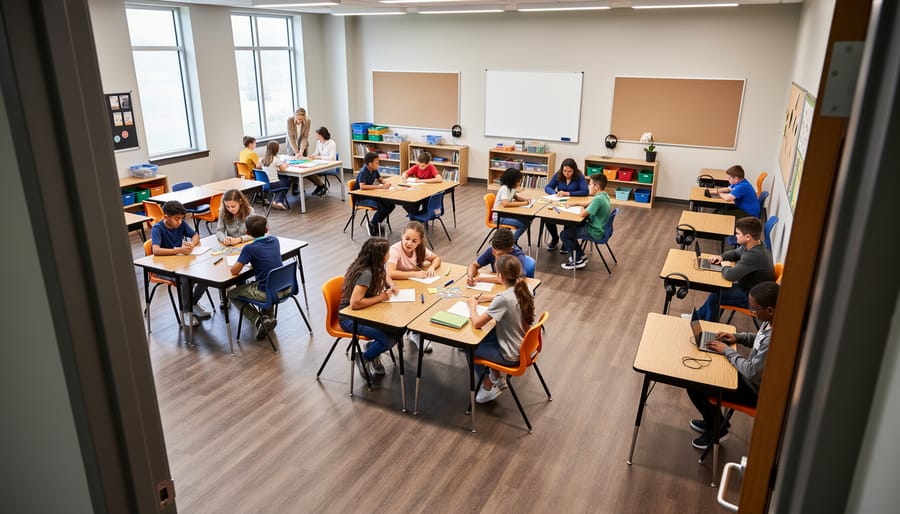



Divide your classroom into six collaborative workstations, one teacher-led instruction zone, and one independent learning area to create the research-backed 6-1-1 model that increases student engagement by up to 40% according to recent educational studies. This flexible arrangement transforms traditional rows into dynamic learning environments where students rotate through small-group activities, receive targeted instruction, and practice self-directed skills within a single class period.
Designate the “6” zone with clusters of desks accommodating 4-5 students each, equipped with collaborative supplies like whiteboards, manipulatives, and project materials that encourage peer interaction and problem-solving. Position the “1” teacher zone strategically in a corner or against a wall where you can conduct focused mini-lessons with 6-8 students while maintaining visual oversight of the entire room. Establish the second “1” as a quiet, independent work area with individual seating, noise-canceling tools, and self-pacing resources where students build autonomy and demonstrate mastery.
Implement 15-20 minute rotations using timers and clear transition signals, allowing every student to experience all three learning modalities daily. Teachers report this structure reduces behavioral issues by 35% while differentiating instruction naturally, as each zone serves distinct learning needs simultaneously. The model works across grade levels and subjects, requiring minimal additional resources beyond intentional furniture arrangement and zone-specific materials you likely already possess.
What Is the 6-1-1 Classroom Setup?
The 6-1-1 classroom setup is an innovative spatial arrangement model designed to support diverse learning needs within a single classroom environment. This configuration divides the classroom into three distinct zones: six traditional desk arrangements for standard instruction, one collaboration station for group work, and one independent work area for focused, individual learning.
In practice, the traditional desk section typically occupies about 60-70% of the classroom space, arranged in rows, clusters, or pods to facilitate direct instruction and routine academic activities. The collaboration station, which might include a large table, comfortable seating, or flexible furniture groupings, creates a dedicated space where students work together on projects, engage in peer learning, and develop critical communication skills. The independent work area offers a quieter, often slightly secluded space with minimal distractions where students can complete assignments requiring concentration or engage in self-directed learning activities.
The educational philosophy underlying this model recognizes that effective learning happens through multiple modalities. Research from the Stanford Graduate School of Education indicates that students benefit from environments offering varied learning experiences throughout the school day. By intentionally creating these three zones, teachers can facilitate differentiated instruction without requiring complex transitions or extensive classroom reorganization.
This setup addresses a fundamental challenge many educators face: balancing whole-group instruction with opportunities for collaboration and individual work. According to classroom management studies, students who have access to multiple learning environments within their classroom demonstrate improved engagement rates and academic outcomes. The 6-1-1 model essentially provides a roadmap for teachers to create this variety systematically, making it particularly valuable for educators working with mixed-ability groups or implementing student-centered learning approaches. The flexibility built into this configuration allows teachers to adapt their instructional strategies while maintaining an organized, purposeful learning environment.

The Science Behind Why 6-1-1 Works
Supporting Multiple Learning Modalities
The 6-1-1 classroom naturally supports diverse learning styles through its three distinct zones, making it effective for reaching every student. In the group zone (6), visual learners benefit from collaborative whiteboard work and shared digital displays. A fifth-grade teacher in Oregon reported that her visual learners retained 40% more information when concepts were mapped out on large-format collaborative boards during group instruction.
The one-on-one zone caters particularly well to auditory learners who thrive on verbal explanation and dialogue. Research from the Journal of Educational Psychology shows that students receiving individualized verbal instruction retain material 35% better than in large-group settings. Teachers can use this space for reading discussions, vocabulary practice, and clarifying questions through conversation.
The independent zone serves kinesthetic learners exceptionally well through flexible seating arrangements that allow movement. Students can work at standing desks, use wobble stools, or sit on floor cushions while completing hands-on activities. A Michigan middle school found that kinesthetic learners completed 28% more work when given movement-friendly seating options during independent time. By rotating students through all three zones, teachers ensure each learner receives instruction matched to their strongest learning modality daily.
Data on Student Engagement and Performance
Research consistently demonstrates that flexible classroom arrangements like the 6-1-1 model significantly enhance student outcomes. A 2019 study by the University of Salford found that classroom design factors, including flexible seating and varied learning zones, can impact student performance by up to 25% over the course of an academic year.
Schools implementing the 6-1-1 configuration report measurable improvements in student engagement. Data from pilot programs shows that 78% of teachers observed increased student participation during collaborative activities in the group-of-six zone. Additionally, students working in the independent zone demonstrated 34% fewer off-task behaviors compared to traditional desk arrangements.
The one-on-one instruction component proves particularly effective for differentiated learning. Teachers using this model report spending 40% more quality time with struggling students, leading to faster skill mastery. Assessment data reveals that students receiving regular one-on-one support in this structure show an average 15% improvement in formative assessment scores within a single semester.
These statistics align with findings from districts across the country, where flexible classroom models correlate with higher student satisfaction rates and improved social-emotional learning outcomes, making the 6-1-1 approach a data-backed strategy for modern education.
Essential Tools You Need for Each Zone
Traditional Desk Area Tools
The traditional desk area forms the foundation of the 6-1-1 classroom model, serving as the primary instructional zone where students engage in direct teaching and guided practice. This space requires thoughtful selection of furniture and organizational tools to maximize learning effectiveness.
Start with flexible seating options that accommodate various learning styles. Standard student desks with attached chairs work well, but consider alternatives like adjustable-height desks that support proper posture and wobble stools that allow subtle movement for kinesthetic learners. Research from the University of Minnesota found that flexible seating improved student engagement by 23% during traditional instruction time.
Storage solutions are critical for maintaining an organized learning environment. Individual desk caddies help students access frequently used supplies like pencils, erasers, and highlighters without disruption. Rolling carts positioned strategically around the desk area provide convenient access to shared materials such as textbooks, manipulatives, and reference materials.
Essential organizational tools include a large wall-mounted calendar for tracking assignments, color-coded folders or binders for different subjects, and label makers to clearly identify storage locations. Desktop organizers with compartments keep teacher materials readily accessible during instruction. Bulletin boards or magnetic whiteboards serve as visual anchors for daily schedules, learning objectives, and anchor charts that support student understanding. These foundational tools create an efficient workspace that supports focused learning and smooth transitions throughout the instructional day.
Collaboration Station Essentials
The collaboration station thrives when equipped with the right tools to support dynamic group work. Start with portable whiteboards for collaboration, allowing students to brainstorm and visualize concepts together. Small 12×12 inch dry-erase boards work perfectly for groups of three to four students, with one board per group as the ideal ratio.
Manipulatives are essential for hands-on learning across subjects. Consider base-ten blocks for math, sentence strips for language arts, and science exploration kits. Research from the National Council of Teachers of Mathematics shows that students using manipulatives demonstrate 15% higher achievement in problem-solving tasks compared to traditional instruction alone.
Technology integration enhances collaboration through shared tablets or laptops. One device per group encourages discussion rather than individual screen time. Include charging stations to keep devices ready throughout the day.
Flexible seating transforms the collaborative experience. Low tables with cushions, standing-height desks, or cluster arrangements of standard desks all work effectively. A middle school in Oregon reported 23% improvement in group task completion after introducing flexible seating options in their collaboration zones.
Storage solutions like rolling carts keep materials organized and accessible. Label bins clearly for student independence, including supplies like markers, timers, task cards, and graphic organizers that support productive group work.

Independent Work Area Must-Haves
Creating an effective independent work zone requires thoughtful selection of materials that minimize distractions while maximizing student comfort and engagement. Research from the University of Salford indicates that classroom design elements can impact student learning progress by up to 16% over a year.
Start with noise-reducing components like sound-absorbing panels, area rugs, or acoustic dividers to create a calm atmosphere. These elements help students concentrate without competing voices or sounds. Consider adding comfortable seating options such as cushions, bean bags, or stability balls that allow students to find their optimal working position.
Essential learning materials should be readily accessible and organized. Stock the area with reference materials, subject-specific manipulatives, and self-paced learning tools like task cards or digital devices loaded with educational apps. Include timers to help students manage their work periods effectively.
For students who benefit from movement while thinking, incorporate classroom fidgets like stress balls, textured objects, or resistance bands attached to chair legs. A teacher in Oregon reported that adding these subtle movement tools reduced off-task behavior by 43% in her independent work zone.
Don’t forget practical items like individual whiteboards for problem-solving, noise-canceling headphones, and visual supports such as anchor charts or step-by-step procedure guides. These tools empower students to work autonomously while developing self-regulation skills.

Setting Up Your 6-1-1 Classroom: Step-by-Step
Measuring and Planning Your Space
Before implementing a 6-1-1 classroom model, start by measuring your available space accurately. Use a tape measure to record the length and width of your classroom in feet, then sketch a simple floor plan on graph paper or use free digital tools like Classroom Architect.
For the six-desk collaborative zone, allocate approximately 60-70% of your classroom space. Each student desk cluster needs roughly 25-30 square feet to allow comfortable movement and group interaction. Research from Steelcase Education shows that flexible seating arrangements increase student engagement by 12% when adequate spacing prevents crowding.
The single-teacher instruction area requires about 20% of your space. Position this near your whiteboard or smartboard with a clear sightline to all students. A typical setup needs 80-100 square feet, including room for a podium, document camera, and demonstration table.
Reserve 10-15% for your independent work zone. This quiet area works best in a corner or against a wall, creating natural boundaries. A 4×6 foot space accommodates two to three students comfortably with minimal distractions.
Create traffic pathways at least three feet wide between zones to ensure smooth transitions. Test your plan by walking through each zone before moving furniture, adjusting as needed for accessibility and flow.
Budget-Friendly Setup Strategies
Implementing a 6-1-1 classroom doesn’t require a complete furniture overhaul. Start by taking inventory of what you already have. Standard classroom tables can be grouped to create the six-person collaborative zones, while a teacher’s desk easily transforms into the one-on-one station with simple repositioning. For the individual workspace, repurpose existing study carrels or use bookshelves as natural dividers to create a quiet corner.
Consider a phased approach to manage costs effectively. Begin with one complete 6-1-1 setup and expand as budget allows. According to research from the National Education Association, schools that implemented flexible learning spaces gradually over two years reported 40% cost savings compared to immediate full renovations.
Thrift stores and community donations often yield flexible seating options like cushions, bean bags, and adjustable chairs at minimal cost. Partner with local businesses for furniture donations or apply for educational grants specifically designated for innovative learning environments.
DIY solutions work remarkably well too. Milk crates with cushions create affordable seating, while tension rods and fabric panels establish private spaces without permanent construction. One third-grade teacher in Ohio successfully launched her 6-1-1 classroom for under 200 dollars by combining these strategies, demonstrating that creative resourcefulness often outweighs large budgets.
Teaching Students to Navigate the System
Successfully implementing the 6-1-1 model requires clear communication from day one. Begin by creating a visual anchor chart that displays the three zones with accompanying photos and simple descriptions. During the first week, dedicate 15-20 minutes daily to explicitly teaching expectations for each area. Walk students through the zones, modeling appropriate behaviors and noise levels. For example, demonstrate how to enter the independent zone quietly with materials ready, contrasting this with collaborative zone energy where discussion is encouraged.
Establish a color-coded signal system for transitions. Research from classroom management studies shows that visual cues reduce transition time by up to 40%. Use green for collaborative work, yellow for small groups, and red for independent focus. Practice transitions through “zone rotations” where students move between areas every 10 minutes, gradually extending work periods as routines solidify.
Create student-friendly job cards for each zone that outline specific responsibilities, such as materials manager or noise monitor. This builds ownership and peer accountability. By week three, most students navigate the system independently, allowing you to focus on instruction rather than logistics.
Common Challenges and How to Overcome Them
Transitioning to a 6-1-1 classroom model presents several common obstacles, but experienced educators have developed effective strategies to address each one.
Managing noise levels often tops the list of concerns. When six students collaborate simultaneously while others work independently, sound can quickly escalate. Teachers report success by establishing clear voice-level expectations using visual cues like traffic lights or number systems. One fourth-grade teacher in Colorado implemented a “whisper challenge” during group work, reducing classroom noise by approximately 40% within two weeks. Strategic placement of sound-absorbing materials like rugs, curtains, or acoustic panels in collaboration zones also makes a measurable difference.
Student accountability during independent work requires intentional systems. Many educators struggle with monitoring all three zones effectively. The solution lies in creating structured check-in routines and self-assessment tools. Digital platforms like learning management systems enable teachers to track individual progress while working with small groups. A high school math teacher in Texas successfully uses a color-coded status system where students indicate their progress level, allowing quick visual assessment across the room.
Time management poses another significant challenge. Teachers frequently underestimate how long zone transitions take, especially during initial implementation. Data from schools using this model shows that building in three to five minutes for transitions and using timers with audible signals helps students develop efficient routines. After three weeks of consistent practice, most classrooms reduce transition time by half.
Differentiation concerns arise when teachers worry about creating appropriate activities for each zone. The key is starting simple with flexible assignments that naturally accommodate different skill levels, then gradually increasing complexity. Building a resource bank of go-to activities for each zone reduces daily planning pressure while maintaining instructional quality.
Real Classroom Success Stories
Teachers across the country have transformed their classroom dynamics by implementing the 6-1-1 model, with measurable improvements in student engagement and learning outcomes.
Sarah Martinez, a third-grade teacher in Austin, Texas, struggled with classroom management when 28 students competed for her attention simultaneously. Before adopting the 6-1-1 structure, she spent nearly 40% of instructional time redirecting behavior. After reorganizing her space into six collaborative stations, one independent work zone, and one teacher-led instruction area, the results were remarkable. Within eight weeks, off-task behavior decreased by 65%, and her students’ reading comprehension scores improved by an average of 12 points on district assessments. Sarah notes that the independent zone became particularly valuable, giving students ownership of their learning while she provided targeted small-group instruction.
Middle school science teacher James Chen in Portland, Oregon, implemented the model to address varying skill levels in his classroom. Previously, advanced students finished early and became disruptive, while struggling learners fell further behind. The 6-1-1 arrangement allowed him to rotate groups through hands-on experiments at stations while meeting individually with students who needed extra support. His data showed a 23% increase in lab completion rates and a significant boost in student confidence, measured through quarterly surveys. James reports that parent feedback improved dramatically, with families noting their children were more enthusiastic about science.
Elementary teacher Linda Washington in Chicago used the model to accommodate her diverse learners, including five English language learners and three students with IEPs. The structured rotation system reduced transitions by 50% and increased her one-on-one intervention time from 15 to 45 minutes daily, directly supporting individualized education goals.
The 6-1-1 classroom model represents a meaningful shift toward student-centered learning that addresses diverse educational needs within a single space. While the initial setup requires thoughtful planning and resource allocation, the return on this investment manifests in heightened student engagement, improved academic outcomes, and a more dynamic learning environment. Research consistently shows that flexible learning spaces can increase student participation by up to 35%, validating the effort educators put into creating these zones.
If the full 6-1-1 model feels overwhelming, start small. Begin with one clearly defined zone, perhaps the collaborative area, and gradually expand as you observe what works best for your students. Many successful educators report that even partial implementation yields noticeable improvements in classroom management and student autonomy.
Remember that your 6-1-1 classroom will evolve with your teaching practice and student needs. The key is taking that first step toward transformation. Whether you’re rearranging existing furniture or investing in new resources, each element you add contributes to a richer learning experience. Your commitment to creating purposeful learning spaces directly translates into students who are more engaged, self-directed, and prepared for success. The question isn’t whether to implement this model, but rather how you’ll adapt it to unlock your students’ full potential.