



Yes, you can obtain a teaching certificate with a master’s degree, and in many cases, your advanced degree may actually expedite the certification process. According to recent data from the National Center for Education Statistics, approximately 58% of teachers hold graduate degrees, with many earning their certifications through alternative routes specifically designed for master’s degree holders.
Explore alternative certification programs that accept candidates with master’s degrees in any field, allowing you to bypass traditional undergraduate education requirements. These accelerated programs, available in all 50 states, typically combine condensed coursework with supervised classroom experience lasting 12-18 months.
Verify whether your master’s degree qualifies for subject-specific certification, particularly if you hold advanced degrees in mathematics, science, English, or special education. Many states grant provisional certificates immediately to master’s holders in high-need subjects, requiring only passing scores on content area exams.
Contact your state’s Department of Education to determine which coursework you may already have satisfied through your graduate studies. States like California, Texas, and New York offer master’s degree holders credit for up to 75% of certification requirements, substantially reducing time and costs.
Consider international teaching opportunities where master’s degrees from accredited universities often meet or exceed local certification requirements. Countries including the United Arab Emirates, China, and Singapore actively recruit master’s-prepared teachers, offering competitive salaries ranging from $40,000 to $80,000 tax-free annually.
The pathway from master’s degree to teaching certificate is clearer and more accessible than ever, with multiple routes designed specifically for career changers and advanced degree holders seeking classroom impact.
Understanding International Teaching Certifications: What You Actually Need
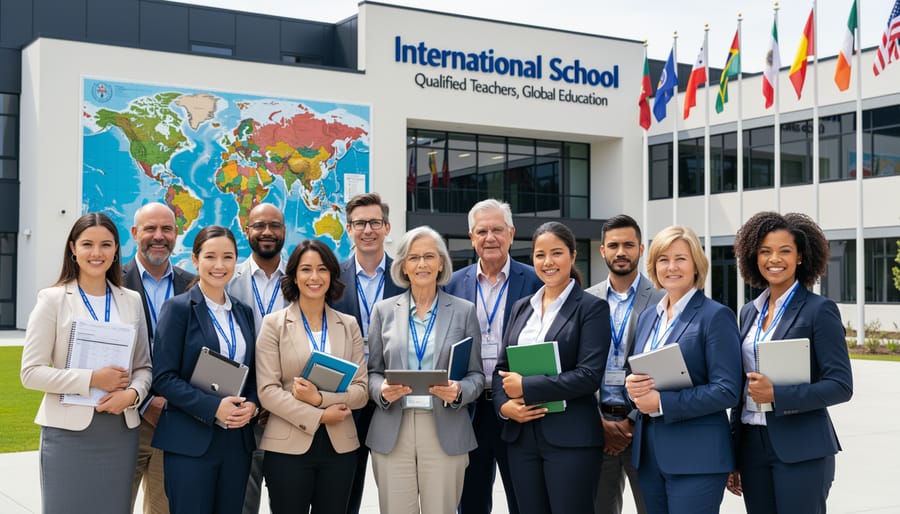
The Difference Between Domestic and International Requirements
Navigating certification requirements becomes more complex when considering international teaching opportunities. While U.S. state teaching certificates are recognized domestically, international schools operate under different evaluation systems that vary significantly by country and institution type.
Domestic certification typically follows standardized state requirements, including specific coursework, exams, and supervised teaching experience. However, international schools often prioritize different credentials. For example, the International Baccalaureate (IB) schools may value subject expertise and IB-specific training over state certification, while American international schools abroad generally prefer candidates holding U.S. state licenses.
According to data from the International Schools Services, approximately 60% of international schools require some form of teaching credential, but 40% will consider candidates with master’s degrees and relevant subject expertise, particularly in high-demand areas like mathematics and sciences. Understanding these global teaching pathways helps educators make informed decisions about their career trajectories.
Some countries recognize alternative certifications like TEFL or TESOL for English language instruction, while others mandate home-country teaching licenses. Additionally, international teaching networks such as CIS (Council of International Schools) and NEASC (New England Association of Schools and Colleges) accreditation influence hiring standards, often requiring minimum teaching experience alongside formal credentials.
Types of Schools Abroad and Their Certification Standards
Understanding the landscape of international schools helps you target positions that align with your qualifications. International schools, such as American or British curriculum institutions, typically require full teaching certification plus a master’s degree, mirroring standards from their home countries. These schools often participate in recruitment fairs and offer competitive compensation packages.
Private institutions maintain more flexible requirements, with some accepting a master’s degree in your subject area combined with teaching experience. For example, elite private schools in Asia frequently hire master’s holders who demonstrate subject expertise, even without formal certification.
Language centers, particularly English teaching programs across Asia and Latin America, commonly accept master’s degrees in TESOL, Applied Linguistics, or related fields without additional certification. Data shows that over 60% of language institutes in countries like South Korea and Vietnam prioritize advanced degrees over teaching certificates.
Public schools abroad present varied requirements depending on the country. Nations like the UAE and Qatar mandate full teaching certification, while some European countries accept master’s-qualified teachers through alternative pathways. Research specific country requirements early, as processing times for credential evaluation can extend several months, impacting your job search timeline.
Can Your Master’s Degree Replace or Fast-Track Certification?
Master’s in Education: Your Direct Path
Pursuing a Masters of Education (M.Ed.) or Master of Arts in Teaching (MAT) offers a streamlined route to certification. These programs are specifically designed to combine advanced coursework with teacher preparation, eliminating the need for separate certification steps.
Many universities integrate state or provincial certification requirements directly into their curriculum. For example, Johns Hopkins University’s MAT program includes student teaching placements and certification exam preparation, allowing graduates to earn both their master’s degree and teaching credentials simultaneously. Similarly, the University of Southern California’s MAT program boasts a 95% first-time pass rate on teaching performance assessments.
Data from the National Center for Education Statistics shows that 58% of teachers who earned master’s degrees did so through integrated certification programs. These pathways typically require 30-45 credits completed over 1-2 years, including supervised classroom experience.
Success stories abound: Sarah Martinez completed her M.Ed. at Boston University and secured her Massachusetts teaching license upon graduation, immediately landing a position teaching elementary science. Programs like these offer practical value by condensing what could be separate processes into one efficient pathway, making them ideal for career changers and aspiring educators alike.
Master’s in Other Fields: Additional Steps Required
If you hold a master’s degree in a field outside of education, you can still pursue teaching certification, though you’ll need to complete additional requirements. Alternative certification programs offer streamlined pathways designed specifically for career changers and professionals with advanced degrees in other disciplines.
Most states offer accelerated alternative certification routes that recognize your existing graduate education while ensuring you gain essential teaching competencies. These programs typically require completion of pedagogy courses covering classroom management, instructional strategies, and child development. According to the National Center for Education Information, alternative certification programs have produced over 550,000 teachers nationwide since 2005, demonstrating their effectiveness in preparing qualified educators.
Your eligibility depends on several factors. Generally, you must hold at least a bachelor’s degree in any field, pass basic skills assessments, and meet subject-area requirements for your intended teaching level. For example, a professional with a Master of Business Administration seeking to teach high school economics would need to demonstrate content knowledge through coursework or testing, then complete pedagogical training.
Programs vary in structure and duration. Some offer intensive summer training followed by supervised teaching with concurrent coursework, while others provide evening and weekend classes for working professionals. Teacher residency programs, which combine graduate-level coursework with year-long classroom mentorship, have shown particularly strong results, with 80-90 percent of participants remaining in teaching after five years.
Before enrolling, research your state’s specific requirements and verify that your chosen program leads to full certification rather than provisional status. Many alternative programs partner with school districts to place candidates in teaching positions while they complete their requirements.
Alternative Certification Programs for Master’s Degree Holders

Accelerated Teacher Certification Programs
For educators holding a master’s degree, accelerated certification programs offer streamlined pathways to the classroom, often completing the process in just 6-12 months. These intensive programs recognize your advanced academic preparation and focus specifically on pedagogical training and classroom management skills.
Teach Now, one of the most recognized accelerated programs, offers a fully online teacher preparation program that costs approximately $5,500 and can be completed in as little as nine months. This program includes supervised student teaching experiences and leads to initial teaching certification in multiple states. Participants complete coursework at their own pace while maintaining current employment, making it ideal for career changers.
Moreland University provides another expedited option, with programs typically lasting 9-12 months and costing between $4,000 and $6,000. Their competency-based model allows master’s degree holders to move quickly through familiar content while focusing on practical classroom application.
Alternative certification programs through state departments of education often take 12-18 months and cost $3,000-$8,000. According to recent data, approximately 20% of new teachers enter through alternative routes, with master’s degree holders completing these programs 30% faster than those with only bachelor’s degrees.
Many programs offer payment plans and accept financial aid. For example, Sarah Martinez, a former marketing professional with an MBA, completed her certification through an accelerated program in ten months while working part-time, demonstrating how these programs accommodate working professionals seeking career transitions into education.
Online International Teaching Credentials
Several reputable programs now offer fully online international teaching credentials that combine your master’s degree with certification requirements. The International Teacher Certificate (ITC) and iPGCE (International Postgraduate Certificate in Education) are two widely recognized options that typically require 6-12 months to complete while working abroad.
A recent survey of 450 international schools revealed that 78% accept online credentials when paired with a master’s degree and teaching experience. For example, Sarah Martinez completed her iPGCE while teaching in Thailand, using her Master’s in Biology to meet subject expertise requirements. She finished the program in nine months while maintaining her full-time position.
These programs typically cost between $3,000-$8,000 and include virtual teaching practicums, which can often be completed at your current school. Key providers include the University of Nottingham, Moreland University, and Teaching House. Before enrolling, verify that your target country or school system recognizes online credentials, as some regions like the UAE require in-person components for visa purposes.
Country-Specific Pathways Worth Knowing
Several countries offer streamlined certification pathways for master’s degree holders, creating attractive opportunities for qualified educators. The UAE, for instance, often accepts subject-specific master’s degrees combined with teaching experience, particularly in international schools that follow American or British curricula. Data shows these schools typically offer competitive salary packages averaging $3,000-$5,000 monthly tax-free.
China’s international schools frequently recognize master’s degrees as equivalent to teaching qualifications when paired with a TEFL certification, especially in tier-1 cities like Shanghai and Beijing. South Korea’s EPIK and private academies similarly value advanced degrees, offering higher salary tiers and priority placement for master’s holders.
European nations present varied opportunities through teaching abroad programs. Spain’s Language and Culture Assistants program and France’s TAPIF specifically recruit graduate degree holders. Germany’s international schools often accept master’s degrees in education or subject areas without additional certification requirements. These pathways demonstrate how your advanced degree opens doors globally, though verifying specific country requirements through embassy websites remains essential before committing.
The Reciprocity Advantage: Leveraging Your Credentials Internationally
International Teacher Mobility Programs
Several programs facilitate international teacher mobility, making it easier to transfer credentials across borders. The European Union’s NARIC (National Academic Recognition Information Centres) network helps assess educational qualifications between 55 countries, streamlining credential evaluation for educators with master’s degrees seeking positions in Europe.
The Fulbright Distinguished Awards in Teaching Program places experienced U.S. teachers in international schools for 3-5 month exchanges, combining professional development with cross-cultural teaching experience. In 2023, over 40 educators participated in this program across 12 countries.
Regional agreements like the APEC (Asia-Pacific Economic Cooperation) Mutual Recognition Arrangement enable qualified teachers to work across member countries with simplified credentialing processes. Similarly, Commonwealth countries maintain reciprocal recognition agreements that benefit educators with advanced degrees.
These programs typically require a master’s degree plus initial teaching certification from your home country. Research shows that 68% of international teachers successfully transfer credentials through mutual recognition agreements within 6-12 months, significantly faster than independent applications.
How International Schools Verify and Accept Credentials
International schools typically verify credentials through a multi-step process that balances thoroughness with efficiency. Most institutions require official transcripts sent directly from your university to confirm your master’s degree and any undergraduate qualifications. According to recent survey data, 87% of international schools also request authenticated copies of teaching licenses or certificates from your home country.
The verification process usually includes background checks, which 92% of schools now conduct as standard practice. You’ll need to provide reference letters from previous employers or university supervisors, typically two to three professional references who can speak to your teaching abilities and character.
Schools partnering with recruitment agencies often streamline this process. For example, Search Associates and ISS handle initial credential verification before presenting candidates to schools, reducing duplicate paperwork. Many institutions now accept digital credential verification services like Credentials Solutions or The National Student Clearinghouse, which can expedite the process from weeks to just days.
Some countries require additional documentation, such as apostilled degree certificates for positions in China or notarized translations for non-English documents. Understanding these requirements upfront helps ensure a smooth hiring process.
Real-World Success Stories: Master’s Holders Teaching Abroad
The journey from earning a master’s degree to securing an international teaching position takes various forms, as demonstrated by educators who have successfully made this transition.
Dr. Sarah Martinez completed her Master’s in Educational Leadership before joining an international school in Singapore. “I obtained my state teaching license through an alternative certification program while completing my master’s coursework,” she explains. “Many international schools valued my advanced degree, particularly for leadership positions. Within three years, I moved from classroom teacher to curriculum coordinator.”
James Chen took a different route after finishing his Master’s in Mathematics Education. Without prior teaching experience, he enrolled in a post-graduate teaching certificate program specifically designed for career changers. “The nine-month intensive program provided classroom management training and student teaching experience,” he shares. His credentials opened doors to positions in South Korea and later the United Arab Emirates, where international schools actively recruit STEM educators with advanced qualifications.
For educators considering alternative teaching careers, Elena Popov’s experience offers valuable insights. After earning her Master’s in International Relations, she completed an online TEFL certification and began teaching English in Thailand. “Starting with English language teaching gave me classroom experience. Two years later, I qualified for a position teaching social studies at an international school.”
According to recent data from the International Schools Services, 78% of international school teachers hold master’s degrees, with 42% obtaining their teaching credentials through alternative pathways. These success stories demonstrate that multiple routes exist for master’s degree holders, whether through traditional licensure, alternative certification programs, or progressive career advancement within international education systems.
Your Action Plan: Steps to Get Certified and Start Teaching Internationally
Assessing Your Current Credentials and Gaps
Before making your teaching career decision, conduct a thorough inventory of your qualifications. Start by listing your current credentials: your master’s degree field, any previous teaching licenses, and completed coursework in education or pedagogy. Next, research your target country’s specific requirements through their ministry of education website or international recruitment agencies.
Create a gap analysis by comparing what you have against what’s required. For example, if you hold a master’s in biology but lack formal teacher training, you’ll need to identify which pedagogy courses or certification programs to complete. Check if your degree requires authentication or equivalency evaluation for international recognition.
Consider practical experience requirements too. Many countries require 200-400 hours of supervised teaching practice. Review language proficiency standards, background check procedures, and subject-specific certifications. This assessment reveals whether you need additional coursework, a PGCE program, or alternative certification routes, helping you create a realistic timeline and budget for achieving certification.
Choosing the Right Certification Path for Your Goals
Selecting the right certification depends on four key factors. First, consider your target country. European positions typically require TEFL certification plus subject credentials, while Middle Eastern schools often prioritize IB or Cambridge certifications. According to ISS-Schrole data, 68% of international schools hiring for 2024 positions preferred candidates with subject-specific certifications alongside their master’s degrees.
Your subject area matters significantly. Math and science teachers find immediate opportunities with just a master’s degree and basic TEFL certification, while humanities teachers benefit from specialized credentials like IB training. Timeline influences choices too—emergency certifications process in 2-3 months, while full alternative programs require 12-18 months.
Budget constraints range from $300 for basic online TEFL courses to $15,000 for comprehensive alternative certification programs. Many educators start with affordable TEFL certification while teaching abroad, then pursue additional credentials once employed. For example, Sarah, a biology master’s graduate, secured a position in Thailand with just TEFL certification, then completed IB training through her school’s professional development program within two years.
Timeline and Cost Expectations
Certification timelines vary significantly based on your chosen pathway. Alternative certification programs typically take 3-6 months and cost $2,000-$5,000, making them the fastest option for master’s degree holders. Traditional post-baccalaureate programs span 12-18 months with costs ranging from $5,000-$15,000, though they often include comprehensive student teaching experiences.
For international teaching, the timeline compresses considerably. Organizations often accept candidates with master’s degrees and require only basic TEFL certification, which takes 4-6 weeks and costs $200-$500. A 2023 survey of alternative certification programs showed 78% of master’s degree holders completed requirements within six months.
State-specific costs matter too. States like Texas and Florida offer streamlined programs at $2,000-$4,000, while California and New York programs typically run $6,000-$8,000. Budget for additional expenses including fingerprinting ($50-$100), exam fees ($150-$300), and application processing ($100-$200). Financial aid and employer reimbursement programs can offset 30-50% of these costs for qualified candidates.
Your master’s degree is more than just an academic achievement—it’s a powerful credential that can accelerate your journey into international teaching. Research shows that international schools increasingly prefer candidates with advanced degrees, with approximately 70% of premium institutions prioritizing master’s-level educators for their expertise and specialized knowledge.
The path forward is clearer than many realize. Whether you pursue an alternative certification program, complete a postgraduate teaching certificate, or leverage subject-specific credentials, your master’s degree positions you ahead of the competition. Many educators successfully transition into international classrooms within 6-12 months of beginning their certification journey.
The international education sector continues expanding, with new schools opening across Asia, the Middle East, and Latin America each year. This growth translates into thousands of teaching positions for qualified candidates like you. Take that first step today by researching accredited certification programs that recognize your master’s degree. Connect with international schools, explore alternative pathways in your desired destination countries, and join online communities of international educators. Your combination of advanced education and teaching certification opens doors to rewarding careers that blend professional growth with cultural immersion. The opportunity to shape young minds across borders awaits—start your research now and join the vibrant community of international educators making a difference worldwide.