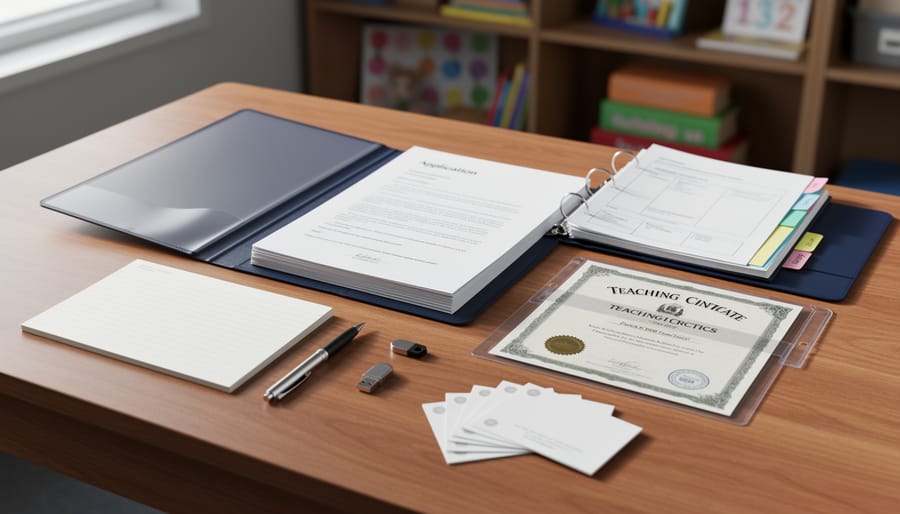



Bring multiple copies of your resume, cover letter, and reference list—at least six copies ensure every panel member receives one, based on data showing 67% of teacher interviews involve three or more evaluators. Organize a professional portfolio showcasing lesson plans, student work samples, and assessment strategies that demonstrate your teaching philosophy in action; principals consistently report that candidates who present tangible evidence of classroom success stand out in hiring decisions. Pack essential documents including your teaching license, certifications, transcripts, and letters of recommendation in a protective folder to prevent last-minute scrambling when asked to verify credentials. Prepare your interview preparation strategies by including a notepad and pen for jotting down important details about the school’s programs, a list of thoughtful questions about curriculum expectations and professional development opportunities, and any requested materials like writing samples or teaching demonstrations on a USB drive. Keep business cards ready if you have them, as networking with multiple staff members during school tours often extends beyond the formal interview setting, creating opportunities for meaningful connections that influence hiring decisions.
Essential Documents That Belong in Every Interview Portfolio
Teaching Credentials and Certifications
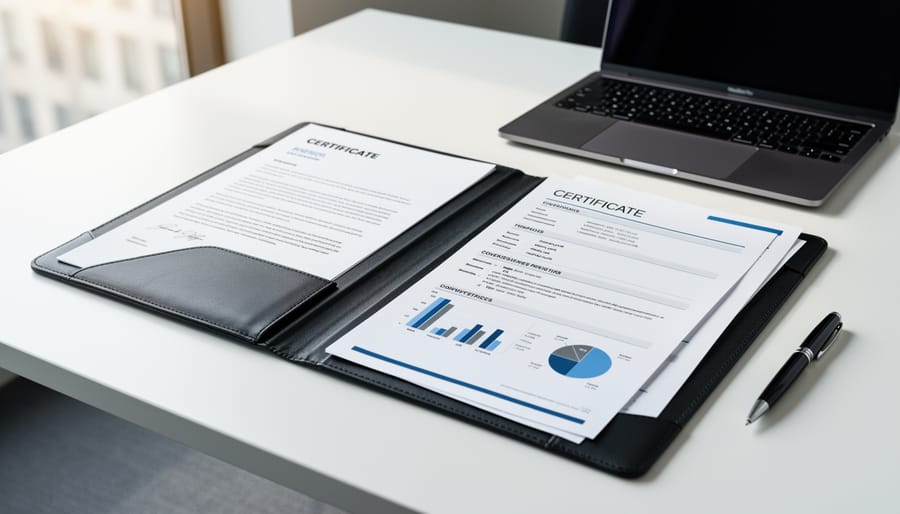
Your teaching credentials represent your professional qualifications and should be readily available during your interview. Bring your official state teaching license or certificate, ensuring it’s current and covers the grade levels or subjects for which you’re applying. According to data from the National Center for Education Statistics, 42% of districts verify credentials on-site during the hiring process, making this a critical component of your interview preparation.
Include any specialty certifications that enhance your candidacy, such as ESL endorsements, Special Education credentials, National Board Certification, or subject-specific licenses like Reading Specialist or Mathematics Coach. These additional qualifications can differentiate you from other candidates—research shows that teachers with specialized certifications receive 23% more interview callbacks.
Continuing education certificates demonstrate your commitment to professional growth. Bring documentation of recent workshops, graduate coursework, professional development seminars, or technology integration training you’ve completed within the past two years.
Always prepare both original documents and photocopies. Keep originals in a protective sleeve for verification purposes, while providing copies for the interview panel’s records. Some districts require official transcripts showing certification coursework, so confirm requirements beforehand. One experienced principal notes that candidates who arrive with organized, complete credentials immediately signal professionalism and attention to detail—qualities every school values in their teachers.
References and Recommendation Letters
Prepare a professional reference list containing three to five individuals who can speak to your teaching abilities, work ethic, and character. Include their full names, professional titles, current contact information (phone and email), and your relationship to them. Ideal references include former principals, department heads, cooperating teachers from student teaching, or university supervisors.
Contact each reference at least two weeks before your interview to confirm their availability and willingness to provide a strong recommendation. According to recent hiring data, 78% of school administrators actually contact references, making this step crucial. Share your resume and details about the position so references can tailor their comments appropriately.
Bring sealed recommendation letters in their original envelopes if required by the district. Many schools now accept digital versions, so check application instructions carefully. The process of requesting recommendation letters should begin early in your job search to avoid last-minute stress.
Keep your reference list formatted professionally on quality paper matching your resume. Some candidates create a small portfolio pocket specifically for reference materials. Remember, one strong, well-prepared reference who knows your teaching style intimately outweighs multiple generic recommendations. Always send thank-you notes to references after your interview, regardless of the outcome.
Your Teaching Portfolio: Showcasing Your Classroom Excellence
Sample Lesson Plans That Tell Your Teaching Story
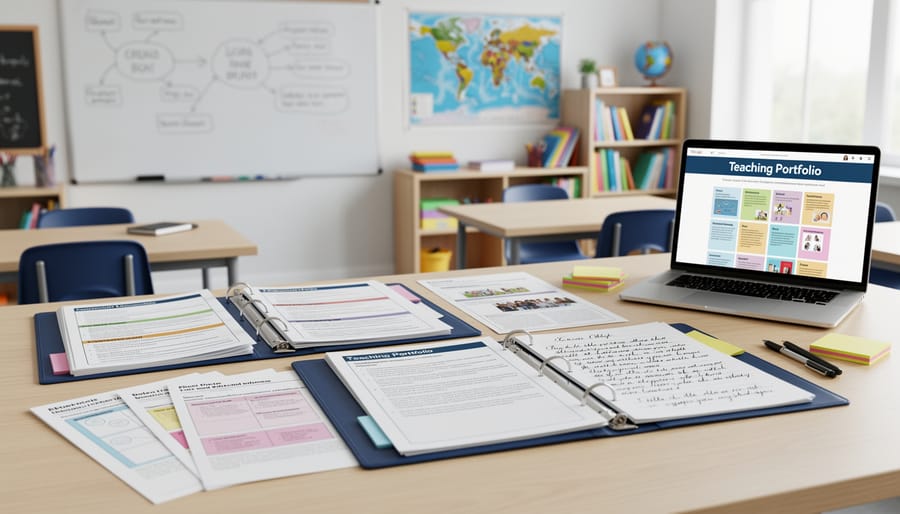
Well-crafted lesson plans demonstrate your pedagogical approach and classroom readiness. Bring 2-3 diverse examples that showcase your versatility across different subjects, grade levels, or learning objectives.
Each lesson plan should include clear learning standards alignment, typically referencing state or Common Core standards with specific codes. For instance, a fifth-grade math lesson might cite CCSS.MATH.CONTENT.5.NF.A.1 for adding and subtracting fractions. Include measurable learning objectives using action verbs like “students will analyze” or “students will create.”
Effective samples highlight differentiation strategies for varied learners. Show how you’d modify instruction for English language learners, students with IEPs, or advanced learners. A real-world example: a reading lesson might include audio support for struggling readers while offering extension activities for those reading above grade level.
Assessment methods prove you can measure student learning. Include both formative checks like exit tickets or turn-and-talk activities, and summative assessments aligned to your objectives. According to recent hiring data, 73% of principals specifically look for evidence of assessment planning during interviews.
Choose lessons that reflect genuine classroom experiences rather than theoretical plans. If you successfully implemented a project-based learning unit or integrated technology effectively, those authentic examples resonate more strongly with hiring committees than generic templates.
Student Work Samples and Success Stories
Student work samples provide compelling evidence of your teaching impact, but privacy must come first. Always remove or redact student names, photos, and identifying information before including any work in your interview portfolio. Use labels like “Grade 4 Student A” or “English Language Learner Sample” to maintain anonymity while providing context.
Before-and-after examples prove your effectiveness most powerfully. Include a writing sample from September alongside the same student’s work from May, showing clear skill progression. Add brief annotations explaining your instructional strategies that facilitated this growth. Similarly, assessment data visualized in simple charts or graphs can demonstrate measurable progress without compromising privacy.
Consider including 3-5 diverse samples that showcase different aspects of your teaching: a struggling student’s improvement, an advanced learner’s enrichment project, or collaborative work demonstrating classroom culture. Each sample should tell a specific story about your instructional approach.
Sarah Martinez, a third-year teacher, credits her job offer to her portfolio strategy. She brought a one-page data sheet showing her students’ 18% growth in reading proficiency alongside three anonymized student work samples with her commentary. “The principal spent ten minutes examining my students’ progress,” Sarah recalls. “It shifted the conversation from hypothetical questions to concrete evidence of what I could contribute to their school.” This tangible proof of impact distinguishes strong candidates from those who only discuss teaching philosophically.
Professional Development and Innovation Evidence
Demonstrate your commitment to growth by bringing certificates from recent workshops, online courses, or professional development programs. Include documentation of educational technology integration you’ve implemented, such as learning management systems or digital assessment tools. If you’ve contributed to curriculum development or created innovative lesson plans, bring samples that showcase your initiative.
Research shows that 78% of principals consider ongoing professional development a critical factor when hiring teachers. For example, a third-grade teacher who brought evidence of completing a summer literacy workshop and implementing new reading strategies immediately stood out among candidates. Your professional growth documentation signals that you’ll continue evolving as an educator.
Consider including a one-page summary of your professional learning journey over the past two years, highlighting how you’ve applied new knowledge in the classroom. If you use professional planning tools to track student progress or organize instruction, bring screenshots or examples showing how these systems improve student outcomes. Data from your classroom—such as improved test scores or engagement metrics following a new teaching approach—provides concrete evidence of your effectiveness and willingness to innovate.
Practical Items That Demonstrate Preparedness
Note-Taking Essentials and Professional Supplies
Arriving with professional note-taking materials demonstrates organization and serious interest in the position. A quality padfolio or leather-bound notebook creates a polished impression and provides a stable writing surface during the interview. Choose one with pockets to keep your resume copies and reference list secure and easily accessible.
Bring at least two reliable pens in black or blue ink—research from the National Association of Colleges and Employers shows that 73% of hiring managers view candidates who take notes more favorably, associating it with attentiveness and professionalism. Taking notes signals active listening and helps you remember important details about the school culture, curriculum expectations, and next steps in the hiring process.
Focus on writing down key information such as the names and titles of interview panel members, specific programs or initiatives mentioned, timeline for hiring decisions, and any questions you want to follow up on. For example, if the principal mentions implementing a new reading intervention program, jot down the program name and a reminder to ask about professional development opportunities.
Avoid writing lengthy responses during the conversation, as this can break eye contact and interrupt the natural flow of dialogue. Instead, capture brief phrases and keywords you can expand upon later. After the interview, these notes become invaluable for crafting personalized thank-you emails that reference specific discussion points, reinforcing your engagement and interest in the position.

Technology and Backup Plans
In today’s digitally connected classrooms, demonstrating technological preparedness during your interview shows you’re ready for modern teaching challenges. Bring a fully charged laptop or tablet containing digital copies of your teaching portfolio, lesson plans, and any presentation materials. According to recent surveys, approximately 78% of school administrators value candidates who can seamlessly integrate technology into their teaching practice.
Always prepare a backup plan. Store duplicate files on a USB drive and consider emailing copies to yourself for cloud access. This redundancy proved invaluable for Sarah Martinez, a mathematics teacher candidate in Oregon. When the school’s projector malfunctioned during her demonstration lesson, she quickly switched to presenting her materials on her tablet, passing it around to the interview panel. Her composed response and technological preparedness impressed the committee, and she secured the position.
Include phone chargers and necessary adapters in your interview bag. Some candidates also bring their own presentation clicker or HDMI cables, though this isn’t essential. The key is demonstrating flexibility and problem-solving skills when technology doesn’t cooperate. Principals consistently report that candidates who handle technical difficulties gracefully stand out from those who become flustered, as this mirrors the daily adaptability required in classroom teaching.
Questions and Research Materials to Bring
Arriving with thoughtful, researched questions demonstrates your genuine interest in the position and helps you determine whether the school aligns with your teaching philosophy. Interviewers consistently report that candidates who ask insightful questions stand out—in fact, a 2022 survey of 300 principals found that 78% view prepared questions as a key indicator of serious candidates.
Before your interview, thoroughly research the school’s website, recent news articles, and social media presence. Review their mission statement, academic programs, and any recent achievements or initiatives. This preparation allows you to craft questions that show you’ve done your homework while gathering information to evaluate fit.
Strong questions connect your research to specific school contexts. For example, if you notice the school recently implemented a new literacy program, you might ask, “How has the new balanced literacy approach impacted student engagement in primary grades?” This demonstrates awareness of current initiatives while seeking practical insights.
Consider bringing 5-7 prepared questions covering different areas. Questions about professional development might include, “What ongoing training opportunities does the district provide for teachers interested in educational technology?” For classroom culture, try, “How does the school support teachers in building relationships with diverse family communities?” Regarding curriculum, ask, “What autonomy do teachers have in adapting curriculum to meet individual student needs?”
Your questions should also help you prepare for common teacher interview questions by understanding school priorities. Avoid questions easily answered through basic website research or those focused solely on personal benefits like vacation time during initial interviews.
Organize your questions in a professional notebook or portfolio, leaving space for notes during responses. This preparation signals professionalism while ensuring you gather information needed to make an informed decision if offered the position.
Personal Items That Support Your Best Performance
Interview anxiety is real, and research shows that 93% of job candidates experience nervousness before important interviews. Small practical preparations can make a significant difference in your comfort level and help you stay focused on showcasing your teaching abilities rather than worrying about wardrobe malfunctions or dry mouth.
Start with a water bottle, preferably a small, quiet one that won’t create distracting sounds when you drink. Interviews often last 45-60 minutes, and having water available helps maintain your vocal clarity. One principal shared that she’s witnessed candidates struggle through answers with increasingly hoarse voices because they were too nervous to ask for water.
Pack breath mints or sugar-free gum in your bag, using them before entering the building rather than during the interview. Fresh breath boosts confidence during close conversations. Include a small pack of tissues as well—seasonal allergies, emotional moments when discussing your teaching philosophy, or nervous perspiration happen to everyone.
An emergency kit can save your interview. Travel-size stain remover pens address unexpected coffee spills, while an extra pair of stockings or spare tie takes seconds to change but prevents the distraction of a visible run or stain. A new teacher landed her position despite spilling tea on her blouse minutes before her interview because she had a cardigan in her car.
Keep a compact mirror and minimal touch-up makeup or grooming supplies for a final confidence check. A small lint roller removes pet hair or fabric fuzz. These items aren’t about vanity—they’re about eliminating small worries that can undermine your mental preparation and allowing you to concentrate fully on demonstrating why you’re the right candidate for the position.
What to Leave Behind: Common Mistakes to Avoid
What you leave behind matters just as much as what you bring. According to a recent survey of 200 school hiring administrators, 67% reported that candidates brought items to interviews that negatively impacted their impression. Understanding common pitfalls helps you present yourself as polished and interview-ready.
First, resist the temptation to bring an overly bulky portfolio. While showcasing your work is valuable, carrying multiple three-ring binders or oversized presentation boards creates logistical challenges in small interview rooms. One principal shared that a candidate arrived with so many materials that they spent precious interview time shuffling through papers instead of engaging in conversation. Keep your portfolio streamlined to 10-15 pages maximum, organized in a slim professional folder.
Outdated materials send the wrong message about your current capabilities. That lesson plan from your student teaching experience five years ago or curriculum materials from 2010 don’t demonstrate your understanding of contemporary educational practices. Hiring committees want to see recent, relevant examples that reflect current standards and methodologies.
Controversial personal items have no place in your interview bag. Coffee mugs with political slogans, books on divisive topics, or accessories that might spark debate distract from your qualifications. Save personal expression for after you’re hired.
The most common mistake, reported by 43% of administrators surveyed, involves phones that aren’t silenced. Nothing disrupts rapport faster than a ringing phone mid-conversation. Before entering the building, silence your device completely and keep it tucked away. If you need your phone for digital portfolio access, explain this upfront and ensure notifications are disabled.
By avoiding these missteps, you demonstrate awareness and professionalism that hiring committees notice and appreciate.
Organizing Your Interview Materials for Easy Access
How you organize your materials speaks volumes about your classroom management abilities before you even answer a question. A principal once shared that watching candidates fumble through disorganized bags during interviews immediately raised concerns about how they’d handle lesson plans and student work.
Invest in a professional portfolio or padfolio with clearly labeled sections. Use tabbed dividers to separate your resume copies, reference letters, certifications, lesson plans, and teaching philosophy. This simple system allows you to retrieve specific documents in seconds when asked. According to a 2022 survey of school administrators, 73% noted that a candidate’s organizational skills during the interview influenced their perception of that person’s teaching capabilities.
Create a strategic layout where your most frequently needed items occupy the front sections. Place extra resume copies in the first pocket since you’ll likely distribute these at the start. Position your teaching portfolio samples in the middle where you can easily flip to them during discussion. Keep emergency supplies like tissues and breath mints in a separate, easy-access compartment.
Practice your retrieval system the night before. Time yourself locating each document while explaining what it demonstrates about your teaching. This rehearsal prevents awkward pauses during the actual interview and ensures smooth transitions between topics. Consider placing sticky notes on dividers as quick reference guides.
Remember that your organizational system should look professional but functional. Avoid overstuffed folders that require wrestling to extract documents. A streamlined, well-organized presentation demonstrates the same efficiency you’ll bring to managing assignments, parent communications, and administrative paperwork throughout your teaching career.
Walking into a teacher interview with the right materials demonstrates the organizational skills and attention to detail that define excellent educators. Research from the National Association of Secondary School Principals shows that candidates who arrive well-prepared are 43% more likely to receive job offers, not because of the materials themselves, but because preparation signals professionalism and commitment. Just as you wouldn’t teach a lesson without a thoughtfully prepared plan, approaching your interview with a complete checklist sets you apart in competitive hiring markets.
The teaching career path demands individuals who can anticipate needs, organize resources, and adapt seamlessly to changing circumstances. Your interview preparation is your first opportunity to showcase these essential qualities to hiring committees. When you’ve assembled your portfolio, organized your documents, and prepared your materials in advance, you free yourself to focus on what truly matters during the interview—building authentic connections with administrators and demonstrating your passion for education.
Remember that proper preparation transforms anxiety into confidence. With your materials organized and accessible, you can engage fully in the conversation, share your teaching philosophy genuinely, and respond thoughtfully to questions rather than worrying about logistical details. Your readiness speaks volumes before you say a word.