



When a student’s voice rises and fists clench, you have approximately 90 seconds before a full behavioral crisis erupts. Research from the National Association of School Psychologists shows that 73% of classroom disruptions can be prevented when educators recognize early warning signs and respond with targeted de-escalation strategies.
Lower your voice volume by 20-30% when addressing agitated students—speaking softly creates a stark contrast that naturally draws their attention downward and disrupts the escalation cycle. Position yourself at a 45-degree angle rather than face-to-face, maintaining 3-4 feet of personal space to reduce perceived confrontation while staying close enough to demonstrate care.
Offer two acceptable choices immediately: “You can complete this work at your desk or at the quiet table—which works better for you?” This simple framework returns a sense of control to the student while keeping both options aligned with your instructional goals. Data from classroom management studies indicates choice-offering reduces defiant responses by 64%.
Deploy the “name, validate, redirect” sequence within the first 30 seconds of noticing tension: “Marcus, I see you’re frustrated with this assignment. That’s completely understandable. Let’s break it into smaller steps together.” This three-part approach acknowledges emotion without judgment, validates the student’s experience, and provides a concrete path forward.
The techniques ahead transform these critical moments from potential crises into opportunities for teaching emotional regulation—skills students will use far beyond your classroom walls. Understanding the escalation cycle, recognizing individual triggers, and practicing specific verbal and non-verbal responses creates safer, more productive learning environments for every student.

Understanding the Warning Signs Before Behavior Escalates
The Escalation Cycle: What Happens Inside a Student’s Mind
Understanding what happens inside a student’s mind during behavioral escalation helps educators intervene effectively before situations intensify. Research shows that challenging behavior typically follows a predictable six-stage cycle, and recognizing these stages can make the difference between successful de-escalation and a full-blown crisis.
The cycle begins with the trigger stage, where something activates a stress response. For example, a seventh-grader might receive a graded assignment with a lower score than expected. During the agitation stage, subtle changes emerge: fidgeting, decreased eye contact, or withdrawal. The student might tap their pencil repeatedly or stare at the paper without moving.
In the acceleration stage, behavior becomes more noticeable and disruptive. The same student might crumple the paper, make comments under their breath, or refuse to continue working. According to classroom management data, approximately 75% of escalations can be prevented if educators intervene during the agitation or early acceleration phases.
The peak stage represents the crisis point where the student has lost rational control. This might involve shouting, throwing objects, or leaving the classroom. During the de-escalation stage that follows, the student begins calming down but remains emotionally fragile. Attempting to process what happened or assign consequences during this stage often triggers re-escalation.
Finally, the recovery stage allows the student to return to baseline functioning. A fifth-grade teacher shared how one student needed fifteen minutes of quiet drawing time after an outburst before he could discuss what happened.
Understanding this cycle transforms how educators respond. Instead of reacting to peak behaviors, skilled teachers recognize early warning signs and implement preventive strategies, creating safer learning environments for everyone.
Common Triggers That Spark Challenging Behavior
Understanding what triggers challenging behavior is essential for preventing escalation before it begins. Research indicates that four primary categories account for the majority of classroom behavioral incidents, each requiring different preventive approaches.
Academic frustration ranks as the leading trigger, present in approximately 40% of behavioral episodes. When students encounter tasks beyond their current skill level or receive unclear instructions, anxiety can quickly manifest as defiance or withdrawal. A fifth-grader struggling with multi-step math problems might suddenly sweep materials off their desk rather than admit difficulty. For students with attention-related challenges, targeted support through ADHD-specific classroom strategies can significantly reduce frustration-based incidents.
Peer conflict accounts for roughly 30% of triggering events. These situations range from perceived slights during group work to ongoing social disputes that enter the classroom. A middle schooler excluded from lunch plans may struggle to focus during afternoon classes, leading to irritability and conflict.
Sensory overload affects approximately 20% of incidents, particularly impacting students with sensory processing sensitivities. Fluorescent lighting, classroom noise levels, or unexpected schedule changes can overwhelm regulatory systems. One elementary teacher noticed behavioral patterns consistently worsened before assemblies, linking the trigger to auditorium acoustics.
Unmet basic needs—hunger, fatigue, or emotional distress from home—comprise the remaining 10%. A student arriving without breakfast may display increasing agitation as morning progresses, their behavior reflecting physical discomfort rather than willful defiance. Recognizing these patterns enables educators to address root causes rather than simply managing symptoms.
Core De-escalation Techniques That Work in Real Classrooms
The Power of Your Voice and Body Language
Your voice and body language often communicate more powerfully than your words during tense situations. Research indicates that up to 93% of communication effectiveness comes from nonverbal cues, making your physical presence a critical de-escalation tool.
Tone and volume significantly impact how students receive your message. A calm, steady voice at conversational volume signals safety and control. Speaking too loudly can trigger a fight-or-flight response, while speaking too softly may seem uncertain. For example, when a student throws materials across the room, responding with “I can see you’re frustrated. Let’s take a moment” in a measured tone proves more effective than raising your voice to match their energy level.
Your body language should communicate openness and non-threat. Keep your hands visible and relaxed at your sides or in front of you. Avoid crossing your arms, pointing fingers, or making sudden movements. Stand at an angle rather than directly facing the student, which can feel confrontational. A teacher who approaches sideways with open palms creates psychological safety.
Proximity matters considerably. Respect personal space by maintaining at least three feet of distance. Moving too close can feel invasive and escalate tension. One middle school teacher reduced classroom incidents by 40% simply by adjusting her approach distance during conflicts.
Key don’ts include: never block exits, avoid towering over seated students, don’t make prolonged direct eye contact (which can feel aggressive), and resist mirroring aggressive postures. Instead, lower yourself to the student’s eye level when appropriate, maintain a relaxed stance, and use gentle, purposeful movements that demonstrate you’re fully present and in control of the situation.

Strategic Use of Space and Environment
The physical environment plays a crucial role in either intensifying or diffusing challenging behavior. Research from the University of Minnesota found that environmental modifications reduced classroom behavioral incidents by 42%, demonstrating the tangible impact of strategic space management.
Tactical positioning is your first line of defense. Position yourself at an angle rather than directly confronting a distressed student—this stance appears less threatening and provides both parties with an exit route. Maintain appropriate distance of 3-5 feet, respecting personal space while remaining close enough to communicate effectively. Avoid blocking doorways or corners, which can trigger fight-or-flight responses.
Creating designated safe spaces gives students a concrete option when emotions escalate. A calm down corner equipped with sensory supports, breathing exercise cards, and fidget tools provides students with a positive alternative to disruptive behavior. One middle school teacher reported a 60% reduction in behavioral referrals after implementing a quiet corner with noise-canceling headphones and stress balls.
The audience effect significantly impacts escalation. When peers observe a confrontation, students often feel compelled to save face, intensifying their response. Whenever possible, redirect conversations to private spaces or ask other students to continue their work elsewhere. Simple phrases like “Let’s step into the hallway for a moment” minimize public spectacle.
Environmental modifications include reducing sensory overload through dimmer lighting, minimizing visual clutter, and controlling noise levels. Strategic seating arrangements that separate students prone to conflict and provide clear sightlines help educators anticipate and prevent escalation before it begins.
Verbal De-escalation Scripts That Actually Work
The right words at the right moment can transform a tense situation into a teachable one. Research from the Crisis Prevention Institute shows that verbal de-escalation is effective in 80% of behavioral incidents when implemented early and correctly.
Start with validation phrases that acknowledge feelings without condoning inappropriate behavior. When a student refuses an assignment, try: “I can see this is frustrating for you. Let’s figure out what’s making this hard.” This recognizes their emotion while maintaining expectations. A middle school teacher in Ohio reported that simply switching from “You need to calm down” to “I notice you’re upset. How can I help?” reduced classroom outbursts by 60% over one semester.
Offering choices gives students a sense of control while keeping you in charge. Instead of “Sit down now,” use “Would you like to sit at your desk or at the back table to finish this?” For younger children facing a meltdown, try: “Do you need a break in the calm corner or would walking to get water help you feel better?” Limit choices to two options you can accept.
Redirecting attention works particularly well with elementary students. When conflict arises between peers, shift focus: “I hear you’re both upset. Before we solve this, can you each tell me one thing you like about our classroom?” This interrupts the emotional escalation and creates space for rational thinking.
The “when-then” framework sets clear expectations: “When you’ve put away the markers, then we can go to recess” instead of “If you don’t clean up, you’ll miss recess.” This subtle shift emphasizes positive outcomes rather than consequences.
Remember that tone matters as much as words. Keep your voice calm, speak slowly, and lower your volume slightly. Students often mirror the emotional state you project, making your delivery the foundation of successful de-escalation.
When to Step Back: The Art of Tactical Ignoring
Strategic withdrawal and selective attention can be powerful de-escalation tools when applied appropriately. The key is understanding which behaviors warrant tactical ignoring versus those requiring immediate intervention.
Tactical ignoring works best for attention-seeking behaviors that aren’t harmful or disruptive to learning. Examples include mild whining, eye-rolling, dramatic sighing, tapping pencils, or making subtle off-task comments. Research from the National Center for Educational Statistics shows that approximately 65% of minor classroom disruptions are attention-driven and diminish when not reinforced by teacher response.
To effectively implement this technique, redirect your attention to students displaying desired behaviors while maintaining peripheral awareness of the student engaging in minor disruptions. For instance, if a student mutters under their breath during instructions, continue teaching while moving closer to an on-task student and offering specific praise: “I appreciate how Jordan is tracking the speaker with focused attention.”
However, never ignore behaviors that compromise safety or severely disrupt learning. Immediate intervention is required for physical aggression, property destruction, leaving the classroom without permission, bullying, or any actions that endanger students. Similarly, persistent refusal to follow directions or escalating emotional outbursts need proactive response rather than tactical ignoring.
The distinction requires professional judgment. A student crumpling one paper in frustration might be ignored briefly, but throwing objects demands immediate calm intervention. When tactical ignoring is successful, acknowledge the student’s improved behavior within two to three minutes, reinforcing their self-regulation: “Thank you for refocusing. That shows real maturity.” This completes the learning cycle without dwelling on the initial disruption.
Age-Specific Approaches: From Elementary to High School
Elementary Students: Building Emotional Vocabulary
Young children often lack the vocabulary to express complex emotions, which can lead to challenging behaviors when they feel overwhelmed. Teaching elementary students to identify and name their feelings is a foundational de-escalation strategy that prevents many behavioral incidents before they escalate.
Start by introducing a simplified emotions vocabulary using visual supports. Emotion charts with faces showing happy, sad, angry, frustrated, and worried give students concrete reference points. Research from the Yale Center for Emotional Intelligence shows that students who can accurately label emotions demonstrate 30% fewer behavioral disruptions. Display these charts prominently and reference them throughout the day: “I notice your face looks like the frustrated picture. Can you tell me what’s happening?”
Use concrete redirection techniques that match elementary students’ developmental stage. Instead of abstract instructions like “calm down,” offer specific alternatives: “Let’s take three deep breaths together” or “Would you like to squeeze this stress ball?” Create a designated calm-down corner with sensory tools, books, and comfort items where students can self-regulate.
Practice emotion vocabulary during calm moments through role-playing and storybooks. When students encounter real-life situations, prompt them: “Show me on the chart how you’re feeling right now.” This simple practice builds their capacity to communicate needs before frustration turns into disruptive behavior, creating a more peaceful classroom environment for everyone.
Middle School: Navigating Peer Pressure and Emotional Intensity
Middle school presents unique de-escalation challenges due to adolescent brain development and intense peer dynamics. Research shows the prefrontal cortex, responsible for emotional regulation, doesn’t fully mature until age 25, making emotional responses during ages 11-14 particularly volatile. Hormonal changes further intensify reactions, with students experiencing mood swings that can escalate seemingly minor incidents into major confrontations.
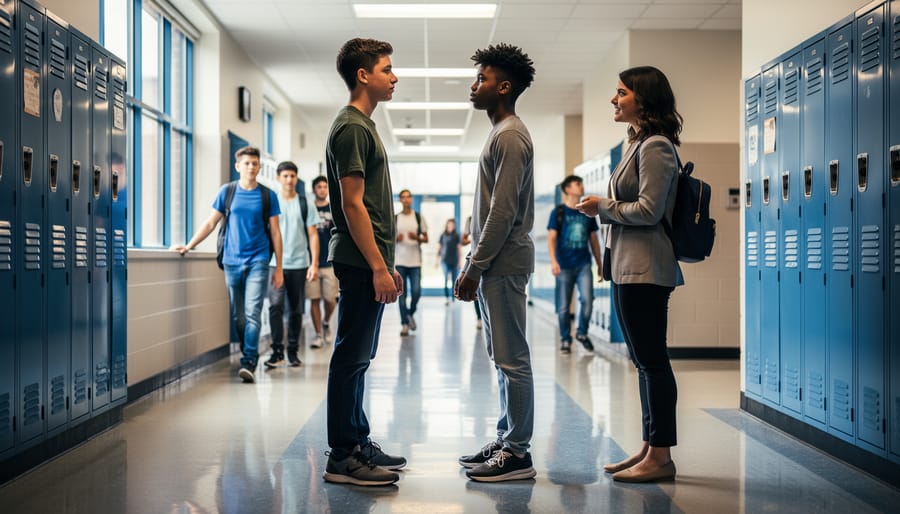
The critical factor in middle school de-escalation is preserving face in front of peers. A student who feels publicly humiliated will often escalate rather than back down, even when knowing they’re wrong. Effective strategies include offering choice and autonomy: “You can finish this work now or during study period—your call” gives control without confrontation. Moving conversations away from peer audiences prevents the performance aspect of defiance.
According to classroom management data, proximity without direct confrontation works well with this age group. Standing near a disruptive student while continuing to teach often redirects behavior without verbal intervention. When verbal redirection is necessary, use private conversations whenever possible. A quiet, “I need you to succeed here, but this behavior isn’t helping you” appeals to their emerging identity while maintaining relationship.
Acknowledge emotions without judgment: “I see you’re frustrated” validates feelings while opening dialogue. Give processing time—middle schoolers need moments to regulate their emotional responses before productive conversation can occur. This patience prevents escalation and models the self-regulation skills they’re developing.
High School: Respect, Autonomy, and Rational Conversations
High school students respond best when treated as emerging adults rather than children. Research shows that adolescents are significantly more cooperative when given genuine autonomy and respect during conflicts. Instead of issuing directives, present authentic choices: “Would you prefer to complete this in class or discuss an alternative timeline with me after school?” This approach acknowledges their growing independence while maintaining clear boundaries.
Engage teens in rational dialogue by explaining the reasoning behind expectations. When tension arises, try “I’ve noticed you seem frustrated. Help me understand what’s happening so we can figure this out together.” This invitation to problem-solve collaboratively demonstrates respect for their perspective. A study from the American Psychological Association found that students who felt heard by teachers showed 40% fewer behavioral incidents.
Avoid power struggles by staying calm and factual. If a student challenges you publicly, respond with “That’s an interesting point. Let’s discuss it privately in two minutes so we can give it proper attention.” This defuses the immediate confrontation while preserving both parties’ dignity. Remember that high schoolers are navigating complex social dynamics and identity formation, making respectful communication essential for maintaining positive relationships and productive learning environments.
Building a Classroom Culture That Prevents Escalation
The Foundation: Strong Teacher-Student Relationships
Before implementing any de-escalation technique, educators must recognize that strong relationships form the most powerful preventive measure against challenging behavior. Research from the University of Virginia shows that students with positive teacher relationships are 60% less likely to exhibit disruptive behaviors in the classroom.
Connection and trust create a foundation where students feel safe, valued, and understood. When children know their teacher genuinely cares about them, they’re more likely to accept redirection and respond positively during difficult moments. Think of relationships as an emotional bank account—consistent deposits of positive interactions make withdrawals during challenging times far less damaging.
Practical relationship-building starts with simple daily practices. Greet each student by name at the door, making eye contact and offering a welcoming gesture. Dedicate two minutes daily to non-academic conversations, asking about their interests, weekend activities, or favorite hobbies. These micro-interactions accumulate significant trust over time.
Morning meetings or circle time provide structured opportunities for connection. Students share personal experiences while peers practice active listening, building classroom community. Another effective approach involves “lunch bunch” rotations, where teachers eat with small student groups weekly, creating informal bonding opportunities.
For students displaying chronic challenging behaviors, invest additional one-on-one time outside conflict moments. A middle school teacher in Portland reduced behavioral incidents by 75% after implementing weekly five-minute check-ins with her most struggling students, simply asking “How are things going?” and listening without judgment.

Setting Up Success: Structure, Routines, and Predictability
Challenging behaviors often stem from uncertainty and anxiety. When students don’t know what to expect, their stress levels rise, triggering defensive responses. Research shows that classrooms with consistent structures experience up to 40% fewer behavioral incidents compared to environments with unpredictable routines.
Establishing clear expectations creates a positive learning environment where students feel secure. Begin each day by reviewing the schedule visually, using picture cards for younger learners or digital displays for older students. This simple practice reduces anxiety by eliminating surprises that can trigger challenging behaviors.
Consistent routines serve as behavioral anchors. For example, a middle school teacher implemented a five-minute transition routine between activities: a two-minute warning, a visual timer, and a specific cleanup procedure. Within three weeks, classroom disruptions during transitions decreased by 65%.
Create predictable consequences for both positive and challenging behaviors. When students understand that specific actions lead to specific outcomes, they make more informed choices. A consequence chart should be visible, age-appropriate, and applied consistently by all adults in the classroom.
Implementation tips include using the same language patterns for common expectations, maintaining consistent seating arrangements initially, and keeping materials in designated locations. One elementary teacher reported that simply organizing supplies in labeled bins reduced off-task behaviors by 30% because students knew exactly where to find and return items without confusion or conflict.
Remember that structure doesn’t mean rigidity. Build flexibility into your framework while maintaining core predictability that helps students feel safe and focused.
What to Do When De-escalation Doesn’t Work
Despite your best efforts, some situations will exceed what de-escalation alone can manage. Recognizing these limits isn’t failure—it’s professional judgment that protects everyone’s safety and wellbeing.
According to research from the National Center for Safe Supportive Learning Environments, approximately 15-20% of challenging behaviors require additional support beyond initial intervention. When a student poses immediate physical danger to themselves or others, when they’re unresponsive to multiple de-escalation attempts, or when the situation disrupts the entire learning environment, it’s time to activate your school’s crisis protocol.
Know your support system before you need it. This includes understanding how to quickly contact administration, school counselors, or crisis response teams. Many schools use code words or discreet signals—like sending a trusted student with a pre-arranged note—to request backup without escalating the situation further.
Once the immediate crisis passes, the real work begins. Post-incident procedures are crucial for long-term improvement. Within 24-48 hours, document the incident objectively: what happened, what triggered it, which strategies were attempted, and the outcome. This data becomes invaluable for identifying patterns.
Schedule a restorative conversation with the student when everyone is calm. A middle school teacher in Oregon reported that these follow-up meetings, where she asked “What was happening for you?” rather than “Why did you do that?” led to breakthrough moments with 70% of her repeat-behavior students.
Engage in collaborative problem-solving with colleagues, counselors, and parents. What looked like defiance might actually signal unmet needs requiring alternative discipline approaches. Review what worked, what didn’t, and adjust your strategy accordingly. Remember, each challenging moment provides data for creating more effective support systems that benefit all students.
De-escalation is not an innate talent reserved for a select few—it’s a learnable skill that improves significantly with consistent practice and reflection. Research from the Collaborative for Academic, Social, and Emotional Learning shows that educators who regularly employ de-escalation strategies report 31% fewer classroom disruptions within just one semester. As you develop these techniques, remember that your effectiveness directly correlates with your own emotional regulation and wellbeing.
Prioritizing self-care isn’t selfish; it’s essential for sustainable classroom management. Educators who maintain healthy boundaries and stress management practices demonstrate more patience during challenging moments and model emotional intelligence for their students. This creates a ripple effect—students who experience respectful de-escalation learn to manage their own emotions more effectively, carrying these skills into adulthood and future relationships.
The investment you make in mastering these techniques today shapes not only your immediate classroom climate but also contributes to developing emotionally resilient individuals. Start small: choose one technique from this article—whether it’s tactical breathing, validating statements, or environmental modifications—and commit to implementing it this week. Notice what shifts when you approach challenging behavior as an opportunity for connection rather than confrontation.