



Music integration transforms elementary classrooms by embedding rhythm, melody, and movement into daily instruction across subjects, typically requiring 10-15 minutes per lesson and minimal equipment. Teachers use songs to reinforce math concepts, incorporate chants for literacy skills, and add background music during independent work, creating a multisensory learning environment that boosts retention and engagement. Research from the National Association for Music Education shows that students exposed to integrated music instruction demonstrate 22% higher performance on memory-based assessments compared to peers in traditional classrooms.
The approach works because music activates multiple brain regions simultaneously, strengthening neural pathways for language, pattern recognition, and spatial reasoning. A third-grade teacher in Austin, Texas, reported that students who struggled with multiplication tables achieved fluency within three weeks after she introduced daily skip-counting songs set to familiar melodies. Another educator in Portland, Oregon, noted a 35% decrease in transition time between activities after implementing musical cues throughout the school day.
Getting started requires no formal musical training. Teachers can begin with simple clapping patterns, recorded instrumental tracks, or familiar children’s songs adapted to lesson content. The key is consistency and intentional pairing of musical elements with academic goals. Most educators see measurable improvements in student participation within two weeks of implementation, with longer-term benefits emerging in areas like classroom community, executive function skills, and creative problem-solving. This guide walks you through the materials, preparation, sequential steps, and assessment methods needed to successfully integrate music into your elementary teaching practice.
What You Need to Get Started
Basic Equipment and Resources
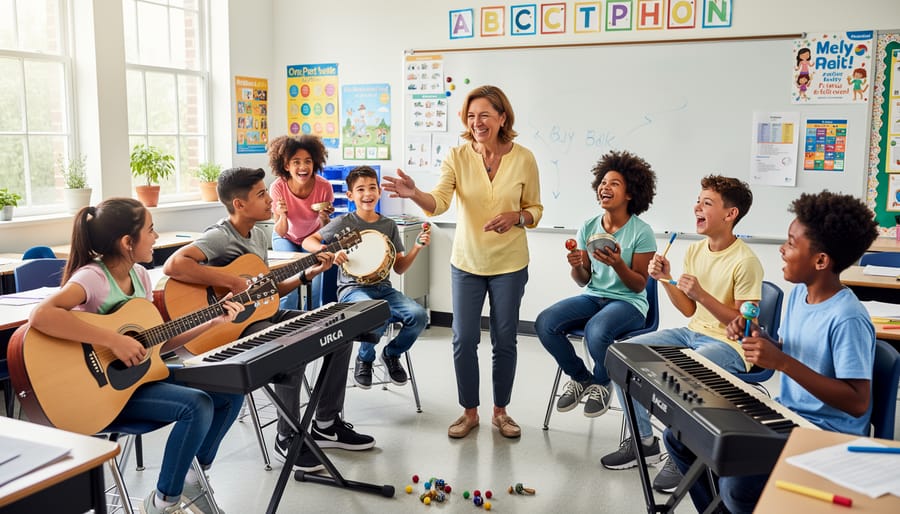
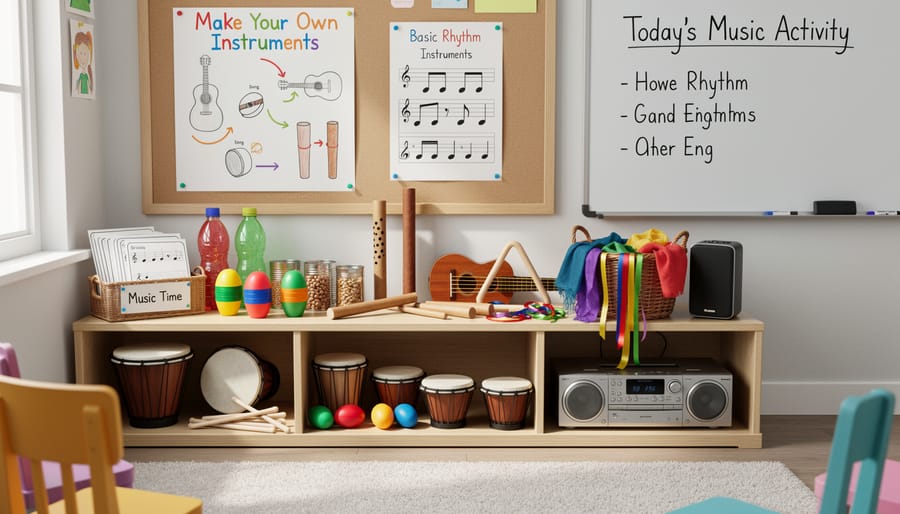
You don’t need expensive equipment to bring music into your classroom. Start with a basic percussion set that includes hand drums, shakers, rhythm sticks, and tambourines, budget-friendly classroom packs typically cost $50-$100 and serve 20-30 students. Boomwhackers, those colorful tuned percussion tubes, offer another affordable option for teaching pitch and melody without requiring musical training.
For audio playback, a Bluetooth speaker ($30-$80) paired with your smartphone or laptop works perfectly. Most elementary teachers in 2026 already have access to classroom tablets or computers that can stream music through platforms like Spotify, YouTube Music, or Apple Music. These services offer curated playlists specifically designed for classroom transitions, brain breaks, and subject-specific learning songs.
Digital resources expand your options considerably. Apps like Chrome Music Lab provide free, browser-based instruments and music creation tools that work on any device. Rhythm Cat and Incredibox engage students with interactive music-making while reinforcing pattern recognition. For older elementary students, GarageBand (iOS) or BandLab (free, cross-platform) enable simple composition projects without prior music knowledge.
Many districts provide access to curriculum-aligned music resources through platforms like Discovery Education or PBS LearningMedia. Check with your media specialist about existing subscriptions before purchasing additional materials.
Preparing Your Physical Space
Rearranging your classroom for music integration doesn’t require a complete overhaul. Start by identifying underutilized areas, corners, carpet spaces, or areas near bookshelves, where students can gather for music activities without disrupting other learning zones.
Create a designated music corner using a small bookshelf or storage bin for instruments and materials. Keep rhythm sticks, shakers, and small percussion instruments within student reach but organized in labeled containers. A simple crate system works well and costs under twenty dollars at most supply stores.
For movement activities, push desks toward the perimeter during scheduled music times, or use existing carpet areas. Many teachers rotate between seated and standing configurations throughout the day, making furniture flexible rather than permanent. If space is extremely limited, hallway time or outdoor areas can supplement classroom music sessions.
Sound management matters in shared-wall classrooms. Position your music corner away from adjoining classrooms when possible, and communicate your music schedule to neighboring teachers. Foam tiles or area rugs help absorb sound and define activity zones without permanent installation.
Even classrooms with thirty students and limited square footage can accommodate music integration through strategic timing and zoning. The key is creating clear pathways and establishing routines so students move efficiently between activities.
Important Considerations Before You Begin
Before launching music activities in your elementary classroom, address several critical considerations that directly impact student safety, learning outcomes, and program sustainability.
Volume control stands as your first concern. Repeated exposure to sounds above 85 decibels can damage developing hearing, and many classrooms naturally amplify noise due to hard surfaces. Establish clear volume guidelines for both recorded music and student-made sounds. Position speakers away from student seating areas, and invest in a simple sound meter app to monitor levels during activities. Many teachers overlook this until complaints arise from neighboring classrooms or administrators.
Student sensory sensitivities require individualized planning. Some children find certain frequencies, rhythms, or timbres genuinely distressing. Review IEPs and 504 plans for documented sensitivities, and communicate with families about how background music will be used. Create a signal system allowing students to request volume adjustments or opt out without drawing attention.
Administrative approval matters more than many educators realize. Before purchasing instruments or restructuring lesson plans, confirm your integration approach aligns with school policies and curriculum standards. Some districts require documentation showing how music activities support specific learning objectives. Schedule a brief meeting with your principal to outline your plans, this prevents misunderstandings later and often reveals available resources you didn’t know existed.
Classroom management protocols need adjustment when music enters the picture. Movement-based activities increase energy levels and require stronger transition cues. Instruments become distractions if introduced without clear usage rules. Establish non-negotiable expectations before the first music session: instruments are learning tools, not toys; movement stays within designated spaces; and your stop signal (a specific sound, raised hand, or lights-off cue) means immediate silence. Practice these protocols without music first, then gradually add musical elements as students demonstrate readiness.
Step-by-Step Music Integration Process
Step 1: Assess Your Curriculum and Identify Integration Points
Begin by reviewing your current lesson plan outline for each subject you teach this week. Look for concepts that naturally involve patterns, sequences, or memorization, these are prime candidates for music integration.
In mathematics, fraction lessons work exceptionally well with rhythm. When teaching 1/4 notes versus 1/8 notes through clapping patterns, students grasp the relationship between fractions physically. Multiplication facts stick when set to familiar tunes; third-graders who struggle with 7×8 often remember it instantly when sung to “Twinkle, Twinkle, Little Star.”
Literacy offers countless integration points. Syllable counting becomes a drumming exercise. Phonics patterns transform into chants where students stomp on consonants and clap on vowels. Poetry units gain depth when students explore rhythm and meter through movement.
For science, create songs about the water cycle, planetary order, or life cycle stages. A second-grade teacher in Oregon reported 94% retention of moon phases after students composed a simple melody about waxing and waning.
Social studies timelines come alive through period-appropriate songs. Fifth-graders studying westward expansion connect emotionally with folk songs like “Sweet Betsy from Pike,” anchoring historical context to melody. Mark these integration opportunities directly in your plans with a music note symbol for quick reference.
Step 2: Start with Transitions and Routines
The easiest entry point for music integration involves replacing verbal cues with musical signals during daily transitions. Instead of raising your voice to announce clean-up time, play a specific 30-second instrumental track that students learn to associate with tidying their workspace. This approach reduces classroom noise while creating predictable routines that children respond to automatically.
Morning arrival works particularly well for musical routines. A consistent welcome song playing as students enter establishes a calm, positive tone for the day. Many elementary teachers report that greeting music reduces morning chaos by 40% because students immediately know what to do when they hear the familiar melody.
Brain breaks represent another low-risk opportunity. When you notice restlessness building, play an upbeat song and invite students to stand, stretch, or perform simple movements for two minutes. “Freeze dance” variations require no preparation, just pause the music randomly and students freeze in place, combining physical activity with listening skills.
These transition-based applications build your confidence because they don’t require lesson planning, musical expertise, or curriculum modification. You’re simply replacing existing management strategies with musical alternatives that prove more engaging and effective.
Step 3: Incorporate Music into Core Subject Lessons
Once you’ve established music during transitions, the next step moves music directly into your lesson delivery across core subjects.
Mathematics becomes more memorable when concepts turn into songs. Teach skip counting through rhythmic chants, students clap on multiples of three while counting aloud. Multiplication facts stick when set to familiar tunes like “Twinkle, Twinkle, Little Star.” Research from the University of California shows students using musical mnemonics retain math facts 34% longer than those using traditional drill methods.
Literacy instruction pairs naturally with music. Create phonics songs for vowel sounds or consonant blends. Students remember long vowel rules better when they sing “When two vowels go walking, the first one does the talking” to a simple melody. For vocabulary development, add rhythm and movement, students stomp while saying multi-syllable words, physically feeling each beat.
Science content becomes accessible through song. The water cycle transforms into a memorable tune with hand motions. Students learning planetary order retain it through mnemonic melodies. One third-grade teacher reported 89% retention rates for states of matter concepts taught through original classroom songs versus 62% for lecture-based instruction.
Social studies benefits from historical songs and folk music from different cultures. Teaching westward expansion? Play period-appropriate folk tunes. Studying geography? Create rhythm patterns matching syllables in country names while pointing to maps.
Start with one subject area where you feel most confident, then expand gradually.
Step 4: Create Student-Centered Music Activities
Student-centered activities transform music from something students hear into something they create and own. Start with simple songwriting exercises where students compose lyrics to familiar melodies. For example, second graders can write new words to “Twinkle, Twinkle, Little Star” explaining the water cycle or multiplication facts. This approach requires no musical expertise while building both academic content and creative confidence.
Set up instrument exploration stations using classroom percussion, found objects, or even body percussion. Rotate small groups through stations where they experiment with creating different sounds and patterns. Use scaffolding by first modeling rhythm patterns, then having students imitate, and finally encouraging original creations.
Collaborative rhythm-building works exceptionally well for fostering teamwork. Divide the class into groups, assign each a simple rhythm pattern, and layer them together to create a complex composition. Students learn their individual part, then perform as an ensemble, experiencing firsthand how musical elements combine.
Provide regular performance opportunities, even informal ones. Friday afternoon sharing circles where students present their musical creations build confidence and validate their work. Keep the focus on creative expression rather than technical perfection, celebrating effort and originality.
Step 5: Build a Sustainable Music Integration Routine
Sustainability hinges on reducing daily decision-making. Create themed playlists for specific purposes, one for morning arrival, another for math transitions, a third for clean-up routines. Once built, these playlists eliminate the need to search for appropriate songs each day. Teachers at Lincoln Elementary in Portland report saving 15-20 minutes of planning time weekly after establishing their core rotation.
Establish predictable music patterns so students know what to expect. Designate specific days for certain activities: multiplication songs every Tuesday during math warm-up, Friday afternoon sing-alongs, or movement breaks every day after lunch. Consistency creates automatic implementation that doesn’t require constant planning.
Collaborate strategically with your school’s music specialist. Request curriculum-aligned song suggestions, borrow instrument sets for specific units, or co-plan integrated lessons quarterly rather than weekly. Many specialists welcome this collaboration and can provide ready-made resources.
Build a shared folder with grade-level colleagues where everyone contributes playlists, activity ideas, and lyric sheets. This collective resource grows organically without burdening any single teacher. Schools using collaborative music folders report 40% higher sustained integration rates after the first implementation year.
Measuring Success and Making Adjustments
Tracking the impact of music integration requires consistent observation and concrete data rather than gut feelings. Start by establishing baseline measurements before you implement new music strategies, note current engagement levels, time-to-task during transitions, and academic performance in the subject areas where you’ll add music elements. This gives you a clear before-and-after comparison.
Watch for behavioral indicators during music-enhanced lessons. Are students more focused during math practice when multiplication songs are playing? Do transitions happen faster with musical cues? Track participation rates in activities that incorporate rhythm or movement compared to traditional instruction. Keep a simple log noting which musical approaches generated the strongest response and which fell flat.
Collect student feedback through brief check-ins, exit tickets, or thumbs-up/thumbs-down polls after music-integrated lessons. Ask specific questions: “Did the rhythm activity help you remember the steps?” or “Would you like to use this song again?” Elementary students provide surprisingly honest input about what helps them learn.
Align your music activities with existing assessments rather than creating new ones. If students perform better on spelling tests after using phonics chants for a month, that’s measurable success. Compare quiz scores, completion rates, or behavior incident reports across grading periods to identify trends.
Red flags require immediate adjustment: students consistently off-task during music activities, complaints about volume or overstimulation, or declining academic performance in music-integrated subjects. When something isn’t working, modify one variable at a time, change the song selection, reduce activity duration, or try a different time of day, rather than scrapping the entire approach. Give each adjustment two weeks of consistent implementation before evaluating its effectiveness.
Document what works in a simple spreadsheet or notebook. Record the activity, subject area, date, student response, and outcomes. This creates a personalized playbook for future years and helps you recognize patterns in what resonates with your specific students.
Next Steps for Deepening Music Integration
Once you’ve established a consistent music integration routine, consider expanding your practice through targeted professional development. Organizations like NAfME (National Association for Music Education) and state-level arts education consortiums offer workshops, webinars, and certification programs designed specifically for classroom teachers. Many of these sessions focus on cross-curricular music strategies rather than performance training, making them accessible regardless of your musical background.
Strengthen your approach by partnering with your school’s music specialist. Schedule quarterly planning sessions to align your classroom activities with the formal music curriculum. Music specialists can recommend age-appropriate songs for specific learning objectives, demonstrate new techniques, and provide instrument coaching. This collaboration creates continuity for students and reduces your planning burden.
Funding remains a practical concern. Explore grants through your state arts council, local community foundations, and national programs like the CMA Foundation’s Music Teachers of Excellence grants or the Mr. Holland’s Opus Foundation. These opportunities specifically support classroom instrument purchases, music technology, and teacher training. Many applications require minimal documentation and award amounts between $500 and $5,000.
Connect your work to established frameworks. Review the National Core Arts Standards for music education to see how your integration activities support specific artistic processes like creating, performing, and responding. This alignment strengthens your instructional rationale during evaluations and provides language for documenting student growth across content areas. Document successful lessons with photos, student work samples, and assessment data to build your portfolio and share with colleagues.
Common Questions About Classroom Music Integration
Elementary educators often hesitate to integrate music into their classrooms, worrying they lack the necessary skills or resources. The reality is that most concerns about classroom music integration stem from misconceptions about what’s required. Understanding these common questions and their practical answers helps teachers move past initial hesitation and begin implementing music with confidence.
Do I need to read music or play an instrument?
No. Successful music integration requires enthusiasm and willingness to explore, not formal musical training. Thousands of elementary teachers use recorded music, simple rhythm patterns, and call-and-response techniques without reading a single note.
How much class time does music integration actually take?
Music integration doesn’t require dedicated time blocks because it happens within existing lessons. A transition song takes 90 seconds, a phonics chant replaces traditional repetition drills, and a math rhythm activity uses the same minutes you’d spend on flashcards.
What if students become overly excited or lose focus?
Clear expectations and consistent routines prevent chaos. Establish signals for starting and stopping music, practice volume control during the first few sessions, and use music as a reward for maintaining appropriate energy levels during activities.
How do I justify music integration when test scores are the priority?
Music integration supports academic achievement rather than distracting from it. When students learn multiplication facts through songs or use rhythm to internalize spelling patterns, they’re building the same knowledge tested on assessments while improving retention through multimodal learning.
What about students with sensory sensitivities?
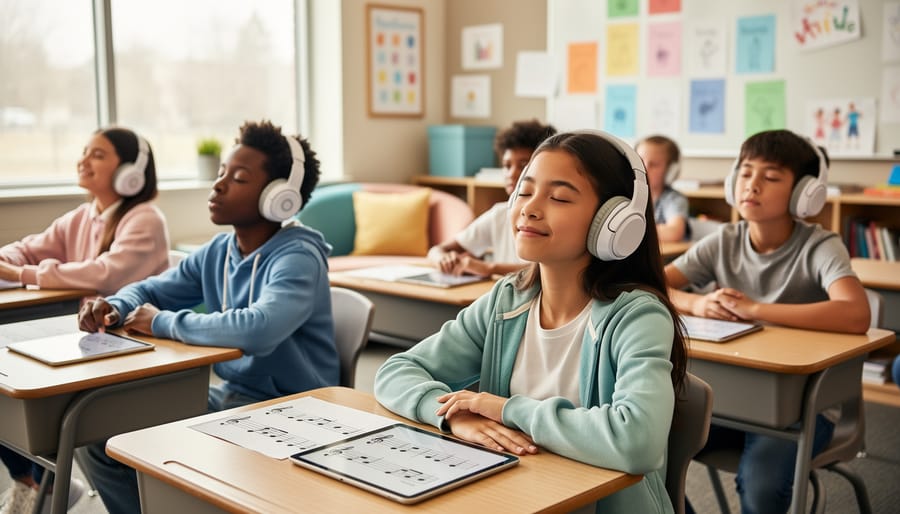
Provide noise-reducing headphones for students who need them, keep volume at conversational levels, and offer alternative participation options like silent movements or observing instead of singing. Most sensory-sensitive students tolerate music better when they can control their exposure level.
Can music integration work with limited technology or instruments?
Absolutely. Clapping, stomping, and vocal sounds cost nothing. A smartphone provides access to thousands of educational songs, and items like pencils, cups, and desks become percussion instruments for rhythm activities.
Many teachers worry about administrative pushback, but presenting music integration as a research-backed instructional strategy rather than entertainment typically addresses concerns. Share your integration plan with administrators before implementing it, frame music as a cognitive tool that supports curriculum standards, and track student response through observation notes or informal assessments.
The question of whether music integration fits with special education accommodations also arises frequently. Music actually supports many IEP goals related to following multi-step directions, improving memory, and developing social skills through group activities. Collaborate with special education staff to adapt musical activities for individual learning needs, and use music as a scaffold for students who struggle with traditional instruction methods.
Integrating music into your elementary classroom is both achievable and transformative, regardless of your musical background. The research is clear: students who experience regular music integration show improved memory retention, stronger pattern recognition skills, and increased engagement across all subject areas. These benefits don’t require conservatory training or expensive equipment, they emerge from consistent, intentional practice.
Start with one transition song this week. Add a subject-specific chant next month. Build your confidence gradually, and remember that your students will respond to your enthusiasm more than your perfect pitch. The educators who see the greatest impact are those who begin small and remain consistent, allowing music integration to become a natural part of their teaching rhythm rather than an overwhelming addition.
Your willingness to explore new approaches matters more than technical expertise. Every time you incorporate a multiplication song, use a rhythm pattern to teach syllables, or lead a movement-based review activity, you’re creating neural pathways that support deeper learning. The step-by-step process outlined in this guide gives you a proven framework, now it’s time to adapt it to your unique classroom and watch your students thrive.