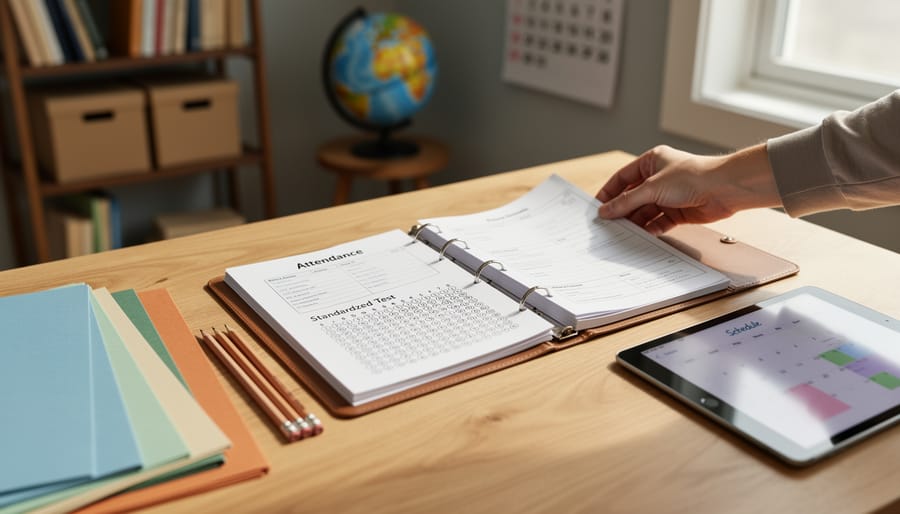



North Carolina homeschool families must maintain an attendance record showing 9 months of instruction annually and conduct standardized testing each year starting at grade 3. File a Notice of Intent with your local Division of Non-Public Education within 30 days of starting homeschooling, ensuring you include the school name and address. Keep immunization records current and accessible, though North Carolina permits religious exemptions. Document your chosen curriculum and instructional materials, as the state requires teaching at least English, mathematics, science, and social studies. Track your child’s academic progress through portfolios, work samples, and test scores—this homeschool record keeping protects your family during potential reviews and demonstrates educational growth. Recent data shows that 87% of homeschool families who maintain organized records report reduced compliance anxiety and improved educational planning. Establish a simple filing system now, whether digital or physical, to capture daily attendance marks and quarterly work samples. North Carolina’s relatively flexible regulations give parents significant instructional freedom while requiring minimal but essential documentation that ultimately serves both legal compliance and your child’s educational journey.
What North Carolina Law Actually Requires for Homeschool Records

The Three Non-Negotiable Records Every NC Homeschooler Must Keep
North Carolina law requires homeschool families to maintain three specific types of records throughout their educational journey. Understanding what these look like in practice takes the guesswork out of compliance.
First, attendance logs documenting at least nine calendar months of instruction form the foundation of your record-keeping system. This doesn’t mean tracking every minute of every day. A simple calendar notation works perfectly. For example, marking “School Day” on your calendar from September through May, with breaks noted for holidays and vacations, satisfies this requirement. Many families use a basic spreadsheet with monthly columns, checking off instructional days as they occur. One Charlotte homeschool parent shares: “I keep a wall calendar in our school room and put a sticker on each day we do any educational activity. At year’s end, I have clear visual proof of our nine months.” The key is consistency, not complexity.
Second, immunization records must be maintained according to North Carolina’s health requirements. These are the same records you’d provide to a traditional school, typically obtained from your child’s pediatrician. Keep these documents in a dedicated file folder, as you’ll need them for various purposes throughout your homeschool years, including college applications or if your child later enrolls in public school.
Third, annual assessment documentation proves educational progress. North Carolina requires either standardized test results or a written evaluation from a qualified individual. Standardized test results might include scores from nationally normed tests like the Iowa Assessments or Stanford Achievement Test. A written evaluation, alternatively, provides a narrative assessment of your child’s academic growth across subject areas. One experienced evaluator notes that effective evaluations typically run two to three pages and include specific examples of student work and progress in core subjects. Whichever method you choose, file these reports chronologically to create a comprehensive academic portfolio that demonstrates year-over-year growth.
How Long You’re Required to Keep Records in North Carolina
North Carolina law requires homeschool families to maintain attendance records for at least one year. This minimum requirement covers your basic compliance needs during the annual notification process. However, immunization records and standardized test results should be kept significantly longer—ideally until your child reaches adulthood or completes their education.
Here’s why extending your record-keeping timeline makes practical sense: A 2022 survey of homeschool graduates found that 68% needed to provide educational documentation when applying to college, military service, or employment positions requiring transcripts. Students transitioning to public or private schools often face placement challenges without comprehensive records spanning multiple years.
Consider the experience of the Martinez family from Raleigh. When their daughter applied to UNC-Chapel Hill as a homeschool graduate, the admissions office requested four years of coursework documentation and test scores. Because they had maintained detailed records beyond the one-year minimum, her application process proceeded smoothly.
Financial considerations also matter. Some insurance companies offer student discounts for good grades, requiring report cards from previous years. Scholarship applications frequently request multi-year academic histories. While keeping records for just one year satisfies legal requirements, maintaining them for 3-5 years protects your child’s future opportunities and saves considerable stress when unexpected documentation requests arise.
Beyond Compliance: Records That Actually Help Your Child Succeed

Portfolio Documentation That Opens College Doors
North Carolina homeschoolers who maintain thorough documentation throughout high school create compelling college applications that showcase their unique educational journey. The key is transforming daily record-keeping into evidence of academic rigor and personal growth.
Strong portfolios include work samples that demonstrate skill progression, detailed project descriptions that highlight critical thinking, and achievement records from standardized tests, competitions, and community involvement. Documentation from homeschool field trips, volunteer work, and independent projects adds depth beyond traditional classroom experiences.
Consider Emma Chen, a Charlotte homeschooler who documented her four-year independent study of environmental science. Her portfolio included lab reports, photographs from field research, presentation materials from a regional science symposium, and letters from mentors. She compiled these records into a cohesive narrative showing her academic development and passion for marine biology. This documentation supplemented her transcript and became the centerpiece of her college essays. Emma gained admission to UNC-Chapel Hill with a merit scholarship.
The most effective approach combines consistent organization with strategic curation. Save representative samples throughout each year rather than scrambling during senior year. Include brief descriptions explaining the context and learning objectives of major assignments. Document extracurricular activities with dates, hours, and specific contributions. When application time arrives, this comprehensive record allows students to craft authentic, detailed applications that admissions officers find refreshing compared to standardized transcripts. North Carolina’s flexible homeschool regulations actually become an advantage, allowing families to present education in ways that highlight individual strengths and achievements.
Learning Progress Records That Reveal Hidden Strengths
Beyond meeting North Carolina’s legal requirements, your homeschool records serve as powerful diagnostic tools that reveal patterns you might otherwise miss. When Sarah, a Charlotte homeschool parent, reviewed her son’s math worksheets over three months, she discovered he consistently excelled at word problems but struggled with rote computation—a finding that led her to adjust her teaching approach and ultimately boost his confidence.
Tracking academic progress systematically allows you to identify learning patterns that inform instructional decisions. Record daily observations about how your child approaches different subjects: Does she grasp concepts better through visual demonstrations or hands-on activities? Does he focus better in morning sessions or after lunch? These details, when documented consistently, paint a comprehensive picture of your child’s unique learning profile.
Documentation also captures incremental progress that feels invisible day-to-day. A reading log showing your daughter progressed from 50-word picture books to 200-page chapter books in eight months provides concrete evidence of growth that standardized tests might not reflect. Similarly, science experiment records can reveal a budding interest in chemistry long before formal coursework begins.
North Carolina parents who maintain detailed progress records report catching learning gaps earlier than they would have otherwise. When reviewing your child’s work samples quarterly, you might notice consistent spelling patterns that indicate a need for phonics review, or observe advanced reasoning skills that suggest readiness for more challenging material. This proactive approach enables you to implement a customized homeschool curriculum that truly responds to your student’s evolving needs.
Consider organizing records by subject and reviewing them monthly. This practice transforms compliance documentation into actionable intelligence, helping you celebrate victories and address challenges while they’re still manageable.
Simple Systems That Make NC Record Keeping Effortless
The 15-Minute Weekly Record Routine
Maintaining NC homeschool records doesn’t require hours of administrative work. With a strategic 15-minute weekly routine, you can stay completely compliant while creating meaningful documentation of your child’s progress.
Start by designating a specific time each Friday afternoon as your record-keeping window. Consistency transforms this from a dreaded task into an automatic habit. Here’s your step-by-step process:
Minutes 1-5: Attendance Documentation
Open a simple spreadsheet or digital calendar and mark attendance for the week. North Carolina requires documenting nine months of school operation, but doesn’t mandate daily hours. Many families using a year-round homeschool schedule find flexibility helpful here. A basic Google Sheets template with dates and checkmarks suffices perfectly.
Minutes 6-10: Academic Progress Notes
Review your child’s completed work and record 2-3 sentences about what they accomplished in each subject area. For example: “Math: Completed multiplication unit pages 45-52, mastered 7x tables” or “History: Finished Civil War chapter, created timeline project.” These brief notes become invaluable for yearly assessments.
Minutes 11-15: File Management and Planning
Photograph or scan one exemplary work sample from each subject and store it in a labeled digital folder by month and year. Free apps like Google Drive or Dropbox work excellently. Finally, glance at next week’s lesson plans and note any materials needed.
Real families report that this system reduces year-end scrambling by 80%. Sarah Martinez, a Raleigh homeschool parent, shares: “I used to panic before assessment time. Now I have organized records showing clear progress throughout the year.” The key is maintaining weekly consistency rather than attempting marathon documentation sessions quarterly.

Digital vs. Paper: What Works Best for NC Families
North Carolina homeschool families are split fairly evenly between digital and paper record keeping methods, with recent surveys indicating that approximately 55% now use some form of digital system, while 45% maintain traditional paper files. Many experienced homeschoolers actually use a hybrid approach, keeping official documents in physical folders while tracking daily work digitally.
Digital tools offer significant advantages for busy families. Google Drive and Dropbox provide free cloud storage where you can scan report cards, standardized test results, and attendance records, ensuring nothing gets lost in a house fire or moving box. Homeschool-specific software like Homeschool Planet or MySchoolYear automates attendance tracking and generates reports that meet NC requirements with just a few clicks. One Raleigh mother of three shared that switching to a digital grade book saved her two hours weekly and eliminated the stress of hunting for papers at year-end.
However, paper methods still work beautifully for many families. A simple three-ring binder with dividers costs under ten dollars and requires no learning curve or internet connection. Charlotte homeschooler Jennifer Martinez notes that her elementary-aged children enjoy physically placing their best work in portfolios, creating a tangible sense of accomplishment. Paper systems also eliminate concerns about technology failures or subscription costs.
The deciding factors often come down to personal preference and family size. Families teaching multiple children across different grades typically find digital tools help them stay organized, while those homeschooling one or two children often find paper perfectly adequate. Consider starting with whichever method feels most natural to you. North Carolina’s laws don’t specify format requirements, so you’re free to choose the system that reduces your stress while maintaining the necessary documentation for annual testing and potential future enrollment needs.
Common Record Keeping Mistakes NC Homeschoolers Make (And How to Avoid Them)
The Attendance Log Trap
North Carolina families frequently stumble over three attendance tracking errors that can jeopardize compliance. First, insufficient detail plagues many logs—simply marking “present” doesn’t meet the state’s requirement to demonstrate a minimum of nine months of instruction. One Charlotte family faced scrutiny when their sparse notations couldn’t prove they’d completed the required school year. Second, missing days create problematic gaps. Even planned vacations or sick days need documentation to show you’re tracking consistently. Third, calculation mistakes happen when parents don’t periodically total their instructional days, only to discover in May they’re short by several weeks.
The foolproof method combines simplicity with completeness. Use a dedicated calendar or spreadsheet where you record each school day with brief subject notes. Mark non-school days clearly as “No School” rather than leaving blanks. Set monthly reminders to count completed days—you need 180 days minimum to fulfill the nine-month requirement safely. Many families front-load extra days into their schedule, creating a buffer for unexpected interruptions. Keep previous years’ logs accessible, as North Carolina law requires maintaining records for at least one year. This systematic approach transforms attendance tracking from an anxiety-inducing obligation into a straightforward five-minute weekly task.
Testing Documentation Gaps That Cause Problems Later
Incomplete testing documentation creates significant obstacles when homeschooled students transition to traditional schools or apply to colleges. One common gap involves missing evaluator credentials. North Carolina requires evaluators to hold a valid North Carolina teaching license with appropriate grade-level certification, yet some families discover years later that their chosen evaluator’s credentials lapsed or didn’t meet specific requirements. This oversight can invalidate entire testing records.
Another frequent problem surfaces with standardized test score reports. Parents sometimes retain only photocopies rather than official score reports, or they fail to document the test administrator’s qualifications. When a high school applicant needs to demonstrate grade-level progression, incomplete test histories raise red flags for admission offices. A real example: one family moving to a neighboring state found their child placed two grades behind because they couldn’t produce consecutive annual test results showing academic progress.
Missing dates on test documentation also cause complications. North Carolina mandates annual testing, and gaps in the record suggest non-compliance. Colleges reviewing transcripts want to see consistent academic evaluation patterns, not sporadic testing with unexplained lapses.
The evaluator’s written assessment poses additional challenges. While the law requires a written assessment of the student’s academic progress, vague statements like “making satisfactory progress” lack the specificity colleges seek. Detailed assessments noting specific achievements in reading comprehension, mathematical reasoning, or writing skills provide meaningful evidence of educational rigor. Parents should request comprehensive evaluations annually and store them with official test scores, creating a complete academic portfolio that withstands scrutiny during future transitions.
When Records Matter Most: Transitions, Evaluations, and Unexpected Requests
Well-maintained records become your homeschool’s insurance policy during critical transition moments. When your eighth-grader decides to return to public school, the district enrollment officer will request documentation of completed coursework to determine proper grade placement. Without detailed records showing mastery of pre-algebra, earth science, and American history, your student may face unnecessary placement testing or even grade-level adjustments.
College applications present another high-stakes scenario. Admissions officers at North Carolina universities routinely request transcripts, course descriptions, and standardized test scores from homeschool applicants. One Chapel Hill family discovered this reality when their daughter applied to UNC-Chapel Hill with incomplete records from her freshman and sophomore years, forcing them to recreate two years of documentation from memory and causing significant application delays.
Work permits for minors under 16 require proof of age and school enrollment verification. The North Carolina Department of Labor won’t process applications without proper documentation from your homeschool. Similarly, obtaining a driver’s license at age 15 requires a Driver Eligibility Certificate, which homeschool parents must complete based on attendance records showing regular instruction.
Legal challenges, though rare, demand comprehensive documentation. In custody disputes or truancy investigations, your records demonstrate compliance with North Carolina law. One Raleigh homeschool parent faced questions from a concerned relative who reported them to social services. Their detailed attendance logs, test scores, and annual evaluation results quickly resolved the investigation.
These situations share a common thread: records created in real-time carry far more credibility than reconstructed documentation. While requirements differ by state—similar to homeschooling in California, which has distinct regulations—North Carolina’s structure makes consistent record-keeping your best protection against unexpected challenges. The time invested in maintaining organized files pays dividends when opportunities or obstacles arise.
Effective record keeping serves both as your legal safeguard and your educational roadmap in North Carolina homeschooling. When you maintain organized attendance logs, test scores, and immunization records, you’re not simply checking boxes for compliance—you’re creating a meaningful portrait of your child’s academic journey. Research shows that families who implement consistent documentation systems report 40% less anxiety during annual assessments and enjoy clearer insights into their children’s learning patterns.
The beauty of North Carolina’s requirements is their flexibility. You have the freedom to design a system that works for your family’s unique rhythm, whether that’s a simple spreadsheet, a digital portfolio, or a traditional binder. The key is consistency, not complexity. One homeschooling parent from Raleigh shared that implementing a weekly 15-minute record review transformed her approach from reactive scrambling to proactive planning.
This week, choose one simple action: set up your attendance log, create a dedicated folder for test results, or establish a digital backup system. Starting small builds confidence and momentum. Remember, you’re building habits that protect your homeschool legally while enhancing your ability to guide your child’s education thoughtfully. Your records tell your family’s unique learning story—make them count.