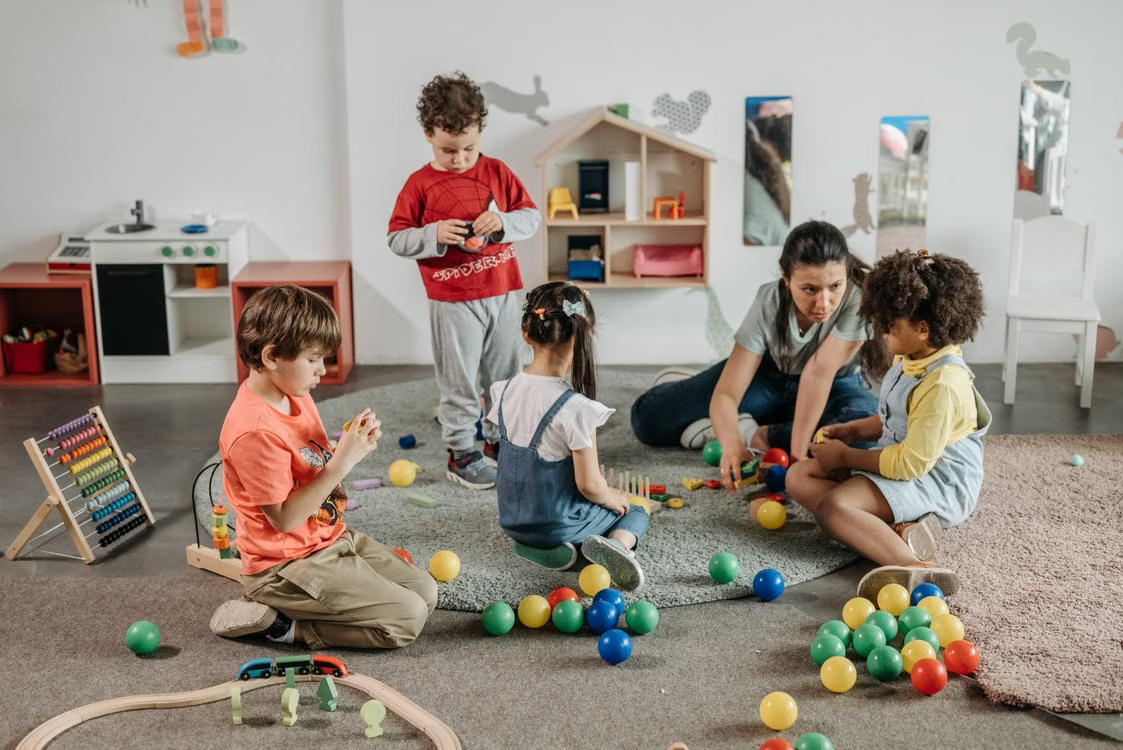


Ever seen a 4-year-old work on a block tower for 40 minutes and questioned if they need to be doing worksheets?
That’s a reasonable question. Every parent hears the same sales pitch. Flashcards. Alphabet apps. Workbooks for toddlers who still need diapers. Meanwhile the preschool classroom across the street is organised chaos. Blocks on the floor. A line for the pretend grocery store. Someone is screaming they are a dinosaur.
Here’s the twist:
That chaos does more test-relevant work than worksheets ever will.
Not “sometime”. Not someday down the road based on feelings. The very skills a Year 1 teacher tests in term one – follow a two-step instruction, hold a pencil, stick with a difficult task, use words not hands – are developed in the block corner.
Here’s how it works…
Here’s what’s coming up:
- Why Schools Are Worried About School Readiness
- The Four Skills Classrooms Actually Measure
- What The Research Says About Play vs Instruction
- How To Spot Real Play-Based Learning
Why Schools Are Worried About School Readiness
Australian teachers test every Australian child in their first year of school in 5 categories. They are physical health, social competence, emotional maturity, language and cognition, and communication.
National data from the latest release is concerning. 23.5% of Australian children were developmentally vulnerable in one or more areas when starting school, up from 22% in 2021. Only 52.9% were on track in all five areas.
Read that again…
Almost 1 in 4 children arrive at school already behind. And the greatest declines were in emotional readiness and social skills — the abilities that determine whether a child can sit in a circle, wait their turn and persevere when faced with something challenging.
And it gets worse. The proportion experiencing difficulty in two or more areas jumped to 12.5% of children, the highest rate since the inception of the census.
So it makes sense that parents feel pressure to “get ahead” with early academics. The issue is that the pressure is almost always directed at the wrong thing.
That is why the quality of early childhood programs is so important. High-quality play-based childcare spends its whole day focusing on those five areas. Not because they are being lenient on academics but because those are what schools look at first. Play-based learning teaches. School readiness is achieved.
The Four Skills Classrooms Actually Measure
Classroom testing appears as reading, writing and maths. Beneath the surface it involves measuring something much narrower.
Executive Function
Executive function is the wonky term for a very important set of skills: working memory, self-control and mental flexibility. It’s what allows you to keep an instruction in mind, tune out a distraction and shift gears without melting down.
Everything a child sits a test on relies on it. If a child can decode words but isn’t able to sit with the page they will fail anyways.
Where does it happen? Places that have games with rules. Places where you take turns. Places with long involved pretend play where you have to remember you’re the teacher, remember the rules of the classroom, and then switch gears when your friend rewrites the plot mid-scenario.
That’s executive function training dressed up as fun.
Language That Stretches
Lexicon is one of the best predictors of reading comprehension. And kids learn exponentially more words through authentic conversational turns than they ever will from flashcards with labels on them.
Make-believe play is a language machine. Children use longer sentences, bigger words and more complex grammar when playing store than when responding to a simple yes/no question.
Early Maths And Spatial Thinking
Sorting. Counting them out. Making patterns. Figuring out that one long block is two short ones.
Block play, in particular, develops spatial reasoning – that skill that lies beneath geometry, fractions and (later) maths achievement.
Social Competence
This one gets dismissed as a “nice to have”. It isn’t.
A kid that can compromise, share, read a room and brush off an argument is a kid that can learn in a classroom of 25 other students. Social intelligence is not disconnected from classroom achievement. It IS classroom achievement.
What The Research Says About Play vs Instruction
Here’s the part that surprises people…
Play-based learning doesn’t mean that adults need to sit back and observe. Research shows us that the most powerful impact comes from guided play – child-led activity with an educator facilitating with questions, providing an extension or adding a challenge to stretch thinking just a bit further.
Guided play research has shown benefits in both the short-term and long-term development of kids. Researchers at Cambridge analyzed 39 studies on guided play and conducted a meta-analysis on those with the strongest designs. Compared with direct instruction, guided play delivered better results in early maths, knowledge of shapes, and task switching.
Let that land. Not “just as good”. Better — on maths, of all things.
Why? Because they care. When a child cares about what they are learning they are truly paying attention. And attention is where all knowledge is gained. Drill a disinterested five-year-old on shapes and you’ll get obedience. Build them a rocket and count the triangles and you’ll get comprehension.
How To Spot Real Play-Based Learning
Every centre says it’s play-based. Not every centre is.
Here’s what to look for when touring early childhood education programs:
- Educators down at child height — asking questions, not supervising from the sidelines
- Long, uninterrupted blocks of time — deep play needs 45 minutes, not 15
- Open-ended materials — blocks, fabric, loose parts, sand, water
- Outdoor access for most of the day — space, movement and manageable risk
- Documentation on the walls — photos and notes explaining what children were learning
- A loose schedule, not a strict timeline — flexibility to pursue curiosity
And the red flags?
Worksheets in a preschool room are a warning sign, not a selling point
Rooms full of worksheets. Every kid doing the same thing at the exact same time. Teachers who can’t articulate what their child is learning while they play.
When a centre cannot answer the question, “what skill is this building?” then they are supervising. Not teaching.
The Takeaway
Play-based learning gets treated like the gentle option. The evidence says otherwise.
Guided play outperforms direct instruction on some of the specific objectives classrooms later assess. Guided play develops the executive function that every test indirectly measures. Guided play also fosters the vocabulary that supports reading comprehension throughout childhood.
To quickly recap:
- Students are measured on five areas of school readiness and Australian trends are negative
- Classroom testing skills are built upon executive functioning skills, language skills, spatial skills, and social competence
- Instruction in guided play improves children’s skills at least as much as direct instruction, and possibly more
- Quality early childhood programs employ competent teachers and offer extended blocks of play with open-ended materials
- Worksheets in a preschool room are a warning sign, not a selling point
The tower isn’t a break from learning.
The tower is the learning.