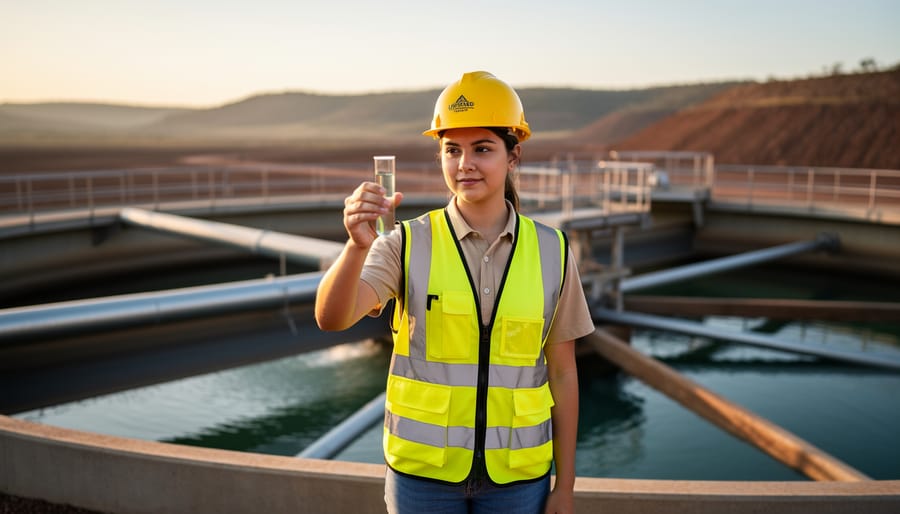



The global eco consciousness today is seeking transition from a consciousness of concern to a consciousness of competence. For the last decade, the education system has successfully raised the most eco-conscious generation in history, but the system has simultaneously triggered a mental health crisis labeled ‘eco-anxiety.’ By shifting the learning discourse toward a strategic industrial case-study model that raises modern and practical agency, the education system addresses what is currently slipping through our fingers: the transition from students who fear the future to professionals who have the technical grit to build it.
Use Real-World Examples like Mine Water Treatment to Replace Abstract Lessons
For students, reducing the learning to terms like “save the planet” or “reduce pollution” are too vague, overwhelming, and psychologically distant to motivate daily action. The language feels distant because it rarely shows them how real industries wrestle with environmental pressure every single day.
However, when you introduce the practicality with innovations like Mine Water Treatment Solutions that remove heavy metals, acidity, suspended solids and other contaminants from water used or produced in mining, you move the conversation from “moral philosophy” to “applied science.” That’s core factor in shifting the student’s identity from a passive observer who turns to just feeling guilty about the problem, to an active professional empowered by practical solutions.
You can challenge students to:
- Analyze simulated treatment-plant discharge data
- Predict how aquatic ecosystems react to contamination
- Debate whether a mining company’s strategy is sustainable or simply compliant
The conversation becomes even more powerful when students encounter systems like the SART process, where waste recovery and environmental protection intersect. That moment matters because the society start realizing that sustainability is not about stopping industry, but more often about redesigning processes intelligently. And honestly, that realization feels empowering.
Teach Environmental Responsibility through Watershed Governance Simulations
One reason environmental education feels dry is because students rarely experience the tension behind environmental decisions. Everything gets simplified into “good choices” and “bad choices,” when reality is far messier. A watershed governance simulation changes the atmosphere instantly.
Now the classroom feels alive. One student is trying to protect a river system. Another is trying to preserve jobs in a mining town. Someone else is defending Indigenous land rights while another struggles to balance public budgets.
That complexity is where real learning happens. Students may take roles such as:
- Water regulators
- City planners
- Mining executives
- Indigenous community representatives
As negotiations unfold, students begin understanding something important: sustainability is not built through perfection. It is built through difficult conversations, trade-offs, listening, and long-term thinking.
And when you introduce concepts like rivers having legal rights, students stop seeing nature as scenery in the background. They begin seeing ecosystems as stakeholders with value beyond economics. That shift in perspective is not small. It changes how they think about responsibility itself.
Make Waste Impossible to Ignore Through School Audits
Most waste remains invisible until someone is forced to touch it, sort it, weigh it, and smell it. That is why school waste audits work so well. Teaching methods that move away from academic theory into the psychology of teaching are effective, and is exactly what learners crave for.
For example, when discussing about the problem of single-use packaging and waste food, the moment students stand in front of overflowing bags of cafeteria waste, disposable packaging, and untouched food, the conversation becomes real in a completely different way.
There is something deeply confronting about realizing your own routines create systems of waste almost automatically.
Students can:
- Measure how much waste their classroom creates weekly
- Identify patterns in paper and plastic use
- Investigate which habits produce unnecessary waste streams
But the real breakthrough comes after the audit. Instead of ending with blame, students move into redesign mode. They begin asking practical questions:
- Could recycled cardboard improve insulation?
- Could digital systems reduce unnecessary printing?
- Could classroom environments become easy to assimilate and smarter instead of simply stricter?
That transition from guilt to design thinking is where environmental responsibility starts feeling constructive rather than performative.
Using AI and Digital Tools to Build Futures Students Actually Want to Live In
Too many environmental lessons accidentally trap students inside visions of collapse. After a while, fear stops motivating people. It just exhausts them. Technology can help reverse that feeling.
Well-curated AI tools, virtual ecosystems, and digital simulations give students space to imagine futures that are not defined by disaster, but by adaptation, creativity, and smarter systems.
Students can:
- Create future debates about environmental laws
- Design cities powered by recycled infrastructure
- Experiment with virtual ecosystems without causing real-world damage
The beauty of digital simulations is that failure becomes safe. Students can test risky decisions, alter water quality, redesign cities, and immediately see the consequences.
That kind of experimentation builds confidence. Instead of growing up believing environmental damage is inevitable, students begin seeing sustainability as a field full of invention, leadership, and possibility.
In essence, when students are taught only about “systems of collapse,” their brains go into a freeze response. However, by introducing specific, solvable problems like a SART process or Watershed Governance, you provide the “steering wheel.” Also, partnering with real-world service providers proves to the student that innovations are already working on these puzzles, which lowers cortisol and raises focus.