



Texas families have more flexibility in online homeschooling than most states realize, with over 400,000 homeschooled students statewide and no mandatory state registration requirements. This educational freedom creates both opportunity and complexity for parents navigating their options.
Online homeschooling programs in Texas fall into three distinct categories: fully accredited online schools that issue diplomas, comprehensive curriculum providers that supply materials and guidance, and supplemental platforms that enhance parent-led instruction. Understanding these differences determines everything from your daily involvement level to your child’s transcript validity for college admissions.
The financial landscape ranges from completely free public virtual schools to premium private programs exceeding $10,000 annually. Recent data shows 68% of Texas homeschooling families spend between $500-$2,500 per student yearly, with online programs typically falling in the higher end of this spectrum due to their structured support and technology platforms.
Texas law treats homeschools as private schools, requiring instruction in five core subjects: reading, spelling, grammar, mathematics, and citizenship. No standardized testing, teacher certification, or curriculum approval is mandated, giving families complete autonomy in selecting online programs that match their educational philosophy and learning needs.
This guide examines the most established online homeschooling programs serving Texas families, breaks down their costs and commitment levels, and provides decision-making frameworks based on real parent experiences. Whether you need full-time structure or flexible supplementation, understanding the Texas-specific landscape ensures you select a program that supports both legal compliance and educational success.
Understanding Texas Homeschool Laws and Online Learning
What Texas Law Requires from Homeschoolers
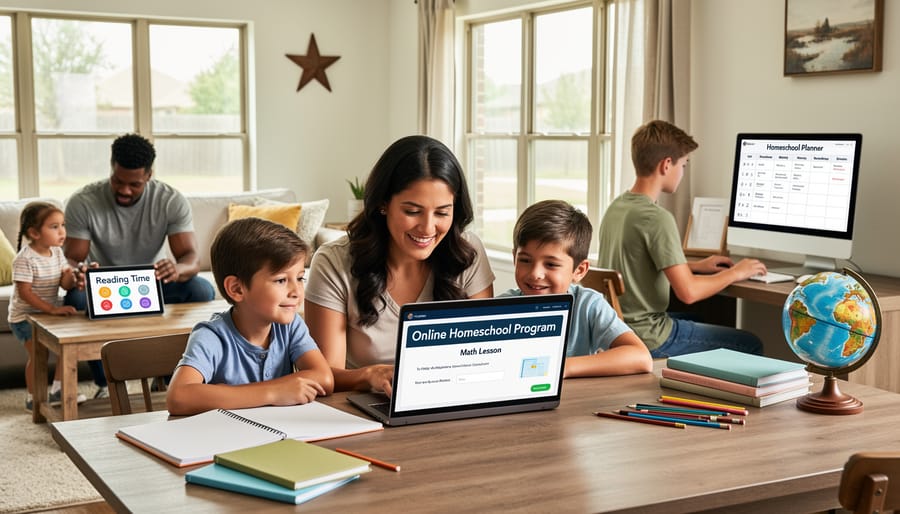
Texas maintains a notably flexible approach to homeschooling compared to many states, requiring just three fundamental elements for legal compliance. First, parents must provide bona fide instruction, meaning genuine educational instruction rather than informal learning activities. This doesn’t require teaching credentials—any parent can legally homeschool their children in Texas.
Second, families must follow a written curriculum covering five core subjects: reading, spelling, grammar, mathematics, and good citizenship. While Texas doesn’t mandate specific textbooks or programs, having documentation of your chosen curriculum is essential for keeping homeschool records. Many online programs automatically meet this requirement by providing comprehensive course materials across all required subjects.
Third, the instruction must be presented in visual format, which includes traditional textbooks, workbooks, computer-based programs, and video lessons. This requirement makes online homeschooling programs particularly well-suited for Texas families, as digital platforms naturally fulfill the visual format mandate through interactive lessons, educational videos, and digital texts.
Importantly, Texas doesn’t require homeschoolers to register with the state, submit attendance records, administer standardized tests, or undergo home visits. According to the Texas Homeschool Coalition, approximately 350,000 Texas students are homeschooled under these straightforward requirements, demonstrating how accessible this educational option has become for families statewide.
How Online Programs Meet State Requirements
Online homeschooling programs operating in Texas streamline compliance by automatically providing features that align with state requirements. Since Texas law doesn’t mandate curriculum approval, testing, or reporting to authorities, most reputable platforms already exceed what’s legally required. These programs typically offer comprehensive curriculum coverage, detailed record-keeping systems, and attendance tracking—all valuable for documentation even though Texas doesn’t require submission to education officials.
For example, platforms like Time4Learning and K12-powered schools generate transcripts and progress reports that parents can retain for their records. According to recent surveys, approximately 78% of Texas homeschooling families use some form of digital record-keeping, with online programs making this process seamless through built-in gradebooks and automated progress tracking.
Many online programs also provide standardized assessments, which, while not required by Texas law, help parents monitor academic growth and prepare students for college entrance exams. The curricula offered typically align with national standards and college-preparatory frameworks, ensuring students remain academically competitive. Parents appreciate that these platforms handle the educational heavy lifting while they maintain the legal autonomy Texas homeschoolers enjoy, creating a practical balance between structure and flexibility.
Types of Online Homeschool Programs Available in Texas

Full-Time Online Accredited Schools
Full-time online accredited schools offer a comprehensive virtual education experience that closely mirrors traditional schooling while providing the flexibility of home-based learning. These programs deliver state-approved curricula, credentialed teachers, and diplomas recognized by colleges and employers across Texas and beyond.
Texas Virtual Academy (TXVA), part of the K12 network, serves students in grades K-12 and operates as a tuition-free public charter school. Students receive structured lesson plans, live class sessions with certified teachers, and all necessary learning materials shipped directly to their homes. According to recent enrollment data, TXVA has helped thousands of Texas families access quality education with individualized pacing and regular progress monitoring.
Connections Academy Texas also provides a complete accredited program at no cost to families. Students benefit from a balanced schedule combining self-paced coursework with real-time virtual instruction. Teachers hold office hours, conduct assessments, and maintain regular communication with families to ensure student success.
These full-time programs typically require students to follow attendance policies, complete standardized testing, and meet state graduation requirements. Parents serve as learning coaches, providing daily supervision and support, while professional educators handle curriculum delivery and academic evaluation. This model works particularly well for families seeking structure without sacrificing flexibility, students with special learning needs, or those living in areas with limited traditional school options.
Curriculum-Only Online Programs
For Texas families seeking flexibility without formal school enrollment, curriculum-only programs offer parent-directed learning materials that align with your pace and schedule. These programs provide structured content while you maintain complete control over instruction and record-keeping, which works perfectly within Texas’s homeschool-friendly regulations.
Time4Learning stands out as a popular choice, offering interactive lessons for pre-K through 12th grade at approximately $25-$55 monthly per student. The platform includes automated grading and progress tracking, making it easier to monitor your child’s advancement. Parents report that the multimedia approach particularly engages visual and kinesthetic learners.
Khan Academy provides completely free, comprehensive content covering math, science, history, and more. While it lacks the structured grade-level progression of paid programs, it excels as a supplemental resource or foundation for a customized homeschool curriculum. Data shows over 18 million students use Khan Academy monthly, testament to its effectiveness.
Easy Peasy All-in-One Homeschool offers another free option with complete daily lesson plans. Parents appreciate the Christian-based content and minimal preparation required.
These curriculum-only programs require parental commitment for teaching and assessment but offer significant cost savings and scheduling freedom, making them ideal for dedicated homeschooling families.
Hybrid and Part-Time Options
Many Texas families find that a hybrid approach offers the ideal balance between online flexibility and in-person community. These programs typically combine independent online coursework during the week with scheduled group classes at physical locations, providing students with structured social interaction while maintaining homeschooling’s flexibility.
University-style homeschool co-ops have grown increasingly popular across Texas, meeting one or two days weekly. Students attend classes like science labs, foreign languages, or fine arts taught by parent-volunteers or hired instructors, while completing core subjects online at home. According to a 2023 survey of Texas homeschoolers, approximately 40 percent participate in some form of co-op arrangement, with metropolitan areas like Houston, Dallas, and Austin offering the most options.
Part-time enrollment programs through local school districts represent another hybrid option. Some Texas districts allow homeschooled students to participate in specific classes, extracurricular activities, or UIL competitions while remaining primarily homeschooled. This arrangement works particularly well for families wanting access to advanced science equipment, competitive sports, or specialized electives like band or robotics.
Faith-based hybrid schools have also expanded throughout Texas, offering 2-3 day weekly programs that complement home-based online learning. These programs provide academic oversight, transcript management, and built-in socialization opportunities that many parents value during their homeschooling journey.
Top Online Homeschool Programs for Texas Families

Texas Virtual Academy (TXVA)
Texas Virtual Academy (TXVA) offers a tuition-free, public school option for Texas families seeking online education. As a state-funded program, TXVA provides online homeschool courses taught by Texas-certified teachers, making it accessible to families across the state without financial barriers.
The program serves students in grades K-12 with a comprehensive curriculum that meets all Texas Education Agency standards. Families receive educational materials shipped directly to their homes, including textbooks, workbooks, and necessary supplies. Students participate in live virtual classes, complete assignments through an online learning platform, and engage with teachers during scheduled office hours.
Enrollment typically opens in spring for the following school year, though mid-year openings may be available based on capacity. According to recent data, TXVA serves over 8,000 students annually, with families reporting appreciation for the structured schedule and direct teacher support. Parents act as learning coaches, dedicating approximately 4-6 hours daily to facilitate younger students’ education, while older students work more independently with periodic check-ins.
K12 and Connections Academy
K12 and Connections Academy stand as two of the nation’s largest online education providers, both offering tuition-free public virtual school options to Texas families. K12 powers multiple Texas virtual academies, including Texas Virtual Academy and Inspire Texas, serving students in kindergarten through 12th grade. These programs operate as public charter schools, meaning they’re funded by the state and follow Texas education standards while providing flexibility for home-based learning.
Connections Academy partners with school districts across Texas to deliver its curriculum, combining live online classes with recorded lessons and interactive materials. Both platforms provide enrolled families with computers, curriculum materials, and internet reimbursement in most cases. Students receive certified Texas teachers who conduct virtual classes, monitor progress, and offer regular office hours for support.
Accreditation comes through their respective school districts and charter authorizers, ensuring diplomas carry the same weight as traditional public schools. According to recent enrollment data, K12-powered schools in Texas serve over 8,000 students annually, while Connections Academy reaches thousands more. Both platforms offer robust parent support through learning coaches, technical assistance teams, and online communities where families share strategies and experiences navigating virtual education.
Power Homeschool and Acellus Academy
Power Homeschool and Acellus Academy offer Texas families budget-friendly alternatives to traditional homeschooling curricula, with monthly subscriptions starting around $25-$65 per student. Both programs utilize the Acellus Learning System, a video-based platform that automatically grades assignments and tracks student progress, making them particularly attractive to working parents who need structured yet flexible learning.
Power Homeschool operates as a parent-directed curriculum provider where families maintain full control over their homeschool program and are responsible for record-keeping and transcript generation. Parents can customize pacing and course selection while students work independently through video lessons that adapt to their performance.
Acellus Academy functions as an accredited private school option, handling administrative tasks including transcripts and diplomas. According to user data, approximately 60% of Texas families choose Power Homeschool for its affordability and flexibility, while others prefer Acellus Academy’s accreditation benefits for college preparation.
Both programs cover core subjects plus electives, though some parents supplement with additional resources for subjects like writing. The self-paced format allows students to accelerate in strong areas or take extra time where needed, appealing to families seeking economical solutions without sacrificing educational structure.
Time4Learning and ABCmouse (Elementary)
For elementary-aged Texas homeschoolers, game-based platforms offer engaging alternatives to traditional curricula. Time4Learning provides a comprehensive PreK-8th grade program covering math, language arts, science, and social studies through interactive lessons and animated activities. The platform costs $24.95 monthly for one student (PreK-8th) with additional students at $14.95 each, making it budget-friendly for larger families. Parents receive automated grading, progress tracking, and printable worksheets to supplement digital learning.
ABCmouse targets younger learners (ages 2-8) with over 10,000 games, songs, and activities across reading, math, science, and art. At approximately $12.99 monthly, it’s one of the most affordable options for early learners. According to independent studies, students using ABCmouse showed measurable gains in early literacy skills after regular use.
Both programs work well as primary curriculum for younger students or as supplemental enrichment. Texas homeschooling families appreciate the flexibility to work at their own pace while maintaining detailed records for portfolio documentation, as required under state law for homeschooling families.
What Texas Parents Need to Consider When Choosing a Program
Accreditation and College Readiness
For Texas families planning for college, accreditation becomes particularly important at the high school level. Accredited online programs provide transcripts that colleges readily recognize, streamlining the admission process. Regional accreditation—such as AdvancED or Cognia—carries the most weight with admissions offices nationwide. According to the National Center for Education Statistics, approximately 87% of homeschooled students who applied to college were accepted, matching or exceeding traditional students’ acceptance rates.
When evaluating programs, verify they offer official transcript services and maintain proper accreditation status. Texas Tech University K-12 and University of Texas High School, both regionally accredited, generate transcripts automatically as students complete coursework. This documentation proves invaluable during college applications.
For families using non-accredited curricula, you’ll need to create transcripts independently. Many Texas homeschoolers successfully compile portfolios, standardized test scores like SAT or ACT results, and dual credit coursework from community colleges to strengthen applications. Several Texas families report that maintaining detailed records from ninth grade forward made transcript creation manageable and helped their students gain admission to competitive universities including UT Austin and Texas A&M. Consider scheduling college entrance exams by junior year to demonstrate academic readiness alongside your homeschool transcript.
Cost Considerations and Free Options
Texas families have access to several no-cost options alongside paid programs. The Texas Virtual School Network (TxVSN) offers free online courses to eligible Texas students enrolled in public schools, though it functions as course supplementation rather than a full-time homeschool program. Texas public virtual charter schools like Texas Virtual Academy and Inspire Texas provide completely free, full-time online education with certified teachers, curriculum materials, and even computers and internet stipends for qualifying families. These publicly funded options served over 30,000 Texas students in 2022-23.
For families pursuing private homeschooling, costs vary significantly. Subscription-based programs like Time4Learning range from $20-$55 monthly per student, while comprehensive curricula such as Abeka or Sonlight may cost $500-$1,200 annually. Many Texas homeschoolers reduce expenses by mixing free resources like Khan Academy with low-cost options or purchasing used curriculum through local co-ops.
Budget-conscious families should also investigate local library resources, free state-provided textbooks through some public school districts, and scholarship programs offered by private online academies. According to Texas Homeschool Coalition data, the average annual homeschooling cost ranges from $300 to $1,800 per child, making it accessible across different income levels with thoughtful planning.
Flexibility vs. Structure: Finding Your Balance
Choosing between structured and flexible programs depends on your child’s learning style and your family’s daily rhythm. Structured programs provide fixed schedules, live class times, and regular deadlines—ideal for students who thrive with routine or families needing predictable schedules around work commitments. For example, a 2023 Texas homeschool survey found that 62% of families with working parents preferred scheduled classes for accountability.
Conversely, self-paced programs offer freedom to learn anytime, allowing families to travel, accommodate health needs, or let advanced learners move quickly through material. One Austin family reported their daughter completed eighth-grade math in five months using a flexible platform, then advanced to algebra early.
Consider your child’s self-motivation level. Does your student complete tasks independently, or do they need external structure? Also evaluate your availability—can you supervise irregular schedules, or do you need set school hours? Many Texas families successfully blend approaches, using structured core subjects with flexible electives, creating customized balance that serves their unique situation.
The Reality of Online Homeschooling: What Texas Parents Say
Texas homeschooling families report varied experiences with online programs, offering valuable insights for parents just beginning their research. According to recent Texas Homeschool Coalition data, approximately 78% of families using online programs express satisfaction with their choice, though the transition period often presents unexpected challenges.
Sarah Martinez from Austin shares that her family’s first semester with an online program required significant adjustment. “We underestimated the parental involvement needed, especially for younger children,” she explains. “Even with pre-recorded lessons, I spent 3-4 hours daily facilitating learning.” This aligns with survey findings showing that parents typically dedicate 15-25 hours weekly to online homeschooling, depending on their children’s ages and independence levels.
Common challenges identified by Texas families include maintaining student motivation, managing screen time concerns, and ensuring adequate socialization opportunities. However, parents also report substantial benefits. Jennifer Thompson from Dallas notes, “The flexibility allowed my daughter to pursue competitive gymnastics while staying academically on track. Her standardized test scores actually improved by 15% compared to her previous traditional school performance.”
Practical tips from experienced Texas homeschoolers prove invaluable for newcomers. Families recommend establishing dedicated learning spaces, maintaining consistent daily schedules, and connecting with local homeschool co-ops for social interaction. Many parents emphasize the importance of making homeschooling engaging through hands-on activities that complement online lessons.
Data from 500 Texas homeschooling families reveals that 65% combine online programs with traditional textbooks or supplemental resources, while 82% participate in at least one extracurricular activity outside their online program. The most successful families report treating online homeschooling as a customizable framework rather than a rigid curriculum, adapting programs to fit their children’s learning styles and family schedules. These real-world perspectives underscore that while online homeschooling requires commitment and flexibility, it offers Texas families a viable pathway to personalized education.
Setting Up for Success: Tech Requirements and Learning Environment
Successfully launching an online homeschool program in Texas starts with ensuring you have the right technical foundation. Most programs require a computer or laptop less than five years old with updated operating systems—Chromebooks work well for elementary students, while middle and high schoolers often benefit from Windows or Mac devices for more advanced coursework. A reliable internet connection of at least 25 Mbps download speed ensures smooth video streaming and interactive lessons, though some Texas families in rural areas successfully manage with 10 Mbps by downloading materials during off-peak hours.
According to recent data from Texas homeschooling families, 68% reported needing to upgrade their home internet when transitioning to online programs. Many providers like Spectrum and AT&T offer affordable plans specifically marketed to students, and programs like the Federal Communications Commission’s Affordable Connectivity Program can reduce costs by up to $30 monthly for eligible families.
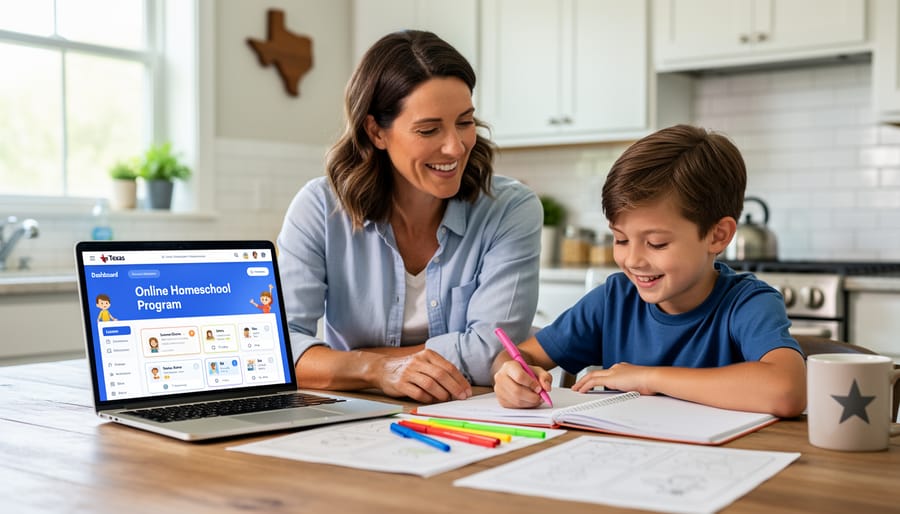
Creating an effective learning space dramatically impacts student success. Educational research shows that dedicated learning areas increase focus by 40% compared to shared spaces like kitchen tables. Even a small corner with a desk, good lighting, and minimal distractions works well. One Houston mother transformed a hallway alcove into her daughter’s learning station using a floating desk and noise-canceling headphones, resulting in improved concentration during live class sessions.
Common technical issues have straightforward solutions. If video lessons buffer frequently, close unnecessary browser tabs and disconnect other devices from WiFi during school hours. For login problems, clear browser cache and cookies or try a different browser. Most Texas online programs provide dedicated tech support lines with average wait times under 10 minutes. Keep program login credentials, tech support numbers, and your student’s schedule printed and posted near the learning space for quick reference when troubleshooting becomes necessary.
Online homeschooling in Texas offers remarkable flexibility, academic quality, and legal freedom that empowers families to create truly personalized educational experiences. Whether you’re seeking a fully accredited curriculum, a flexible part-time option, or a faith-based program, Texas families have access to diverse, high-quality online learning solutions that accommodate various learning styles, schedules, and budgets.
The decision to choose online homeschooling is significant, but Texas parents can approach it with confidence. Recent data shows that approximately 750,000 Texas students are now homeschooled, with online programs accounting for a growing percentage of that population. This trend reflects increasing satisfaction with digital learning outcomes and the proven effectiveness of quality online curricula.
Before committing to any program, take advantage of trial periods and free consultations that most platforms offer. For example, many families spend two to four weeks testing different programs to see which interface, teaching style, and support structure works best for their children. This hands-on approach removes guesswork and helps identify the right fit.
Remember that the ideal program depends entirely on your family’s unique needs, including your child’s learning preferences, your involvement level, budget constraints, and educational goals. There is no one-size-fits-all solution. A program that works beautifully for one family may not suit another, and that’s perfectly normal.
Texas families are fortunate to have exceptional online homeschooling options backed by supportive laws and a thriving homeschool community. With careful research and thoughtful consideration, you can confidently select a program that will help your child thrive academically while honoring your family’s values and lifestyle.