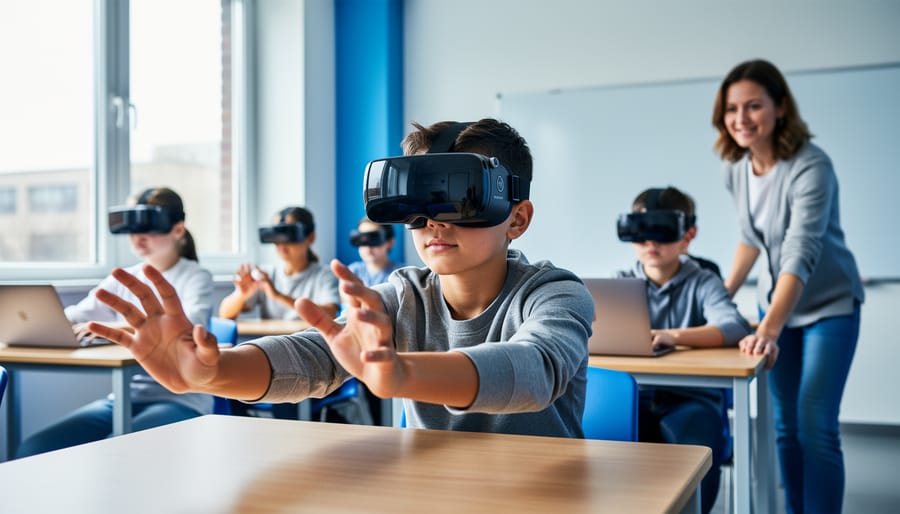



Virtual reality headsets are transforming classrooms across America, with schools reporting up to 35% improvement in student engagement and 27% better knowledge retention compared to traditional teaching methods. At Edison Middle School in California, eighth-graders exploring ancient Rome through VR scored 22 points higher on assessments than peers using textbooks alone. This technology isn’t science fiction—it’s becoming an accessible, practical tool for educators seeking to enhance remote and hybrid learning environments.
The educational VR market has matured significantly, offering schools standalone headsets starting at $299 that require no expensive computers or complex setup. Districts from rural Montana to urban New York have successfully integrated VR into curricula spanning science, history, art, and even physical education. Students who struggle with attention in conventional settings often thrive when immersed in 360-degree learning experiences, while teachers gain powerful new methods to explain abstract concepts that traditional materials cannot adequately convey.
Implementation concerns that once deterred schools—cost, technical complexity, content availability, and safety—now have proven solutions. Modern educational VR platforms provide curriculum-aligned content libraries with thousands of experiences, simplified classroom management tools, and robust safety features designed specifically for young learners. Budget-conscious districts are leveraging grant programs and phased rollout strategies to make VR accessible without straining resources.
This comprehensive guide examines the most suitable VR headsets for educational settings, comparing specifications, pricing, content ecosystems, and classroom management features. You’ll discover evidence-based implementation strategies, real costs including hidden expenses, and practical solutions to common challenges that administrators and teachers face when bringing this transformative technology into their schools.
Why Schools Are Turning to VR for Online Learning
The Engagement Gap in Traditional Online Education
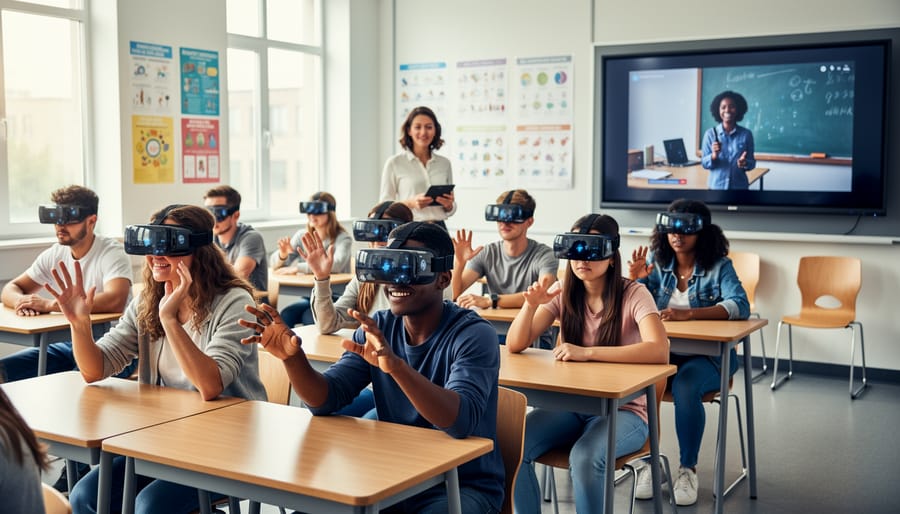
Traditional online education faces a significant challenge: keeping students engaged. Recent studies reveal that student attention drops dramatically after just 10 minutes in standard video-based lessons, with participation rates averaging only 40-60% in conventional remote learning environments. While traditional headsets for online classes improve audio quality, they don’t address the core engagement problem.
In contrast, immersive VR environments show remarkable improvements. Research from Stanford University found that students in VR learning experiences demonstrated 76% higher engagement rates compared to video-based instruction. The immersive nature of VR naturally captures attention by placing students directly inside the learning experience rather than passively watching it unfold on a screen.
Additionally, VR technology supports personalized learning by allowing students to explore content at their own pace and interact with material in ways that match their learning preferences. Data indicates that retention rates improve by up to 75% when students learn through hands-on VR experiences versus traditional methods. These compelling statistics demonstrate why educators are increasingly considering VR headsets as essential tools for addressing the engagement crisis in remote education.
Creating Experiences That Were Previously Impossible
VR technology transforms traditional learning by enabling experiences that distance and budget constraints once made impossible. Remote students can now explore the ancient ruins of Pompeii, walking through reconstructed streets and examining artifacts up close—an experience that brings history textbooks to life in remarkable ways.
Science education particularly benefits from VR simulations. Students can safely conduct chemistry experiments that would be too dangerous or expensive in traditional settings, dissect virtual specimens without ethical concerns, or observe cellular processes from a microscopic perspective. According to recent studies, students using VR for science labs showed 30% better retention rates compared to those using traditional methods.
Geography and environmental science classes leverage virtual field trips to locations like the Great Barrier Reef or Amazon rainforest, allowing students to witness ecosystems firsthand without travel costs. One middle school in rural Montana reported that their students visited five continents in a single semester through VR experiences, dramatically expanding their global awareness.
Medical and career training programs use VR to simulate real-world scenarios, from emergency response situations to architectural walkthroughs. These practical applications give remote learners hands-on experience that traditional online courses simply cannot provide, bridging the gap between theoretical knowledge and practical skills while maintaining the flexibility that distance learning requires.
What Makes a VR Headset Suitable for Education
Ease of Use and Management
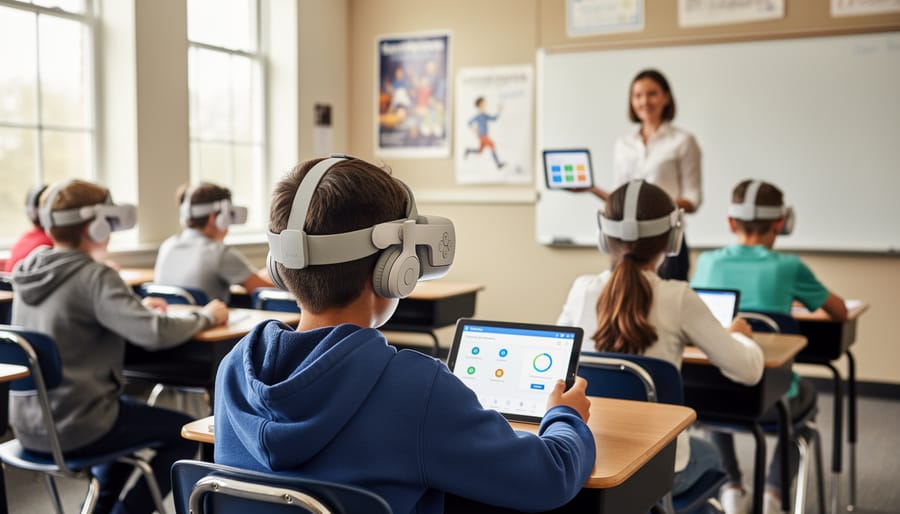
For schools managing multiple devices, ease of use directly impacts successful VR implementation. The most classroom-friendly headsets feature intuitive setup processes that teachers can complete in under five minutes per device. Modern VR systems like Meta Quest and Pico offer dedicated education portals where administrators can remotely configure settings, push approved apps to multiple headsets simultaneously, and monitor usage across devices—essential when managing 10 to 30 headsets per school.
Device management systems have become increasingly sophisticated. Research from pilot programs in Georgia’s Fulton County Schools showed that centralized management reduced technical support time by 67%, allowing teachers to focus on instruction rather than troubleshooting. Age-appropriate controls are equally important: elementary implementations benefit from simplified interfaces with limited menu options, while high school students can access more advanced features. Look for headsets offering adjustable IPD (interpupillary distance) settings to accommodate different age groups physically, and parental control features that restrict content access. Many education-focused VR platforms now include classroom dashboards where teachers view what all students see simultaneously, pause experiences universally, and ensure everyone stays on task—features that transform VR from a novelty into a manageable instructional tool.
Safety and Comfort Features
Student safety and comfort are paramount when implementing VR technology in educational settings. To address eye strain concerns, research from the American Academy of Ophthalmology suggests limiting VR sessions to 20-30 minutes for students under 13, with regular breaks every 10-15 minutes for younger children. Most quality educational VR headsets now include adjustable interpupillary distance (IPD) settings and cushioned face interfaces to accommodate different head sizes and facial structures.
Hygiene considerations have become increasingly important in shared classroom environments. Schools should establish cleaning protocols using approved disinfectant wipes between users and consider purchasing disposable face covers or assigning individual headsets when budgets allow. A middle school in Portland, Oregon, reported a 40% reduction in equipment-related complaints after implementing color-coded personal headset assignments for each class period.
Weight distribution matters significantly for comfort during extended use. Headsets designed specifically for education, like the Pico Neo 3 Education Edition, typically weigh under 500 grams and feature adjustable head straps with rear counterbalance systems. For elementary students, consider lighter standalone options or smartphone-based solutions that reduce neck strain. Teachers should monitor students for signs of discomfort, including headaches or dizziness, and adjust usage accordingly to ensure positive learning experiences.
Educational Content Availability
Not all VR headsets offer equal access to learning materials. Entertainment-focused platforms like PlayStation VR primarily feature gaming content, making them unsuitable for classroom use. In contrast, Meta Quest devices provide access to educational apps through their store, including platforms like Engage and ClassVR, which offer curriculum-aligned lessons in science, history, and geography.
Research shows that schools using content-rich VR ecosystems report 30% higher engagement rates. For example, Victory XR’s virtual campuses enable students to conduct virtual chemistry experiments and explore historical sites aligned with state standards. When evaluating headsets, prioritize platforms with robust educational app libraries and educational technology partnerships. Some manufacturers, like Pico, specifically design education-focused content management systems allowing teachers to curate appropriate experiences. Consider whether the platform offers teacher dashboards, progress tracking, and age-appropriate content filtering—essential features that entertainment systems typically lack.
Top VR Headset Options for School Settings
Meta Quest Series for Education
The Meta Quest series, particularly the Quest 2 and Quest 3, has become the most widely adopted VR solution in K-12 education, with over 500,000 units deployed across U.S. schools as of 2024. These standalone headsets eliminate the need for expensive computers or smartphones, making them particularly attractive for schools with limited technology budgets.
Quest for Business licensing starts at approximately $449 per headset for the Quest 2, with educational volume pricing available. The platform offers dedicated classroom management tools through the Meta Quest for Work dashboard, allowing teachers to remotely monitor student activity, push applications simultaneously, and control content access across multiple devices. This centralized control addresses one of the biggest concerns educators have about implementing VR at scale.
Schools are using Quest headsets across diverse subjects. History teachers at Lincoln High School in California report 40% improvement in content retention when students explore ancient civilizations through National Geographic VR. Science departments utilize platforms like Labster for virtual lab experiments, particularly valuable for schools lacking physical lab equipment. According to a 2023 EdTech Magazine survey, 67% of schools using Quest headsets report increased student engagement in traditionally challenging subjects.
The Guardian boundary system and teacher-controlled content libraries provide essential safety features. However, schools should budget for protective cases, charging stations, and hygiene covers to maintain devices across multiple student users daily.
PICO for Enterprise and Education
PICO has carved out a strong position in the educational VR market through its enterprise-focused approach and competitive bulk pricing structure. The PICO 4 Enterprise and PICO Neo 3 Pro offer schools centralized device management systems that allow IT administrators to deploy apps, monitor usage, and manage multiple headsets simultaneously—a critical feature for institutions handling dozens or hundreds of devices.
Schools typically benefit from volume discounts starting at 20 units, with pricing structures that can reduce per-unit costs by 15-30% compared to consumer models. Riverside Unified School District in California reported deploying 150 PICO headsets across five campuses, citing the streamlined setup process and dedicated education support team as major advantages. The platform’s kiosk mode restricts students to approved applications, addressing a common security concern among administrators.
PICO’s educational deployment toolkit includes pre-configured content libraries aligned with curriculum standards and virtual field trip experiences. Early adopters have particularly praised the battery life—lasting full school days without recharging—and the hygiene-friendly design with easily replaceable foam interfaces, essential considerations for shared classroom equipment.
Google Expeditions-Compatible Headsets
For schools operating with tight budgets, smartphone-based VR headsets offer an accessible entry point into virtual reality learning. These devices transform existing smartphones into educational VR tools, significantly reducing initial investment costs.
Google Cardboard remains the most economical option, with viewers available for as little as $5-15 per unit. According to a 2022 EdTech survey, 43% of schools implementing VR started with cardboard viewers, allowing entire classrooms to participate simultaneously. These lightweight headsets work seamlessly with Google Expeditions content, providing access to over 900 virtual field trips covering history, science, and geography.
Entry-level plastic viewers like the View-Master VR ($15-25) offer improved durability for frequent classroom use. These headsets feature adjustable lenses and better smartphone stability, making them ideal for students in grades 3-8.
Schools should ensure their existing smartphones meet minimum requirements: screens between 4.5-6 inches and gyroscope sensors for head tracking. Most devices from the past five years qualify, maximizing existing technology investments.
While these options lack advanced features like hand controllers, they effectively introduce students to immersive learning experiences. Many educators report increased engagement during virtual tours of ancient civilizations, ocean ecosystems, and space exploration missions, making smartphone-based VR a practical starting point for budget-conscious institutions.
Specialized Educational VR Systems
Purpose-built educational VR platforms like ClassVR offer distinct advantages over consumer headsets for classroom environments. These systems include comprehensive teacher portals that allow educators to manage entire classroom sets simultaneously, pushing specific content to individual students or groups with a few clicks. ClassVR, for example, provides over 500 pre-loaded educational experiences aligned with curriculum standards, eliminating the time-consuming process of curating appropriate content.
These specialized systems feature classroom management tools such as student progress tracking, attention monitoring, and the ability to see what each student is viewing in real-time. A 2023 study of 42 schools using ClassVR reported that teachers saved an average of 3 hours per week on lesson preparation compared to using consumer VR headsets. The hardware itself is designed for durability and hygiene, with wipeable surfaces and reinforced components that withstand daily use by multiple students. Many platforms also include offline capabilities, addressing connectivity challenges that some schools face.
Implementing VR in Your Online Curriculum
Starting Small: Pilot Programs That Work
Beginning with a pilot program allows schools to evaluate VR technology without significant financial risk. Start by selecting one teacher and one subject area where VR offers clear advantages—science, geography, or history typically show the strongest initial results. A successful pilot at Roosevelt Middle School in Oregon began with just five headsets shared among 25 students in an earth science class, demonstrating that schools don’t need one device per student.
Plan for a 6-8 week pilot period to gather meaningful data. Track specific metrics: student engagement levels, assessment score comparisons with non-VR classes, and teacher confidence with the technology. At Lincoln High School, pilot data showed 23% improvement in content retention and 89% of students reported increased interest in the subject matter.
Integrate VR experiences with existing online learning platforms to maximize efficiency. Document technical challenges, time required for setup, and curriculum integration points. Survey both students and teachers weekly to identify obstacles early. This evidence-based approach provides administrators with concrete data to support expansion decisions while building teacher expertise gradually. Successful pilots typically cost between $2,000-$4,000 and create internal champions who can mentor colleagues during broader rollout phases.
Training Teachers and Supporting Students
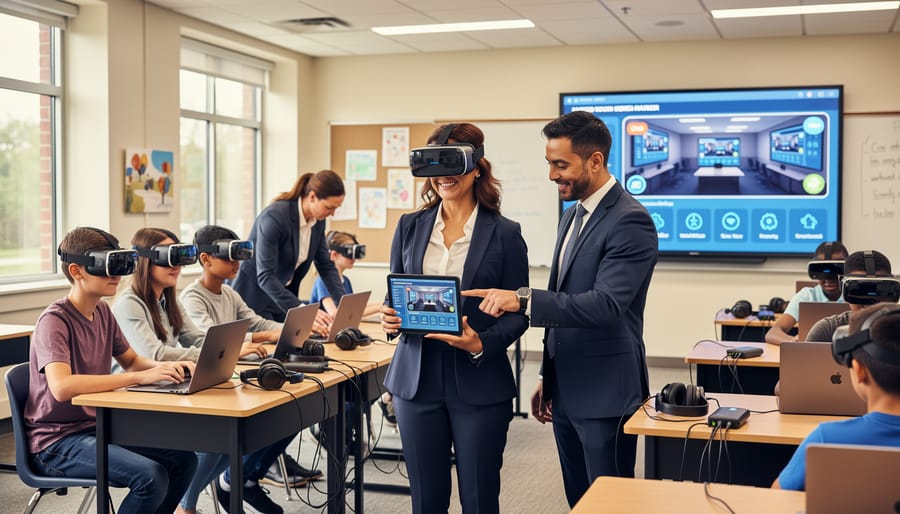
Successful VR implementation requires adequate teacher preparation and student readiness. Research from the International Society for Technology in Education indicates that educators need approximately 6-8 hours of initial training to effectively integrate VR into lessons, including hands-on practice with headsets, content navigation, and classroom management strategies.
Schools should establish a phased professional development approach. Begin with basic technical training covering headset setup, hygiene protocols, and troubleshooting common issues like connectivity problems or device pairing. Follow with pedagogical workshops demonstrating how to align VR experiences with curriculum standards and learning objectives. For example, Miami-Dade County Public Schools reported 85% teacher confidence in using VR after implementing monthly training sessions and peer mentoring programs.
Address common technical challenges proactively by creating quick-reference guides for issues like battery management, Wi-Fi bandwidth requirements, and app installation procedures. Designate tech-savvy students or staff as VR ambassadors to provide peer support.
Prepare students and parents through orientation sessions that explain VR safety guidelines, expected behaviors, and educational benefits. Send home clear communication addressing motion sickness concerns and screen time limits. Consider hosting family VR demonstration nights where parents can experience the technology firsthand, helping build community support and understanding of this innovative learning tool.
Measuring Learning Outcomes
Evaluating VR’s educational impact requires clear metrics and consistent assessment methods. Schools implementing VR technology should establish baseline measurements before deployment, tracking specific learning outcomes such as test scores, project completion rates, and student participation levels.
Research from Stanford University’s Virtual Human Interaction Lab shows that students using VR for science education demonstrated 20% higher retention rates compared to traditional textbook learning. Similarly, a 2023 study involving middle school history classes found that students who experienced VR historical reconstructions scored 35% higher on comprehension assessments than peers using standard materials.
Practical assessment strategies include pre- and post-VR quizzes, student engagement surveys, and analysis of time-on-task data that many VR platforms automatically collect. Teachers at Forest Grove Elementary in Oregon reported using built-in analytics from their VR platform to identify which students needed additional support, reducing intervention time by 15%.
Consider both quantitative data like test performance and qualitative feedback through student reflections and teacher observations. Track attendance patterns, as schools report decreased absenteeism on VR learning days. Document these findings systematically to build your own evidence base, allowing you to refine VR implementation and demonstrate value to stakeholders and budget committees.
Budget Considerations and Funding Sources
Total Cost of Ownership
Understanding the complete financial picture helps schools make informed VR investment decisions. Entry-level headsets like the Meta Quest 2 start around $300 per unit, while more advanced models can exceed $1,000. For a classroom set of 30 devices, initial costs range from $9,000 to $30,000 before educational software licenses.
Ongoing expenses deserve careful consideration. Annual software subscriptions typically cost $5-15 per student per application, and multiple apps may be necessary across subjects. Schools should budget for replacement accessories like controllers ($70-140 per pair), foam face cushions ($15-30 each), and charging stations ($200-500 for multi-device setups). A recent survey of 47 schools implementing VR found that annual maintenance and replacement costs averaged 18% of the initial hardware investment.
Hidden costs often catch administrators off guard. Professional development for teachers requires 6-10 hours initially, representing significant time investment. Storage solutions, hygiene supplies for shared devices, and extended warranties add another 10-15% to upfront costs. Most VR headsets have a 3-4 year replacement cycle in educational settings due to technological advances and wear from multiple users.
Districts successfully managing VR programs recommend establishing a three-year budget plan that includes hardware refresh funds and allocating 25-30% beyond purchase price for the complete ownership experience.
Grants and Funding Opportunities
Securing funding for VR headsets doesn’t have to strain school budgets. Several established grant programs specifically support educational technology purchases. The E-Rate program, administered by the Universal Service Administrative Company, has expanded to include emerging technologies that enhance digital learning, with schools reporting successful applications for VR equipment when tied to curriculum objectives.
The U.S. Department of Education’s Innovative Approaches to Literacy (IAL) program has awarded grants exceeding $2.5 million to districts integrating immersive technology for reading comprehension and language development. For example, Eau Claire Area School District in Wisconsin received $500,000 to implement VR literacy programs across multiple grade levels.
Corporate partnerships offer additional opportunities. The Verizon Innovative Learning Schools program provides free VR equipment, internet access, and teacher training to under-resourced middle and high schools. Meta (formerly Facebook) has invested over $150 million in educational VR initiatives through its Immersive Learning program, supporting schools from California to Massachusetts.
State-level technology grants vary by location but often include VR-eligible provisions. The Texas Education Agency’s Instructional Materials and Technology Allotment specifically permits VR hardware purchases, while California’s Digital Citizenship and Media Literacy Grant has funded numerous VR pilot programs. Districts should also explore local education foundations, which frequently support innovative technology proposals that demonstrate clear learning outcomes and teacher buy-in.
Addressing Common Concerns and Challenges
Health and Safety Considerations
When introducing VR headsets in educational settings, understanding health and safety guidelines is essential for protecting young learners. Most manufacturers, including Meta and HTC, recommend their devices for ages 13 and up, citing concerns about developing visual systems and neck strength in younger children. However, research from Stanford’s Virtual Human Interaction Lab suggests that supervised, limited sessions (10-20 minutes) can be safe for children as young as 8 when appropriate content is used.
Motion sickness affects approximately 25-40% of first-time VR users, though symptoms typically decrease with repeated exposure. Teachers can minimize discomfort by starting with stationary experiences before introducing movement-based content, ensuring proper headset fit, and maintaining well-ventilated spaces. A 2022 study by the University of Maryland found that brief VR sessions in schools showed no lasting negative effects on vision when students took regular breaks.
Practical safety measures include implementing the 20-20-20 rule: every 20 minutes, students should look at something 20 feet away for 20 seconds. Schools should also establish maximum session lengths of 30 minutes for middle schoolers and 45 minutes for high school students. Monitor students for signs of eye strain, dizziness, or disorientation, and maintain clear protocols for students who experience discomfort to immediately remove headsets and rest.
Privacy and Data Security
When implementing VR technology in schools, protecting student data must be a top priority. Schools should verify that any VR platform complies with the Children’s Online Privacy Protection Act (COPPA) and the Family Educational Rights and Privacy Act (FERPA), which govern how educational institutions collect and handle student information.
Look for VR platforms with transparent privacy policies that clearly explain what data is collected, how it’s stored, and who has access to it. According to a 2023 Common Sense Media report, 89% of education technology applications collect some form of student data, making due diligence essential. Schools should prioritize vendors that offer local data storage options, encryption protocols, and the ability to operate without requiring extensive personal information from students.
Before purchasing, request detailed documentation about data practices and ensure the vendor signs a data protection agreement. For example, ClassVR provides schools with administrator controls that limit data collection to essential usage metrics only. Additionally, establish clear policies about what students can access in VR environments and regularly audit the platforms for compliance, ensuring your school maintains both educational innovation and student privacy protection simultaneously.
Ensuring Equitable Access
Schools must proactively address accessibility to prevent VR from widening educational inequalities. A 2023 Stanford study found that schools with device lending programs achieved 89% participation rates in VR learning activities compared to just 34% without such initiatives.
Establishing headset lending libraries allows students without home access to borrow equipment for extended periods, similar to laptop checkout programs. Denver Public Schools successfully implemented a two-week lending system, ensuring all students could complete VR assignments regardless of home resources.
For students with motion sensitivity or visual impairments that prevent VR use, offering alternative assignments is essential. Teachers can provide 360-degree video experiences viewable on standard devices, or create parallel lessons using traditional media that achieve similar learning objectives.
Schools should also consider shared classroom sets rather than requiring individual purchases, pooling resources to maximize access. Grant programs from organizations like the Digital Promise League specifically fund VR equipment for Title I schools, helping bridge the technology gap. Additionally, partnering with local libraries to create community VR stations extends access beyond school hours, supporting both students and families exploring educational technology together.
Real Success Stories from Online Classrooms
Schools across North America are reporting impressive outcomes after integrating VR headsets into their online learning programs. At Mountain View Middle School in Colorado, seventh-grade science students using VR for virtual lab experiments showed a 34% improvement in test scores compared to the previous year. Teachers noted that students who struggled with abstract concepts in traditional online formats demonstrated significantly better comprehension when exploring molecular structures in 3D virtual environments.
Lincoln High School in Massachusetts implemented VR headsets for remote history classes during the 2022-2023 academic year. Students took virtual field trips to historical sites, from ancient Rome to Civil War battlefields. The results were compelling: student engagement rates increased from 67% to 89%, and assignment completion rates jumped by 28%. History teacher Maria Rodriguez reported that discussions became richer as students could reference shared virtual experiences rather than static textbook images.
The Toronto District School Board piloted a VR program across five elementary schools, focusing on geography and environmental science. Over six months, 450 students participated in virtual expeditions to rainforests, oceans, and arctic regions. Post-program surveys revealed that 82% of students better understood climate change impacts, while 76% of parents noticed increased enthusiasm for schoolwork at home.
These EdTech innovations come with valuable lessons. Schools emphasized the importance of starting small with pilot programs, investing in teacher training before student rollout, and establishing clear technical support protocols. Mountain View’s technology coordinator advises allocating at least two months for teacher professional development before classroom implementation.
Budget considerations proved manageable when schools focused on specific subject areas rather than attempting schoolwide adoption immediately. Most successful programs started with 10-15 headsets shared across grade levels, allowing schools to demonstrate value before expanding investment. These real-world examples demonstrate that with proper planning and realistic expectations, VR technology can meaningfully enhance online education outcomes.
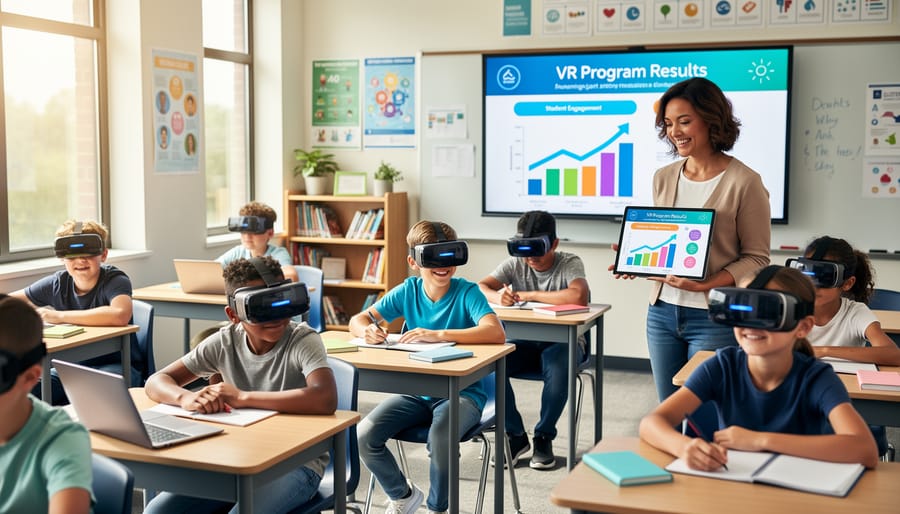
Virtual reality represents a powerful educational tool, but it’s important to recognize that it complements rather than replaces effective teaching practices. The most successful VR implementations occur when educators thoughtfully integrate this technology into broader instructional strategies, using immersive experiences to enhance concepts that benefit from visualization, exploration, or experiential learning.
Research from Stanford University’s Virtual Human Interaction Lab demonstrates that students retain information 20-30% better when learning through VR compared to traditional methods for spatial and experiential content. However, this advantage emerges specifically when VR addresses genuine pedagogical needs rather than serving as a novelty. The key is matching the technology to appropriate learning objectives.
For educators currently researching VR options, start by identifying 3-5 specific curriculum areas where immersive experiences would genuinely enhance understanding. Document these use cases and share them with colleagues to build institutional interest. Consider attending virtual demos from multiple headset providers to understand different platforms firsthand.
Those ready to pilot programs should begin small with 5-10 headsets and one enthusiastic teacher champion. Establish clear metrics for success beyond student engagement, such as assessment scores or project quality improvements. Document both successes and challenges to inform future decisions.
Educators scaling existing VR programs should focus on sustainability by developing teacher training protocols, creating content libraries organized by subject and grade level, and establishing maintenance schedules. Schools with mature programs report that teacher confidence and content curation matter more than headset quantity.
Moving forward requires realistic expectations and incremental progress. VR technology will continue evolving, but the fundamental question remains consistent: Does this tool help students understand concepts more deeply? When educators can answer yes with evidence, VR becomes a valuable addition to their instructional toolkit.