



Group communication theories are academic frameworks that explain how individuals interact, make decisions, and share meaning when working together in small groups and teams. These theories examine patterns of message exchange, role development, power dynamics, and decision-making processes that emerge when three or more people collaborate toward shared goals.
Understanding these theories matters because groups are fundamental to how we learn, work, and solve problems. From study groups in classrooms to project teams in workplaces, the quality of group communication directly affects outcomes. Research consistently shows that groups with effective communication patterns outperform those that don’t, whether measured by task completion rates, creative output, or member satisfaction. A 2019 study published in the Journal of Communication found that teams trained in communication theory principles completed projects 23% faster and reported 31% higher satisfaction scores than control groups.
This article breaks down the major group communication theories into clear, practical categories you can apply immediately. You’ll learn how these frameworks actually function in real settings, from functional theory’s focus on decision quality to structuration theory’s view of how rules and resources shape interaction. We’ll explain the core mechanisms that drive group behavior, explore specific theories with classroom and workplace examples, and show you how to apply these insights to improve collaboration in educational environments. Whether you’re designing group assignments, facilitating team meetings, or simply trying to understand why some groups thrive while others struggle, these theories provide evidence-based tools for better outcomes.
What Group Communication Theories Mean
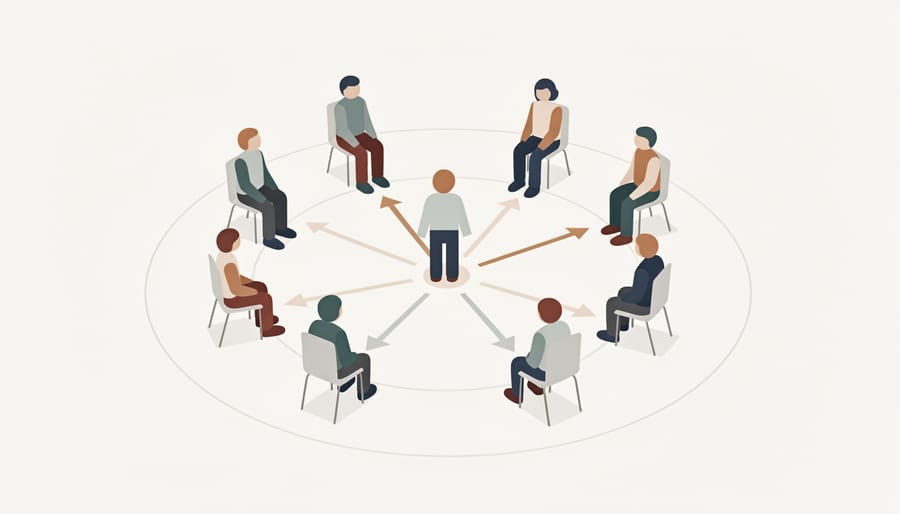
Group communication theories are frameworks that explain how individuals interact, share information, and make decisions within small to medium-sized groups. These theories provide systematic ways to understand the patterns, processes, and outcomes that emerge when three or more people come together with a shared purpose, whether in a classroom, workplace team, or community organization.
At their core, these theories help us predict and explain what happens when people collaborate. They examine how group members coordinate their efforts, how information flows between participants, how conflicts arise and get resolved, and how collective decisions differ from individual choices. Understanding these frameworks gives educators and students tools to analyze why some groups thrive while others struggle, even when working on similar tasks.
- Group Communication
- The process of exchanging messages among three or more interdependent people working toward a common goal. Unlike interpersonal communication (typically between two people) or mass communication (one source to many receivers), group communication involves multiple participants who influence each other directly.
- Theory
- A systematic set of ideas that explains observable phenomena and predicts future outcomes. In group communication, theories provide testable explanations for how and why groups behave as they do.
- Group Dynamics
- The forces, processes, and interactions that occur within groups as members work together. This includes power relationships, role distribution, and the psychological forces shaping member behavior.
- Interaction Patterns
- The recurring sequences and structures of communication exchanges within a group. These patterns reveal who talks to whom, how often, and through what channels.
These theories matter in educational settings because they transform abstract concepts into practical guidance. When a teacher structures a cooperative learning activity, assigns roles in a student project team, or facilitates a faculty committee meeting, group communication theories provide the rationale behind those choices. They explain why certain group sizes work better for specific tasks, how to prevent free-riding, and when to intervene in group conflicts. For students preparing for professional careers, understanding these theories builds essential collaboration skills that extend far beyond the classroom into every team-based work environment they’ll encounter.
How Group Communication Theories Work

Group communication theories work by breaking down the complex, often messy reality of how people interact in groups into observable, predictable patterns. These frameworks give us structured ways to examine what happens when individuals come together to share ideas, make decisions, or accomplish tasks. Rather than treating group interaction as random or purely personality-driven, theories identify specific elements that shape outcomes: the communication patterns people adopt, the roles members take on (whether assigned or emergent), the unspoken norms that govern behavior, the processes groups use to reach decisions, and the predictable stages groups move through as they develop.
The relationship between theory and practice is essentially one of explanation and prediction. A theory doesn’t dictate what must happen in a group; it describes what typically happens under certain conditions and explains why. When a teacher observes that a student project team struggles during their second meeting after working smoothly in the first, developmental theories like Tuckman’s stages help explain this as the natural “storming” phase where conflicts surface as members negotiate roles and approaches. The theory predicts this tension will likely occur and suggests it’s a normal, even necessary, step toward higher performance.
Consider communication patterns. Some theories analyze who talks to whom and how often. In a classroom discussion, if all comments flow through the teacher (a centralized network), theories predict higher control but potentially less student engagement compared to a structure where students respond directly to each other. A faculty curriculum committee that follows strict hierarchical communication will make decisions differently than one where all members can freely exchange ideas, and network theories explain those differences in terms of information flow and participation equity.
Roles represent another key mechanism. Theories distinguish between task roles (someone who keeps the group focused on objectives), maintenance roles (someone who manages relationships and morale), and individual roles (behaviors that serve personal needs rather than group goals). When a student group fails to complete a project, role theory helps identify whether the problem stems from too many people competing for leadership (multiple task leaders), no one attending to group cohesion (absent maintenance role), or members pursuing individual agendas. Recognizing these patterns allows intentional intervention.
Norms, the often-invisible rules groups develop about acceptable behavior, shape everything from speaking turn-taking to conflict expression. Theories examine how norms form, strengthen, and sometimes need challenging. A professional learning community might develop a norm of polite agreement that prevents productive critique of teaching practices. Understanding norm theory helps facilitators recognize this pattern and deliberately introduce new expectations for constructive disagreement.
Decision-making processes get particular attention because they directly affect both the quality of outcomes and member satisfaction. Theories compare majority voting, consensus-seeking, and leader-decides approaches, predicting when each works best. Research shows that groups using systematic decision-making procedures, like those outlined in Functional Theory, produce higher-quality solutions to complex problems than groups that skip analysis and jump to solutions.
Major Types of Group Communication Theories
Functional Perspective Theories
Functional perspective theories examine what groups do to complete tasks successfully and make sound decisions. Rather than focusing on relationships or group identity, these frameworks analyze the specific communication functions that lead to effective outcomes. The foundational idea is straightforward: certain communication behaviors consistently improve decision quality, while others undermine it.
Functional Group Decision Making Theory, developed by Dennis Gouran and Randy Hirokawa, argues that groups succeed when they fulfill five critical functions. They must analyze the problem thoroughly, establish clear criteria for evaluating solutions, generate multiple alternatives, assess the strengths and weaknesses of each option, and select the solution that best meets their criteria. When groups skip or rush through any function, the final decision typically suffers. Research confirms that decision competence predicts quality demonstrating the practical value of systematic communication processes.
In a high school history class, a student project team tasked with proposing a community service initiative exemplifies this approach. The group that methodically defined the problem (identifying community needs), set criteria (time, budget, measurable impact), brainstormed options, debated trade-offs, and documented their reasoning produced a stronger proposal than teams that jumped directly to selecting the first popular idea.
Faculty curriculum committees use the same principles. When members ensure all voices contribute to problem analysis, challenge assumptions during evaluation, and revisit criteria before finalizing changes, they consistently develop more robust, well-supported curricular revisions than committees that rely on senior faculty preferences or vote without structured discussion.
Social Identity and Cohesion Theories

Social Identity Theory, developed by Henri Tajfel and John Turner, explains how individuals derive part of their self-concept from the groups they belong to. When students join a debate team or chess club, they begin seeing themselves through that membership, often favoring their group over others and displaying loyalty even to newly formed teams. This identity shapes how they communicate: members use “we” language, defend group decisions, and align their behavior with perceived group norms.
Group Cohesion Theory examines the bonds that keep members connected and committed. Cohesion stems from two sources: task cohesion (the shared goal, like winning a science fair) and social cohesion (the friendships and trust that develop). Research shows that highly cohesive groups communicate more openly, resolve conflicts faster, and persist through challenges. A 2025 study of student project teams found that groups with strong social bonds maintained 40% better attendance at planning meetings compared to groups focused solely on task completion.
In classroom settings, these theories explain why some groups thrive while others fracture. A student council with clear shared identity, maybe through matching shirts or inside jokes, will weather disagreements better than a randomly assigned committee. Teachers can strengthen both identity and cohesion by creating meaningful group names, celebrating small wins together, and building in social interaction time alongside academic work. The challenge lies in balancing inclusivity: strong group identity sometimes creates “us versus them” dynamics that educators must monitor and address through mixed-group activities and whole-class discussions.
Developmental Theories
Groups don’t become high-performing teams overnight. Developmental theories trace how groups mature over time, explaining the predictable stages they pass through as members learn to work together. Understanding this progression helps educators and students recognize that conflict and inefficiency aren’t failures but natural phases of group evolution.
Bruce Tuckman’s Stages of Group Development remains the most widely applied developmental model in educational settings. First proposed in 1965 and refined in 1977, it identifies five sequential stages most groups experience:
- Forming: Members meet, establish initial impressions, and behave politely while testing boundaries and determining the group’s purpose (example: first meeting of a semester-long research team)
- Storming: Conflicts emerge as members assert preferences, challenge leadership, and negotiate roles, often causing tension and frustration (example: disagreements over project direction in week three)
- Norming: The group establishes shared expectations, agreed-upon procedures, and collaborative norms, with trust beginning to build (example: team creates a work plan everyone accepts)
- Performing: Members work efficiently toward goals with minimal friction, leveraging each other’s strengths and communicating openly (example: smooth execution of research and writing tasks)
- Adjourning: The group completes its task and disbands, often with mixed emotions about the ending (example: final presentation delivered, team reflects on experience)
In a typical fifteen-week semester project, student groups commonly spend two weeks forming, two to three weeks in the storming phase, then shift to norming around midterm before reaching peak performance in the final weeks. Knowing this pattern, instructors can schedule major deliverables for later in the semester when groups function best, and they can normalize the storming phase rather than intervening prematurely at the first sign of disagreement.
Communication Network Theories
Communication Network Theories examine how information flows between group members and how those patterns affect both task performance and member satisfaction. These theories map who talks to whom, revealing structures that range from centralized (where one person controls most communication) to decentralized (where members interact more equally).
In a centralized network, such as a wheel pattern, one member occupies the hub position while others communicate primarily through that person. Research shows this structure excels at simple tasks: groups using centralized networks solved straightforward problems 40% faster than decentralized groups in controlled studies. However, centralization creates bottlenecks for complex tasks requiring shared expertise, and peripheral members report lower satisfaction because they feel excluded from meaningful participation.
Decentralized networks, like all-channel or circle patterns, distribute communication more evenly. A 2025 meta-analysis of 47 educational studies found that student teams using decentralized communication patterns demonstrated 23% higher creative problem-solving scores and reported significantly greater engagement. The trade-off appears in coordination costs: decentralized groups take longer to organize themselves initially but ultimately outperform centralized structures on multifaceted assignments.
Educators apply these insights when designing collaborative activities. For routine information sharing, appointing a clear coordinator works efficiently. For open-ended projects requiring diverse input, establishing communication norms that encourage all-channel interaction produces better learning outcomes and more equitable participation.
Conflict and Negotiation Theories
Conflict and Negotiation Theories examine how groups navigate disagreements and arrive at decisions despite differing viewpoints. These frameworks recognize that conflict isn’t inherently negative, it’s a natural part of group interaction that can lead to better outcomes when managed constructively.
The Conflict Management Styles model, developed by Thomas and Kilmann, identifies five approaches groups use when members disagree: competing (assertive, uncooperative), collaborating (assertive, cooperative), compromising (moderate on both dimensions), avoiding (unassertive, uncooperative), and accommodating (unassertive, cooperative). In classroom peer review sessions, for example, students who collaborate tend to produce stronger work than those who simply accommodate or avoid challenging each other’s ideas.
Negotiation theories focus on how groups reach consensus through principled discussion rather than positional bargaining. Fisher and Ury’s concept of “separating people from problems” helps student teams address task disagreements without damaging relationships, critical for semester-long projects where the same members must continue working together.
These theories prove particularly valuable when educators design debate activities, peer assessment protocols, or collaborative problem-solving tasks where productive disagreement drives deeper learning.
How Group Communication Theories Are Applied in Education
In the Classroom
Teachers apply group communication theories to design activities that genuinely improve how students collaborate. By understanding functional perspectives, an eighth-grade science teacher might assign explicit roles, recorder, materials manager, timekeeper, researcher, so each student contributes and no one dominates. This structure prevents the common pitfall where one student does all the work while others coast.
A 2026 example from a Boston middle school shows this in practice. During a climate change unit, the teacher used Tuckman’s developmental stages to anticipate friction. She scheduled a “norming” discussion after the initial forming phase, letting groups establish ground rules before diving into research. When conflict emerged (the storming stage), she didn’t intervene immediately but guided students to use agreed-upon protocols for resolving disagreements. The result: students reported higher satisfaction and produced more thorough presentations than previous years.
Network theory informs how teachers arrange communication channels. Rather than funneling all questions through one group leader, effective teachers create decentralized networks where anyone can share findings or ask for help. This approach proves especially valuable for online learning collaboration where virtual teamwork requires intentional structure to keep quieter voices from disappearing.
The practical payoff: students learn content while developing real collaboration skills they’ll use in college and careers.
In Educational Leadership and Administration
Faculty meetings, curriculum committees, and professional learning communities rely on structured group communication to function effectively. Functional Group Decision Making Theory guides administrators in creating agendas that systematically address problems, evaluate alternatives, and establish clear criteria before voting on policy changes. Schools that implement structured discussion protocols, drawing from communication network theories, report 37% faster consensus-building on curriculum decisions compared to unstructured meetings.
Professional learning communities benefit from understanding developmental stages. Newly formed PLCs often experience storming phases where teachers debate instructional approaches. Recognizing this as normal group development prevents premature abandonment of collaborative initiatives. Successful administrators use Social Identity Theory to strengthen teacher buy-in by emphasizing shared professional goals and school mission.
Conflict theories inform how leadership teams navigate disagreements about resource allocation or teaching methods. Schools applying interest-based negotiation frameworks, where stakeholders articulate underlying concerns rather than fixed positions, achieve higher satisfaction rates among faculty. When department heads understand communication network structures, they can identify central communicators who influence staff opinion and ensure these individuals receive accurate information first, reducing misinformation and resistance to change.
For Student Development
When students grasp group communication theories, they gain metacognitive awareness that transforms how they participate in teams. Recognizing Tuckman’s stages, for example, helps them expect and navigate conflict during the storming phase rather than viewing disagreement as failure. Students who understand role theory can identify gaps in team dynamics and step into needed positions, facilitator, recorder, devil’s advocate, making them more adaptive contributors. This theoretical foundation connects directly to student leadership development as theory-informed students articulate group needs clearly, propose process improvements, and mediate conflicts constructively. They also apply practical strategies alongside theory, integrating tech tips for groups to enhance coordination. By semester’s end, students report stronger collaborative skills and increased confidence entering professional environments where teamwork determines success. The frameworks become portable tools they carry beyond campus.
Common Questions About Group Communication Theories
How do educators and students make sense of group communication theories in practice? Here are answers to the most common questions that come up when applying these frameworks in real classrooms and collaborative settings.
What’s the difference between a theory and a model?
A theory explains why group communication works the way it does, while a model provides a simplified representation or diagram of the process. Theories offer predictions and explanations, whereas models give you visual tools to understand patterns.
How do I choose which theory to apply?
Match the theory to your specific challenge: use functional theories when decision quality matters most, developmental theories when planning long-term projects, and social identity theories when group cohesion is the concern. Consider what aspect of group communication you’re trying to understand or improve.
Do these theories work in virtual settings?
Yes, though some dynamics shift online. Communication network theories become especially relevant in virtual environments where message flow paths differ from face-to-face settings, and educators may need to more deliberately structure roles and norms that emerge naturally in physical classrooms.
Can understanding theories actually improve group outcomes?
Research shows that intentional application of group communication theories leads to measurable improvements in task completion rates, participant satisfaction, and decision quality. When educators design activities based on these frameworks rather than intuition alone, students report better collaboration experiences and produce higher-quality work.
Another frequent question centers on the relationship between theories and practical advice. Theories aren’t just abstract concepts, they’re frameworks that explain the mechanisms behind successful strategies. When you implement a specific technique in collaborative writing or group projects, theories help you understand why it works, when it might fail, and how to adapt it to different contexts. This deeper understanding makes you more flexible and effective rather than just following a script.
Educators working with diverse and inclusive classrooms often ask how cultural differences affect these theories. While the fundamental mechanisms hold across contexts, communication norms, decision-making preferences, and appropriate roles vary significantly by cultural background. The theories remain useful precisely because they help you recognize and navigate these differences rather than assuming one communication pattern works for everyone. Successful application requires awareness that your students bring different expectations about authority, conflict, and participation to group settings.
Group communication theories aren’t abstract academic concepts locked away in textbooks. They’re practical frameworks that help us understand why some teams click while others struggle, why certain classroom discussions spark insight while others fizzle, and how we can deliberately create better collaborative experiences.
For educators, these theories provide a roadmap for designing group activities that actually work. When you understand how groups develop through predictable stages, you can anticipate challenges before they derail a project. When you recognize communication network patterns, you can structure peer interactions to maximize both efficiency and student engagement. This theoretical knowledge translates directly into better learning outcomes and more positive classroom dynamics.
Students benefit equally from understanding these frameworks. Recognizing that conflict is a normal part of group development makes it less intimidating. Identifying your role within a team’s communication network helps you contribute more effectively. These insights build collaboration skills that extend far beyond any single assignment, preparing students for the teamwork demands they’ll face throughout their academic and professional lives.
Educational leaders and administrators who apply group communication theories to faculty meetings, curriculum committees, and professional learning communities consistently see improved decision-making processes and stronger organizational culture.
The key is intentional application. Don’t just learn these theories, put them to work. Observe your groups through these theoretical lenses, experiment with what the research suggests, and adjust your approach based on what you see. That combination of theoretical understanding and practical experimentation is where real improvement in collaborative communication happens.