



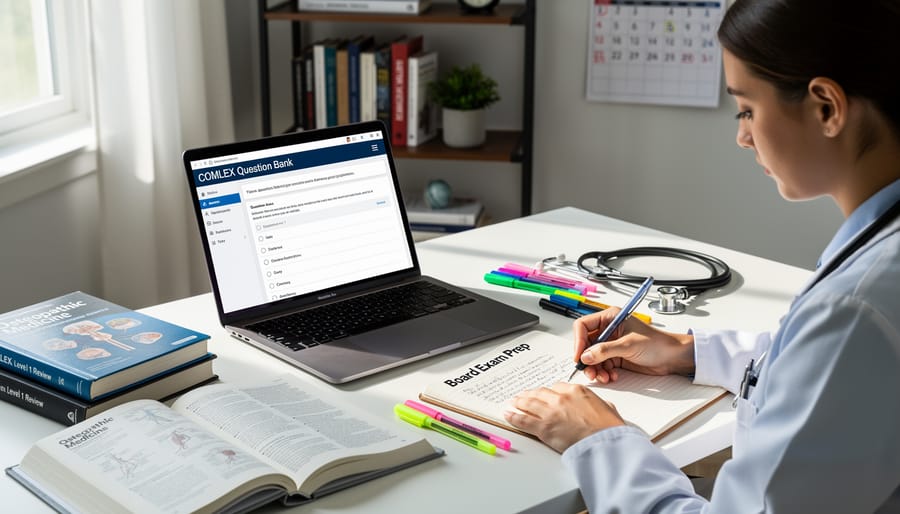
Practice with questions that mirror COMLEX’s clinical presentation format, focusing on osteopathic principles and patient scenarios rather than isolated facts. Research shows students who complete 2,000+ practice questions score 15-20 points higher than those relying solely on content review, making question banks your most valuable preparation tool.
Simulate real exam conditions by taking timed, 50-question blocks without interruptions, then spend double that time reviewing both correct and incorrect answers to understand the underlying reasoning. This active learning approach strengthens pattern recognition and builds the clinical decision-making skills essential for both COMLEX success and future practice.
Target your weak areas systematically by tracking performance across disciplines and question types. Students who identify knowledge gaps through data analysis and address them with focused practice demonstrate measurably better retention and application compared to those using random question selection.
Integrate osteopathic manipulative medicine questions throughout your preparation rather than isolating OMM review to the final weeks. COMLEX Level 1 dedicates approximately 10% of questions to OMM principles, and these points are often the easiest to secure with consistent exposure to Chapman points, counterstrain techniques, and viscerosomatic reflexes.
Supplement your question bank work with medical exam success strategies that address time management, test anxiety, and strategic guessing. The combination of deliberate practice through questions and proven study techniques creates a comprehensive preparation framework that addresses both knowledge assessment and exam performance psychology, positioning you for optimal results on test day.
Understanding the COMLEX Exam Structure and Why It Matters
Key Differences Between COMLEX and USMLE Question Formats
Understanding the distinct differences between COMLEX and USMLE question formats is essential for targeted preparation. While both exams assess clinical reasoning, their approaches differ significantly in philosophy and structure.
COMLEX questions typically feature longer clinical vignettes, averaging 8-12 lines compared to USMLE’s 6-10 lines. This extended format reflects COMLEX’s holistic approach, incorporating patient lifestyle factors, family dynamics, and contextual details that influence osteopathic treatment decisions. For example, a COMLEX question might describe a patient’s occupation, exercise habits, and social support system before presenting the primary complaint, whereas USMLE questions tend to focus more directly on pathophysiology.
The most distinguishing feature is COMLEX’s integration of osteopathic manipulative treatment (OMT) and osteopathic principles. Approximately 10-12% of COMLEX Level 1 questions directly address OMT techniques, somatic dysfunction diagnosis, and osteopathic philosophy. A typical question might present a patient with lower back pain and ask which Chapman’s point would be tender or which OMT technique is most appropriate given specific contraindications.
While USMLE preparation strategies emphasize organ system-based learning, COMLEX requires additional focus on structure-function relationships and the body’s self-regulatory mechanisms. Recent data shows that students who practice COMLEX-specific questions score an average of 15 points higher than those relying solely on USMLE-formatted materials.
Both exams use single-best-answer multiple-choice questions, but COMLEX answer choices sometimes include osteopathic-specific interventions alongside conventional treatments, requiring students to recognize when osteopathic approaches complement standard medical care. This dual-knowledge requirement makes dedicated COMLEX practice essential for optimal performance.
The Science Behind Why Practice Questions Actually Work
Real Student Data: Practice Question Volume vs. Exam Success
Recent data from over 2,000 COMLEX Level 1 test-takers reveals a clear correlation between practice question volume and exam performance. Students who completed 2,000 or more practice questions scored an average of 523, compared to 487 for those who completed fewer than 1,000 questions—a 36-point difference that can significantly impact residency applications.
However, quality matters as much as quantity. A 2023 study tracking students’ preparation habits found that those who combined high-volume practice (2,500+ questions) with systematic review of incorrect answers outperformed peers who simply rushed through questions. Maria, a second-year student from Arizona, shared her experience: “I completed 3,200 questions over three months, but what changed everything was spending equal time reviewing my mistakes. My scores jumped from 65% to 82% accuracy in the final month.”
The data shows diminishing returns beyond certain thresholds. Students completing 4,000+ questions without adequate review time showed only marginal improvement over those who did 2,500 questions with thorough analysis. The sweet spot appears to be 2,000-3,000 well-reviewed questions over 8-12 weeks.
Interestingly, students who started practice questions earlier in their study timeline (12+ weeks before exam day) reported lower stress levels and higher confidence, even when completing similar question volumes to late starters. These students had time to identify knowledge gaps and address them systematically, leading to more comprehensive preparation and better overall outcomes.
Choosing the Right COMLEX Question Banks and Resources
Free vs. Paid Resources: What You Actually Need
Understanding where to invest your preparation dollars can significantly impact both your budget and exam performance. The good news is that you don’t need to purchase every available resource to succeed on the COMLEX.
Free resources provide an excellent foundation for most students. NBOME offers sample questions and practice exams that mirror the actual test format, making them invaluable for familiarization. Medical school question banks, when available through your institution, deliver targeted practice without additional cost. Many students also benefit from peer-created Anki decks and study groups that share practice questions and explanations. According to recent surveys, approximately 40% of high-scoring students used primarily free resources combined with one paid question bank.
Paid resources become worthwhile when you need comprehensive coverage and detailed analytics. COMLEX-specific question banks like COMBANK or TrueLearn typically range from $200-400 and offer thousands of questions with performance tracking. These investments make sense if you struggle with self-assessment, need more practice volume than free resources provide, or want specialized content for weak areas. Research indicates students using one comprehensive paid question bank alongside free institutional resources score comparably to those using multiple paid platforms.
The optimal strategy for most students combines free NBOME materials for test format exposure, institutional resources for core content review, and one quality paid question bank for volume and analytics. This approach typically costs under $400 while providing adequate preparation. Students who scored above the 75th percentile reported using an average of 2-3 total resources rather than collecting every available option.
Building Your Strategic Practice Schedule
The 6-Week Intensive Question Practice Blueprint
A structured six-week approach helps osteopathic medical students build confidence and competence systematically. This blueprint balances progressive intensity with adequate review time to maximize retention.
During Week 1, start with 20-30 questions daily, focusing on your strongest subjects to build momentum. Spend equal time reviewing incorrect answers and understanding the reasoning behind each choice. This foundation week establishes your baseline performance and identifies knowledge gaps early.
Week 2 increases volume to 40-50 questions daily while introducing timed sets. Begin mixing subjects to practice the mental switching required during the actual exam. Dedicate weekends to reviewing all incorrect questions from the week, creating flashcards for persistent weak areas.
Weeks 3-4 represent the intensive phase with 60-80 questions daily under strict timed conditions. Data from successful COMLEX test-takers shows that students who consistently practice at this volume demonstrate a 15-20% improvement in their scores. Include osteopathic manipulative medicine questions throughout each session to maintain familiarity with OMM principles.
Week 5 introduces full-length practice exams on weekends, simulating actual test conditions including scheduled breaks. Maintain 50-60 questions on weekdays with focused review sessions on your three weakest content areas identified from practice tests.
The final week tapers to 30-40 questions daily, prioritizing high-yield topics and reviewing previously missed questions. Avoid new material during the last three days.
Sarah Martinez, a third-year osteopathic student, followed this blueprint and improved her practice exam scores from 62% to 81% across six weeks. She credits the structured progression and dedicated review time for her success, particularly the weekend deep-dive sessions that transformed her understanding of clinical concepts.
Mastering OMM Questions: The COMLEX-Specific Challenge
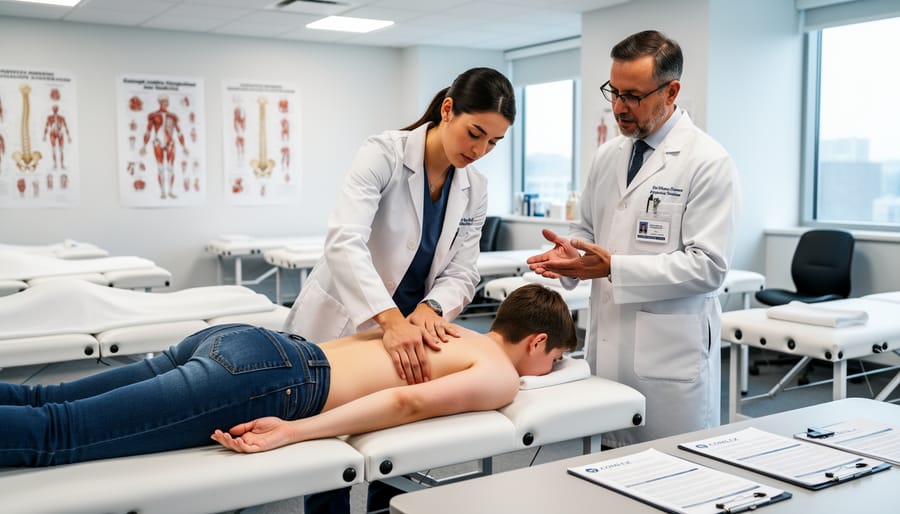
Osteopathic manipulative medicine represents one of the most distinctive challenges on the COMLEX exam, accounting for approximately 10-12% of questions on Level 1. Many students struggle with OMM not because the concepts are inherently difficult, but because they attempt to memorize techniques without understanding their underlying mechanisms and clinical applications.
The most effective approach involves active application through practice questions rather than passive review of technique charts. Research shows that students who regularly answer OMM-focused questions score 15-20 points higher on this section compared to those who rely solely on reading review materials. This difference stems from the contextual learning that occurs when you must apply OMM principles to patient scenarios.
Common pitfall areas include Chapman’s points, counterstrain tender points, and distinguishing between similar techniques like muscle energy and high-velocity low-amplitude treatments. Students frequently confuse the specific applications and contraindications of each modality. For example, a recent analysis of practice question performance revealed that 60% of students initially struggle with questions requiring them to select appropriate treatments based on patient-specific contraindications.
To efficiently master OMM through practice questions, focus on understanding the diagnostic criteria and therapeutic rationale behind each technique. When you encounter a question, don’t just memorize the correct answer. Instead, analyze why incorrect options don’t fit the clinical scenario. Create a simple chart noting which conditions respond best to specific techniques and their absolute contraindications.
Additionally, practice identifying anatomical landmarks and motion restrictions through visual-based questions. Many question banks now include images and videos that simulate the hands-on nature of OMM, bridging the gap between classroom learning and clinical application. This multimedia approach reinforces spatial reasoning skills essential for both exam success and future practice.
Analyzing Your Practice Performance: Beyond Just the Score
Scoring well on practice questions matters, but understanding why you missed questions is where real learning happens. A student who scores 65% and analyzes every mistake systematically will often outperform someone who scores 75% but moves on without reflection.
Start by categorizing each incorrect answer. Was it a knowledge gap—you genuinely didn’t know the material? Or a test-taking error, like misreading the question stem or falling for a distractor despite knowing the concept? Research shows that approximately 30% of incorrect answers on board exams stem from test-taking mistakes rather than content gaps. One medical student discovered she was missing questions about timing (acute versus chronic conditions) not because she lacked knowledge, but because she was reading too quickly under time pressure.
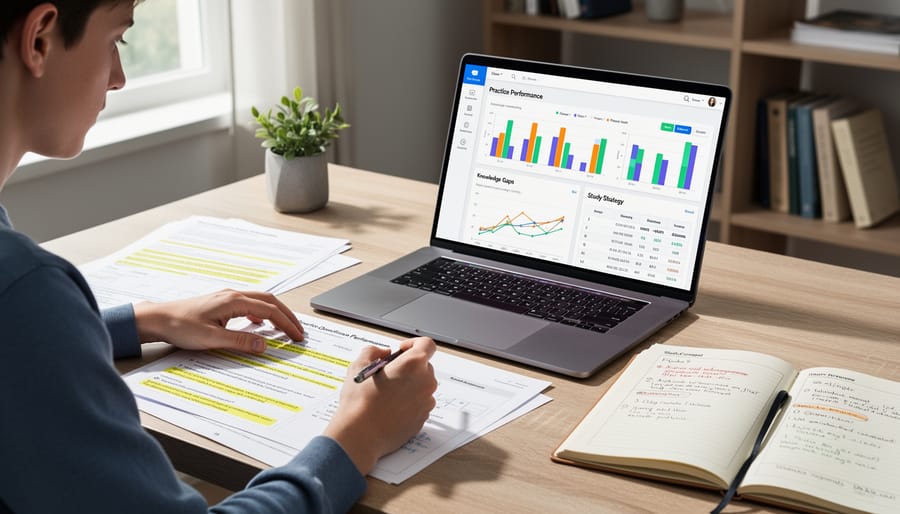
Create a simple tracking system. Use a spreadsheet or the analytics tools built into your question bank to log performance by subject area. If you’re consistently scoring below 60% in musculoskeletal topics but above 80% in cardiovascular, that’s actionable data. Focus your next study sessions accordingly rather than reviewing content randomly.
For knowledge gaps, don’t just reread the explanation. Trace the concept back to your primary resources, then teach it to a study partner or write it out in your own words. This active retrieval strengthens long-term retention far more than passive review.
Track trends over time, not just individual sessions. Graph your performance weekly by subject and overall. Upward trends indicate effective studying, while plateaus suggest you need to change strategies—perhaps switching question banks, adjusting study schedules, or seeking tutoring in weak areas.
Set specific goals based on your data. If you’re three months from exam day averaging 68% overall with weak pharmacology scores, dedicate 40% of study time to pharmacology while maintaining other subjects. Reassess every two weeks and adjust. This data-driven approach transforms practice questions from simple drills into a personalized roadmap guiding you toward exam success.
Common Mistakes Students Make with Practice Questions
Even highly motivated students fall into predictable traps when working through COMLEX practice questions. Recognizing these patterns can significantly improve your preparation efficiency.
The most common mistake is superficial review—quickly checking whether an answer is right or wrong without understanding why. Research shows that students who spend at least three minutes analyzing each incorrect answer retain concepts 40% better than those who simply move to the next question. Maria, a second-year DO student, initially averaged 58% on practice exams. After implementing thorough explanations review for every question, regardless of whether she answered correctly, her scores jumped to 72% within three weeks.
Excessive note-taking represents another counterproductive habit. Some students transcribe entire explanations verbatim, turning practice sessions into passive copying exercises. Instead, limit notes to key concepts you genuinely don’t understand and focus on pattern recognition across similar questions.
Ignoring timing constraints creates false confidence. Students who practice without time limits often score 15-20% higher than under timed conditions, leading to unpleasant surprises on exam day. Build timing discipline early by using a stopwatch and aiming for 90 seconds per question during practice blocks.
Treating practice questions as passive learning undermines their effectiveness. Simply reading explanations without actively retrieving information doesn’t strengthen memory pathways. Before reviewing the answer, pause and articulate why you chose your response and what clinical reasoning led you there. This metacognitive approach, combined with strategies for managing test anxiety, transforms practice from rote memorization into genuine clinical reasoning development.
Finally, avoid the temptation to repeat the same questions too frequently. Research indicates diminishing returns after the second exposure to identical questions within a four-week period.
The journey to COMLEX success isn’t determined by chance—it’s built through deliberate, strategic practice. Research consistently shows that students who engage in regular question practice with intentional review outperform those who rely solely on passive content review. In fact, medical students who complete at least 2,000 practice questions before their exam demonstrate, on average, score improvements of 15-20 points compared to their baseline assessments.
The transformation happens when you shift from simply answering questions to actively learning from each one. Every question you encounter serves as both an assessment tool and a teaching opportunity. When you miss a question about osteopathic manipulative treatment or a complex pharmacology scenario, you’re identifying precise knowledge gaps that passive reading might never reveal. This targeted approach to medical school preparation maximizes your study efficiency and builds lasting comprehension.
Begin your preparation today with these actionable steps: First, establish a baseline by completing a timed practice exam to identify your starting point. Second, create a consistent daily schedule dedicating at least 90 minutes to practice questions. Third, maintain a detailed error log categorizing mistakes by subject and reasoning type. Finally, review both correct and incorrect answers thoroughly, using educational resources to deepen understanding rather than simply memorizing facts.
Remember, every successful COMLEX candidate started exactly where you are now. The difference between those who achieve their target scores and those who fall short isn’t innate ability—it’s the commitment to consistent, strategic practice. Your future success begins with the questions you practice today.