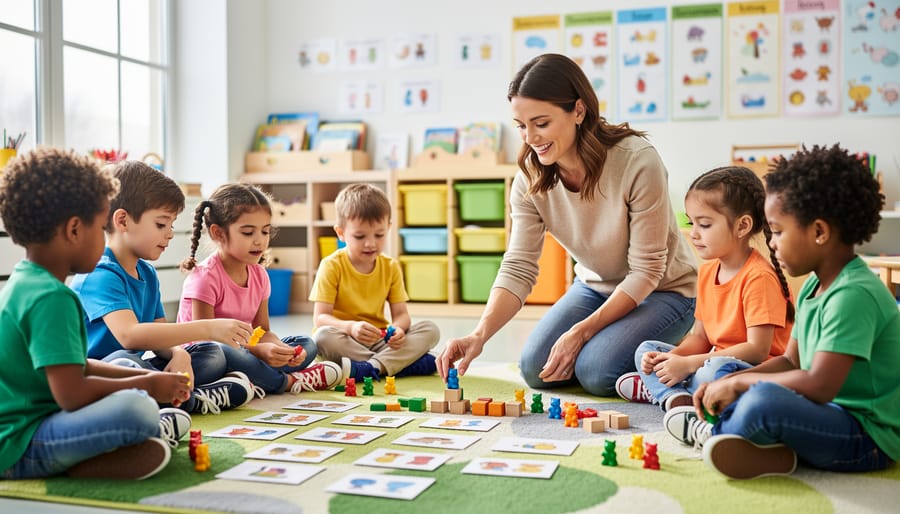



Educational classroom games transform abstract kindergarten concepts into hands-on experiences that five- and six-year-olds can grasp, retain, and apply. Research shows that game-based learning increases student engagement by up to 60% compared to traditional instruction methods, while building foundational skills in literacy, numeracy, social-emotional development, and critical thinking.
The games featured in this guide were selected based on three criteria: alignment with early learning standards, minimal preparation requirements, and proven effectiveness in real kindergarten classrooms. Each activity supports multiple developmental domains simultaneously. For example, a simple counting game also strengthens fine motor skills and turn-taking abilities.
Teachers often face the challenge of keeping young learners focused while meeting diverse learning needs within a single classroom. The 12 games outlined here address this reality. They require common classroom materials, accommodate mixed-ability groups, and can be modified on the fly when a child needs additional support or enrichment.
Whether you’re planning your first week of school or looking to refresh your activity rotation mid-year, these games provide structure without rigidity. They create opportunities for authentic assessment as you observe children problem-solving, collaborating, and demonstrating mastery through play rather than worksheets.
How We Selected These Educational Games
Choosing games that truly support kindergarten learning requires more than picking activities that look fun. We evaluated dozens of classroom games against research-backed criteria to identify those that deliver genuine educational value while remaining practical for busy teachers.
Each game in this collection meets these essential standards:
- Developmental appropriateness: Activities match the cognitive, physical, and social abilities of 5-6 year-olds
- Standards alignment: Games target specific early learning goals in literacy, math, social-emotional development, or physical skills
- Simple implementation: Teachers can prepare and launch games quickly without extensive training or complex instructions
- Minimal materials: Most games use common classroom supplies or low-cost items that schools already have
- Built-in differentiation: Activities adapt easily for students at different skill levels, including those with special needs
- Proven engagement: These games have demonstrated success in real kindergarten classrooms during the 2025-2026 school year
Current research on play-based learning confirms that kindergarteners retain information better when physical movement, peer interaction, and hands-on manipulation accompany academic content. The games that follow incorporate these elements while maintaining clear learning objectives that educators can document and assess.
1. Sight Word Swat
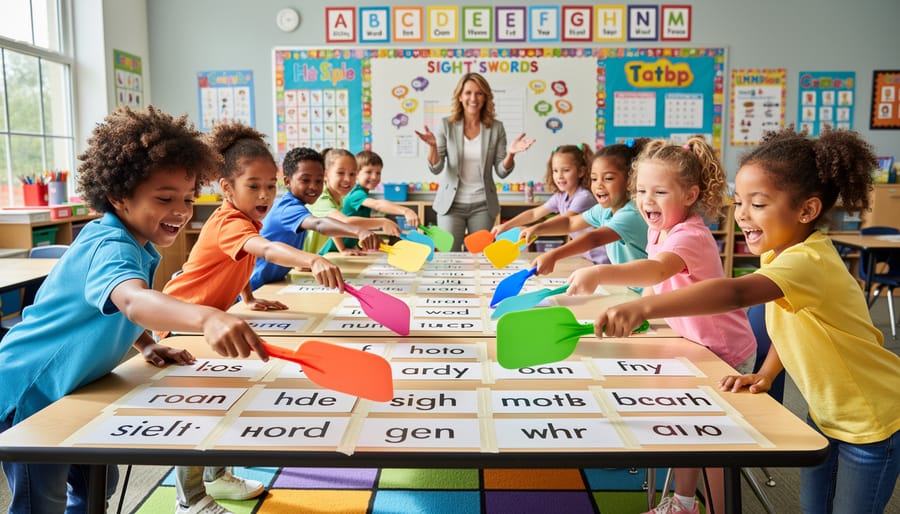
Sight Word Swat turns literacy practice into an energetic, competitive activity that kindergarteners love. Place sight word flashcards on the floor or tape words directly to your whiteboard. Give two students clean fly swatters (dollar store finds work perfectly). Call out a word, and the first student to swat the correct card earns a point for their team.
The physical movement component keeps five and six-year-olds engaged far longer than traditional flashcard drills. Students practice rapid word recognition under time pressure, which directly builds automaticity and reading fluency. The game naturally differentiates: start beginners with 8-10 high-frequency words like “the,” “and,” “is,” then add more challenging words as students progress.
Set up teams of 3-4 students to maximize participation while maintaining manageable energy levels. Rotate players every 5-7 swats so everyone gets multiple turns during a 10-minute session. For classroom management, establish a swatting boundary (no wild swinging) and require students to read the word aloud after swatting to confirm recognition. Store your word cards in labeled envelopes by difficulty level for quick setup during transition times or indoor recess.
2. Number Line Hop
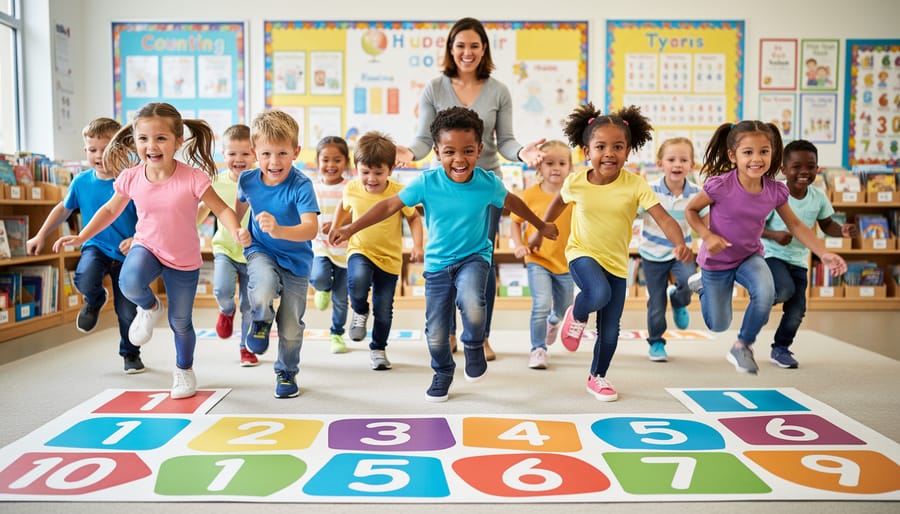
Number Line Hop transforms math practice into a full-body activity that kindergarteners love. Create a number line on your classroom floor using painter’s tape, numbered cards, or a vinyl mat (0-20 works well for most kindergarten classrooms). Students physically hop from number to number while counting aloud, making abstract numerical concepts tangible through movement.
For basic counting practice, call out a target number and have students hop to it while counting each step. Once they’re comfortable, introduce simple addition: “Start at 3, hop forward 2 more spaces, where did you land?” The physical act of moving along the line helps students visualize “more” and “less” in ways worksheets can’t replicate.
Differentiate by adjusting the number range. Struggling learners might work with 0-10, while advanced students can tackle 0-30 or practice skip counting by twos and fives. Add challenge cards with simple equations, or create a relay format where teams race to solve problems correctly.
The kinesthetic element reinforces number sequencing and builds conceptual understanding of operations. Students who struggle with abstract math often excel when they can literally step through problems, and the movement breaks help manage kindergarten energy levels productively.
3. Shape Sorting Relay
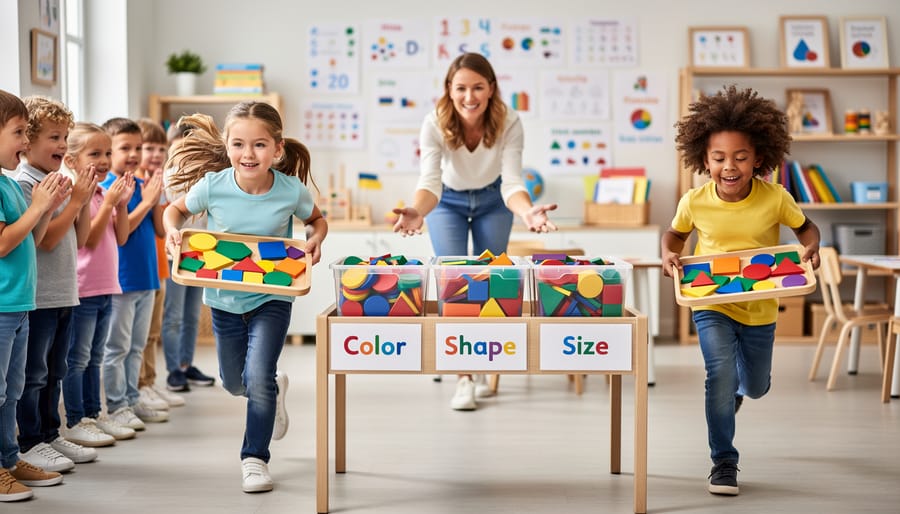
The Shape Sorting Relay transforms geometry practice into an active team competition that kindergarteners love. Divide your class into teams of 3-4 students and create sorting stations at one end of your classroom or play area. Place a mixed collection of foam shapes, cardboard cutouts, or plastic manipulatives in bins at the opposite end.
Each student races to grab one shape, returns to their team’s sorting station, and places it in the correct category before tagging the next teammate. You can vary the sorting criteria: by shape type (circles, squares, triangles), by color, by size, or even by the number of sides. This flexibility lets you adjust difficulty as students master each classification skill.
The game reinforces geometry vocabulary as students identify attributes quickly under time pressure. More importantly, it builds cooperative learning, teammates naturally begin coaching each other and celebrating correct sorts together. The physical movement helps kinesthetic learners grasp abstract concepts through hands-on manipulation.
For classroom management, establish a “walk fast, don’t run” rule and designate clear pathways to prevent collisions. Start with just two teams until students understand the routine, then expand to three or four teams as needed.
4. Alphabet Treasure Hunt
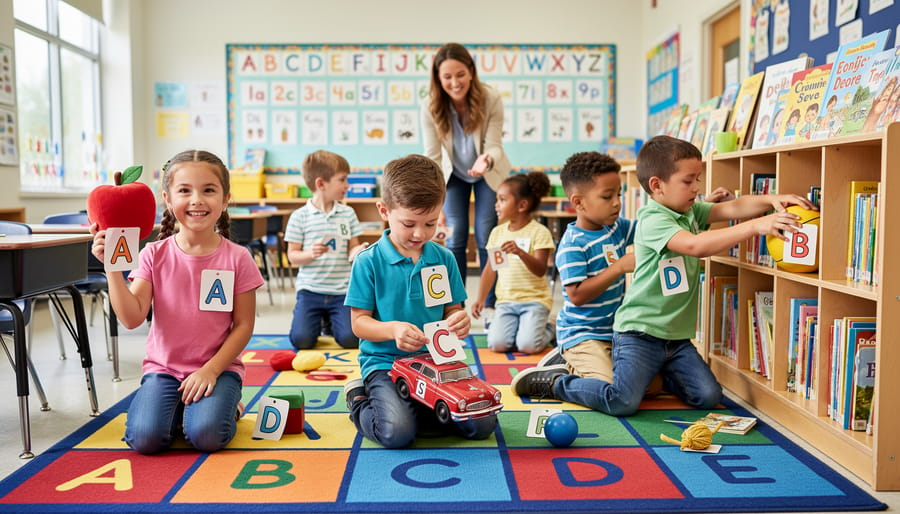
The Alphabet Treasure Hunt transforms letter learning into an exciting exploration that gets kindergarteners moving and thinking. Students search the classroom for objects that start with a target letter, like finding a book, block, and basket for the letter B.
Preparation Steps
Start by selecting 3-4 focus letters based on your current curriculum. Create simple recording sheets with letter boxes where students can draw or check off their discoveries. Consider designating “treasure zones” in different classroom areas to prevent crowding. You can provide picture clues for students who need extra support or challenge advanced learners to find multiple items per letter.
Learning Benefits
This active game strengthens phonemic awareness as students isolate initial sounds and connect them to letter symbols. The physical act of searching and touching objects creates memorable associations between letters and real-world items, reinforcing letter-sound correspondence through multisensory engagement.
Adapting for Different Levels
Emergent readers benefit from hunting with a partner who provides hints. Advanced students can record findings with invented spelling or search for objects with specific ending sounds. Mix familiar and challenging letters, and rotate focus letters weekly to build comprehensive alphabet knowledge while maintaining excitement.
5. Pattern Block Challenge
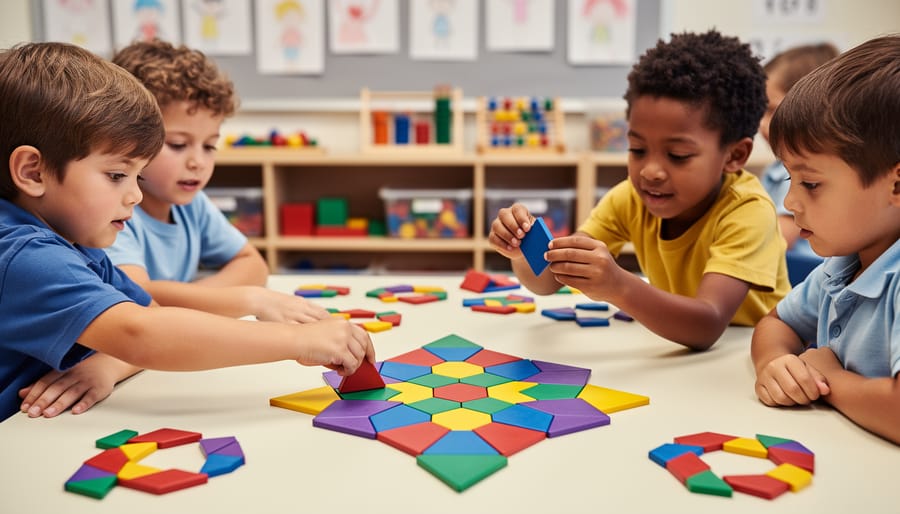
Pattern Block Challenge transforms geometry exploration into an engaging hands-on activity that kindergarteners can approach at their own pace. Set up stations with pattern blocks (triangles, squares, rhombuses, trapezoids, hexagons) and challenge cards showing designs students need to recreate. Start with simple 3-4 piece designs, then progress to more complex 8-10 piece patterns as confidence builds.
This game strengthens spatial reasoning as children mentally rotate shapes and figure out which pieces fit where. They develop problem-solving skills by testing different combinations when their first attempt doesn’t match the card. The physical manipulation of blocks builds fine motor control and hand-eye coordination essential for writing readiness.
Begin with matching activities where students simply cover a printed design with corresponding blocks. Move to independent pattern creation where kids design their own pictures, trace the outline, and challenge classmates to recreate them. Partner variations encourage verbal communication as students describe their spatial thinking process. Keep multiple difficulty levels available simultaneously so advanced learners stay challenged while others master foundational concepts.
6. Rhyming Musical Chairs
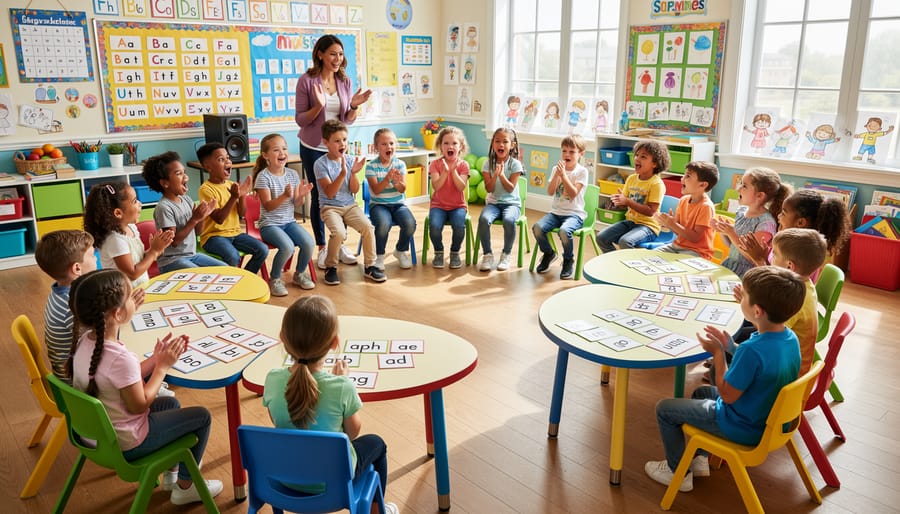
Rhyming Musical Chairs transforms the classic elimination game into a phonological awareness builder that kindergarteners love. Set up chairs in a circle (one fewer than the number of players) and play music while students walk around them. When the music stops, each child sits in a chair. The twist: the student left standing must say a word that rhymes with a teacher-provided prompt word to earn a chair from another player and stay in the game.
Start with simple, common word families like “cat,” “dog,” or “sun” that offer multiple rhyming options. As students become more confident, introduce challenging prompts like “light” or “play.” This game strengthens phonological awareness, the ability to hear and manipulate sounds in words, which directly supports reading development.
For smaller groups of 8-10 students, play traditional rounds. With larger classes, divide into two simultaneous games or create a “rhyme bank” station where eliminated students generate rhyming words to help peers still playing. Adjust difficulty by accepting nonsense rhymes from struggling learners while challenging advanced students to provide real words only. The combination of physical activity, quick thinking, and sound manipulation keeps energy high while building critical pre-reading skills.
7. Color and Number Bingo
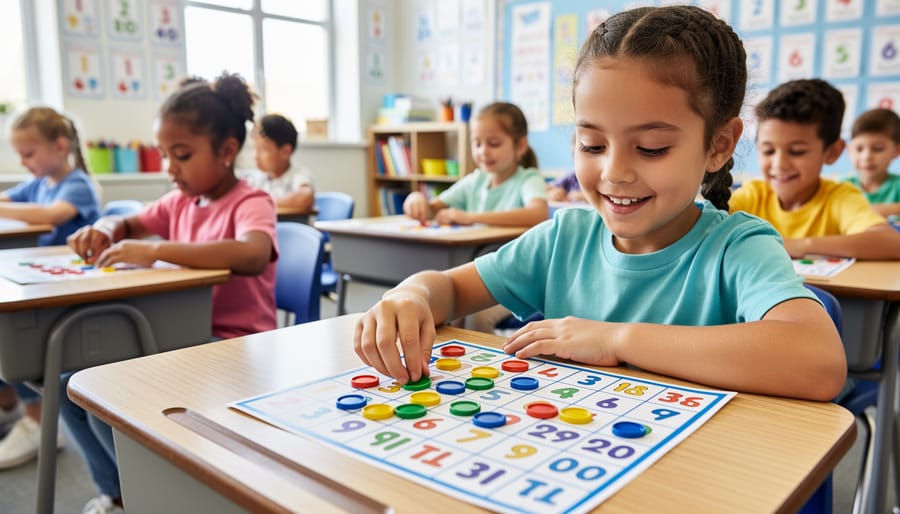
Color and Number Bingo transforms the classic game into a versatile learning tool that kindergarteners love. You’ll need bingo cards (5×5 grids work well), calling cards, and markers like counters or crayons. Create cards featuring numbers 1-20, color words with matching colored squares, or simple addition problems (2+1, 3+0) depending on your learning goals.
The basic gameplay remains familiar: call out items randomly while students mark their cards, aiming for five in a row. This simplicity helps five and six-year-olds grasp rules quickly while building crucial skills. Number recognition strengthens as students scan their cards to find called numbers. Listening skills develop since players must attend carefully to each call, and attention span naturally extends because the game creates engaging reasons to stay focused.
Mix up your approach throughout the week. Monday might feature number bingo, Wednesday could spotlight color words, and Friday can challenge students with simple math problems. Create multiple card variations so students play different layouts each time, preventing memorization and keeping engagement high. The competitive element motivates students while the familiar structure provides comfort for emerging learners.
8. Phonics Fishing Game
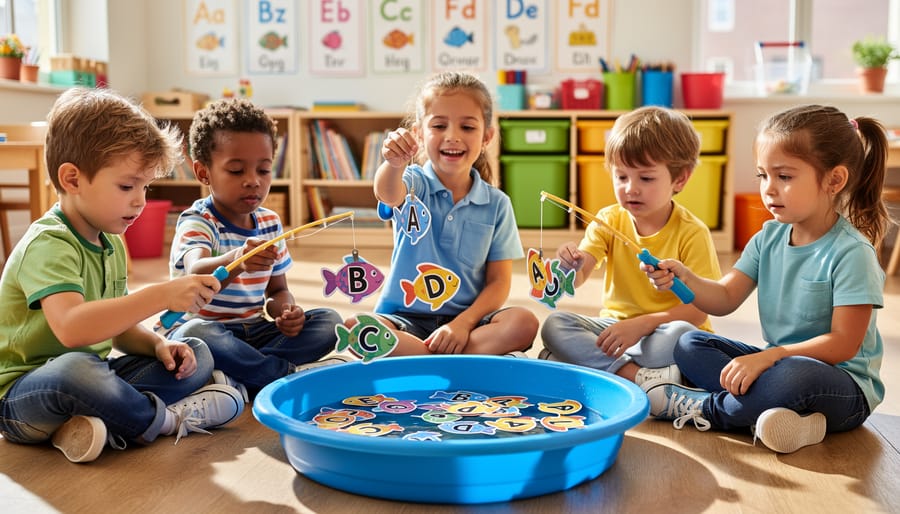
The Phonics Fishing Game transforms letter recognition practice into an exciting hands-on activity that captures kindergarteners’ attention while building critical literacy skills. Students use simple fishing poles, dowels with string and magnets attached, to “catch” paper fish labeled with letters, letter blends, or CVC words.
Set up takes minutes: cut fish shapes from cardstock, attach paper clips to each fish’s mouth, and write target letters or words on the bodies. Place fish in a small inflatable pool, large container, or spread them on a blue tablecloth “pond.” Students take turns fishing, identifying what they caught, and saying its sound or reading the word aloud.
This multisensory approach works because it combines fine motor practice with phonics instruction. The physical act of fishing helps kinesthetic learners stay focused while the game element reduces anxiety around letter practice.
Differentiate easily by adjusting difficulty: use uppercase letters for beginners, lowercase for advancing students, or consonant-vowel-consonant words for emerging readers. Partner advanced students with those still learning letters for peer support. Add a challenge by requiring students to say three words starting with their caught letter before keeping their fish.
9. Counting Bears Sort and Graph
Counting bears are small, colorful manipulatives that transform abstract math concepts into concrete, hands-on learning experiences. In this game, students receive a collection of bears in various colors and use them to practice sorting by attributes, counting, and creating simple bar graphs or pictographs. The activity begins with free exploration where students sort bears by color, size, or any characteristic they notice. This initial phase encourages mathematical thinking and classification skills.
Once students have sorted their bears, they count each group and create a simple graph using a floor mat, poster board, or pre-printed graph template. Each bear is placed in a column above its corresponding color label, creating a visual representation of their data. Teachers can guide discussions with questions like “Which color has the most bears?” or “How many more red bears than blue bears do you have?” These questions develop data analysis skills and comparative language.
The game reinforces one-to-one correspondence as students touch each bear while counting, a critical developmental milestone. In practice, teachers report that kindergarteners remain engaged for 15-20 minutes with this activity, especially when working in pairs or small groups. You can extend the learning by having students draw their graphs in math journals or use the data for simple addition problems. The tactile nature of the bears combined with the visual feedback of the graph makes abstract mathematical relationships concrete and memorable.
10. Emotion Charades
Emotion Charades transforms social-emotional learning into an engaging activity where one student acts out a feeling while classmates guess which emotion they’re showing. Start by selecting an emotion card (or whispering it to the actor), then have the child use facial expressions, body language, and gestures, but no words, to convey that feeling. This game builds emotional intelligence by helping kindergarteners identify and name feelings, expand their emotional vocabulary beyond just “happy” or “sad,” and recognize how emotions appear in others’ faces and bodies.
The self-regulation component emerges naturally as students must wait their turn, manage excitement when they know the answer, and practice expressing emotions in controlled ways. For age-appropriate starting emotions, use: happy, sad, excited, worried, surprised, frustrated, proud, tired, silly, and scared. You can gradually introduce more nuanced feelings like disappointed or nervous as students gain confidence.
Play Emotion Charades as one of your brain break ideas or during circle time, keeping rounds short (30 seconds per turn) to maintain engagement. Consider creating emotion cards with simple face drawings to support pre-readers and English language learners in selecting and identifying feelings independently.
11. Simon Says with Academic Twists
Simon Says transforms into an academic powerhouse when you incorporate subject-specific commands that reinforce classroom learning. Instead of generic movements, use directions like “Simon says point to the letter M,” “Simon says make a triangle with your arms,” or “Simon says hop four times.” This modification keeps the familiar structure kindergarteners love while sneaking in repeated practice with colors, numbers, letters, shapes, and positional words.
For math reinforcement, try commands such as “Simon says show me 5 fingers” or “Simon says stand in a line from shortest to tallest.” Literacy variations include “Simon says touch something that starts with B” or “Simon says clap out the syllables in your name.” Science concepts work beautifully too: “Simon says waddle like a penguin” or “Simon says show me how a seed grows into a plant.”
The game’s structure naturally supports classroom management by requiring students to listen carefully, follow multi-step directions, and practice self-control. It works equally well with the whole class or during small-group instruction when you want targeted practice with specific skills. The zero-cost setup and quick transitions make it perfect for filling those awkward five-minute gaps between activities.
12. Collaborative Story Building Dice
Collaborative Story Building Dice transforms kindergarten students into confident storytellers through a simple yet powerful game structure. Students take turns rolling large foam dice (or drawing picture cards) featuring images like animals, objects, weather symbols, and characters. Each child adds one sentence to an evolving group story based on what they rolled, building narrative skills while practicing turn-taking and active listening.
This game strengthens multiple developmental areas simultaneously. Language skills expand as students construct grammatically complete sentences and learn new vocabulary from peers. Sequencing abilities improve when children connect their contribution to what came before, understanding cause and effect in narratives. Creativity flourishes as students imagine possibilities within the story framework, while social skills develop through respectful waiting and building on classmates’ ideas.
Creating DIY story dice requires minimal materials. Use wooden blocks or small milk cartons covered in construction paper, then glue simple magazine cutouts or hand-drawn pictures on each face. Start with basic categories: characters (child, dog, princess), settings (house, forest, beach), objects (ball, treasure, car), and actions (running, flying, sleeping). Keep images concrete and recognizable for kindergarten comprehension levels.
Begin with teacher-guided rounds where you model adding to the story, then gradually release control as students gain confidence. Three to five rounds typically maintains engagement without overwhelming young attention spans.
Making Educational Games Work in Your Kindergarten Classroom
Success with educational games depends on thoughtful preparation and consistent routines. Start by establishing clear expectations before introducing any game: demonstrate the activity, explain the rules in simple language, and model appropriate behavior. Many 2026 kindergarten teachers report that spending five minutes on setup prevents 15 minutes of confusion later.
Create visual rule charts for frequently played games and integrate visual aids like picture cards to support English language learners and students with special needs. Use timers to signal transitions between activities, giving students a two-minute warning before cleanup begins. One teacher in Portland found that assigning specific roles (materials manager, rule reminder, encourager) helps students stay engaged and builds responsibility.
Schedule games strategically throughout the day. Active games like Number Line Hop work well before independent work sessions, while quieter games like Pattern Block Challenge fit naturally during center time. Track learning progress through observation notes rather than formal assessments, noting which students demonstrate mastery and which need additional support. Teachers emphasize that the same game played repeatedly with slight variations often produces better learning outcomes than constantly introducing new activities.
Frequently Asked Questions
How long should kindergarten games last?
Most kindergarten games work best when kept to 10-15 minutes, matching typical attention spans for this age group. Shorter games of 5-7 minutes work well for transitions or energizing breaks between longer activities.
How do you manage behavior during active games?
Establish clear signals for starting and stopping (like a bell or raised hand), practice the rules before playing, and designate specific play boundaries. Having a “pause” routine where everyone freezes helps regain control quickly when needed.
Can these games work in small classroom spaces?
Absolutely. Many games like Sight Word Swat, Bingo, and Story Building Dice require minimal space. For active games, consider taking students to the hallway, gym, or outdoor area, or adapt movements to be smaller (tapping toes instead of hopping).
How often should educational games be used in kindergarten?
Aim for 2-3 game sessions daily, one during morning meeting, one mid-morning as an academic reinforcement, and one after lunch to re-engage students. This provides structure without overwhelming your schedule.
What materials are essential versus optional?
Essential items include basic manipulatives (counting bears, pattern blocks), chart paper, markers, and common classroom supplies. Optional upgrades like laminated cards, specialty dice, or magnetic fishing sets make games more durable but aren’t necessary to start.
Do educational games really improve learning outcomes?
Yes, when implemented consistently. Games provide repetition without boredom, activate multiple learning pathways simultaneously, and help students practice skills in low-pressure contexts where mistakes feel less intimidating than traditional worksheets.
The key to successful game implementation lies in your preparation and consistency rather than having perfect materials. Start with games using items you already have in your classroom, observe which ones generate the most engagement and learning, then gradually build your collection based on what works for your specific students.
Educational classroom games transform kindergarten learning from passive to participatory, turning abstract concepts into tangible experiences that stick with young learners. The twelve games outlined here aren’t just activities to fill time, they’re strategic tools that build literacy, numeracy, social-emotional skills, and critical thinking while keeping five and six-year-olds genuinely engaged.
Start small. Choose two or three games that align with your current instructional goals and your classroom’s specific needs. Introduce them gradually, establishing clear routines and expectations before adding more to your rotation. Pay attention to which games spark the most enthusiasm and learning breakthroughs with your particular students.
This week, pick one game from this list that addresses a skill your kindergartners are working to master. Gather the materials, practice the instructions, and try it during your next lesson block. Watch how your students respond, make adjustments as needed, and build from there. The investment in setting up these games pays dividends in student achievement and classroom energy throughout the entire school year.