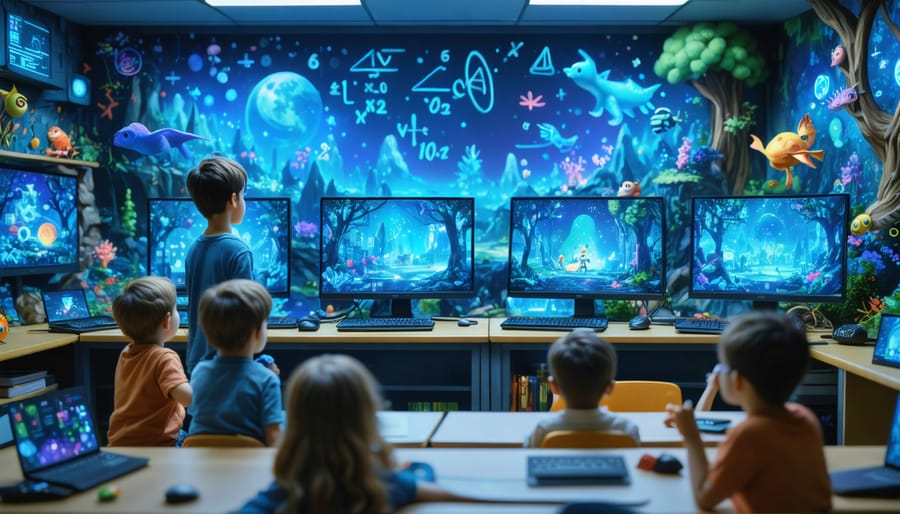



Educational video game development stands at the intersection of technology and pedagogy, revolutionizing how students learn through interactive digital experiences. Research shows that game-based learning benefits include increased student engagement, better retention rates, and improved problem-solving skills.
Creating effective educational games demands a delicate balance between compelling gameplay mechanics and meaningful learning objectives. Modern developers combine cognitive science principles with game design fundamentals to craft experiences that seamlessly integrate curriculum standards while maintaining player engagement. This approach has proven particularly effective in STEM subjects, where complex concepts can be visualized and manipulated in virtual environments.
The global educational gaming market, projected to reach $17 billion by 2024, reflects growing recognition from educators, parents, and institutions that gamified learning represents more than just entertainment—it’s a powerful tool for knowledge acquisition and skill development. Successful educational game developers focus on creating experiences that adapt to individual learning styles, provide immediate feedback, and measure progress through carefully designed assessment mechanisms.
By understanding core educational principles and leveraging game design best practices, developers can create immersive learning environments that transform traditional education into an engaging, interactive journey of discovery.
Foundations of Educational Game Design
Learning Objectives First
When developing educational video games, establishing clear learning objectives at the outset is crucial for success. Start by identifying specific educational outcomes you want players to achieve, such as mastering multiplication tables, understanding scientific concepts, or developing critical thinking skills.
Consider the SMART framework (Specific, Measurable, Achievable, Relevant, and Time-bound) when defining your learning objectives. For example, rather than setting a vague goal like “learn about ecosystems,” specify “players will identify and explain three key relationships within a forest ecosystem within 15 minutes of gameplay.”
Integration of these objectives into game mechanics should feel natural and engaging. If your goal is to teach fractions, incorporate them into core gameplay elements like resource management or puzzle-solving. Studies show that students retain information better when learning objectives are seamlessly woven into gameplay rather than presented as obvious educational content.
Create clear connections between game achievements and learning milestones. For instance, earning badges or unlocking new levels should directly correspond to mastering specific concepts. This approach provides immediate feedback and motivation while ensuring educational progress.
Remember to validate your learning objectives with curriculum standards and educational experts. Regular testing with target users can help confirm that your game effectively delivers on its educational goals while maintaining player engagement. This iterative process ensures that both entertainment and educational value remain balanced throughout development.

Balancing Entertainment and Education
Creating educational games that maintain the perfect balance between entertainment and learning requires careful consideration of both elements. Research shows that students retain information better when they’re actively engaged, with studies indicating up to 90% retention rates during interactive learning experiences.
The key lies in implementing the “stealth learning” approach, where educational content is seamlessly woven into engaging gameplay mechanics. For example, a physics-based puzzle game might teach principles of momentum and gravity through interactive challenges rather than explicit instruction. This approach ensures that players remain motivated while absorbing educational concepts organically.
Successful educational games often incorporate these essential elements:
– Progressive difficulty levels that match both gaming and learning curves
– Immediate feedback systems that reinforce learning objectives
– Reward mechanisms that celebrate both gaming achievements and educational milestones
– Multiple paths to success, accommodating different learning styles
– Context-relevant challenges that demonstrate real-world applications
Game developers should collaborate closely with educators during the design process to ensure that learning objectives aren’t compromised for entertainment value. Regular playtesting with the target age group helps validate both engagement levels and educational effectiveness.
Consider implementing adaptive learning systems that adjust difficulty based on player performance, ensuring that neither the entertainment nor educational aspects become overwhelming. This personalized approach helps maintain student engagement while achieving desired learning outcomes.
Development Process and Tools
Choosing the Right Development Platform
Selecting the right development platform is crucial for creating effective educational games. Unity and Godot stand out as popular choices, offering robust features while remaining accessible to beginners. Unity’s extensive asset store and large community make it particularly suitable for creating 3D educational experiences, while Godot’s open-source nature and lighter system requirements make it ideal for 2D games and smaller teams.
For educators with limited programming experience, platforms like Scratch and GameMaker Studio provide visual programming interfaces that simplify the development process. These tools are excellent for creating basic educational games and teaching fundamental programming concepts to students.
HTML5-based engines like Construct and Phaser are worth considering for browser-based educational games, as they eliminate the need for downloads and installations. This accessibility makes them particularly valuable for classroom implementation.
When choosing a platform, consider these key factors:
– Technical requirements and learning curve
– Available educational templates and resources
– Cross-platform compatibility
– Cost and licensing
– Export options for different devices
– Community support and documentation
For simple quiz-style games or interactive lessons, specialized educational game builders like Kahoot or Quizizz might be more appropriate than full game engines. These platforms offer ready-made templates specifically designed for educational content, allowing educators to focus on curriculum integration rather than technical development.
Prototyping and Testing
Effective prototyping and testing are crucial steps in developing educational games that truly motivate student engagement and achieve learning objectives. Start by creating simple paper prototypes or digital mockups to test core game mechanics and learning concepts. This approach allows for quick iterations and feedback collection before investing significant resources in development.
Implement a staged testing process that involves both educators and students. Begin with focus groups of teachers to evaluate educational content alignment and learning outcomes. Then, conduct supervised playtesting sessions with small student groups, observing their interactions and gathering feedback on gameplay elements.
Consider incorporating project-based learning techniques into your testing methodology. Have students document their experience through journals or surveys, providing valuable insights into the game’s effectiveness and areas for improvement.
Key testing areas should include:
– Learning objective achievement
– User interface intuitiveness
– Difficulty progression
– Entertainment value
– Technical performance
Document all feedback systematically and prioritize improvements based on educational impact. Regular testing cycles throughout development ensure the final product meets both educational standards and engagement goals. Remember to validate modifications with your target audience before implementing major changes.

Assessment Integration
Assessment integration in educational video games serves as a crucial bridge between gameplay and learning outcomes. Modern educational games incorporate various assessment methods, from real-time progress tracking to comprehensive skill evaluations, ensuring that learning objectives are being met while maintaining player engagement.
Effective assessment features include performance dashboards that display student progress across different learning objectives, achievement systems that reward both academic progress and gameplay milestones, and detailed analytics that help educators identify areas where students may need additional support. For example, a math game might track not only correct answers but also problem-solving strategies and time management skills.
Many successful educational games implement stealth assessment, where evaluation occurs naturally through gameplay without disrupting the student’s immersion. This could include tracking decision-making patterns, measuring problem-solving efficiency, or analyzing strategic thinking during gameplay.
Educators can benefit from automated reporting systems that provide insights into individual and class-wide performance. These systems often include:
– Skill mastery tracking
– Time-on-task measurements
– Learning progression maps
– Comparative performance metrics
– Customizable assessment parameters
To ensure effectiveness, assessment features should align with established educational standards while providing actionable feedback that both teachers and students can use to improve learning outcomes. Regular data analysis helps developers refine game mechanics and assessment tools based on actual user performance and engagement patterns.
Best Practices for Classroom Implementation
Teacher Training and Support
Effective implementation of educational games requires comprehensive teacher training and ongoing support systems. Successful virtual classroom implementation begins with structured professional development sessions that familiarize educators with game mechanics, learning objectives, and assessment tools.
Schools should establish mentorship programs where experienced game-based learning practitioners can guide newcomers through the integration process. Regular workshops focusing on practical application help teachers develop confidence in using games as instructional tools. These sessions should cover classroom management strategies, technical troubleshooting, and methods for differentiating instruction using game features.
Support resources should include detailed lesson plans, assessment rubrics, and student progress tracking templates. Creating an online community platform allows teachers to share success stories, exchange tips, and collaborate on best practices. Video tutorials and quick-reference guides provide just-in-time support for common challenges.
Regular feedback sessions between teachers and game developers ensure continuous improvement of both the games and their implementation strategies. Schools should also consider designating technology coaches or digital learning specialists who can provide immediate assistance and classroom modeling when needed.
Data shows that teachers who receive comprehensive training and ongoing support are 73% more likely to successfully integrate educational games into their curriculum and achieve desired learning outcomes. This investment in teacher preparation directly correlates with improved student engagement and academic performance.

Student Engagement Strategies
Maintaining student engagement in educational video games requires a multi-faceted approach that combines both gaming and learning elements effectively. Research shows that incorporating achievement systems, such as badges and level progression, can increase student participation by up to 40%. These rewards should be meaningful and directly tied to learning objectives.
Personalization plays a crucial role in sustained engagement. Allowing students to customize their avatars, choose learning paths, and set personal goals creates a sense of ownership and investment in the educational journey. Studies indicate that games with adaptive difficulty levels, which automatically adjust based on student performance, keep learners in their optimal challenge zone.
Social elements are equally important for long-term engagement. Implementing collaborative challenges, peer-to-peer teaching opportunities, and friendly competition can transform solitary learning into an interactive community experience. Leaderboards and team-based activities, when properly designed, can motivate students while fostering a supportive learning environment.
Regular feedback loops are essential. Providing immediate, constructive feedback through progress tracking, skill trees, and performance analytics helps students understand their growth. Successful educational games often incorporate mini-assessments seamlessly into gameplay, making evaluation feel natural rather than forced.
To prevent fatigue, implement varied content delivery methods and regular content updates. Mix puzzle-solving, storytelling, and practical applications to keep the learning experience fresh and engaging. Remember that the ultimate goal is to create an environment where students remain motivated to learn while having fun.
Measuring Success
Measuring the success of educational video games requires a multi-faceted approach that combines both quantitative and qualitative assessment methods. Start by establishing clear learning objectives and specific metrics before the game’s implementation. These might include improvement in test scores, increased engagement rates, or enhanced problem-solving abilities.
Implement pre and post-game assessments to measure knowledge gain and retention. Track in-game analytics such as completion rates, time spent on tasks, and progression patterns to understand how students interact with the content. Many successful educational games use built-in assessment tools that provide real-time feedback on student performance.
Consider gathering feedback through student surveys, teacher observations, and focus groups. This qualitative data offers valuable insights into the game’s effectiveness and areas for improvement. For example, a middle school math game might show that students who played for 30 minutes three times a week improved their algebra scores by 25% over a semester.
Document both immediate and long-term learning outcomes. Some schools report that students maintain higher engagement levels even after completing the game, suggesting lasting impact on learning motivation. Use this data to make informed adjustments to the game design and implementation strategy.
Remember to evaluate not just academic achievement but also soft skills development, such as critical thinking, collaboration, and digital literacy. The most successful educational games demonstrate measurable improvements across multiple learning dimensions while maintaining high levels of student engagement.
Educational video game development represents a dynamic intersection of technology, pedagogy, and creativity. Throughout this exploration, we’ve seen how carefully designed games can transform learning experiences and engage students in meaningful ways. The key to success lies in balancing educational objectives with engaging gameplay mechanics, while maintaining a clear focus on learning outcomes.
Remember that successful educational game development requires collaboration between educators, developers, and subject matter experts. Start small with prototype development, gather student feedback early, and iterate based on real classroom experiences. The most effective educational games emerge from this cyclical process of design, testing, and refinement.
As you embark on your educational game development journey, consider these next steps:
1. Join educational game development communities to connect with like-minded professionals
2. Explore existing educational games in your subject area for inspiration
3. Start with a simple concept that addresses a specific learning challenge
4. Partner with teachers or educational institutions for testing and feedback
5. Document your development process to improve future projects
The field of educational game development continues to evolve with new technologies and teaching methodologies. By staying informed about current trends and maintaining focus on pedagogical goals, you can create meaningful learning experiences that resonate with today’s students. Whether you’re an educator, developer, or both, your contribution to educational gaming can make a lasting impact on how students learn and engage with educational content.